the coming terror

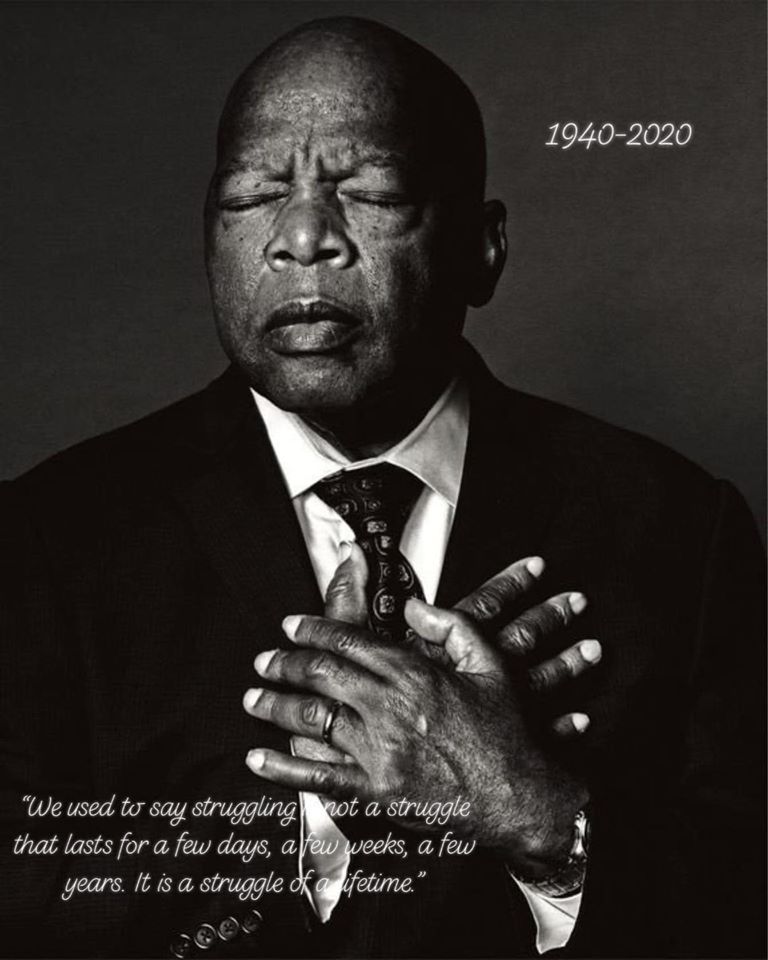
John Lewis is dead. It is to be hoped there will be appropriate national gestures to honor him. A friend posted this memorial photo at Facebook this morning. Somehow—I’m not sure how—it captures the poignancy of the moment, this moment of John Lewis’s death and what may become his enduring legacy. Authorities in Selma may rename the Edmund Pettus bridge for him, but the abomination of institutional racism continues unabated in the land despite the struggle, despite his struggle, the struggle of his lifetime that continues and will continue in spite of attempts to crush it. In that regard it is at least interesting to note that praise for Lewis is now coming from both sides of the political divide.

However, In 1965, in the aftermath of almost universal horror as news reports displayed the casual brutality of the police attack on protestors attempting to cross the Edmund Pettus Bridge on the way to Montgomery, a second march was allowed to proceed with the protection of federalized National Guard troops. Not so today, as a fascist federal secret police force now roams city streets in Portland, Oregon carrying on a work of suppression no less sinister than that visited upon Lewis and other protestors during the first “bloody Sunday” march from Selma to Montgomery. It is an irony that shouldn’t be lost on us. It undercuts the claims of rightist political figures such as Mike Pence and Mitch McConnell who have stated publicly how much they loved and respected “John” even going so far as to use his first name, a usage that in itself makes an obscene claim of solidarity with his legacy.

Lewis’s death, and that of C. T. Vivian, his companion in the struggle, both come at a time of terrifying constitutional crisis in the land, a time that exposes deep flaws in our constitutional system. And the terrible irony is that these flaws have been exposed again and again in our history by reformers such as Lewis and Vivian, some of whom have become martyrs, like Eugene Debs and Dr. KIng. But the efforts, the suffering, and the deaths of these martyrs have yet to make headway against the intransigence of the people. I speak of systemic racism, but it was the people who installed our present regime, and it is the people who may very well unleash the full potential of this regime to foment terror in order to ensure its survival. The senate’s refusal to remove the president from office should assure all of us that the congress will not stop the terror. The willingness of the highest court in the land to reauthorize the federal death penalty should assure us all that courts will not stop the terror.

Downstairs just now I noticed that a poster welcoming refugees still hangs in my front window. Passing my front door I noticed the Black Lives Matter sign I share with my neighbor. Some days ago when protests were beginning along my street I welcomed them. I have absolutely no fear of protestors; I would join them if I could. On the night I speak of I opened my front door and waved at groups of them. But I fear the terror and chaos a deranged president with ambitions to be a dictator may unleash on the rest of us as he continues to confront reports of his failure to cope with the pandemic and his falling poll numbers. I fear that terror because the signs of its emergence are becoming plainer each day. I do not know whether we will be able to hold an election this fall. Last post I quoted George Will, but I did not mention his most ominous paragraph, which is this one:

This nation built the Empire State Building, groundbreaking to official opening, in 410 days during the Depression, and the Pentagon in 16 months during wartime. Today’s less serious nation is unable to competently combat a pandemic, or even reliably conduct elections. This is what national decline looks like.

“National decline,” says will? “and worse can be confidently expected.”

The desk where I write now sports my two modern stoic medallions. Memento mori reminds me that death stalks me. When I look down the staircase where I fell only last year I sometimes wonder “Will it be here?” These more or less grisly thoughts are my companions these days, but they background a concern that I should like not to die just yet. Off and on during my adult life I have felt that I was living towards some high point in my country’s history. That’s the real dream of liberalism, a word I still use to describe myself, a word I have never believed could be abused beyond efficacy by its detractors or its adherents. I believe in what Richard Rorty called liberal hope.

My own liberal hope is grounded in Christian humanism, unlike Rorty’s, which was grounded in an atheism for which he made an eloquent lifelong defense. But if you read Rorty you will realize that his version of liberal hope does not invalidate mine. Christian humanism gives me my final vocabulary, a term I learned from Rorty. But Rorty’s final vocabulary is the history of Western philosophy. We can agree to disagree. My own liberalism contains the naive hope that my country might one day come to resemble the kingdom of heaven, of which the writer of Hebrews remained confident in the face of disconfirming data because she could “see Jesus.” In a time when even Jesus has been almost entirely coopted into Rightist idolatry, it is difficult to envision the Prince of Peace.  I now have a lifetime’s experience of confrontation with that idolatry, which is presently enjoying a cultural ascendancy I cannot recall ever having observed before.

Twelve years ago my beloved and I stood in a line outside the Edward Jones center waiting to be admitted to a rally in support of Barack Obama. We fell into conversation with a family from Oklahoma, young farmers they were with a couple of children, bright, educated. They were passionate as we were about this young man who promised to be a transformational president. Here is something I wrote about Obama back then.

Obama reminds me how it felt to make one with my sisters and brothers and students and colleagues in the marches of the sixties, how it felt to sing “We Shall Overcome” in those days when we lost a lot of fights, but won some too. Obama reminds me what it was like to win (even when we lost), what “Glory, Hallelujah!” meant to us then and how it almost became the national anthem. He reminds me what it was like to love my country when I loved my country with a passion that’s perhaps only possible when one is young. We’ve lost a lot of fights recently, but Obama gives me hope that we might still win a big one or two before what for me will be the end.

I’ve lived another twelve years now, long enough to have weathered my own personal disillusion with Obama. His fatal flaw was a desire for bipartisan governance, which we now know that Republicans conspired from the beginning to deny him, but he remains for me chief among modern presidents as exemplar of liberal hope.

I should like not to die before his portrait goes up on the White House wall.
Advent I: Who is an American?

Some years back I attended a funeral in one of my city’s conservative Catholic churches. On this particular day, the celebrant in inviting the faithful to communion went out of his way to explain to us non-Catholics that we were not welcome at the Lord’s table. We were told to remain in our pews and pray for the unity of God’s Church. I was a bit taken aback at the blatancy aand harshness of this priest’s inhospitality, but the rubric was not unfamiliar. I grew up in a town dominated by two Protestant sects that each believed only its members were destined for heaven.

I’ve never understood such exclusivity. If we are to believe John Dominic Crossan, the unique things about Jesus were that he healed freely without enquiring whether his patients were deserving and that he ate with anybody. The remarkable thing about Jesus’ feeding the five thousand may not be the miraculous multiplication of the five loaves and two fishes but rather Jesus’ specific prohibition of gatekeeping on the part of his disciples. No one seems to have been excluded from Jesus’ healing ministry on that day, or from the meal that followed. On the other hand scripture is replete with examples of Jesus’ eating with ‘publicans and sinners;’ and If we are to believe the gospel accounts, Jesus shared his last meal in the flesh with the disciple he knew would betray him to the Romans and also with a disciple he correctly predicted would deny knowing him before morning.

I have found myself returning to Jesus, A Revolutionary Biography again and again over the years since I first read it, and I find myself returning to it again this year as a discipline for the four weeks of Advent. I have never believed that the question ‘Who is a Christian’ is answered by The Baltimore Catechism or the thickets of proof texts some evangelical Christians use as weapons to protect the territory of faith from incursion by the ritually unclean or by persons whose beliefs particular sects judge to be incorrect. I think with Crossan that scripture does not provide a unitary picture of Jesus; there is no view of him that one can adopt with scriptural certainty, no view that is supported by the entire body, even, of canonical scripture without leaving a scriptural remainder that might support another conflicting view. Indeed, the Bibles as Christians and Jews have fashioned them over the centuries do not support a unitary conception of God, and on that one fact hang all our diverging communities of doxa and praxis. If one adds the Quranic tradition to the mix as we do, for instance, when we speak of the Abrahamic religions, further complications arise.

But I am presently thinking of something I’m describing to myself as the sociology of religious certainty, from which I stand aside as a dissenter and sometime critic. Advent is good for me because it forces me to examine again for the near eightieth time (since I will be eighty soon), my reasons for standing aside and the images of Jesus and of God to which my experience and affection have inclined me. I like the Christian Science appellation for God, father/mother. It could just as well be turned around, mother/father. The metaphor calls attention to itself and moves my mind to the thought of a god without gender, whose attributes I like to think are creativity, empathy, nurturing, and a disinclination to self-glorification. One difficulty I have with some contemporary feminist images of God is that they retain the triumphalism of traditional imaging, having removed gender references only. I’m still back there with Micah, who set it down that God requires justice, mercy, and humility of us humans.

I am a cultural Christian, a Christian humanist, and I have reasonably specific reasons for claiming these things. Christianity provides me with much of my fundamental vocabulary, with the linguistic tools I need to cope with the world as it seems to me to be. I could be a complete pragmatist, like Richard Rorty whom I admire, but for a profound awareness of sin, in myself and in the world I inhabit. I am a humanist in the sense of understanding that the world I experience is a text, composed of many subtexts, some of which I know and some of which remain opaque to me. In this I am not alone. Not even Kant or Einstein could read the world entire. It should be obvious by now that I am describing a position that posits uncertainty as a fundamental. I might have certainty if I had reached the end of the unknown, but to know everything is not a human possibility. I can hear a voice telling me to have faith, but that instruction merely requires me to accept someone else’s partial and interested description of the world and its history. I prefer uncertainty. I particularly prefer uncertainty to the dogmatism and exclusivity of much contemporary Christianity.

And now I am confronted with a new messiah, Donald Trump, who has drawn upon the savior language of past centuries in advancing his rise to prominence, who is recommended to me by an apparent majority of evangelical Christians in my country. “I alone can protect you,” he has told his ardent supporters as he encouraged them to brutalize dissenters at his rallies. Trump’s position as president elect is in part the product of mass dramas recalling medieval Good Friday sermons that whipped up the faithful to brutalize Jews and their communities in pogroms that were a standard feature of European history well down into the twentieth century; that resembled the whipping up of lynch mobs in this country, most of which targeted African Americans but not all. In the East St. Louis riots of 1917 some ten whites were killed along with upwards of one hundred blacks, though the true death tolls will never be known precisely.

My point is that Trump populism was and is of a piece with these past excesses. We saw them at the Trump rallies. If you voted for Trump, this is what you voted for, regardless of how you may try to sugar-coat it. You voted to enable violence against those aliens, those illegals, and you voted to “Lock her up” (or perhaps to kill her) on the basis of a pack of lies invented by unscrupulous people with no purpose beyond their own aggrandizement. The Trump rallies were spectacles designed to force an answer to another question: ‘Who is an American?’ And the answer is rhetorical: ‘Not those others, not those brown people, not those aliens with strange names who don’t worship Jesus.’ The Islamic conception of Jesus is very like that of Judaism, but most Americans are utterly ignorant of Islam, or worse, are informed by anti-Islamic bigotry masquerading as history or news.

Advent invites me to ponder the last things: heaven, hell, death, and judgment. In my eightieth rethinking I am struck by the realization that the last things are not last. The holy is last. But the problem with the holy is that we have located it in the person of a cosmic despot who demands worship and abject obedience. As Christians we have assimilated Jesus to this despot, and before Jesus there was Moses. In the tale of Moses’ conversion the holy had already been imaged as a despotic ruler; as in the tale of St. Paul’s conversion the assimilation of Jesus to cosmic despotism had already taken place. There is a deep truth in the stories of Moses and the burning bush, and of of St. Paul’s blinding. The holy sometimes breaks into common experience when least expected, like a thief in the night, as St. Paul said of the coming of the day of the Lord. But the small among us might have done without the murders, torturings, enslavements, deportations, and other excesses that have come in the wake of our hanging holy robes on bishops, kings, and dictators through the Christian centuries.

Donald Trump has behaved from the beginning of his candidacy for the Presidency, and is behaving now, like the leader of a cult, and his following has many of the trappings of cultic discipleship. Either sense of cult will do here. Trump demands worship and abject obedience. He punishes subordinates who fall short. He has in a few short months gathered a cult following, still a minority of Americans but a very effective one. Will he be able to turn at least the Republican party into the Church of Donald Trump? I don’t know. I decline to join. But the faux holy has been a force to reckon with throughout the history we know. It has broken out into the common life of nations many more times than once in Germany since the Great War. And I fear it is upon us again.

a sailboat named desire

Including a homily preached on November 28, 2015 at St. Barnabas Episcopal Church, Denton, Texas by Fr. Donald K. Johnson

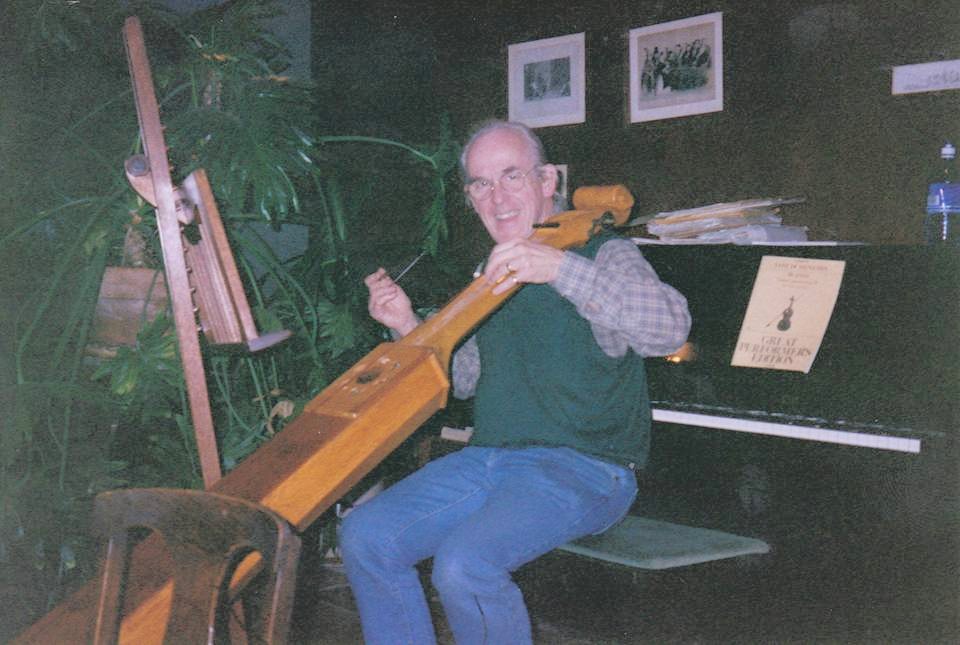
Last weekend I traveled to Texas to participate in a memorial service celebrating the life of my old friend, Cecil Adkins. Here he is with a tromba marina or trumpet marine, a strange instrument about which he llkely knew more than anybody. The photo is courtesy of his daughter, Madeline. The grin was his own. I’m thinking that Cecil built this tromba marina, though I think he also owned another that was quite old. He built many musical instruments in his long and rich life.

Cecil’s career spanned thirty-seven years as a member of the musicology faculty of the College of Music at what is now the University of North Texas. His obituary, published in the Denton Record Chronicle lists his accomplishments through those years. One of the last dissertations Cecil directed at North Texas concerned the Hinners Organ Company, long a builder of pipe organs for churches, mostly in the Midwest.

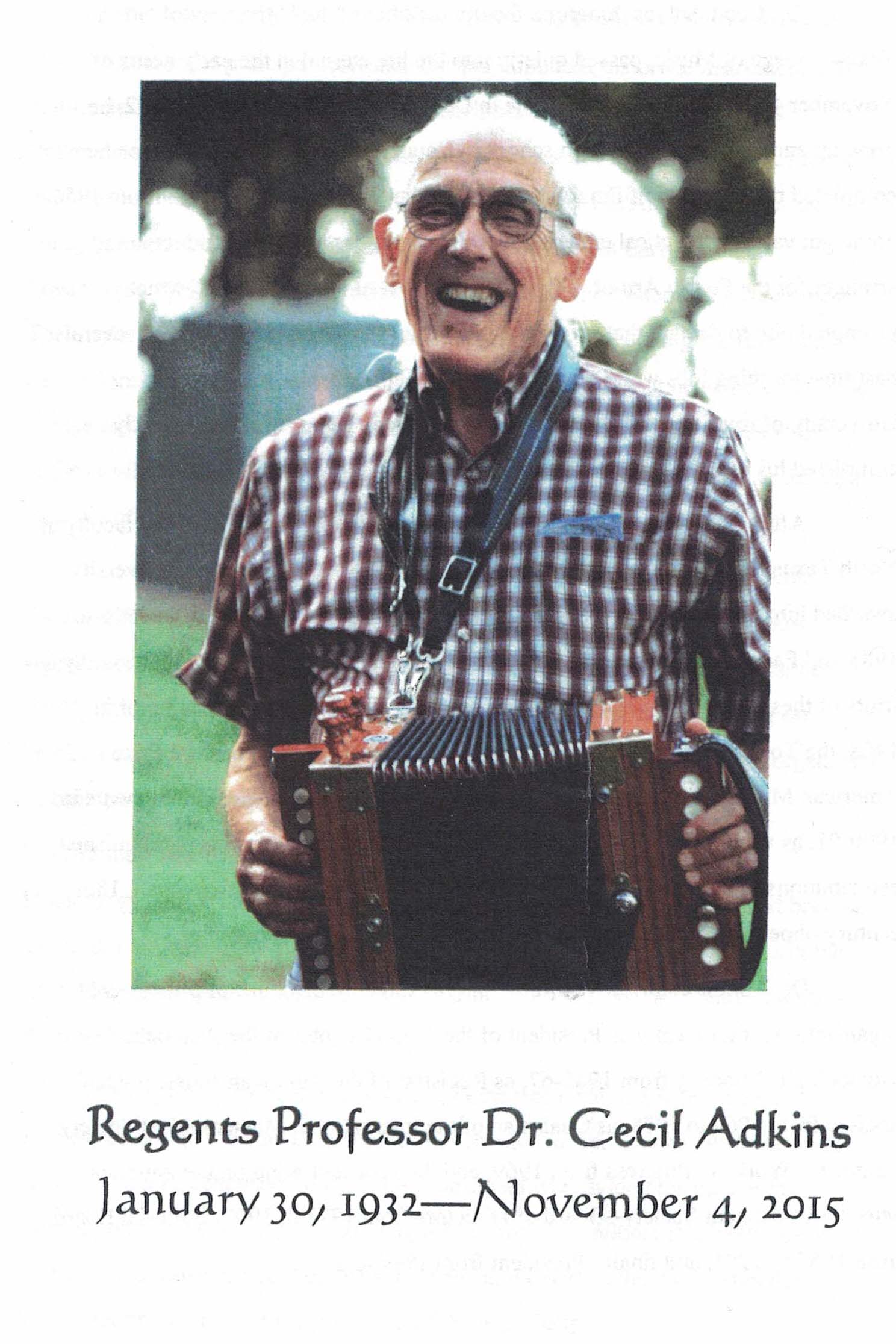
He also loved the accordion and turned to playing that instrument in retirement. His family chose a photograph of Cecil with an accordion to represent him on the cover of the memorial pamphlet they prepared for his funeral. Again, the grin is his own.

Whatever else he was, Cecil was a man who loved life, who loved to work with his hands as he loved the life of his mind. The memorial service at St. Barnabas Church, arranged and presented by his wife of many years, Alis Dickinson Adkins, and his wonderful children, was moving and beautiful. I can think of no better way to remember him here than to quote Fr. Donald Johnson’s eulogy at that service. It perfectly images my memory of my friend and relates it to the occasion of our presence on that day.

Prayer lies at the heart of the life of faith. It does so because prayer is, in a very real sense, the human half of a conversation or dialog with God, an interaction with the Creator of all things. Though we sometimes limit our understanding of prayer to our words, either audible or silent, this is a rather unfortunate limitation of understanding. Prayer is really an attitude, an approach to life; as such, it may undergird and find expression in any aspect of our lives, and is not limited just to our conversation. As we gather today as family and friends to remember Cecil Adkins and to commend him to God’s eternal love, it seems appropriate that we recall once again the words of that great 16th century German theologian Martin Luther that, “the person who sings, prays twice.”

Yet even Luther’s words, taken on their own, are far too limiting, especially when we consider Cecil’s life. Along with many others, a humble monk named Brother Lawrence reminds us that anything, even so mundane a task as washing the dishes, can be a form of prayer.

Cecil Adkins lived his life with an enthusiasm and a creativity which revealed a soul in constant dialog with God. Music was, of course, central to his life, from his college days, through his military service, through his career at the University of North Texas, and then in his retirement years. His skills as a musician, and as a builder of instruments, were great gifts to his family and friends, his university, and his church. And I always appreciated the way that he could track down and silence a cyphering pipe when our often cranky but much beloved pipe organ decided it wanted attention. Together with Alis, Cecil helped to create the musical tradition which is still a central a part of the identity of St. Barnabas’ Parish.

Cecil’s skill as a craftsman was not limited to instrument building. I was blessed by being able to work with him for several months on a project that brought him great satisfaction – the rebuilding of a 28 foot mahogany sailboat, named “Desire” by her previous owner. Since I have no real skills in woodworking or boatbuilding I felt like an apprentice because I knew that I was working in the shadow of a Master Craftsman. Someone else is now continuing that rebuilding process, and I hope that he finds as much joy and fulfillment in that work as Cecil always did.

An instrument builder and a boat builder, Cecil’s work also included furniture and marquetry. While working on his boat, I watched him build a beautiful cherry wood night stand for Alis. So, whatever he was creating, his work was always at the highest level of beauty and function.

I suspect, however, that when it came to his legacy, Cecil was most proud – and rightly so – of his and Alis’ children. Whether it was Sean, a scientist-engineer in the field of astronomy, Lynne in radio and television, Anthony in the business world, or Elizabeth, Christopher, Clare, Anthony, Alexandra, and Madeline in music, he took great pride in their accomplishments. And, of course, we know that Cecil and Alis were dedicated to one another. Their love for each other was obvious to all that knew them.

Cecil’s faith was evident in all that he did, and especially in his efforts on behalf of his parish church. Through music and through many other ways, he served to enhance the life of the St. Barnabas community. At the time of his death, for example, Cecil was serving on the building committee which is in the process of planning for new facilities for the parish.

We have much to celebrate today as we give thanks to God for sharing Cecil’s life with us. That, then, is our primary purpose here today.

Still, though we gather to celebrate, because of our sense of loss which we have experienced in his death, this is also a time for grieving, a time for sorrow. That sorrow is far from inappropriate. Even Jesus wept at the news of the death of Lazarus, his friend.

Yet, our sorrow should be for our own loss, and not for Cecil. His faith assured him that death will not have the last word. As the Apostle Paul expressed that faith in his letter to the Church at Rome, nothing can separate us from the love of God, not even death. The Holy Spirit given in baptism is not taken from us, and because we are assured of this we are also assured that we have a share in resurrection life. Cecil knew that promise, and he trusted in God’s faithfulness.

I mentioned earlier Cecil’s skill in marquetry. I first became aware of that extraordinary talent several years ago when I saw a beautiful marquetry box at Cecil and Alis’ house. It was a box that Cecil had made long before. Up to that point whenever I thought about Cecil and music I was much more likely to think baroque rather than folk music, so I was somewhat amused to discover that the box contained one of Cecil’s favorite things: one of his accordions. I mentioned to him a well-known Larsen Far Side cartoon. It contained two panels, one above the other. In the top panel, a line of souls was waiting to enter heaven. St. Peter greeted each person by saying, “Welcome to heaven; here’s your harp.” Then, in the lower panel, a similar line was waiting at the entrance to hell, where they were greeted with the words, “Welcome to hell; here is your accordion.” I think you will probably understand when I say that Cecil hated that particular cartoon. And I suspect that he was absolutely right, as I can only imagine that when he arrived at the gates of heaven God said, “Welcome to heaven; here is your accordion. Forget that nonsense about a joyful noise; let’s go make some glorious music.”

I have to add a word about the boat, as Cecil told it to me. Cecil was in the habit of sailing in Chesapeake Bay with his friend and former mentor, Eugene Helm. One summer in nineteen ninety something they were driving along the eastern shore when they saw a beautiful, but damaged, sailboat landlocked in front of a house. They stopped to inquire and were told that the boat was available at no cost to anyone who could give it a good home. Cecil brought the boat back to Texas and eventually built a shop to house the project it became. I always thought it fitting that the boat was named Desire, since it had called to Cecil in its need, and since that need had ultimately required a response that had to be passed on. Mike Cochran, Cecil’s friend and long time colleague in his many restoration projects, now has Cecil’s shop and the boat and the task of finishing its restoration.

It’s just business

When I hear somebody use the expression I’ve taken for a title, I think one of two things. Either some monstrous evil is about to be justified by appeal to the sacredness of profit, or it’s time to hold on to your wallet. I should likely leave this topic alone, since I’ve been trying not to write about political firecrackers. But there are so many things wrong with the SCOTUS Hobby Lobby decision that one hesitates to try to list them. Still, among the concatenation of fact, falsehood, and argument swirling around the decision’s aftermath a few things seem to me to be of particular importance.

It’s been known for some time that Hobby Lobby’s owners are connected with right-wing organizations whose goal is to push “a Christian agenda into American law,” as Eli Clifton has reported in Salon. Time has reported this week that the Green Family (Owners of Hobby Lobby) were recruited to act as poster children for this particular lawsuit against a portion of the Affordable Care Act. They had a family prayer meeting about the matter before they decided to act, but in the final analysis they signed their company up to front for a political action that originated with The Becket Fund for Religious Liberty.

The Becket Fund is a right-wing Washington law firm that specializes in “religious freedom” cases. To be fair, Becket has defended persons and organizations of a variety of faiths. On the other hand, the Fund has made significant recent contributions to the current trend that interprets religious freedom as a Christian license to discriminate against individuals and has been allied with others, including Hosanna-Tabor Evangelical Lutheran Church and School v. EEOC, about which I’ve written earlier, the recently enacted Arizona SB 1062 that would have provided religious exceptions to protections in federal public accommodations law and specifically permitted discrimination on the basis of sexual orientation, vetoed by Governor Jan Brewer, and now in Burwell v. Hobby Lobby.

It appears as well that the Green family’s participation in this present case was not the sincere religious matter it has been portrayed to be by media and by the Supreme Court. The Greens are heavily invested through their pension fund in pharmaceutical companies that manufacture IUDs and the specific birth control medications to which the Greens affected to object as well as drugs used to induce abortions. The story was first reported by Molly Redden in Mother Jones and has been confirmed by Rick Ungar in a piece published today in Forbes, and elsewhere.

The Greens have a perfect right to invest pension funds in whatever way they choose, as long as their investments meet their fiduciary obligations. But they do not have a right, it seems to me, to support the manufacture of the very devices and medications to which they claim a religious objection that qualifies them for an exemption from the Affordable Care Act’s employer mandate. Conservatives have rushed to defend the Greens, claiming among other things that they were not responsible for these investments, didn’t know about them, and didn’t profit from them. Ungar pretty much demolishes those arguments and sums up as follows:

You simply can’t say that you will give your all in defense of your closely held beliefs when it suits you while seeking to make money in violation of those beliefs. You also cannot pretend you were simply negligent in learning what investments you hold if you are going to hold yourself out as an example of righteousness.

These observations underscore the extent to which this lawsuit is a move in the political chess game that is being played out over the Affordable Care Act. Justice Alito admitted in his majority opinion that the SCOTUS doctrine that corporatiions are people is a fiction, but claimed it is a useful fiction designed to protect the people who own corporations from harm.

[T]he purpose of extending rights to corporations is to protect the rights of people associated with the corporation, including shareholders, officers, and employees. Protecting the free-exercise rights of closely held corporations thus protects the religious liberty of the humans who own and control them.

Whether Justice Alito was aware that he had contradicted himself here in including employees in one sentence among those protected by the “familiar legal fiction” of corporation=person and excluding them in the next I cannot judge. But the contradiction makes clear the perversity of the fiction.

There is a second perverse fiction involved in Burwell v. Hobby Lobby, and that is the fiction of sincerely held religious beliefs. The Greens’ beliefs as described in Burwell v. Hobby Lobby are at the very least problematic scientifically, but now it turns out that their sincerity is open to question as well. Women, it is claimed, may not use certain contraceptives with the Greens’ support, but it is perfectly all right for the Greens to profit from the manufacture of these same contraceptives.

To be sure, the court more or less invited the President and Congress to extend the arrangement devised for non-profits who claim a religious exception to for-profit corporations such as Hobby Lobby. I suspect that this will be done, and that the cost of covering Hobby Lobby employees for the contraceptives to which Hobby Lobby objects will ultimately be passed on to you and me. And perhaps this means can be extended to the many other corporations now in queue for the religious exception. I will be glad to pay it, but this eventuality merely invites the religious right to espouse another putatively righteous cause.

It’s tempting to dismiss this entire matter as just another example of the contemporary practice of religion as identity politics, though I have no dog in that hunt. But now that this deplorable Supreme Court decision has entered the realm of precedent it is being interpreted with some justice, as in Justice Ginsburg’s dissent but also on the right, as opening the door to all sorts of new exceptions to established law on the basis of religious scruple, which need not have a grounding in fact and may, perhaps, even be feigned. As Justice Ginsburg has wisely pointed out, the court has “ventured into a minefield,” exposing itself to the necessity of deciding perhaps thousands of supposed “religious freedom” cases ad hoc.