
everything old is new again

Today I went searching for something John Dos Passos wrote in The Big Money about the execution of alleged murderers Nicola Sacco and Bartolomeo Vanzetti. I had read the USA trilogy, which contains The Big Money, back in the 1950s, when its radicalism seemed a little dated, given that of Allen Ginsberg. I didn’t know it at the time, but Dos Passos had already completed a transition from 30s radical to 50s neocon, as so many American writers of his generation did. Still, the passage in question has stuck with me over the years as a cry of hopeless rage on the order of Ginsberg’s Howl.

they have clubbed us off the streets they are stronger they are rich they hire and fire the politicians the newspapereditors the old judges the small men with reputations the collegepresidents the wardheelers (listen businessmen collegepresidents judges America will not forget her betrayers) they hire the men with guns the uniforms the policecars the patrolwagons

all right you have won you will kill the brave men our friends tonight

there is nothing left to do we are beaten

….they have built the electricchair and hired the executioners to throw the switch

all right we are two nations

America our nation has been beaten by strangers who have bought the laws and fenced off the meadows and cut down the woods for pulp and turned our pleasant cities into slums and sweated the wealth out of our people and when they want to they hire the executioner to throw the switch . . .

I found it in plenty of places; a poignant blog by Kevin Drum came up among them. “Everything old is new again,” Drum writes at the end, echoing the Peter Allen song. And it all seems to coalesce into a huge pile of significance today as I read reports of a federal secret police unit raging round the city of Portland, Oregon detaining and maiming peaceful protestors and fast backward to the re-institution of the federal death penalty by a venal Attorney General and a Supreme court that can hardly be trusted to avoid equal venality.

I add these abominations to the list of crimes the president and his minions (among whom I include his enablers in the United States Senate) have got away with: cheating to win the 2016 election and then covering it up, the latest chapter in that sorry story being the Roger Stone commutation; wholesale scapegoating of immigrants including the now infamous separation policies, concentration camps, and other efforts to subvert immigration statutes, undermining our nation’s public health service as part of an overall attack upon the provisions of the Affordable Care Act with the result that we now have the worst of the worldwide coronavirus epidemics whose death toll is now over 140,000 and rising; attempting to seize control of messaging to the nation about the current pandemic first by holding daily press briefings that were little more than campaign rallies and when that didn’t work launching a series of attacks on Anthony Fauci and when that began to backfire demanding that hospitals and states bypass the CDC and submit coronavirus data to the White House; subverting half a century of foreign policy in eastern Europe to further the geopolitical ambitions of Vladimir Putin while ignoring Putin’s cash bounties for the lives of American soldiers. The list goes on and on. George Will has charged that our country “is now being administered by a gangster regime.” I agree.

The Sacco and Vanzetti execution was clearly a miscarriage of justice by legal standards that constituted norms only yesterday. We can now add those norms to the list our present regime seeks to overturn. Support for that regime continues to wane as the coronavirus pandemic grows worse, but leaders, supporters, and enablers of the regime continue to laud and to pursue its criminal agenda, all the while attempting to ratchet up its authority. As of today I am no longer interested in the niceties of analysis. Like George Will I hope for an electoral tsunami in November so profound that it destroys this present regime and the Republican Party with it.

While I intend to vote for Joe Biden, I believe Biden will have to relent about Medicare for All and abandon his historic commitments to the banking and insurance industries. He will also have to confront his record of uncritical support of policing This present Republican regime has exhibited the death throes of late capitalism, particularly its violence against struggling minorities. Perhaps late capitalism will maintain itself by force among us; it can only do so by displaying its illegitimacy for all the world to see. Democratic socialism is the way of any viable path out of our present decadence. What stands against democratic socialism is massing now to support the continuation of our present kleptocracy. Its playbook will include the time-honored tactics of smear and voter suppression, which loom particularly large this election cycle because of the pandemic. Added to the usual tools of voter suppression now are lack of federal support for election reform and the current effort by Republicans to destroy the US Postal Service, which will be charged with transporting the millions of mail-in ballots expected to be cast. But the most disturbing elements of that emerging Republican playbook are a federal secret police of unknown size and the thousands of militarized police forces throughout the country who through their national union have now declared support for the Republican gangsters and their president.

The Fraternal Order of Police supported Obama and Biden in past elections but endorsed Trump over Clinton in 2016 claiming that she ‘snubbed’ them. It is time for Biden to repudiate police militancy if he is to represent the hopes and dreams of the thousands of Americans who have now taken to the streets. This will be a massive task, but it might begin with a truth and reconciliation commission, modeled on the South African experience but with some added legal authority. A more massive task will be to restore the rule of law. It isn’t true that we’ve never before been where we are now as a people, or that the character of our times “isn’t who we are.” But it is true that we have never before confronted so massive a task as it will be to establish justice in a land that can no longer forget its sins nor sweep them under the rug.

America our nation has been beaten by strangers who have bought the laws and fenced off the meadows and cut down the woods for pulp and turned our pleasant cities into slums and sweated the wealth out of our people and when they want to they hire the executioner to throw the switch . . .

But we are the strangers who beat our nation bloody. We are the crooks and liars who bought the laws and fenced off the meadows and cut down the woods for pulp. We turned our pleasant cities into slums and sweated the wealth out of our people, and we didn’t care as long as it wasn’t us who got herded into those slums and factories and sweatshops. And we have now got this miserable excuse for a government because we voted for it. And it may be too late to vote it out. We can now certainly not vote it out before countless more Americans die. We have hired the executioner to administer the lethal dose.

secure in our persons

Between the years of 1969 and 1972 I had a brief love-hate relationship with a 1959 Porsche. The model on the right is from 1958 and somewhat cleaner than the car I owned, but in all other respects that’s my car. Also during those years I commuted back and forth four days a week from Durham, N. C., where I lived, to Fort Bragg, N. C., where I was attached to a branch of North Carolina State University.

My work was in the evenings. Usually I finished teaching at 9:30 and drove back to Durham after that. I didn’t drive the Porsche much because it wasn’t entirely dependable and I had visions of being stranded in the dark on the lonely farm road between Spring Lake and Lillington. But on one particular night, when circumstance had dictated that I drive the Porsche, I had an interesting encounter.

Somewhere on that dark stretch of road I mention, full of curves and declivities that could fill up with fog and make for chancy driving, especially in an old vehicle with a six-volt electrical system, I noticed that a car behind me kept moving up uncomfortably close to my rear bumper and then falling back. At some point I began to move over as far as I could to the right edge of the road (which had no shoulders) and blink my lights to invite the car to pass, but to no avail.

Finally I saw a flashing blue light and pulled off the road onto a grassy patch. After I showed the policeman my bona fides, I was asked what I was doing on the road at night. And though I had every right to be where I was and knew I had broken no law, I explained politely that I worked at NCSU Ft. Bragg and was on my way home to Durham after an evening of teaching my classes.

The policeman then told me that he had stopped me because I seemed to be driving erratically, weaving about on the road, and he had feared I might be drowsy. Both he and I knew that I had only been weaving about because his intrusive headlights had alarmed me, but I thanked him for the warning nevertheless. He returned my bona fides, reminding me to be careful, and allowed me to go on my way.

I had been profiled. I was driving a strange foreign car on a N. C. farm road at night where I didn’t belong. I don’t know what that young police officer thought he would find in my car, but he was surprised not to find it and a bit chagrined, I thought. These days I would likely have been ordered to get out of my car, perhaps required to submit to a search. That was then.

XXX

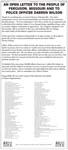
The dog days finally arrived in St. Louis last week as the streets of Ferguson cooled down. Sunday’s Post Dispatch carried a full page ad from the National Association of Police Organizations expressing support for Officer Darren Wilson and portraying police nationwide as suffering public servants intent upon the protection of citizens and grief stricken that “a life was cut short in this case.” It’s a well-crafted letter, but its claim of solidarity with the motto “To Serve and Protect” rings false to me in light of the spectacle we have witnessed in this city. To my mind the militarized and provocative police response to citizen outrage over the killing of Michael Brown is of a piece with the killing, itself; and both are cases which display the disturbing fact that citizen control of police has become a mere myth. Police are out of control, and the law protects them.

To be sure there were looters among the protesters. Shots were fired. Molotov cocktails were thrown. Some journalists abused their freedom. But most arrests were for procedural violations, mouthing off at police, stepping off a sidewalk, failure to move rapidly when ordered to do so by police. A few carefully crafted photo ops showing Captain Ron Johnson of the Missouri Highway patrol hugging protesters hardly weigh in the balance existentially, however much they may have done from a public relations standpoint. In spite of the change on the ground after Governor Nixon replaced local police with the Highway patrol, what we have seen in this city, and what we continued to see as protests continued, is far more correctly characterized by a statement from a Los Angeles police officer quoted in Daily Kos several days ago [emphasis added].

Regardless of what happened with Mike Brown, in the overwhelming majority of cases it is not the cops, but the people they stop, who can prevent detentions from turning into tragedies. […]

Even though it might sound harsh and impolitic, here is the bottom line: if you don’t want to get shot, tased, pepper-sprayed, struck with a baton or thrown to the ground, just do what I tell you. Don’t argue with me, don’t call me names, don’t tell me that I can’t stop you, don’t say I’m a racist pig, don’t threaten that you’ll sue me and take away my badge. Don’t scream at me that you pay my salary, and don’t even think of aggressively walking towards me. Most field stops are complete in minutes. How difficult is it to cooperate for that long?

Much has been written about the lack of transparency in official responses to the shooting of Michael Brown, but lack of transparency is hardly the issue when Ferguson police have seemed inclined to shield Oficer Wilson and to portray Michael Brown as a criminal. And in the final analysis whether Brown was armed, how many times he was shot, whether his hands were up, indeed all the aspects of this miscarriage of justice that “shock the conscience,” will carry little, if any, weight in law. For present law is so skewed in favor of police power as to make it well-nigh impossible to hold a police officer accouuntable for injuring or killing a citizen, no matter how egregious the officer’s conduct may have been.

The stern likelihood is that there will be no justice for Michael Brown. The probability is that Officer Wilson, who (as the Post Dispatch pointed out in an early editorial) is being given all the benefit of the due process his actions denied Michael Brown, will be found to have acted within established guidelines for police conduct. What actually happened in the Brown/Wilson confrontation may remain in dispute. And even if clear and irrefutable evidence emerges that Wilson shot Brown after Brown had made a gesture of surrender, a court would only have to find that Wilson had a “reasonable perception of being threatened with bodily harm” in order to exonerate him.

Even if the officer made a mistake in shooting, that will not be enough to support criminal charges so long as his mistake was reasonable — a determination in which the officer will receive some benefit of the doubt because of the split-second judgments that he had to make.

Or again:

Experts on police shootings say the investigation, including the grand jury deliberations, will focus on whether Wilson had a reasonable perception of being threatened with bodily harm. The experts say it does not matter how many bullets Wilson fired. Police are trained to shoot at the center of mass and stop the threat.

The Supreme Court established the reasonable expectation standard in the 1989 Graham v. Connor decision, denying redress under the fourteenth Amendment to a diabetic victim of police brutality who had been assaulted in a situation where he had committed no crime, had sustained multiple injuries including a broken foot, and then had been unceremoniously dumped in his front yard by police when they could find no crime to charge him with. The court also narrowed the fourth amendment protection in this case requiring that the defendant prove that police had injured him “maliciously and sadistically for the very purpose of causing harm,” in effect requiring proof of premeditation, a standard so high as to render citizen redress almost impossible. The consequence of this deplorable decision has been to give police carte blanche to abuse citizens. And of course the most egregious abuse this decision has fostered has fallen upon members of socially marginalized groups, racial and ethnic minorities, the mentally ill, the elderly.

Nevertheless it appears that there is popular support for the standard. St Louis Police shot and killed Kajieme Powell a few days ago, an apparently mentally ill man who behaved erratically, brandished a knife, and called out to police to kill him. Acording to a witness, “The man was agitated and animated. He said, ‘Kill me!’ They didn’t have any alternative.” Nobody seems to be questioning that assessment. Police killed the man, declared the incident to be suicide by cop, and that was that. The Supreme Court’s mapulation of law regarding the bill of rights over the past half century or more now allows police to kill citizens even when police behavior “shocks the conscience.” And with a handy citizen witness whose conscience was not shocked by the Powell shooting, everything seems perfectly copacetic. (See James Boyd White, Justice as Translation, 103ff., re “shocks the conscience”).

Senator Claire McKaskill intends to conduct hearings into the police militarization that was on display in Ferguson over the past few weeks. We should all support those hearings. But unless Congress and the courts act to restrict police power to conduct searches and seizures, there’s very little hope of changing the culture of policing or the relationship between police and citizens. Here’s the fourth amendment.

The right of the people to be secure in their persons, houses, papers, and effects, against unreasonable searches and seizures, shall not be violated, and no warrants shall issue, but upon probable cause, supported by oath or affirmation, and particularly describing the place to be searched, and the persons or things to be seized.

Long before the appearance of privacy issues that inform most popular concern over the fourth amendment these days, citizens of this country were no longer secure in our persons. And after all is said and done about the many economic, societal, and historical injustices that may have combined to produce the spectacle we have witnessed in Ferguson, Missouri over the past several weeks, it is the loss of the right to be secure in our persons that ought to disturb us the most.

It’s just business

When I hear somebody use the expression I’ve taken for a title, I think one of two things. Either some monstrous evil is about to be justified by appeal to the sacredness of profit, or it’s time to hold on to your wallet. I should likely leave this topic alone, since I’ve been trying not to write about political firecrackers. But there are so many things wrong with the SCOTUS Hobby Lobby decision that one hesitates to try to list them. Still, among the concatenation of fact, falsehood, and argument swirling around the decision’s aftermath a few things seem to me to be of particular importance.

It’s been known for some time that Hobby Lobby’s owners are connected with right-wing organizations whose goal is to push “a Christian agenda into American law,” as Eli Clifton has reported in Salon. Time has reported this week that the Green Family (Owners of Hobby Lobby) were recruited to act as poster children for this particular lawsuit against a portion of the Affordable Care Act. They had a family prayer meeting about the matter before they decided to act, but in the final analysis they signed their company up to front for a political action that originated with The Becket Fund for Religious Liberty.

The Becket Fund is a right-wing Washington law firm that specializes in “religious freedom” cases. To be fair, Becket has defended persons and organizations of a variety of faiths. On the other hand, the Fund has made significant recent contributions to the current trend that interprets religious freedom as a Christian license to discriminate against individuals and has been allied with others, including Hosanna-Tabor Evangelical Lutheran Church and School v. EEOC, about which I’ve written earlier, the recently enacted Arizona SB 1062 that would have provided religious exceptions to protections in federal public accommodations law and specifically permitted discrimination on the basis of sexual orientation, vetoed by Governor Jan Brewer, and now in Burwell v. Hobby Lobby.

It appears as well that the Green family’s participation in this present case was not the sincere religious matter it has been portrayed to be by media and by the Supreme Court. The Greens are heavily invested through their pension fund in pharmaceutical companies that manufacture IUDs and the specific birth control medications to which the Greens affected to object as well as drugs used to induce abortions. The story was first reported by Molly Redden in Mother Jones and has been confirmed by Rick Ungar in a piece published today in Forbes, and elsewhere.

The Greens have a perfect right to invest pension funds in whatever way they choose, as long as their investments meet their fiduciary obligations. But they do not have a right, it seems to me, to support the manufacture of the very devices and medications to which they claim a religious objection that qualifies them for an exemption from the Affordable Care Act’s employer mandate. Conservatives have rushed to defend the Greens, claiming among other things that they were not responsible for these investments, didn’t know about them, and didn’t profit from them. Ungar pretty much demolishes those arguments and sums up as follows:

You simply can’t say that you will give your all in defense of your closely held beliefs when it suits you while seeking to make money in violation of those beliefs. You also cannot pretend you were simply negligent in learning what investments you hold if you are going to hold yourself out as an example of righteousness.

These observations underscore the extent to which this lawsuit is a move in the political chess game that is being played out over the Affordable Care Act. Justice Alito admitted in his majority opinion that the SCOTUS doctrine that corporatiions are people is a fiction, but claimed it is a useful fiction designed to protect the people who own corporations from harm.

[T]he purpose of extending rights to corporations is to protect the rights of people associated with the corporation, including shareholders, officers, and employees. Protecting the free-exercise rights of closely held corporations thus protects the religious liberty of the humans who own and control them.

Whether Justice Alito was aware that he had contradicted himself here in including employees in one sentence among those protected by the “familiar legal fiction” of corporation=person and excluding them in the next I cannot judge. But the contradiction makes clear the perversity of the fiction.

There is a second perverse fiction involved in Burwell v. Hobby Lobby, and that is the fiction of sincerely held religious beliefs. The Greens’ beliefs as described in Burwell v. Hobby Lobby are at the very least problematic scientifically, but now it turns out that their sincerity is open to question as well. Women, it is claimed, may not use certain contraceptives with the Greens’ support, but it is perfectly all right for the Greens to profit from the manufacture of these same contraceptives.

To be sure, the court more or less invited the President and Congress to extend the arrangement devised for non-profits who claim a religious exception to for-profit corporations such as Hobby Lobby. I suspect that this will be done, and that the cost of covering Hobby Lobby employees for the contraceptives to which Hobby Lobby objects will ultimately be passed on to you and me. And perhaps this means can be extended to the many other corporations now in queue for the religious exception. I will be glad to pay it, but this eventuality merely invites the religious right to espouse another putatively righteous cause.

It’s tempting to dismiss this entire matter as just another example of the contemporary practice of religion as identity politics, though I have no dog in that hunt. But now that this deplorable Supreme Court decision has entered the realm of precedent it is being interpreted with some justice, as in Justice Ginsburg’s dissent but also on the right, as opening the door to all sorts of new exceptions to established law on the basis of religious scruple, which need not have a grounding in fact and may, perhaps, even be feigned. As Justice Ginsburg has wisely pointed out, the court has “ventured into a minefield,” exposing itself to the necessity of deciding perhaps thousands of supposed “religious freedom” cases ad hoc.