
another season’s promise . . .

feelin’ fine for now goin’ down the road

Since the inauguration I’ve been alternating between a combination of elation and relief and a now familiar anger as the Republican rump continues to assert itself. But first elation and relief and a few observations about current trends in popular culture.

The Tik-tok sea shanty craze has made popular culture icons of old songs like “Leave Her Johnny” and “The Wellerman.” It has also reminded me of the late Stan Rogers, who liked to sing sea shanties and wrote a few of his own. Rogers’ untimely death in 1983 was a loss to Canadians and the to the rest of us as well. A consummate talent, he lost his life in a horrific fire aboard an airplane as he returned to Canada from the 1983 Kerrville Folk festival. Here he is, performing a song by Mary McCaslin, in a live concert recorded just five days before he died.

“Feelin’ fine for now” sums up my present mood, and I love things about this performance a lot, especially when Rogers urges his audience to sing “like an organ.” But my personal favorite Rogers song is “The Field Behind the Plow,” whose theme I have stolen for my title. I want to claim that if there is hope for another season’s promise in our present day politics, that hope may have more than a little to do with American popular culture and yes, with the bashable villains of social media, which make it possible for ordinary folk to combine disparate elements in novel ways, something the pedant in me can’t help but point out was Samuel Johnson’s definition of ‘the metaphysical’ in poetry. There’s already a Bernie meme, for instance, that features the grizzled and be-mittened Senator singing “The Wellerman” along with a crowd of other Bernies.

I am thinking now of Amanda Gorman’s fine inaugural poem, “The Hill We Climb” with its affinities with slam poetry and Hip-Hop and its evocation of a perpetual and normatively unfinished America. I like that idea and wrote about it in my last post. As Timothy Egan speculates in a recent New York Times piece, it may be possible for Biden to govern in poetry. As Egan puts it, “Why not reverse the political aphorism, and govern in poetry after campaigning in prose?” American popular culture was on full display throughout the inauguration, especially the poetry of popular song; though not without some detractors. Lots of folks noticed Lady Gaga’s switching from 3/4 to 4/4 time as she belted out the National Anthem. I personally thought her performance struck a fine balance between rendering the anthem as a pop piece (what we have become accustomed to at sports events, for instance) and the more traditional rendering we might have expected from a classical singer. And I liked the switch to 4/4 because I took it to be one of several rhetorical devices that gave emphasis to text in what has become for most Americans a forgettable national anthem (parts of which need to be forgotten). And while Amanda Gorman has received well-nigh universal acclaim for her poetry, there are some who have derided her as inauthentic. Here’s an example, for which I have to thank my friend Moumin Quazi who collected it on Facebook. In “The Hill We Climb,” as elsewhere, Amanda Gorman speaks out of various traditions of popular poetry and oratory. One suspects that is part of what this writer finds amiss about her. But the country loved her, as did I, and it was her poem that started the thoughts I am exploring here.

As I say, American popular culture was on powerful display during the Biden inauguration festivities. “What about Yo-Yo Ma?” I can hear someone ask. But Ma is a popular culture icon equivalent to Bruce Springsteen. He is a Rock Star in an age that blurs distinctions between genres. That blurring is the life of American popular culture, however much it may trouble folk who find it inauthentic. In the remarkable display of popular culture featured in last week’s inauguration, the Biden administration stands in sharp contrast to its predecessor, whose central figure didn’t like to be upstaged. But it will take more than blurring to overcome Republican determination to prevent Democrats from governing. The Biden team might consider harnessing the power of popular culture both to promote policies clearly desired by the great majority of Americans, especially policies that pertain to desperately needed efforts to combat the covid pandemic, and also to shame Republicans who need to be held accountable for the growing covid death spiral and the countless other anti-humane policies of the previous administration. Republicans are presently behaving in predictable fashion as though only they have a right to govern: all the way from the Texas lawsuit over immigration and voter suppression measures being proposed in many states to Mitch McConnel’s cynical effort to preserve the filibuster in the Senate. The time has come for Democrats to fight back, and a popular culture campaign may be just what circumstances call for in today’s political climate. The Tik-tok sea shanty phenomenon is a recent development in the history of what Howard Rheingold calls Smart Mobs. I’m wondering what applications of the same might be explored by media savvy Democrats who gave us a memorable virtual convention this past summer. I am thinking here of the ways in which popular culture has been harnessed against tobacco use, for instance.

Back to poetry–Biden’s love of modern Irish poetry is well known. We are told that he recited poems by W. B. Yeats in front of a mirror as part of his youthful effort to overcome stuttering. And his use of a fragment of Heaney’s play, The Cure at Troy, which he has quoted in a number of contexts over the years to advocate for a circumstance in which “hope and history rhyme,” draws on an already iconic item of popular culture and amplifies it. In a recent piece in the Washington Post, Teo Armus points out that “By 2000, [Darach] Ó Séaghdha noted, the line had become famous enough in pop culture that the Irish rock band U2 alluded to it in a song.” “Hope and history don’t rhyme” in the U2 song “Peace on Earth,” but Heaney’s poem had already anticipated the event would take a miracle.

So hope for a great sea-change
On the far side of revenge.
Believe that further shore
Is reachable from here.
Believe in miracle
And cures and healing wells.

As I write, Republicans are accusing Democrats of vengefulness in calling for the impeachment of the former president for his role in planning and inciting the January sixth attack on the capitol. And as Biden has proceeded with his ambitious program of executive actions undoing some of the egregious effects of Trumpism, Republicans are seeking political cover in familiar tropes of movement conservatism as though it were still possible without irony to deny the pandemic and plead impecuniousness in the wake of their party’s record of deficit exploding tax cuts. While major parts of the Biden covid relief program can clear the Senate through budget reconciliation, most of the president’s ambitious legislative program cannot. Faced with that fact I see no alternative to abolishing the filibuster. Recalcitrant Democrats need to be brought in line. Lyndon Johnson could have done it; we’ll see whether Chuck Schumer is up to the task.

For the rest, I think it undeniable that the last four years represented a triumph of American Fascism, a thing that has been part of our politics since long before we could call it Fascism. Recent history presents us with two models for dealing with the remnants of that Fascism; The Nuremberg Trials and the South African Truth and Reconciliation commission. Current law enforcement efforts have been directed solely at the foot soldiers who did the bidding of the former president and those of his followers in government who played a role in the the January sixth attack on our capitol. Because of the extent to which Fascism remains embedded in our politics, in states like my own state of Missouri, in Texas, in the Republican Party and elsewhere, I doubt whether the South African model is applicable to our present situation. In fact, I am convinced that we require an American version of the Nuremberg Trials if we wish to recover as a society from the last four years. Conviction of the former president in the coming impeachment trial and barring him from holding public office again is only a beginning, it seems to me. It will need to be a priority of the incoming Merrick Garland administration of the Justice Department to do the rest.
sentries of the heart

Before I go back to writing about my country, here’s a riff on the death of Leonard Cohen. It ultimately feeds back into my particular political angst and will, perhaps, make a nice segue.

To speak of Cohen’s death I need to do more than quote a few lines from my favorite Cohen song. indeed, I have some sympathy for the idea that Cohen would have been a better choice for the Nobel Prize than Bob Dylan. I think Dylan never escaped the historical moment to which his best songs were a response, though we can argue about what I think of as his retreat into religion. Cohen, on the other hand, spoke to the human condition at large; though a certain piety always tinged his vocabulary.

But I want to speak about Cohen from a moral perspective. I used to direct my students to a website devoted to Cohen’s “Alexandra Leaving,” one of his great songs, overlooked in the Facebook posts I have seen, as fans have flocked to songs like “Hallelujah” and “Anthem” that are easily susceptible to ideological translation. (Interestingly I have seen only one reference to “Suzanne, none to “Bird on a Wire.”) The Cohen songs of which I am most fond celebrate courage in the face of existential loss—and thereby hangs a tale.

“Alexandra Leaving” is a parody (in the musical sense of a copy or appropriation that does not necessarily imply or proceed from humorous or satirical intention) of a poem entitled “The God Abandons Antony” by Constantine Cavafy. If you look at the website I’ve referenced in the last graph you can read the texts of Cohen’s song and Cavafy’s poem in my favorite translation. My purpose in referring students to this website was that it exposes a complex case of appropriation. It also illustrates how an appropriation may not erase an appropriated text but rather comments on it in such a way that familiarity with the appropriated text can enhance and deepen one’s reading of the new. The website I reference cites Cavafy’s source in Plutarch but doesn’t mention Shakespeare’s use of it. Here’s another website that does.

It is both enough and not enough to say that “Alexandra Leaving” is about the end of a love affair, the loss of a lover and the speaker’s attempt to accept that loss without rancor or blame, even for himself, though acceptance of the loss necessitates acceptance of responsibility. For the loss is existential, like a death, a wound to the speaker’s identity and sense of his place in the world. That was Cohen’s gift in this song, to see how the loss of a lover to the death of love was akin to Antony’s loss of his adopted city, one of the greatest of Mediterranean cities, Alexandria.

There is a place in the Republic wherein Glaucon addresses Socrates as follows: “[Y]ou mean [to describe] this commonwealth we have been founding in the realm of discourse; for I think it nowhere exists on earth.” Socrates replies, “Yes, but perhaps there is a pattern set up in the heavens for one who desires to see it and, seeing it, to found one in himself.” (I’m quoting the Cornford translation.) For the Romans such a pattern was to be found in the earthly city, preeminently in Rome, itself. Even St. Paul paid homage to this conceptualization, claiming famously that he was a citizen of “no mean city,” taking some pride in his Roman citizenship. And it is this idea to which Cavafy alludes as he describes the defeated Antony:

As one long prepared, and graced with courage,
as is right for you who were given this kind of city, . . .

“[I]t is right and a good and joyful thing,” to quote the Book of Common Prayer, for the defeated Antony, having lost everything, to step to the window as an invisible procession passes, to listen with a heart filled with courage

to the exquisite music of that strange procession,
and say goodbye to her, to the Alexandria you are losing.

One may lose a lover. One may even lose a city. One may lose the center and focus of one’s life. But one is not permitted to lose heart, not one who had been given such a lover, such a city, in the first place and for a while, at least, been found worthy of the gift.

I thought of these things before I knew of Cohen’s death, as I tried to sort through my own sense of having been gobsmacked by the election of Trump. For a while I felt as though I had lost my country and a big chunk of my identity as well. But countries come and go. I have lived through many iterations of my country in my almost eighty years. Here is one of my favorites among the songs of Leonard Cohen.

May he go with God.

a sailboat named desire

Including a homily preached on November 28, 2015 at St. Barnabas Episcopal Church, Denton, Texas by Fr. Donald K. Johnson

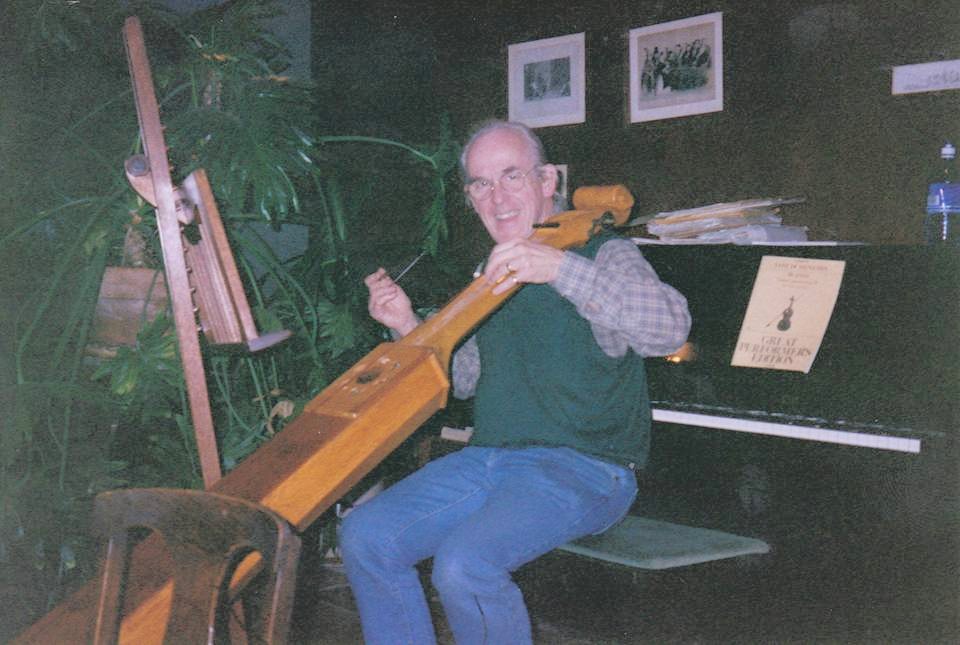
Last weekend I traveled to Texas to participate in a memorial service celebrating the life of my old friend, Cecil Adkins. Here he is with a tromba marina or trumpet marine, a strange instrument about which he llkely knew more than anybody. The photo is courtesy of his daughter, Madeline. The grin was his own. I’m thinking that Cecil built this tromba marina, though I think he also owned another that was quite old. He built many musical instruments in his long and rich life.

Cecil’s career spanned thirty-seven years as a member of the musicology faculty of the College of Music at what is now the University of North Texas. His obituary, published in the Denton Record Chronicle lists his accomplishments through those years. One of the last dissertations Cecil directed at North Texas concerned the Hinners Organ Company, long a builder of pipe organs for churches, mostly in the Midwest.

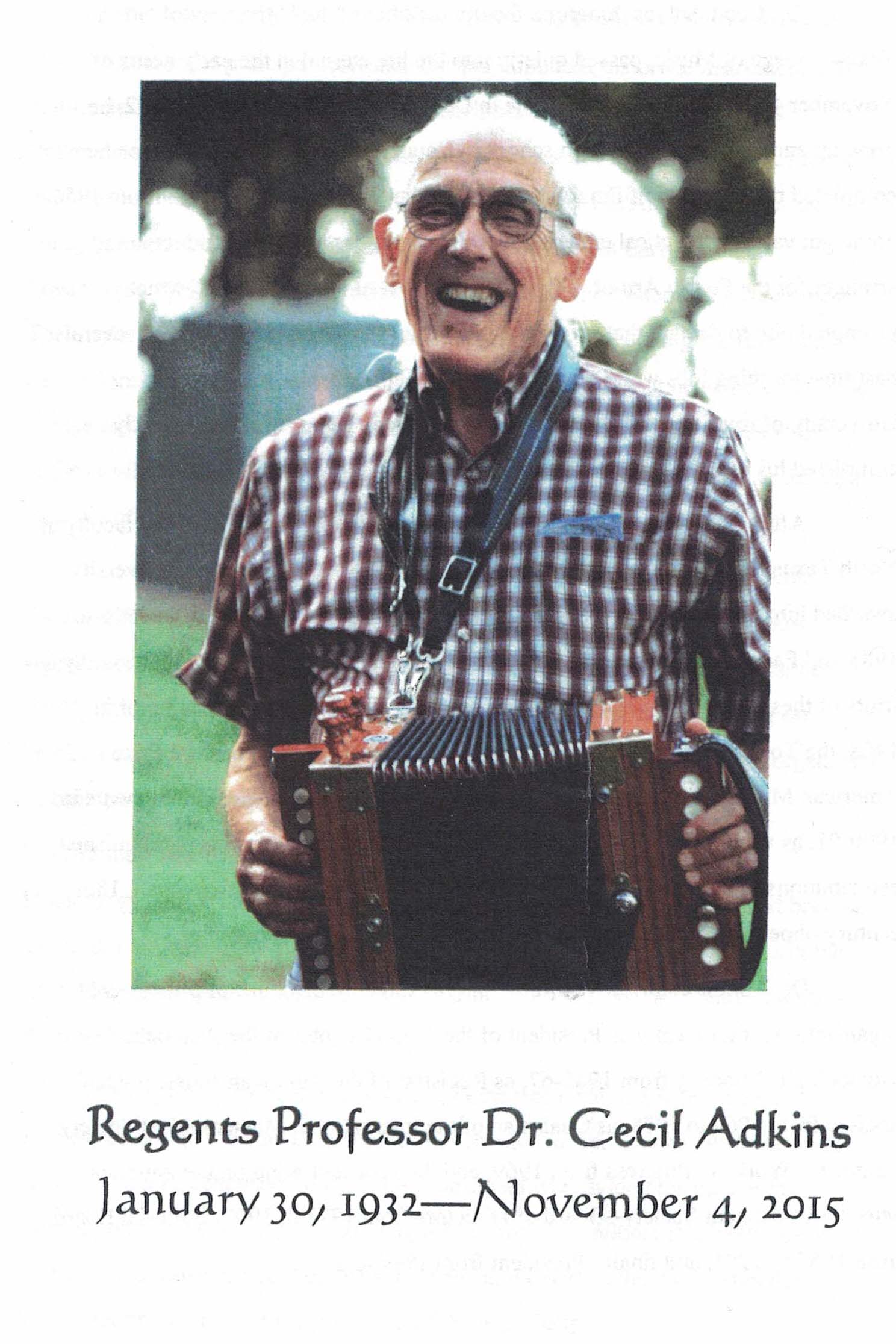
He also loved the accordion and turned to playing that instrument in retirement. His family chose a photograph of Cecil with an accordion to represent him on the cover of the memorial pamphlet they prepared for his funeral. Again, the grin is his own.

Whatever else he was, Cecil was a man who loved life, who loved to work with his hands as he loved the life of his mind. The memorial service at St. Barnabas Church, arranged and presented by his wife of many years, Alis Dickinson Adkins, and his wonderful children, was moving and beautiful. I can think of no better way to remember him here than to quote Fr. Donald Johnson’s eulogy at that service. It perfectly images my memory of my friend and relates it to the occasion of our presence on that day.

Prayer lies at the heart of the life of faith. It does so because prayer is, in a very real sense, the human half of a conversation or dialog with God, an interaction with the Creator of all things. Though we sometimes limit our understanding of prayer to our words, either audible or silent, this is a rather unfortunate limitation of understanding. Prayer is really an attitude, an approach to life; as such, it may undergird and find expression in any aspect of our lives, and is not limited just to our conversation. As we gather today as family and friends to remember Cecil Adkins and to commend him to God’s eternal love, it seems appropriate that we recall once again the words of that great 16th century German theologian Martin Luther that, “the person who sings, prays twice.”

Yet even Luther’s words, taken on their own, are far too limiting, especially when we consider Cecil’s life. Along with many others, a humble monk named Brother Lawrence reminds us that anything, even so mundane a task as washing the dishes, can be a form of prayer.

Cecil Adkins lived his life with an enthusiasm and a creativity which revealed a soul in constant dialog with God. Music was, of course, central to his life, from his college days, through his military service, through his career at the University of North Texas, and then in his retirement years. His skills as a musician, and as a builder of instruments, were great gifts to his family and friends, his university, and his church. And I always appreciated the way that he could track down and silence a cyphering pipe when our often cranky but much beloved pipe organ decided it wanted attention. Together with Alis, Cecil helped to create the musical tradition which is still a central a part of the identity of St. Barnabas’ Parish.

Cecil’s skill as a craftsman was not limited to instrument building. I was blessed by being able to work with him for several months on a project that brought him great satisfaction – the rebuilding of a 28 foot mahogany sailboat, named “Desire” by her previous owner. Since I have no real skills in woodworking or boatbuilding I felt like an apprentice because I knew that I was working in the shadow of a Master Craftsman. Someone else is now continuing that rebuilding process, and I hope that he finds as much joy and fulfillment in that work as Cecil always did.

An instrument builder and a boat builder, Cecil’s work also included furniture and marquetry. While working on his boat, I watched him build a beautiful cherry wood night stand for Alis. So, whatever he was creating, his work was always at the highest level of beauty and function.

I suspect, however, that when it came to his legacy, Cecil was most proud – and rightly so – of his and Alis’ children. Whether it was Sean, a scientist-engineer in the field of astronomy, Lynne in radio and television, Anthony in the business world, or Elizabeth, Christopher, Clare, Anthony, Alexandra, and Madeline in music, he took great pride in their accomplishments. And, of course, we know that Cecil and Alis were dedicated to one another. Their love for each other was obvious to all that knew them.

Cecil’s faith was evident in all that he did, and especially in his efforts on behalf of his parish church. Through music and through many other ways, he served to enhance the life of the St. Barnabas community. At the time of his death, for example, Cecil was serving on the building committee which is in the process of planning for new facilities for the parish.

We have much to celebrate today as we give thanks to God for sharing Cecil’s life with us. That, then, is our primary purpose here today.

Still, though we gather to celebrate, because of our sense of loss which we have experienced in his death, this is also a time for grieving, a time for sorrow. That sorrow is far from inappropriate. Even Jesus wept at the news of the death of Lazarus, his friend.

Yet, our sorrow should be for our own loss, and not for Cecil. His faith assured him that death will not have the last word. As the Apostle Paul expressed that faith in his letter to the Church at Rome, nothing can separate us from the love of God, not even death. The Holy Spirit given in baptism is not taken from us, and because we are assured of this we are also assured that we have a share in resurrection life. Cecil knew that promise, and he trusted in God’s faithfulness.

I mentioned earlier Cecil’s skill in marquetry. I first became aware of that extraordinary talent several years ago when I saw a beautiful marquetry box at Cecil and Alis’ house. It was a box that Cecil had made long before. Up to that point whenever I thought about Cecil and music I was much more likely to think baroque rather than folk music, so I was somewhat amused to discover that the box contained one of Cecil’s favorite things: one of his accordions. I mentioned to him a well-known Larsen Far Side cartoon. It contained two panels, one above the other. In the top panel, a line of souls was waiting to enter heaven. St. Peter greeted each person by saying, “Welcome to heaven; here’s your harp.” Then, in the lower panel, a similar line was waiting at the entrance to hell, where they were greeted with the words, “Welcome to hell; here is your accordion.” I think you will probably understand when I say that Cecil hated that particular cartoon. And I suspect that he was absolutely right, as I can only imagine that when he arrived at the gates of heaven God said, “Welcome to heaven; here is your accordion. Forget that nonsense about a joyful noise; let’s go make some glorious music.”

I have to add a word about the boat, as Cecil told it to me. Cecil was in the habit of sailing in Chesapeake Bay with his friend and former mentor, Eugene Helm. One summer in nineteen ninety something they were driving along the eastern shore when they saw a beautiful, but damaged, sailboat landlocked in front of a house. They stopped to inquire and were told that the boat was available at no cost to anyone who could give it a good home. Cecil brought the boat back to Texas and eventually built a shop to house the project it became. I always thought it fitting that the boat was named Desire, since it had called to Cecil in its need, and since that need had ultimately required a response that had to be passed on. Mike Cochran, Cecil’s friend and long time colleague in his many restoration projects, now has Cecil’s shop and the boat and the task of finishing its restoration.

remembering a great singer

Jon Vickers is dead. A Google search for his name now turns up a number of obituaries. In the last century, so replete with great singers, Vickers stood out as monumental. His stage presence and vocal strength were widely celebrated and sometimes debunked, as were his intransigence, hot temper, and moral rigidity. But he was a great singer, a dramatic tenor who could sing a lyric line like no other if he chose to do so. His career encompassed the most demanding roles for dramatic tenor (except Siegfried, which tends to kill those who attempt it) and a number of big lyric roles as well. In all he sang with seriousness, to be sure, but also with that quality William Hazlitt famously called Gusto, “power or passion defining any object.” Hazlitt found this quality primarily in the works of Titian, Michaelangelo, Reubens, and in Greek sculpture.

Vickers’ held himself to a standard that required him to become fluent in German and Italian. He said in a late interview that his French was only passable. But he didn’t consult his vocal coaches, for whom he had high praise, in order to study the roles he performed linguistically. For that study he consulted language professors who could teach him idiom and nuance. He wanted to understand his operatic and oratorio roles comprehensively, like a method actor. Indeed he was a singing actor in an age that saw the revival of bel canto. Some did not think his voice beautiful. I did.

And I sang with him once, in 1958 in the Cherubini Medea in which he played opposite Maria Callas in the second season of what was then the Dallas Civic Opera. A few years ago I acquired the recording of that performance, released in 2000 after years of dormancy somewhere. I hadn’t known it existed until I discovered it quite by accident looking for something else. Singing as a chorister with such people—I had recently turned twenty-one at the time—was a heady experience for a very young man from West Texas, made more memorable by other aspects of the ensemble.

Our stage director was Alexis Minotis, of the Greek National Theatre, whose 1990 New York Times obituary credits with speaking “a resonant English.” We in Dallas experienced that resonance, but were very seldom able to understand Minotis’ directions—they were Greek to us. Fortunately, Franco Zeffirelli, on hand to direct the Traviata we also sang that year with Callas, was able to translate. I have sometimes wondered if Zeffirelli collected a fee for all his work on the Medea, for which, of course, he had no billing. Minotis would instruct us, and we would do our best to translate those directions into stage behavior with the result that Minotis would scream I don’t know what epithets at us and then hurriedly consult Zeffirelli in Greek, who would tell us what to do so that we could do it.

Rudolph Bing had fired Callas at the Metropolitan Opera just days before she was to perform in Dallas that year as well. We wondered if she would stiff us as she had Bing, but she came to Dallas, more or less resurrected her career, and acquired a devoted biographer in John Ardoin, who made his own career writing about her afterwards. Reviews of the Callas 1958/59 Medea focus on her—there were four performances, I believe, in different cities. But the Dallas performance may be the most renowned of her many performances of the role in and out of opera. And the young Vickers held his own as Giasone, bringing “his huge, glorious voice to this rather one-dimensional role,” as one reviewer put it. I remembered him as a big bluff man who liked to joke around about his ranching life until a Met broadcast of Das Rheingold in the late 1960s changed my perception of him forever.

Of all the Vickers postings I have seen around in the last day or two, this one is to me the most moving. I am grateful to my son, Julian, for it. Here, Vickers sings the great Aria “Total Eclipse,” from Handel’s Samson. The source is Milton’s closet drama, Samson Agonistes. Newburgh Hamilton’s libretto recalls the Poet’s language, often quoting directly. Here’s the specific Miltonic text that stands behind the aria, though Hamilton and Handel give most of the Poet’s theology of light to other characters and to the chorus:

O dark, dark, dark, amid the blaze of noon,
Irrecoverably dark, total Eclipse
Without all hope of day!
O first created Beam, and thou great Word,
Let there be light, and light was over all;
Why am I thus bereav’d thy prime decree?

In his later career Vickers was known almost as much for the role of Handel’s Samson as he was known for Peter Grimes. I think Vickers understood the philosophical chiaroscuro of the Hamilton libretto. I have no idea whether he had read Milton, though it would fit the profile of a singer who consulted professors about turns of language if he had. I think I hear the Poet’s voice in Vickers’ reading of this aria, ‘finding no dawn.’ And I can characterize Vickers’ performance no better than to quote my son: “for me this somehow captures the enormous scale of his artistry in a way that many things don’t.” It’s the difference between Samson and Pagliacci, between tragedy and melodrama.