 Between the years of 1969 and 1972 I had a brief love-hate relationship with a 1959 Porsche. The model on the right is from 1958 and somewhat cleaner than the car I owned, but in all other respects that’s my car. Also during those years I commuted back and forth four days a week from Durham, N. C., where I lived, to Fort Bragg, N. C., where I was attached to a branch of North Carolina State University.
My work was in the evenings. Usually I finished teaching at 9:30 and drove back to Durham after that. I didn’t drive the Porsche much because it wasn’t entirely dependable and I had visions of being stranded in the dark on the lonely farm road between Spring Lake and Lillington. But on one particular night, when circumstance had dictated that I drive the Porsche, I had an interesting encounter.
Somewhere on that dark stretch of road I mention, full of curves and declivities that could fill up with fog and make for chancy driving, especially in an old vehicle with a six-volt electrical system, I noticed that a car behind me kept moving up uncomfortably close to my rear bumper and then falling back. At some point I began to move over as far as I could to the right edge of the road (which had no shoulders) and blink my lights to invite the car to pass, but to no avail.
Finally I saw a flashing blue light and pulled off the road onto a grassy patch. After I showed the policeman my bona fides, I was asked what I was doing on the road at night. And though I had every right to be where I was and knew I had broken no law, I explained politely that I worked at NCSU Ft. Bragg and was on my way home to Durham after an evening of teaching my classes.
The policeman then told me that he had stopped me because I seemed to be driving erratically, weaving about on the road, and he had feared I might be drowsy. Both he and I knew that I had only been weaving about because his intrusive headlights had alarmed me, but I thanked him for the warning nevertheless. He returned my bona fides, reminding me to be careful, and allowed me to go on my way.
I had been profiled. I was driving a strange foreign car on a N. C. farm road at night where I didn’t belong. I don’t know what that young police officer thought he would find in my car, but he was surprised not to find it and a bit chagrined, I thought. These days I would likely have been ordered to get out of my car, perhaps required to submit to a search. That was then.
XXX
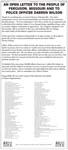 The dog days finally arrived in St. Louis last week as the streets of Ferguson cooled down. Sunday’s Post Dispatch carried a full page ad from the National Association of Police Organizations expressing support for Officer Darren Wilson and portraying police nationwide as suffering public servants intent upon the protection of citizens and grief stricken that “a life was cut short in this case.” It’s a well-crafted letter, but its claim of solidarity with the motto “To Serve and Protect” rings false to me in light of the spectacle we have witnessed in this city. To my mind the militarized and provocative police response to citizen outrage over the killing of Michael Brown is of a piece with the killing, itself; and both are cases which display the disturbing fact that citizen control of police has become a mere myth. Police are out of control, and the law protects them.
To be sure there were looters among the protesters. Shots were fired. Molotov cocktails were thrown. Some journalists abused their freedom. But most arrests were for procedural violations, mouthing off at police, stepping off a sidewalk, failure to move rapidly when ordered to do so by police. A few carefully crafted photo ops showing Captain Ron Johnson of the Missouri Highway patrol hugging protesters hardly weigh in the balance existentially, however much they may have done from a public relations standpoint. In spite of the change on the ground after Governor Nixon replaced local police with the Highway patrol, what we have seen in this city, and what we continued to see as protests continued, is far more correctly characterized by a statement from a Los Angeles police officer quoted in Daily Kos several days ago [emphasis added].
Regardless of what happened with Mike Brown, in the overwhelming majority of cases it is not the cops, but the people they stop, who can prevent detentions from turning into tragedies. […]
Even though it might sound harsh and impolitic, here is the bottom line: if you don’t want to get shot, tased, pepper-sprayed, struck with a baton or thrown to the ground, just do what I tell you. Don’t argue with me, don’t call me names, don’t tell me that I can’t stop you, don’t say I’m a racist pig, don’t threaten that you’ll sue me and take away my badge. Don’t scream at me that you pay my salary, and don’t even think of aggressively walking towards me. Most field stops are complete in minutes. How difficult is it to cooperate for that long?
Much has been written about the lack of transparency in official responses to the shooting of Michael Brown, but lack of transparency is hardly the issue when Ferguson police have seemed inclined to shield Oficer Wilson and to portray Michael Brown as a criminal. And in the final analysis whether Brown was armed, how many times he was shot, whether his hands were up, indeed all the aspects of this miscarriage of justice that “shock the conscience,” will carry little, if any, weight in law. For present law is so skewed in favor of police power as to make it well-nigh impossible to hold a police officer accouuntable for injuring or killing a citizen, no matter how egregious the officer’s conduct may have been.
The stern likelihood is that there will be no justice for Michael Brown. The probability is that Officer Wilson, who (as the Post Dispatch pointed out in an early editorial) is being given all the benefit of the due process his actions denied Michael Brown, will be found to have acted within established guidelines for police conduct. What actually happened in the Brown/Wilson confrontation may remain in dispute. And even if clear and irrefutable evidence emerges that Wilson shot Brown after Brown had made a gesture of surrender, a court would only have to find that Wilson had a “reasonable perception of being threatened with bodily harm” in order to exonerate him.
Even if the officer made a mistake in shooting, that will not be enough to support criminal charges so long as his mistake was reasonable — a determination in which the officer will receive some benefit of the doubt because of the split-second judgments that he had to make.
Or again:
Experts on police shootings say the investigation, including the grand jury deliberations, will focus on whether Wilson had a reasonable perception of being threatened with bodily harm. The experts say it does not matter how many bullets Wilson fired. Police are trained to shoot at the center of mass and stop the threat.
The Supreme Court established the reasonable expectation standard in the 1989 Graham v. Connor decision, denying redress under the fourteenth Amendment to a diabetic victim of police brutality who had been assaulted in a situation where he had committed no crime, had sustained multiple injuries including a broken foot, and then had been unceremoniously dumped in his front yard by police when they could find no crime to charge him with. The court also narrowed the fourth amendment protection in this case requiring that the defendant prove that police had injured him “maliciously and sadistically for the very purpose of causing harm,” in effect requiring proof of premeditation, a standard so high as to render citizen redress almost impossible. The consequence of this deplorable decision has been to give police carte blanche to abuse citizens. And of course the most egregious abuse this decision has fostered has fallen upon members of socially marginalized groups, racial and ethnic minorities, the mentally ill, the elderly.
Nevertheless it appears that there is popular support for the standard. St Louis Police shot and killed Kajieme Powell a few days ago, an apparently mentally ill man who behaved erratically, brandished a knife, and called out to police to kill him. Acording to a witness, “The man was agitated and animated. He said, ‘Kill me!’ They didn’t have any alternative.†Nobody seems to be questioning that assessment. Police killed the man, declared the incident to be suicide by cop, and that was that. The Supreme Court’s mapulation of law regarding the bill of rights over the past half century or more now allows police to kill citizens even when police behavior “shocks the conscience.” And with a handy citizen witness whose conscience was not shocked by the Powell shooting, everything seems perfectly copacetic. (See James Boyd White, Justice as Translation, 103ff., re “shocks the conscience”).
Senator Claire McKaskill intends to conduct hearings into the police militarization that was on display in Ferguson over the past few weeks. We should all support those hearings. But unless Congress and the courts act to restrict police power to conduct searches and seizures, there’s very little hope of changing the culture of policing or the relationship between police and citizens. Here’s the fourth amendment.
The right of the people to be secure in their persons, houses, papers, and effects, against unreasonable searches and seizures, shall not be violated, and no warrants shall issue, but upon probable cause, supported by oath or affirmation, and particularly describing the place to be searched, and the persons or things to be seized.
Long before the appearance of privacy issues that inform most popular concern over the fourth amendment these days, citizens of this country were no longer secure in our persons. And after all is said and done about the many economic, societal, and historical injustices that may have combined to produce the spectacle we have witnessed in Ferguson, Missouri over the past several weeks, it is the loss of the right to be secure in our persons that ought to disturb us the most.