A grand occasion

On Sunday, June 22, we celebrated the anniversary of Rev. Teresa Danieley’s tenth year as Rector of St. John’s Parish, St. Louis; which is also, incidentally, the tenth anniversary of her ordination to the priesthood. It was a grand occasion; here’s something I wrote for it.

There’s also a recording of my reading of the poem on the St. John’s Tower Grove Facebook page. I’ve not been able to bring myself to listen to it yet, and I’m not posting a link for fear of creating a feedback loop, but you can find it if you look. For those who might like to have a print copy of the poem, when you click on the image to your left it comes up as a PDF that you can save or print.

last Advent

So, what horizon do I look towards as Advent closes?

Perhaps not a new miraculous birth, but a couple of posts ago I wrote about some signs of the times that give me pause. Here’s one that gives me hope. Just hours ago my long-time Internet friend, Hadar Aviram, swam the length of the Sea of Galilee. I can’t even imagine swimming nine and a half hours, and Hadar is quick to point out that she did not do it all by herself, having been assisted by members of her family and friends. You can read various narratives and see some photos here.

Hadar’s swim raised funds for Beit Dror, an Israeli shelter for homeless LGBT teens. According to the shelter’s website, it is “the first and only center designed to meet the needs of out-of-home GLBT youth in Israel, and one of the few similar institutions in the world operated by governmental organizations.” Opened in 2002, Beit Dror has a modest program at present, but its goals call for expanding programs and services. Hadar’s fundraising goal was a modest $2000, which she has substantially exceeded. I want to tell another story now, but I’ll come back to this.

My calendar shows that December 29, 1957 was a Sunday. I’m thinking it must have been that evening I found myself driving back to Dallas from Waxahachie, where I had a church job. I’m sure it was late, after an evening service. I was driving my four-year-old Oldsmobile 88, a lemon for sure; I had to shift the Hydramatic manually. I had traded a beautiful De Soto coupe for it, but it had a twelve-volt electrical system, whereas the De Soto had an old-fashioned six volts, which made for dim lights at night and bad radio reception.

The Oldsmobile had bright lights and a great radio. That evening, December 29, 1957 (if that’s when it was), I was listening to Monitor, the NBC weekend radio service, as host Dave Garroway mused ironically about quirky things in between news episodes with Chet Huntley, and skits by Bob and Ray and Mike Nichols and Elaine May and other Monitor regulars. At one point, Garroway chuckled about how Americans had been down recently because the Soviets had launched Sputniks one and two and made us feel inferior, or at least a little insecure. Indeed the Soviets’ capture of the lead in the space race, a race we Americans didn’t even know we were running until we found ourselves losing it, had become a major political issue at the end of 1957. Sputnik two had carried a dog and weighed a thousand pounds. We Americans didn’t even have a Rocket capable of launching such a behemoth.

But we had launched a Santa Claus, as Garroway pointed out with a gentleness that gave the cliché some cover, who had been sighted many times orbiting the earth (or at least our part of it) just days before, as he had since time immemorial. I was twenty that year, old enough to have been stung in a bad car deal, and it still embarrasses me a little to acknowledge that for a moment I took some consolation and perhaps a bit of hope from Garroway’s sentimental ramble. We had launched Santa Claus, that particularly American myth figure, whom my Grandmother had taught me to think was the spirit of Christmas: brash, jolly, generous, full of good will, and fearless—all that and a lover of children, somehow the guarantor of the good middle-class world many of our parents in my generation had died, we thought, to preserve in the preceding decade.

The Soviets might have the better of us for a little with their beeps in the night and thousand-pound flying dog houses; they may have stolen Eastern Europe and China from the good world. But Americans knew we were not totalitarians in the depths of our hearts. We were still a long way from achieving racial and economic justice, but we had repudiated McCarthyism. Our understanding of life and the world and the social contract we had based upon it offered more of the goods of life, more liberty and prosperity than any other. It disturbed us a little that some outside our country thought of us as ugly Americans, but we wished them well as we did our best to spread the same liberty and prosperity we enjoyed around the planet. Or so we thought, some of us at least.

Why think of this now? Perhaps because I hope my fellow citizens have not lost the naïve impulse towards human good will I took from Dave Garroway on my evening road home that fifth day of Christmas so many years ago. It’s problematic, to be sure. We err in its service, as I have often erred. But it’s the best thing about us as a people. Still, if the last century taught us anything it taught us the limits of our mythology. If we are to remain major stakeholders in the evolving world we shall need a better vision of ourselves than that offered by present versions of American ambition. We ultimately won the space race, only to abandon it. Neil Armstrong’s first step on the moon proved to be somewhat less than a giant leap for all humans.

So who or what else might escape the surly bonds of earth and point the way for us towards a usable future? What present brightest and best might dawn on our darkness and lend us aid? I take present hope from young people like Hadar Aviram. You can read about her at the websites I’ve linked. I don’t know why Hadar chose the day of the winter solstice for her swim, but it seems fitting. It draws together both the adventurous and philanthropic aspects of the winter festival as it is celebrated in many traditions; for it isn’t just Christmas, or even the ancient Yule—it’s ecumenical whether we like it or not and always has been. It crosses seas and deserts. I will never ponder another Advent without thinking of this one and of Hadar’s Swim. Then too, there are profound ethical and human issues involved in the very existence of Beit Dror. You can read about some of those at the shelter’s website as well.

Finally, I’m thinking of the orchestra that Daniel Barenboim and Edward Said founded. To proclaim such things, to support such enterprises as Beit Dror and the Divan Orchestra, is to preach the gospel of peace, however one does it; though how fine a gesture to swim the Sea of Galilee! And I’m thinking of the words of Isaiah as James Jenyns fit them up for Handel’s music: How Beautiful are the feet of them . . . who cross such seas. Deer walk upon our mountains now, as the poet says. Great white bears still swim amongst the polar ice floes. And the universe rolls on into what heavens, what still unspeaking and unspoken Word to one who has seventy six winters and fewer tomorrows than he used to have? There is more in heaven and earth than is dreamt of in anyone’s philosophy.

after Advent III

Yesterday I joined a new network of blogging Episcopalians. I had been part of an older network that seems to have gone defunct, but this new one has garnered twenty-nine members already and looks to have a good future. One reason I joined is that I got a very nice invitation, written as a comment on my last blog post, from proprietor, Lisa Jones. I’m convinced that folks like Lisa and her young family are the best hope we have as Episcopalians looking at declining church numbers. That’s certainly been the case in my parish.

St. John’s Episcopal Church is the second oldest surviving Episcopal church in the city of St. Louis, founded in 1841. Only Christ Church Cathedral is older. I served two terms as Senior Warden of St. Johns, from 2006 until 2012. During that time we increased membership and budgets so that the parish now supports a strong pastoral size congregation that is on the verge of becoming program size. Here is a photo of our present building, where the congregation moved in 1908. And here’s a video (embedded below) that tells our story. It was made by the national church in 2012 and illustrates what I think is needed if our national church is to reverse its present decline.

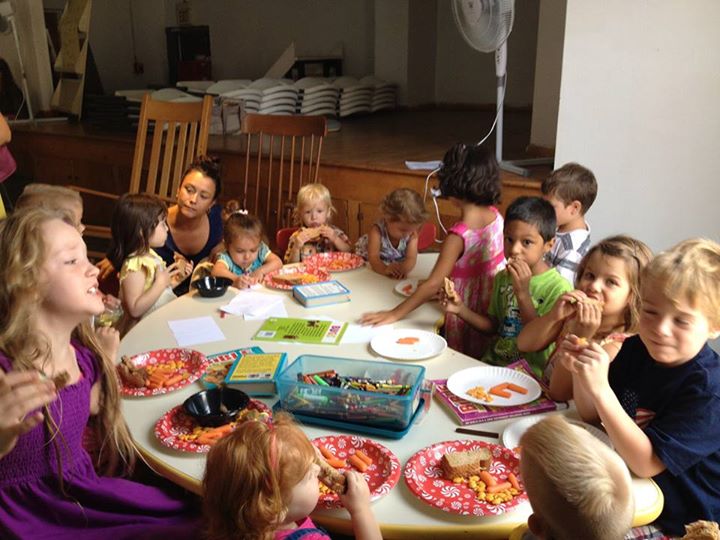
St. John’s had declined to a handful of members at the fime I first attended a service, partly because of changing demographics and partly for other reasons. One index of our growth is that we now have a thriving children’s program supported by a number of young families who have joined us over the past eight or ten years. We built some new nursery and sunday school spaces in 2010. Here is a picture that we recently featured on our Facebook page. It includes many of our youngest members. If you look at our Facebook page today, You’ll see a spread of photos from last Sunday’s Christmas Pageant in which you’ll see these same children and others. We’re blessed.

And we informally call St. John’s Tower Grove Church, affirming that we strive to be relevant to the Tower Grove/South Grand community in which we are embedded, with programs such as Peace Meal, Isaiah 58 Ministries, Integrity, and our partnership with Mann School. Also as we are called to a progressive ministry of relevance to the times in which we find ourselves, we seek to continue the work of the gospel as we are given to understand it.

In my last post I wrote about why I need the dark time of Advent, as the days grow shorter whilst a new liturgical year begins. It’s appropriate, I think, that we begin a new Christian year with a time set aside for reflection and waiting. What begins is the familiar story of the history of salvation, which is also the history of human being. We are called annually to renew that history in a world from which suffering and death and injustice and hypocrisy and crime have not only never disappeared but have also remained parts of our fundamental experience in the richest nation on earth.

Like many churches, my church has several congregations. We serve a meal every Saturday that is free and open to all who come, not just during Advent but all year. Some who come are homeless. However, in advent we might reflect that in serving this meal we honor Jesus’ Parable of the Banquet, which ought to remind us that the risk to our spiritual lives is always the practice of indifference to misfortune, and in modern times particularly the practice of ideological indifference. Advent reminds us that there is a darkness deeper than winter and calls us to a particular mindfulness. The vulnerability of the homeless, the hungry, the destitute, is our own.

Kyrie Eleison—God bless us every one!

Snakes-to-go

This is another post in a series that honors my long ago major professor’s habit of coming into the classroom some Fridays and saying “Let’s talk about snakes,” which meant we would spend the class talking about whatever was on our minds.

Ashes-to-go: My church is in the news today because we, along with partners in Isaiah 58 Ministries, offered ashes-to-go at the corner of Grand and Arsenal as we have for the past good many years. This year’s program made the front page of the St. Louis Post Dispatch and was featured in The Washington Post in a piece that circulated widely crediting our Pastor, The Rev. Teresa K. M. Danieley, with the original idea. Apparently the idea was not Pastor Teresa’s but originated in a Bible study group of which she was part. Pastor Teresa has asked the Post to publish a correction and has published a disclaimer at Facebook. But that hasn’t prevented a person from California, who claims to have originated the program, himself, from writing flaming posts on Pastor Teresa’s Facebook page. Perhaps he should write to God.

Planned parenthood: Two days ago in The Washington Post Melinda Henneberger opined that the birth control controversy is playing out to benefit Democrats. Says Henneberger:

The beauty of the current birth-control conversation for Democrats is that they not only have public opinion on their side but have cannily managed to make contraception a front-burner election-year campaign issue — by complaining that Republicans are making it front-burner election-year campaign issue.

I couldn’t be happier, and I’m happier still if Andrew Sullivan is right in a piece to which Henneberger refers, in claiming that President Obama lured Republicans into the birth-control swamp by design.

Cardinal Dolan: Timothy Dolan is back in this country, where he celebrated Mass for Ash Wednesday at St. Patrick’s Cathedral in New York and distributed some ceremonial bags of food to the hungry. Though he wore Lenten purple and affected to care little for the trappings of his new status as Cardinal, saying “The fact that I’m wearing red amounts to a hill of beans,” his vestments were still pretty grand and he wore a red zucchetto. Much is being made of Dolan’s new status in St. Louis, where he is regarded almost as a native son. But the writer of one letter to the editor in today’s paper isn’t entirely thrilled:

It is impressive indeed to see St. Louis proud of Ballwin native Timothy Dolan, who was “elevated” to the status of “prince” of the church and member of the “club” of cardinals who are charged with electing the pope’s successor (“He’s got a million of ’em,” Feb. 18). His humor, wit and understanding of the people are rare and often unseen qualities in much of the existing male hierarchy of the Roman Catholic Church.

As a Catholic, however, I continue to be mystified by the lack of understanding by the hierarchy of the humble servant mentality of Jesus Christ. Magnificent jeweled pectoral crosses, gold rings, flamboyant tailor-made vestments, days of celebration and dining out do not seem to fit in with the simplicity and humility of Jesus, the carpenter who washed the feet of His disciples. Nor does (sic) the terms “elevated” or “prince” describe Jesus, who came to serve and not to be served.

It will be interesting to see what Dolan does with his newly expanded superstardom. I am inclined to agree with Andrew Sullivan who has written, in a piece to which I have already referred, that Dolan and other American Bishops have staked out positions on social issues that do not reflect “Christian engagement with a changing world” but rather presage a retreat into fundamentalism; but I think it would be more accurate to characterize the Bishops’ retreat from social justice as a retreat into majesterium; though a few bags of food doled out to presumably hungry folk makes a good photo op, I’ll admit.