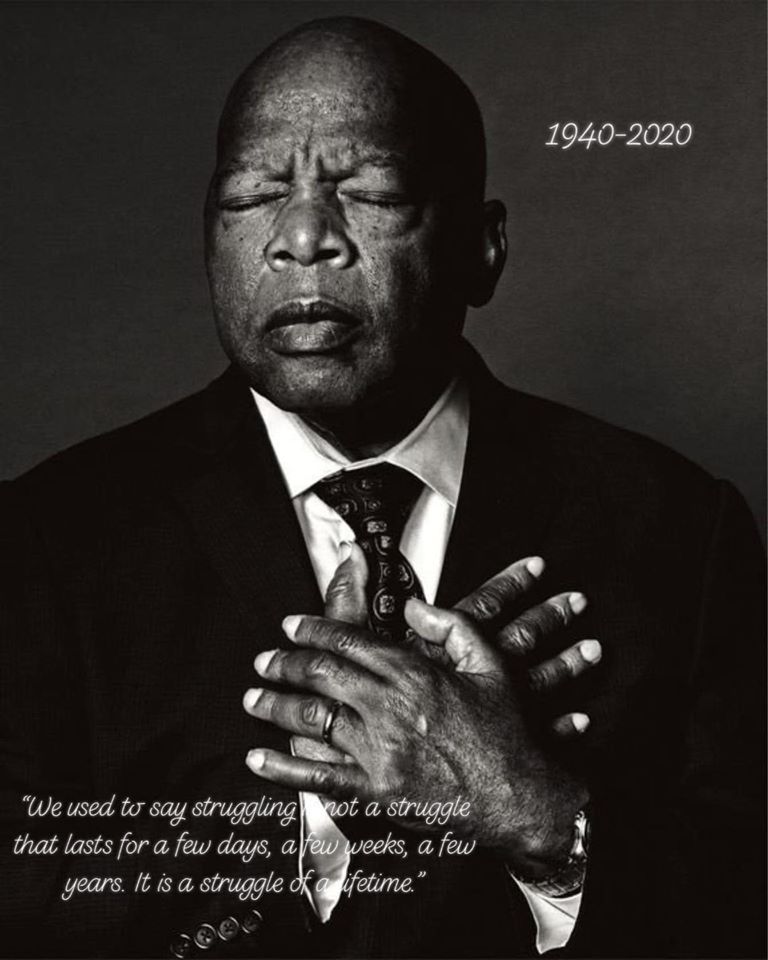
 John Lewis is dead. It is to be hoped there will be appropriate national gestures to honor him. A friend posted this memorial photo at Facebook this morning. Somehow—I’m not sure how—it captures the poignancy of the moment, this moment of John Lewis’s death and what may become his enduring legacy. Authorities in Selma may rename the Edmund Pettus bridge for him, but the abomination of institutional racism continues unabated in the land despite the struggle, despite his struggle, the struggle of his lifetime that continues and will continue in spite of attempts to crush it. In that regard it is at least interesting to note that praise for Lewis is now coming from both sides of the political divide.
However, In 1965, in the aftermath of almost universal horror as news reports displayed the casual brutality of the police attack on protestors attempting to cross the Edmund Pettus Bridge on the way to Montgomery, a second march was allowed to proceed with the protection of federalized National Guard troops. Not so today, as a fascist federal secret police force now roams city streets in Portland, Oregon carrying on a work of suppression no less sinister than that visited upon Lewis and other protestors during the first “bloody Sunday” march from Selma to Montgomery. It is an irony that shouldn’t be lost on us. It undercuts the claims of rightist political figures such as Mike Pence and Mitch McConnell who have stated publicly how much they loved and respected “John” even going so far as to use his first name, a usage that in itself makes an obscene claim of solidarity with his legacy.
Lewis’s death, and that of C. T. Vivian, his companion in the struggle, both come at a time of terrifying constitutional crisis in the land, a time that exposes deep flaws in our constitutional system. And the terrible irony is that these flaws have been exposed again and again in our history by reformers such as Lewis and Vivian, some of whom have become martyrs, like Eugene Debs and Dr. KIng. But the efforts, the suffering, and the deaths of these martyrs have yet to make headway against the intransigence of the people. I speak of systemic racism, but it was the people who installed our present regime, and it is the people who may very well unleash the full potential of this regime to foment terror in order to ensure its survival. The senate’s refusal to remove the president from office should assure all of us that the congress will not stop the terror. The willingness of the highest court in the land to reauthorize the federal death penalty should assure us all that courts will not stop the terror.
Downstairs just now I noticed that a poster welcoming refugees still hangs in my front window. Passing my front door I noticed the Black Lives Matter sign I share with my neighbor. Some days ago when protests were beginning along my street I welcomed them. I have absolutely no fear of protestors; I would join them if I could. On the night I speak of I opened my front door and waved at groups of them. But I fear the terror and chaos a deranged president with ambitions to be a dictator may unleash on the rest of us as he continues to confront reports of his failure to cope with the pandemic and his falling poll numbers. I fear that terror because the signs of its emergence are becoming plainer each day. I do not know whether we will be able to hold an election this fall. Last post I quoted George Will, but I did not mention his most ominous paragraph, which is this one:
This nation built the Empire State Building, groundbreaking to official opening, in 410 days during the Depression, and the Pentagon in 16 months during wartime. Today’s less serious nation is unable to competently combat a pandemic, or even reliably conduct elections. This is what national decline looks like.
“National decline,” says will? “and worse can be confidently expected.”
The desk where I write now sports my two modern stoic medallions. Memento mori reminds me that death stalks me. When I look down the staircase where I fell only last year I sometimes wonder “Will it be here?” These more or less grisly thoughts are my companions these days, but they background a concern that I should like not to die just yet. Off and on during my adult life I have felt that I was living towards some high point in my country’s history. That’s the real dream of liberalism, a word I still use to describe myself, a word I have never believed could be abused beyond efficacy by its detractors or its adherents. I believe in what Richard Rorty called liberal hope.
My own liberal hope is grounded in Christian humanism, unlike Rorty’s, which was grounded in an atheism for which he made an eloquent lifelong defense. But if you read Rorty you will realize that his version of liberal hope does not invalidate mine. Christian humanism gives me my final vocabulary, a term I learned from Rorty. But Rorty’s final vocabulary is the history of Western philosophy. We can agree to disagree. My own liberalism contains the naive hope that my country might one day come to resemble the kingdom of heaven, of which the writer of Hebrews remained confident in the face of disconfirming data because she could “see Jesus.” In a time when even Jesus has been almost entirely coopted into Rightist idolatry, it is difficult to envision the Prince of Peace. I now have a lifetime’s experience of confrontation with that idolatry, which is presently enjoying a cultural ascendancy I cannot recall ever having observed before.
Twelve years ago my beloved and I stood in a line outside the Edward Jones center waiting to be admitted to a rally in support of Barack Obama. We fell into conversation with a family from Oklahoma, young farmers they were with a couple of children, bright, educated. They were passionate as we were about this young man who promised to be a transformational president. Here is something I wrote about Obama back then.
Obama reminds me how it felt to make one with my sisters and brothers and students and colleagues in the marches of the sixties, how it felt to sing “We Shall Overcome” in those days when we lost a lot of fights, but won some too. Obama reminds me what it was like to win (even when we lost), what “Glory, Hallelujah!” meant to us then and how it almost became the national anthem. He reminds me what it was like to love my country when I loved my country with a passion that’s perhaps only possible when one is young. We’ve lost a lot of fights recently, but Obama gives me hope that we might still win a big one or two before what for me will be the end.
I’ve lived another twelve years now, long enough to have weathered my own personal disillusion with Obama. His fatal flaw was a desire for bipartisan governance, which we now know that Republicans conspired from the beginning to deny him, but he remains for me chief among modern presidents as exemplar of liberal hope.
I should like not to die before his portrait goes up on the White House wall.