a sailboat named desire

Including a homily preached on November 28, 2015 at St. Barnabas Episcopal Church, Denton, Texas by Fr. Donald K. Johnson
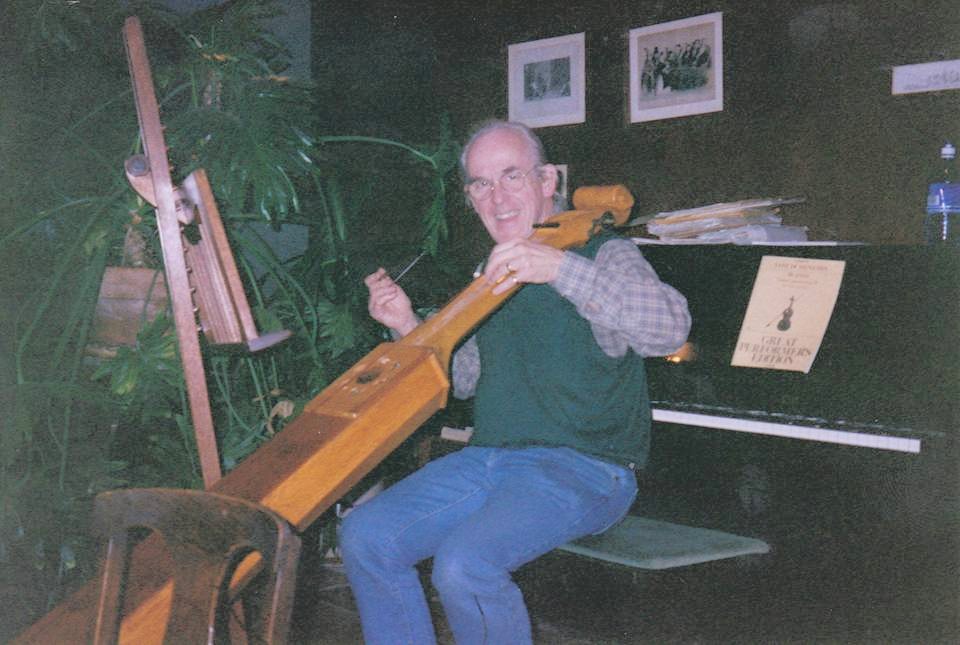
Last weekend I traveled to Texas to participate in a memorial service celebrating the life of my old friend, Cecil Adkins. Here he is with a tromba marina or trumpet marine, a strange instrument about which he llkely knew more than anybody. The photo is courtesy of his daughter, Madeline. The grin was his own. I’m thinking that Cecil built this tromba marina, though I think he also owned another that was quite old. He built many musical instruments in his long and rich life.

Cecil’s career spanned thirty-seven years as a member of the musicology faculty of the College of Music at what is now the University of North Texas. His obituary, published in the Denton Record Chronicle lists his accomplishments through those years. One of the last dissertations Cecil directed at North Texas concerned the Hinners Organ Company, long a builder of pipe organs for churches, mostly in the Midwest.
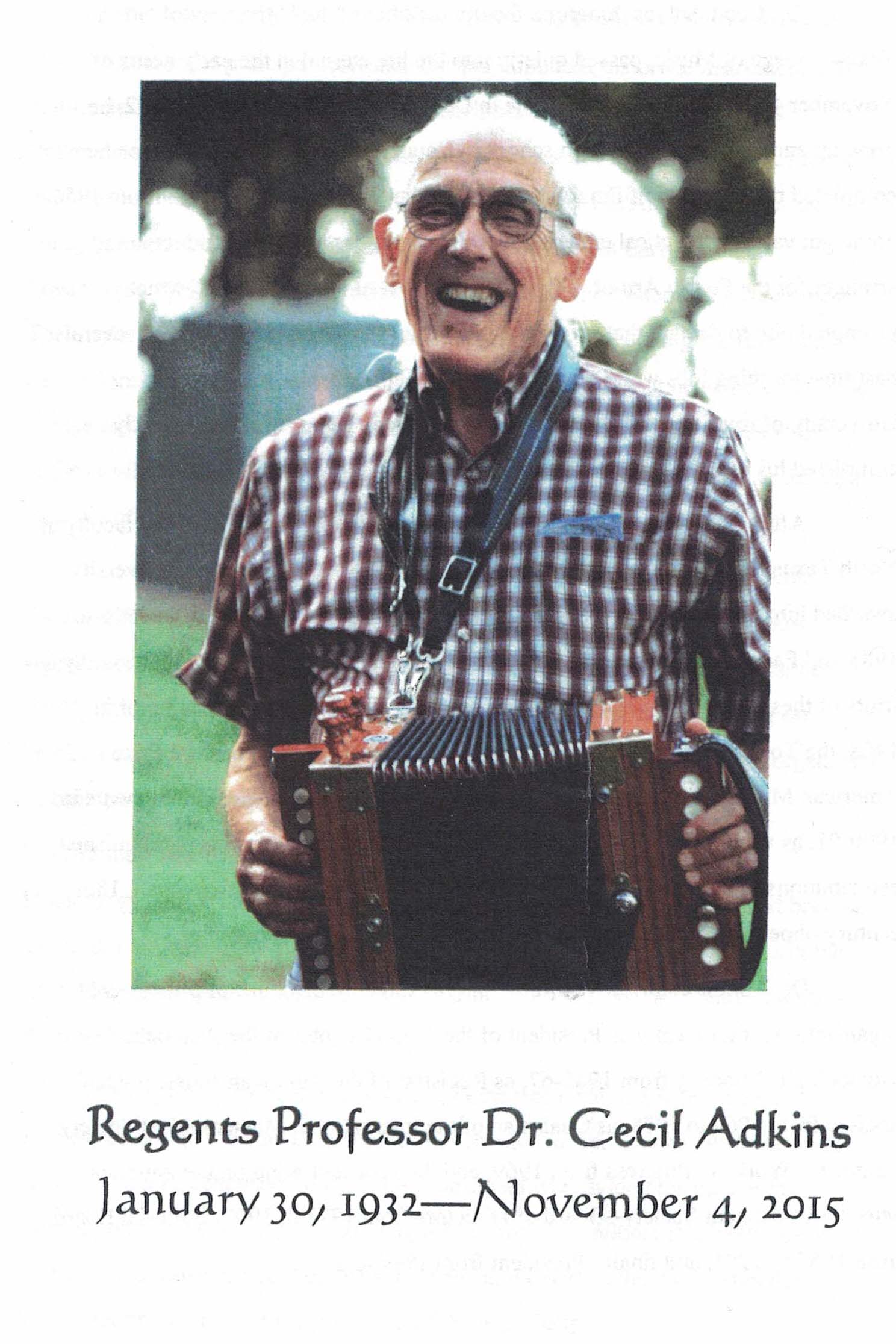
He also loved the accordion and turned to playing that instrument in retirement. His family chose a photograph of Cecil with an accordion to represent him on the cover of the memorial pamphlet they prepared for his funeral. Again, the grin is his own.

Whatever else he was, Cecil was a man who loved life, who loved to work with his hands as he loved the life of his mind. The memorial service at St. Barnabas Church, arranged and presented by his wife of many years, Alis Dickinson Adkins, and his wonderful children, was moving and beautiful. I can think of no better way to remember him here than to quote Fr. Donald Johnson’s eulogy at that service. It perfectly images my memory of my friend and relates it to the occasion of our presence on that day.

Prayer lies at the heart of the life of faith. It does so because prayer is, in a very real sense, the human half of a conversation or dialog with God, an interaction with the Creator of all things. Though we sometimes limit our understanding of prayer to our words, either audible or silent, this is a rather unfortunate limitation of understanding. Prayer is really an attitude, an approach to life; as such, it may undergird and find expression in any aspect of our lives, and is not limited just to our conversation. As we gather today as family and friends to remember Cecil Adkins and to commend him to God’s eternal love, it seems appropriate that we recall once again the words of that great 16th century German theologian Martin Luther that, “the person who sings, prays twice.”

Yet even Luther’s words, taken on their own, are far too limiting, especially when we consider Cecil’s life. Along with many others, a humble monk named Brother Lawrence reminds us that anything, even so mundane a task as washing the dishes, can be a form of prayer.

Cecil Adkins lived his life with an enthusiasm and a creativity which revealed a soul in constant dialog with God. Music was, of course, central to his life, from his college days, through his military service, through his career at the University of North Texas, and then in his retirement years. His skills as a musician, and as a builder of instruments, were great gifts to his family and friends, his university, and his church. And I always appreciated the way that he could track down and silence a cyphering pipe when our often cranky but much beloved pipe organ decided it wanted attention. Together with Alis, Cecil helped to create the musical tradition which is still a central a part of the identity of St. Barnabas’ Parish.

Cecil’s skill as a craftsman was not limited to instrument building. I was blessed by being able to work with him for several months on a project that brought him great satisfaction – the rebuilding of a 28 foot mahogany sailboat, named “Desire” by her previous owner. Since I have no real skills in woodworking or boatbuilding I felt like an apprentice because I knew that I was working in the shadow of a Master Craftsman. Someone else is now continuing that rebuilding process, and I hope that he finds as much joy and fulfillment in that work as Cecil always did.

An instrument builder and a boat builder, Cecil’s work also included furniture and marquetry. While working on his boat, I watched him build a beautiful cherry wood night stand for Alis. So, whatever he was creating, his work was always at the highest level of beauty and function.

I suspect, however, that when it came to his legacy, Cecil was most proud – and rightly so – of his and Alis’ children. Whether it was Sean, a scientist-engineer in the field of astronomy, Lynne in radio and television, Anthony in the business world, or Elizabeth, Christopher, Clare, Anthony, Alexandra, and Madeline in music, he took great pride in their accomplishments. And, of course, we know that Cecil and Alis were dedicated to one another. Their love for each other was obvious to all that knew them.

Cecil’s faith was evident in all that he did, and especially in his efforts on behalf of his parish church. Through music and through many other ways, he served to enhance the life of the St. Barnabas community. At the time of his death, for example, Cecil was serving on the building committee which is in the process of planning for new facilities for the parish.

We have much to celebrate today as we give thanks to God for sharing Cecil’s life with us. That, then, is our primary purpose here today.

Still, though we gather to celebrate, because of our sense of loss which we have experienced in his death, this is also a time for grieving, a time for sorrow. That sorrow is far from inappropriate. Even Jesus wept at the news of the death of Lazarus, his friend.

Yet, our sorrow should be for our own loss, and not for Cecil. His faith assured him that death will not have the last word. As the Apostle Paul expressed that faith in his letter to the Church at Rome, nothing can separate us from the love of God, not even death. The Holy Spirit given in baptism is not taken from us, and because we are assured of this we are also assured that we have a share in resurrection life. Cecil knew that promise, and he trusted in God’s faithfulness.

I mentioned earlier Cecil’s skill in marquetry. I first became aware of that extraordinary talent several years ago when I saw a beautiful marquetry box at Cecil and Alis’ house. It was a box that Cecil had made long before. Up to that point whenever I thought about Cecil and music I was much more likely to think baroque rather than folk music, so I was somewhat amused to discover that the box contained one of Cecil’s favorite things: one of his accordions. I mentioned to him a well-known Larsen Far Side cartoon. It contained two panels, one above the other. In the top panel, a line of souls was waiting to enter heaven. St. Peter greeted each person by saying, “Welcome to heaven; here’s your harp.” Then, in the lower panel, a similar line was waiting at the entrance to hell, where they were greeted with the words, “Welcome to hell; here is your accordion.” I think you will probably understand when I say that Cecil hated that particular cartoon. And I suspect that he was absolutely right, as I can only imagine that when he arrived at the gates of heaven God said, “Welcome to heaven; here is your accordion. Forget that nonsense about a joyful noise; let’s go make some glorious music.”

I have to add a word about the boat, as Cecil told it to me. Cecil was in the habit of sailing in Chesapeake Bay with his friend and former mentor, Eugene Helm. One summer in nineteen ninety something they were driving along the eastern shore when they saw a beautiful, but damaged, sailboat landlocked in front of a house. They stopped to inquire and were told that the boat was available at no cost to anyone who could give it a good home. Cecil brought the boat back to Texas and eventually built a shop to house the project it became. I always thought it fitting that the boat was named Desire, since it had called to Cecil in its need, and since that need had ultimately required a response that had to be passed on. Mike Cochran, Cecil’s friend and long time colleague in his many restoration projects, now has Cecil’s shop and the boat and the task of finishing its restoration.

town again

I awoke this morning to reports of the terrorist atacks in Mali, which I’m sure will rachet up xenophobic paranoia in this country. For some days now I’ve been thinking of an essay I posted back in 2012. Part of it was another essay I had initially posted five years before that. It’s a memory that haunts me. Unlike some who seek solace in being alone during times of stress, perhaps in favorite secluded outdoor places, I tend to look for company when the world turns mean.

I’ve been going to church a bit more than usual here lately; and while there are some purely local reasons why, I also have to acknowledge a need in me to locate myself (or relocate myself) among folk with whom I share much of my final vocabulary. Notice I did not say my faith community or my religious family. I have stopped using such terms because I think they have been debased beyond present repair by identity politics and are now ciichés of various discourses in which I have no wish to participate.

In response to my 2012 speculation that perhaps we need a bigger tent, religiously speaking, a friend commmented that parhaps we’d build a bigger tent if we had bigger hearts. I think I seek a large heartedness that can leave to the cosmos its undoubted unfathomability, at the same time claiming solidarity with a sense of human community that embraces enmity, even enmity unto death, without irritably reaching after fact and reason, as the poet says, and still proclaim what Reynolds Price has called “the unaccountable worth of the world.” This is very hard.

* * *

August 26, 2012

I attended church today, and while I enjoyed seeing my friends and loved the eucharist as always, I found the lessons a bit edgy. We’re at the end of the sixth chapter of John’s gospel in the lectionary, and in today’s lesson Jesus protests that his way is the only way a bit heavy handedly with the result that many of his followers leave him and only the few most faithful remain. The epistle lesson was Paul’s injunction to the Ephesians that they put on the whole armor of God, language that I as a boy in the fourth grade was required to memorize in my public school class.

Perhaps it was that memory, or perhaps it was that we sang “I am the Bread of Life,” with its strong assertion of the exclusivity of the Christian way, as a communion hymn—whatever the specific trigger, I found myself thinking (as I often do these days) that we need a bigger tent. In a recent post I used Churches as a generic term for religious houses of all sorts. When I realized the error of my usage I decided not to edit myself and to talk about it. Having attained the age of 75 I often find myself thinking and sometimes speaking the language of my youth before I learned from my old friend Martha Webb that there are some women who really don’t like being lumped in with men as the linguistic default and further came to realize by reading Abraham Heschel, James Carroll, and others, that Judaism gets a bad rap in the gospels. Some Christian apologists draw a distinction between anti-Semitism and the anti-Judaism of the New Testament, but that seems to me to be interested pleading claiming a distinction that doesn’t count for much.

For these reasons, and for some others, I thought I’d repost a piece I wrote just after I began this blog. I’ve edited a bit, and I’m going to leave it up for a while because I constantly find myself reaching out for some spiritual balance as my country slides deeper into a slough of hateful sectarian partisanship. I can’t be any smarter than I was in this piece from five years ago.

* * *

Here’s a story. It begins in the parking lot of the Denton (TX) Islamic Society, a tiny congregation named so as to claim standing in the world outside the traditional Islamic realm. It was Sunday, the Christian Sabbath. Three hundred or so local citizens, Muslims, Christians, Jews, and others gathered in the back parking lot of the society’s tiny mosque in order to express our solidarity after someone had fire bombed the place. I didn’t visit the interior of the building because I didn’t know whether I should take off my shoes, and I don’t know today whether the Sabbath has any standing in Islam.

Tuesday the week before—I won’t put the date down—a thing occurred that I never dreamed I would live to see when terrorists crashed two hijacked airliners into the main towers of the World Trade Center in New York and destroyed them, together with other buildings nearby and the lives of several thousand souls. I should set it down that other terrorists also hijacked airplanes that were crashed into the Pentagon and the Pennsylvania countryside. These terrorists were almost immediately identified with Islamic fundamentalism by government and press–hence the bombing of our little mosque in Denton.

I’d been stunned since the destruction of the World Trade Center. Our very young President (he seemed so at the time) had told us we were at war. I had resisted that conclusion in my own heart since I watched the first news reports and believed them to be true. I couldn’t find any anger in myself, though perhaps it was there and I didn’t recognize it. What I remember now is that as the Imam began to chant the prayer with which we began the little service that afternoon, I wept.

Bishop James Stanton was with us, having come to town for a confirmation service at my church. His preaching had urged the proposition that we all needed to touch one another in the aftermath of our communal loss. Those of us who remained alive needed to touch, I think he meant. I thanked him for his sermon and his presence at the mosque, felt close to him for a moment and was surprised because I disagree with him more often than not. I was struck too by a dear old friend’s comment as we walked around the parking lot together, exchanging greetings after the service, when he said to me that he didn’t want to go to war without God (without something he could pose to himself in his own mind as God—those were his words). I can go along with Bishop Stanton that we seek to touch what grounds us in times of great crisis. I’m not sure I understand my friend’s anxiety about going to war without God.

The Imam chanted and then translated. His prayer expressed gratitude to God for his beautiful creation. ‘This is my Father’s world,’ as we sang in the Methodist Sunday School of my childhood, I thought—I will take the memory of that prayer, which I didn’t initially understand, as a symbol of our struggle to find community with inadequate language and inadequate minds as we stood there in the hot sun on that concrete parking lot, greeting one another with words expressing our knowledge that we are not one people. I believe we stood in grace there, however much God may have turned his attention from his beautiful creation as the World Trade Center exploded. The next evening I opened my class at the university with the statement that I’d be glad to hear thoughts and expressions in regard to our country—we’d been asked to do this by the president—and I let my students talk for an hour and a half. There was a variety of expression, including that of one student who left the room because the discussion disturbed him. Later I put my arm around him, and the other students welcomed him back for the remainder of the evening.

I can now report that my eldest child, who is 45 years old, is as likely to have another birthday as I am. He worked in the World Trade Center–when there was a World Trade Center. Fortunately for him and his coworkers and their families and friends including yours truly, his office didn’t open until 10:00. St. Paul says ‘here we have no continuing city, but we seek one to come.’ I’ve always loved that sentiment; somehow, it suggests to me the kindness of strangers. Maybe that’s why I felt at church the next week that our processions and triumphal evocations of God were not just pretentious but wrong headed. I thought of a Quaker meeting house I know and wondered if real piety waits upon grace without asking any questions.

I tend to think the moral universe is a human creation, more like a town than like the vast reaches of interstellar space. What I believe in outside that is grace and the human struggle for community, a version perhaps of what we used to call in my church ‘the summary of the law.’ I remembered my son’s words as he looked from his apartment in midtown Manhattan and described the smoke and the smell of the great explosions at the World Trade Center. That awful thing caused many New Yorkers to remember their town and to become citizens behaving like citizens in countless ways that filled the news reports in the aftermath. Perhaps something similar happened to us in Denton; perhaps we remembered our town, and remembering, perhaps we transcended our differences for a while.

And I’m remembering now a notion of Karl Jaspers’s, in a little book entitled Die Schuldfrage, that in the aftermath of the Nazi terror perhaps all who remained alive felt a sense of what he termed metaphysical guilt, a sense of estrangement from the body of humanity. I have felt and talked with others who have also felt, in the aftermath of the terror of what we now call nine-eleven, a sense of alienation from the body of humanity and the world, not guilt but something that makes us reach out for one another. Was God in those terrible explosions that destroyed so many innocent? Was God absent? I don’t know. I can’t believe God caused them in the sense that some religious zealots have claimed. To my mind the question is something like asking if God was in the Tsunami of 2004. All fear and trembling is not hierophany. Some of it, even the unthinkable, is the ordinary terror of the world. This makes us feel uneasy in our skins sometimes, to experience ourselves as painfully other. Some say that Jesus undid our alienation just as he healed the eyes of the man born blind; and perhaps it is significant that the mud Jesus placed on the blind man’s eyes is mixed with spittle, earth and human stuff.

The blind man’s answer when he is asked what occurred is enigmatic: ‘I only know that before I was blind and now I can see.’ The wind of God blows where it will. But in the interstices of the world, where we are who mostly lead ordinary lives, it often seems good that we touch each other, that we love as much as we can and do what we can to make the world better than it often manifestly is. We’d like to think that the world as God made it is as fresh as we’d like to find it on Easter morning. We’d like to think that the prophets and poets who have taught us to love our father’s world were right and that it is indeed a good and joyful thing to give thanks for it, even on a hot Texas parking lot in the aftermath of a fire bombing.

UNT contemplates at-will policy

I’m distresed today to learn that my former employer, the University of North Texas, is planning to implement an employment at-will policy with respect to staff. Some staff members at UNT (and others in the community around the university judging from the comments attached to this report from the Denton Record-Chronicle) are understandably disturbed and have publicly wondered what problem the new policy is intended to address.

My guess is that there is no problem. The new policy is being promulgated by Chancellor Lee Jackson, a Rick Perry appointee, who recently fired former university president, Gretchen Bataille. My guess is also that UNT is following the same style of corporate consolidation that is transforming many American institutions of higher learning. But the goal at UNT, which I still affectionately think of as North Texas, seems not merely to entail transfer of power from the traditional entities of academic governance into the hands of administrators and their corporate cronies in the profit-making world.

I’m thinking that the agenda at North Texas, as at other Texas state institutions of higher learning (though this is not happening without dissent), is to politicize the university system, to redefine educational objectives in favor of producing docile workers (who will likely vote Republican) rather than critical citizens, and to redefine university research agendas to support economic development and the business interests of wealthy corporations. It’s too bad. I used to love North Texas. Now, I suppose my employer of twenty-five plus years will become as remote to me as my Alma Mater, Southern Methodist University, which renamed the building I lived in as a freshman Clements Hall, in honor of a man who (however much he may have represented the Dallas business elite) did SMU a great deal of harm, though he’s now dead.

More recently, SMU has solicited and won the opportunity to house the George W. Bush Presidential library and its partisan think tank, over strong but poorly organized protests from faculty, staff and student groups, as well as Methodist ministers, and local interest groups.

I remember a number of conversations years back with the late A. C. Greene, who was a UNT faculty member for some years in the 1980s and 90s, in which A. C. expressed the conviction that UNT should form stronger alliances with Dallas business, establish a Dallas presence, and perhaps eventually move to the city. All of these things have now taken place, though UNT’s main campus remains in Denton; but I can’t imagine A. C., whose roots were in the same West Texas town as mine, countenancing UNT’s present top-down reorganization strategy, any more than I can imagine Willis Tate, who was SMU president when I was a student, tearing his shirt for George W. Bush.