
Another summer day

I’ve been to the mountaintop, he said, and I’ve seen the promised land. Then, the very next day, he was shot dead.

For me the occasion was marked forever as I arrived at my church for choir practice on the fourth of April, 1968 to words more or less barked at me by an acquaintance in the bass section with whom I had often sparred about politics: “Well, we’ve killed that son of a bitch! What do you think of that?” Now that Dr. King is as close to being a national saint as anybody ever gets in this country, those words and the events that occasioned them stand in my memory as a poignant memento.

I lived in Durham, NC at the time. When I arrived there almost three years earlier in August, 1965, I turned on the evening news to witness a Ku Klux Klan rally in which a number of costumed hooligans were brandishing guns. This wasn’t taking place halfway across the country but just across town at a watering hole known as the Confederate Inn. Many have wondered if Dr. King foresaw his own death. He seems to speak of it in this, his last great speech. Certainly, given the violence of those years it was a pretty good bet, if not a sure one, that he would be assassinated.

And it ought to be said any time one mentions Dr. King’s death that in life he was much hated by those on the political right in this country and still is by many. Newspapers still get letters opposing the naming of public things for him. The federal holiday that honors his memory has had a mixed history. Those on the right who pretend to honor him often misrepresent his accomplishments and/or parts of his career. But my purpose isn’t to argue about Dr. King. There is something nearer to hand.

Last summer about this time I wrote about trying to explain to myself why I love my country. Part of the thrust of that essay was contained in this paragraph:

For the past several days I’ve been trying to think of something to say about why I love my country, but that immediately puts me at odds with many people I know and love who believe that the country I love, the creation of a liberal establishment, needs to be dismantled in the name of freedom and creativity. I am now to understand that greed is not only good but socially redemptive as well; to accept the destruction of the fundamental institutions of a great nation, everything from public universities to highways and bridges in the name of privatization or that will-o-the-wisp, reform; and to adjust to a public sphere in which swaggering thugs strut about brandishing assault rifles.

Similar groups of thugs have recently forestalled federal agents attempting to enforce a court order in Nevada and are now attempting to reorganize and go to Texas to “secure the border.” There was a time when groups like these militias could be dismissed as part of the political lunatic fringe, but my country has now so embraced lunacy as to confer a kind of normalcy upon them. And we are a long way past threatened destruction of the country’s great institutions. That destruction is well advanced. In my last summer’s essay I used the memory of an old Pat Boone song sounding across a lake as an image of what I love about my country. Now Pat Boone has taken to writing hate-filled media pieces about President Obama.

What I have to say about my country this summer isn’t very optimistic. It used to be possible for us Americans to absorb and transcend the horror of our political violence, even in Texas, where a large fund of right-wing bigotry and hate is presently being ramped up again by vicious pols inside and outside the state, where a humanitarian crisis involving hundreds of innocent children is being held hostage by the same logic that has shut our national government down. The Republican party failed in its last attempt at formally shutting government down but has largely succeeded informally, and it has done so by plunging the country into perpetual chaos in order to blame the president for it.

Nobody will ever convince me that the present strategy of the Republican party isn’t racist. It works in precisely the same studied manner employed by Lee Atwater in the Willie Horton attack ads against Michael Dukakis. Its designers understand that the Republican base can be aroused by appeals that give its members permission to express socially impermissible hatreds by using language that masks their real nature. But when a mob of middle class white people prevents busloads of brown-skinned children from entering a town in California, all the while chanting USA! USA!, it’s pretty clear what’s going on. And when those same children are described as disease infested, etc., at a town hall meeting, it’s pretty clear what’s going on. And when the whole sorry spectacle is hyped by wannabe’s like Sarah Palin and Rick Perry as a way to stoke hatred of the president, it’s pretty clear what’s going on.

None of this is news any more. But there’s a bit of a new twist in claims such as this one from Jeff Stone, the chairman of the Riverside County Board of Supervisors as he spoke to a crowd at a town meeting in Murrieta, California after the mob action—“Obama needs to enforce the border and stop this action of exploiting traumatized women and children for his own political gain,”—when it is Mr. Stone and others who think as he seems to think who are exploiting traumatized women and children. Such statements are beneath contempt, but they are also signs of the times in Dr. King’s promised land.

It’s just business

When I hear somebody use the expression I’ve taken for a title, I think one of two things. Either some monstrous evil is about to be justified by appeal to the sacredness of profit, or it’s time to hold on to your wallet. I should likely leave this topic alone, since I’ve been trying not to write about political firecrackers. But there are so many things wrong with the SCOTUS Hobby Lobby decision that one hesitates to try to list them. Still, among the concatenation of fact, falsehood, and argument swirling around the decision’s aftermath a few things seem to me to be of particular importance.

It’s been known for some time that Hobby Lobby’s owners are connected with right-wing organizations whose goal is to push “a Christian agenda into American law,” as Eli Clifton has reported in Salon. Time has reported this week that the Green Family (Owners of Hobby Lobby) were recruited to act as poster children for this particular lawsuit against a portion of the Affordable Care Act. They had a family prayer meeting about the matter before they decided to act, but in the final analysis they signed their company up to front for a political action that originated with The Becket Fund for Religious Liberty.

The Becket Fund is a right-wing Washington law firm that specializes in “religious freedom” cases. To be fair, Becket has defended persons and organizations of a variety of faiths. On the other hand, the Fund has made significant recent contributions to the current trend that interprets religious freedom as a Christian license to discriminate against individuals and has been allied with others, including Hosanna-Tabor Evangelical Lutheran Church and School v. EEOC, about which I’ve written earlier, the recently enacted Arizona SB 1062 that would have provided religious exceptions to protections in federal public accommodations law and specifically permitted discrimination on the basis of sexual orientation, vetoed by Governor Jan Brewer, and now in Burwell v. Hobby Lobby.

It appears as well that the Green family’s participation in this present case was not the sincere religious matter it has been portrayed to be by media and by the Supreme Court. The Greens are heavily invested through their pension fund in pharmaceutical companies that manufacture IUDs and the specific birth control medications to which the Greens affected to object as well as drugs used to induce abortions. The story was first reported by Molly Redden in Mother Jones and has been confirmed by Rick Ungar in a piece published today in Forbes, and elsewhere.

The Greens have a perfect right to invest pension funds in whatever way they choose, as long as their investments meet their fiduciary obligations. But they do not have a right, it seems to me, to support the manufacture of the very devices and medications to which they claim a religious objection that qualifies them for an exemption from the Affordable Care Act’s employer mandate. Conservatives have rushed to defend the Greens, claiming among other things that they were not responsible for these investments, didn’t know about them, and didn’t profit from them. Ungar pretty much demolishes those arguments and sums up as follows:

You simply can’t say that you will give your all in defense of your closely held beliefs when it suits you while seeking to make money in violation of those beliefs. You also cannot pretend you were simply negligent in learning what investments you hold if you are going to hold yourself out as an example of righteousness.

These observations underscore the extent to which this lawsuit is a move in the political chess game that is being played out over the Affordable Care Act. Justice Alito admitted in his majority opinion that the SCOTUS doctrine that corporatiions are people is a fiction, but claimed it is a useful fiction designed to protect the people who own corporations from harm.

[T]he purpose of extending rights to corporations is to protect the rights of people associated with the corporation, including shareholders, officers, and employees. Protecting the free-exercise rights of closely held corporations thus protects the religious liberty of the humans who own and control them.

Whether Justice Alito was aware that he had contradicted himself here in including employees in one sentence among those protected by the “familiar legal fiction” of corporation=person and excluding them in the next I cannot judge. But the contradiction makes clear the perversity of the fiction.

There is a second perverse fiction involved in Burwell v. Hobby Lobby, and that is the fiction of sincerely held religious beliefs. The Greens’ beliefs as described in Burwell v. Hobby Lobby are at the very least problematic scientifically, but now it turns out that their sincerity is open to question as well. Women, it is claimed, may not use certain contraceptives with the Greens’ support, but it is perfectly all right for the Greens to profit from the manufacture of these same contraceptives.

To be sure, the court more or less invited the President and Congress to extend the arrangement devised for non-profits who claim a religious exception to for-profit corporations such as Hobby Lobby. I suspect that this will be done, and that the cost of covering Hobby Lobby employees for the contraceptives to which Hobby Lobby objects will ultimately be passed on to you and me. And perhaps this means can be extended to the many other corporations now in queue for the religious exception. I will be glad to pay it, but this eventuality merely invites the religious right to espouse another putatively righteous cause.

It’s tempting to dismiss this entire matter as just another example of the contemporary practice of religion as identity politics, though I have no dog in that hunt. But now that this deplorable Supreme Court decision has entered the realm of precedent it is being interpreted with some justice, as in Justice Ginsburg’s dissent but also on the right, as opening the door to all sorts of new exceptions to established law on the basis of religious scruple, which need not have a grounding in fact and may, perhaps, even be feigned. As Justice Ginsburg has wisely pointed out, the court has “ventured into a minefield,” exposing itself to the necessity of deciding perhaps thousands of supposed “religious freedom” cases ad hoc.

A grand occasion

On Sunday, June 22, we celebrated the anniversary of Rev. Teresa Danieley’s tenth year as Rector of St. John’s Parish, St. Louis; which is also, incidentally, the tenth anniversary of her ordination to the priesthood. It was a grand occasion; here’s something I wrote for it.

There’s also a recording of my reading of the poem on the St. John’s Tower Grove Facebook page. I’ve not been able to bring myself to listen to it yet, and I’m not posting a link for fear of creating a feedback loop, but you can find it if you look. For those who might like to have a print copy of the poem, when you click on the image to your left it comes up as a PDF that you can save or print.

Emma’s place, and some random thoughts about education as therapy

Too long away. Sometimes I get burnt out, Maybe that has something to do with what I’m writing here, now. My experience last weekend may be implicated as well.

I’ve acquired a stake in Oberlin College. My beloved and I are de facto god parents to a rising sophomore there. I’ve written about Emma before in these pages. Last weekend we accompanied her mother to Oberlin to collect her and her things for the post-freshman year return home to Iowa City. It was good to see Emma in “her place,” as she called it a couple of times, good to meet her Oberlin friends and to get a first hand impression of the college.

Its quality stands out: four libraries, a world class art museum, a large and beautiful campus that is the chief feature of the town surrounding it, a highly qualified and well-compensated faculty (Oberlin has a 9:1 student faculty ratio), all for three thousand students each year, some six hundred of whom study in the Oberlin Conservatory of Music, a world class institution in its own right. It was also nice to speculate that the college seems not to take itself too seriously.

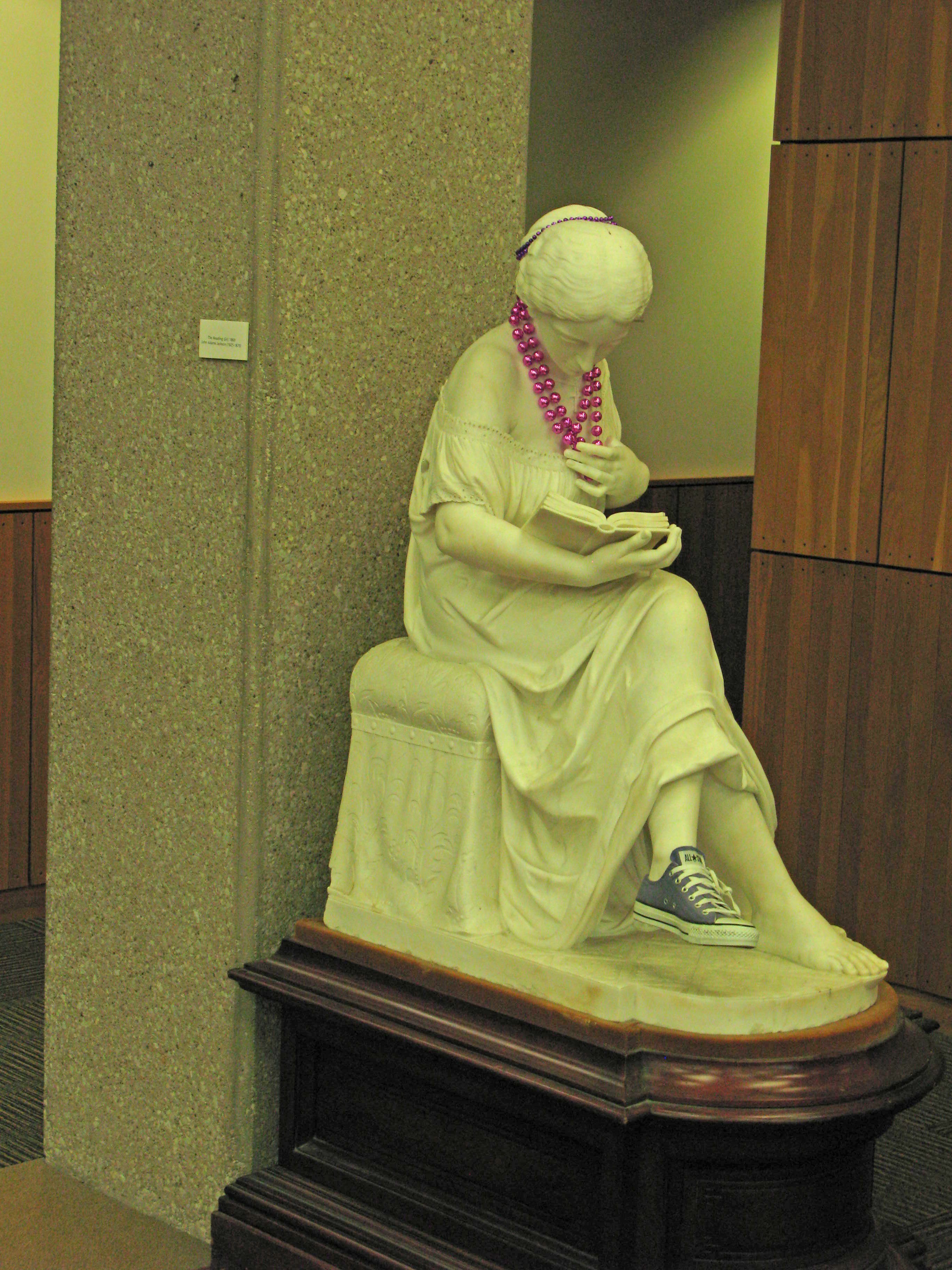
On the first floor of Mudd Library, one encounters The Reading Girl, “a statue created by John Adams Jackson (1825–1879) in 1869,” according to OberWiki. Apparently no one interferes with students (or others) who adorn that marble lady with a variety of items of clothing and/or jewelry from time to time. One campus source considers the sneaker (size six) to be a permanent part of the statue. Indeed, my beloved purchased a tee shirt at the library circulation desk featuring an image of the statue, sneaker and all. What relation, if any, Oberlin’s Reading Girl may have with other reading girls, such as Pietro Magni’s La Leggitrice, now in the National Gallery, I’m unable to say.

But Oberlin does take itself seriously, and that seriousness is reflected in a news story carried in The New York Times on the very Sunday we were wandering around the Ohio Campus as Emma packed her things. Somebody at the Times should have been fired for writing the headline: “Warning: the Literary Canon Could Make Students Squirm.” Oberlin and several other colleges and universities around the country are considering whether to mandate trigger warnings on syllabi that contain material some students might find threatening, a trend that is getting a good deal of attention in the popular press.

Proponents of the idea stress that the intent is not to proscribe any and all material any student might find offensive. The idea of the first such policy (at UC Santa Barbara) was simply to provide students with a headsup warning about the possibility that a particular book or film might “tap into memories of trauma.” But the argument about such policies has tended towards framing as a rights discourse (free speech vs. the right not to be harmed) or an argument about the values of liberal arts education. Unfortunately both framings are easily coopted into already large structures of cliché.

So before it gets to be impossible to talk about trigger warnings in ordinary academic contexts without automatically entering the house built by culture war, perhaps one might pause to say that there is a very old question at issue here that has almost nothing in common with the familiar issues of present academic culture. The idea of education as therapy is neither new nor radical. It isn’t the same as the old-fashioned idea that education shapes character, but it is a cousin to it. Education as therapy conceives that souls can be restored to health by right learning. Sorry about the old-fashioned lingo; we’re talking about a very old idea here.

When The Lady Philosophy first appears to Boethius in in his prison cell as he awaits trial for treason, she finds the philosopher medicating himself with poetry, which (as she contends) only makes him worse. Boethius has forgotten who he is and hence needs reeducation in the basics of Neoplatonism, his former grounding. He needs particularly to reunderstand why it is that nothing bad can happen to a good person. I speak here of Boethius the character in The Consolation of Philosophy (c. 524 C. E.). Boethius the author may have needed to reinhabit the house of Socrates as well, especially since he was eventually put to death in a particularly gruesome manner.

So–education as therapy isn’t new. It wasn’t invented by feminists or others who can easily be dismissed as calling for the latest iteration of political correctness. And the point of Boethius’s reeducation shouldn’t be seen as a blanket rejection of poetry, especially since much of The Consolation of Philosophy, itself, is poetry. Not to speak of psychoanalysis (particularly the Jungian kind) one might remember as well John Stuart Mill’s claim in his autobiography that he cured himself of depression by reading the poetry of Wordsworth: the point being that different times and conditions might arguably call for different remedies, and that use of any particular remedy might entail avoidance of others.

Unfortunately, the Oberlin trigger warning guide (which mercifully has been withdrawn) seems made to order for deconstruction by anti-PC critique. Here’s a part that’s been widely referenced. I’m quoting from a Jenny Jarvie piece in The New Republic:

Oberlin College has published an official document on triggers, advising faculty members to “be aware of racism, classism, sexism, heterosexism, cissexism, ableism, and other issues of privilege and oppression,” to remove triggering material when it doesn’t “directly” contribute to learning goals and “strongly consider” developing a policy to make “triggering material” optional. Chinua Achebe’s Things Fall Apart, it states, is a novel that may “trigger readers who have experienced racism, colonialism, religious persecution, violence, suicide and more.”

Ironic that students might need to be inoculated against Things Fall Apart, which we all read in the last century as an antidote to our colonial prejudices, nourished by Joseph Conrad and others. Part of the difficulty here is the reduction of education to things called learning goals, the darling of today’s assessment driven school environment. If assessment is all that matters, education becomes a process of ticking off items on a list. But the real trouble with trigger warnings is that their use sets up a filter that may impede students’ engagement with a broad range of learnings that have a transformative potential. Here education as character formation and education as therapy may cross, but it is important not to blur the distinction between them.

The trouble with reading Achebe when we did is that we stopped reading Conrad. I’m not talking about specialists, now, but about the broad range of college students who as a matter of general education need to understand the sensibilities of the age of Conrad and E. M. Forster if they are to understand their own. It is as important to read Conrad as it is to read Achebe contra Conrad if one’s goal is a discourse that recognizes that even oppressors have sensitivities, experience guilt, etc. Achebe’s portrayal of Okonkwo’s British antagonists is perhaps as limited as Conrad’s portrayal of the Fang people. Both have the character of ex parte.

Dropping Conrad in favor of Achebe was an exercise in Education as therapy. We wanted to be sure our students didn’t become colonialists; hence, therapy for their immersion in post-colonial culture. But in depriving them of Conrad we may have deprived them of a serious opportunity to think about what it means to be “one of us,” potentially a character building experience. I realize that’s Lord Jim, not Heart of Darkness, but you get my drift. And there is a sense in which humanistic education (what we’re talking about after all) must entail immersion in the destructive element. From what Emma tells me, Oberlin (her place) is not only aware of that necessity but is also aware of its risks.

And if the Oberlin trigger warning policy is at this point a failure, or perhaps even a remedy seeking a wrong, there is another therapeutic education program reported in last week’s New York Times Magazine that seems to be destined for success. In an essay entitled “Who Gets to Graduate” Paul Tough reports on a program of small interventions at the University of Texas at Austin designed to help students from working class families overcome internalized cultural expectations that seem to retard their academic progress.

[W]hether a student graduates or not seems to depend today almost entirely on just one factor — how much money his or her parents make. To put it in blunt terms: Rich kids graduate; poor and working-class kids don’t. Or to put it more statistically: About a quarter of college freshmen born into the bottom half of the income distribution will manage to collect a bachelor’s degree by age 24, while almost 90 percent of freshmen born into families in the top income quartile will go on to finish their degree.

The chief reason for this trend seems to be that low income and working class students tend to over-interpret small failures as meaning that they are inferior and don’t belong at college. Developmental and remedial programs seem to reinforce the trend rather than arrest it. Researchers at Austin have designed a series of small interventions intended to foster in these students a sense of being part of a community of high-achieving scholars so that they can more easily take small failures in stride in the same way that their more privileged peers do.

Can souls be returned to health by right learning? Ought we to think of humanistic education as a search for the soul’s weal? No matter how instrumental our conception of education becomes, such questions seem unavoidable. The difficulty is, as always, that our conceptions of the soul’s weal are guarded by fierce ideological angels. It’s refreshing to encounter these contemporary resolves to wrestle with such ageless angels who visit our dreams sometimes when we least expect them.