Still sits the schoolhouse

Image is live and can be enlarged.


When I was obliged to memorize Whittier’s “In School-days” in 1947, I was in the fourth grade. I don’t recall wondering what the speaker meant by describing the schoolhouse as a ragged beggar or by characterizing his protagonist as a failure in the poem’s final stanza, but these thoughts jump out at me now. The loss of a beloved past is a harsh lesson, for no love is lost between the poem’s ageing protagonist and those upwardly mobile others who have passed above him socially, whilst the love of his life is ensconced forever in the one-room schoolhouse of his memory.

He lives to learn, in life’s hard school,
   How few who pass above him
Lament their triumph and his loss,
   Like her,—-because they love him.

For readers in its time Whittier’s lines evoked a generalized nostalgia, perhaps for a simple hearted era that was waning as the nineteenth century gave itself over to the bureaucratic life of a mechanized modernity. Specific reactions to Whittier are widely noted from Longfellow and Lowell. More generalized conservative reactions to the changing world of the nineteenth century may be found all over the place. One thinks of Walden and Henry Adams’s Education. Or of Dickens’s Hard Times, a specific attack on the progressive schooling of its era and upon the utilitarianism that engendered it.

Our time knows a similar nostalgia for the putative simple heartedness of the 1950s when the shocks and social dislocations of the late twentieth century were not yet strongly felt. My generation of white Americans likes to think of the time of our growing up in such terms, generally omitting from memory the facts that our beloved schools were racially (and often ethnically) segregated and our cherished communities bastions of privilege enforced by a rigid caste system. I now live in a city whose landscape is littered with empty schoolhouses. I did most of my growing up in a small city in West Texas whose inner landscape (the old part of town) is similarly littered with abandoned school buildings, many of which sit empty, monuments to a careless upward mobility that has found no new purposes for most of them. Around the country the old caste system is resurgent, or perhaps it never disappeared; and the combination of forces that have undermined our schools and hollowed out our cities works on unabated.

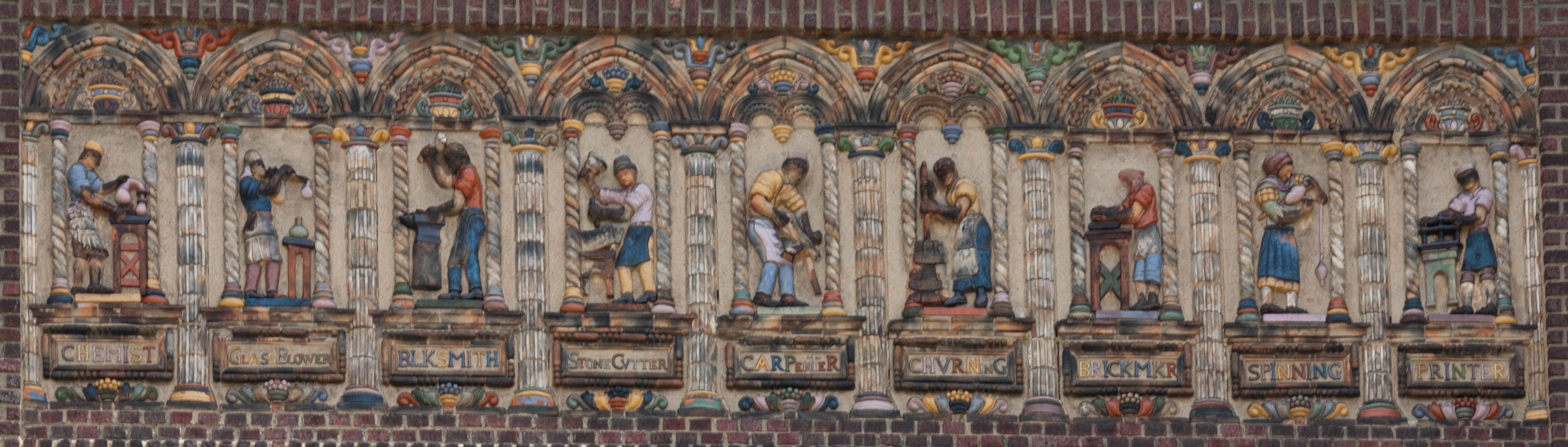
The photo I have used as a headpiece for this essay depicts a frieze that adorns the facade of Cleveland High School in the Saint Louis neighborhood known as Dutchtown. The building has been empty for some years now, though Cleveland High still exists as a magnet school, one of two high schools housed in a building halfway across town at Arsenal and Kingshighway. A video produced by one of our local PBS stations sketches Cleveland’s history and includes a few interior shots of the old building that show the early stages of inevitable decay since it was shuttered. That decay is much worse now as old Cleveland succumbs to the spread of graffiti and the combined forces of disuse and lost maintenance. Once a magnificent building, erected in 1915 and designed by St. Louis’ premier school architect, William Ittner, old Cleveland schoolhouse must now be regarded as urban waste. Though the building is for sale, even the for sale sign is falling apart, a ragged beggar indeed.

Our public school system in this city is a shadow of its former self, a victim of flight to the suburbs and having been systematically defunded by a state government that favors private and charter schools and would like to put true public schools out of business. The system tends to lose good teachers to the suburbs where salary scales are higher. Both newer and older school buildings are not being adequately maintained. Our city government has collaborated in the state’s disinvestment, though there are signs that change may be possible. Our schools are again fully accredited and may be returned to local control—good things if we can change city and state government sufficiently to restore some of our lost funding. We have a handful of excellent public schools, but it will take a long time under the best of circumstances to restore the system to excellence. Aside from lost funding the chief problem our system faces is the general perception amongst the suburban populations that surround us that the city public schools are for the supposedly disadvantaged and the non-white—and the story of the city, disadvantaged and crime ridden, into whose heart suburban folk fear to travel, perpetuates itself and perpetuates the conditions it purports to describe,

I believe the undermining of public education in America (which is now affecting colleges and universities as well as schools) is part of a more generalized undermining of our public life. It is tempting to dismiss the decay of our public life as a footnote to the history of late capitalism. Such a dismissal isn’t unjust. Predatory capitalism is undermining all other systems of value in present day culture and may in the long run undermine itself. But that’s too easy. It leaves in place the symbiosis between capitalist theory and the Marxist critique and implies that nobody has to take responsibility. We’re in the grip of an impersonal and inevitable history that we neither understand nor control. That’s another message of the Harari books I discussed in my last post. But the question I want to ask is something like this: What is entailed by a large and complex society’s abandonment of its public life to the vicissitudes of commerce? I’ve been hearing that’s a good thing for as long as I can remember, but I’ve never seen the benefit of it. And there’s a corollary question as well: What is entailed by a large, rich society’s abandonment of the responsibility to educate its rising generations.

For that is what we Americans have done. As a people largely educated in public schools we no longer support the schools that educated us. The history of this deplorable situation is complex, but there’s more to be seen in the frieze at old Cleveland High than the quaint, gendered world picture it evokes. For all the parochialism of that world picture its presence on Cleveland High’s facade was meant to evoke a relationship between education and the necessary work of the world. The conception of necessary work had components both altruistic and pragmatic. It was aspirational as well as practical, and it was grounded in a shared commitment to the honor and dignity of human seriousness and of labor in the service of that seriousness. It was also creative, though its creative thrust sometimes evoked immersion in the destructive element.

The woman named Tomorrow
sits with a hairpin in her teeth
and takes her time
and does her hair the way she wants it
and fastens at last the last braid and coil
and puts the hairpin where it belongs
and turns and drawls: Well, what of it?
My grandmother, Yesterday, is gone.
What of it? Let the dead be dead.

For we were convinced that we were special, we Americans of my generation and previous ones; and because we were special we had almost a natural right to use up the present, its resources, even its institutions. The church congregation in which I did most of my growing up decided it needed a new gothic revival home in the early 1950s and in order to build it destroyed a gorgeous period building whose value is incalculable, destroyed its gorgeous stained glass windows depicting Jesus as the good shepherd and a John Wesley whose parish was the world, broke them up into niggling little fragments of art glass and reassembled them in a fashionable rose window and a series of unremarkable lancets. Nobody objected at the time. My home town is now remarkable for its wise and humane historic preservations downtown, but the Methodist church of my childhood with its spacious half-round sanctuary and its windows that spoke of salvation history is gone forever.

Moreover, in the larger polis of my town our seriousness was at war with itself in at least two ways. Our town existed as a human community only in the myth of itself to which we were committed; it was in fact chiefly remarkable for its exclusions and divisions. And for all our present-day nostalgia for the 1950s, to have lived then is to have been part of a collective striving that valued an imagined future over any present condition. I wanted to get away from my childhood’s place—didn’t have the courage to get as far away as some of my friends did, but I got away. Then, when my life broke down in the 1980s I went back for a while, but that never works. I’m searching for a way now to think about the questions I’ve asked here in the concrete terms of my lived experience. What is entailed by the abandonments I describe: that is, what follows from them?

The high school building where I spent four years is one of the now empty school buildings in my Texas home town. There is an effort developing to save it, to turn it into a community center containing a public library branch, a theater, and other public spaces. As I’ve said, my town has had some success with this sort of thing in the past. I hope the present effort succeeds; but its success, if it does succeed, will not speak to my questions. My town still has a better than average public school system, I think, but it is not typical. St. Louis is far more nearly typical of the state of public education in urban America, and beyond that, of the state of our public life as a nation. What do we stand to lose if present trends continue? If our present love affair with privatization and the social dislocations and inequalities it has engendered continues unabated, what do we stand to lose as a people?

It seems a relatively good bet that present trends will not simply continue but will accelerate for the foreseeable future, that our social divisions will sharpen and become more intense as our public life is drained of wealth in order to support and enrich our corporate oligarchy. We have now almost entirely lost any sense of shared commitment to human seriousness and the work of the world, seriousness having fragmented into a congeries of new parochialisms whose brands are bought and sold, and the world’s work more and more being performed by robots and low wage workers. If these claims seem extreme, consider this: university faculties are now largely made up of low wage workers, and those of us who have worked to change that situation are only just discovering how much of the wealth of the social system is deployed against us. In our remaining public schools, teachers have long been programmed not to teach but rather to coach students for standardized tests. Indeed the idea of teachers as coaches is emerging as the new cool conception of good teaching.

“Where there is no vision the people perish,” reads the biblical proverb; but we need more change than a simple return to keeping the law. The fragmenting of seriousness we have experienced has turned law into politics and politics into a collection of irreconcilable disputes. One easy symptom of what I mean is that appeals to evidence are generally drowned out by ad hominem in today’s so-called public debates. By such illogic many of us are now confident that science itself is a liberal interest group bent upon making life difficult for the decent and the God fearing, and this confidence seems impervious to any need for or reliance upon the products of science. It is now possible to troll the Internet while receiving chemotherapy and still to believe that the world was created in six days about six thousand years ago and that reports of global warming are fake news. What we need is an escape from this cultural dead end, but without public education I don’t see the possibility of it. To be sure, elites continue to be educated, but the dream of a commonality of thoughtful citizens, capable of participating in their republic and making choices for the common good, indeed even that republic itself, may be buried and forgotten. If so, perhaps the frieze above the door of old Cleveland High would make a fitting grave marker.

Or perhaps not. My experience as a teacher taught me over the years that it is still possible to engage young people in conversations with and about human seriousness; though most of my students for the last fifteen years of my career were products of elite high schools. Perhaps my frame needs to be larger. In the Saint Louis Urban Debate League, in which I now participate as a judge and informal advisor, I continue to encounter middle and high school students who are not merely susceptible to but seemingly hungry for serious encounters with life and the world. The Debate League is grounded in the St. Louis public schools, but we are expanding now. We already include a couple of charters and may include others. We are successfully competing in debate tournaments with county school systems and plan to add at least one county system to the League next year. One of our alumni has recently graduated from Princeton, another from Wylie College whose debate program is underwritten by Denzel Washington. Others are at the University of Chicago and other elite colleges and universities. One of last year’s graduates, a ward of the League as he was homeless at the beginning of his junior year, got a full ride to Duke.

But the successes I most enjoy are the students with whom I become acquainted as middle schoolers. Watching them grow and seeing how this program encourages and refines their abilities to think and communicate says to me that teaching and learning are still going on in our schools. I continue to believe that the present state of public education in our country is one of our chief political failures. I also continue to think that many of us may have succumbed to the blandishments of supposed school reformers who are gaslighting us in hopes of convincing us that public education is doomed when the reality is that these reformers view public education as a potentially lucrative new market for capitalist exploitation. All that aside, cultural revision has always been a struggle for Americans, but it goes on. The myth of the good society still animates us, but the good society of tomorrow will need to affirm the polyglot, pluralist culture that is America today. The Debate League helps me again. A new frieze to replace old Cleveland’s would need to incorporate a significance (under present conditions a majority) of dark faces, but others as well: Asian faces, Latinas, Muslim girls in hijabs, as well as the inevitable contingent we call white. This is how the Debate League looks, how our public schools presently are.

The work of the world is harder, the question ‘What do you want to be when you grow up?’ harder to answer. The combination of pressures from corporate bureaucracies more intent on perpetuating and aggrandizing themselves than on mission, metastatic economic inequality, and cultural stagnation are shrinking opportunity for the young and driving a large wedge between altruism and the practical life for everybody, with fewer and fewer real careers in the traditional professions available and more and more gig work, shift work, and low wage peonage with few or no benefits. It’s still possible to achieve traditional success in a traditional career or as an entrepreneur, but the middle ground between celebrity success and low wage peonage is fast disappearing. What these things will mean in the long run is hard to predict. More and more we are educating ourselves for temporary situations, not for meaningful working lives. A new frieze for the schoolhouse door, like Cleveland’s old one but relevant to this present time, is almost impossible to imagine.

‘What do you want to be when you grow up?’ has a number of corporate corollaries. ‘What occupations are necessary for and therefore typical of life in today’s world?’ ‘what sorts of value do we assign to these occupations, what degrees of autonomy to their practitioners?’ ‘How, and how well, do we reward today’s necessary occupations?’ These questions are problematic, the questions themselves not their potential answers. They may not be among the right questions to ask about life in todays world. On the one hand, technological development is driving social change at a pace that creates funds of obsolescence and human waste, And on the other hand the present tendency of capital to feed upon itself rather than increase real productivity is constantly widening the gap between haves and have-nots among us. As a consequence cohorts of workers for one reason or another find themselves irrelevant: middle aged workers who since the great recession cannot find jobs and have left the workforce permanently, former employees and abandoned pensioners of dying heavy industry, surplus PhD graduates who are transforming university faculties into cadres of casual employees, low wage workers who lack education and are denied advancement come to mind.

We’re all living longer too, and collectively extending childhood and adolescence at one end of the life cycle and retirement or something like it at the other. Perhaps in fifty years these trends will emerge as measurable demographics, but for now the relationship between education and the necessary work of the world remains unclear. In this circumstance, perhaps my city’s collection of private, public, and charter schools reflects that lack of clarity as much as it reflects and embodies the city’s destructive past. Still, the best high school in town is a public school, though St. Louis also supports a few excellent private high schools and at least one excellent charter, If the tensions and stresses between and among our city’s schools mean that we need a new understanding of the relationship between private and public education, perhaps that need follows from the need to reconnect education with the world’s work. But we need to support our public schools better than we do. Even given the historical trough in which we find ourselves, a system of public education that is being slowly starved to death is hardly the best we can do.
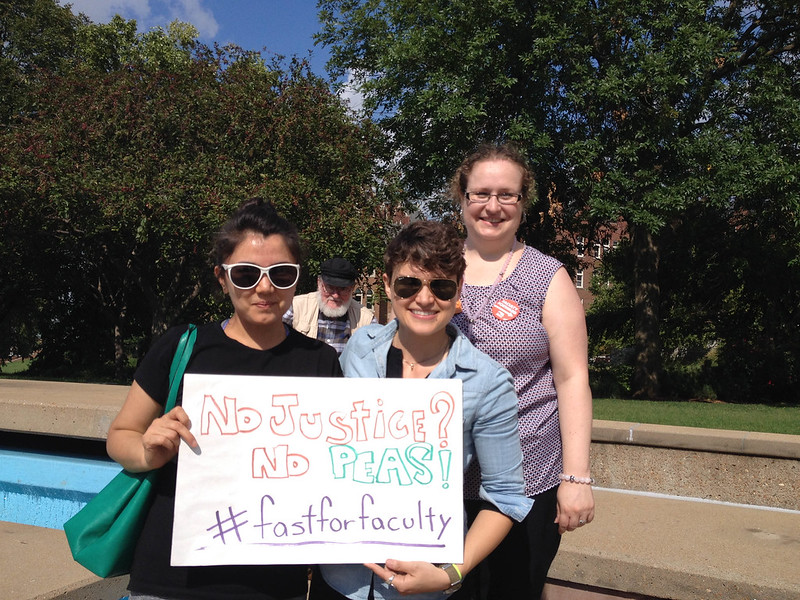
I’d have written “pease.”

Yesterday I participated in the Adjunct Action Fast for Faculty on my campus at Saint Louis University. Here I am photo bombing some of my young friends at that event late in the afternoon.

IMG_0451.jpg

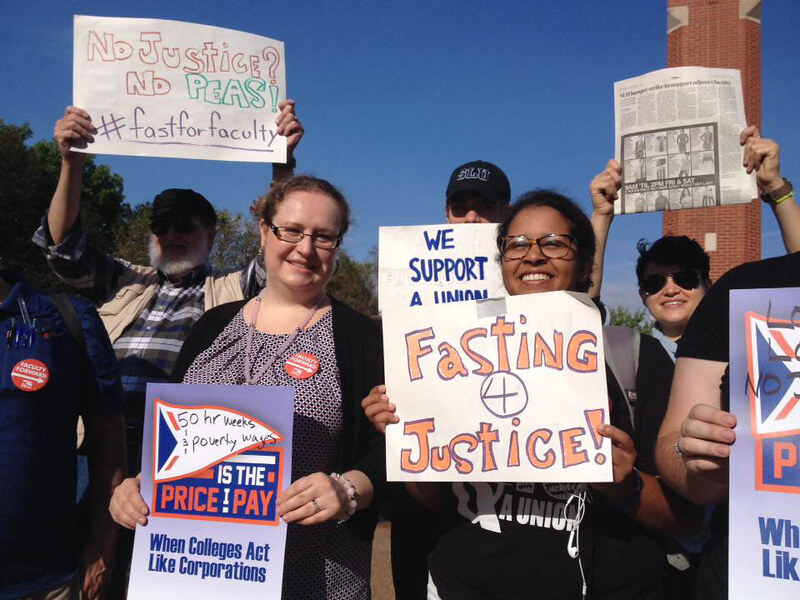
And here’s a shot of a number of us in the early morning hours. I’m in the background holding up a silly poster—good silliness, to be sure. Of course, if I had made the poster I’d have written “pease” (q. v.).

11181865_528496013983309_7428248693347719987_n.jpg

We talked to members of the university community at the clock tower and collected a respectable number of signatures from folks who were willing to support our efforts to negotiate for better wages and working conditions for adjunct faculty at the Jesuit colleges and universities. A Just Employment Policy has been in effect at Georgetown University for ten years now. We’re hoping that similar policies can be adopted throughout the Jesuit system.

We’re also hoping that Pope Francis’ visit to this country will help to energize our effort, perhaps even endorse it; and in the spirit of that hope we joined the Nuns on the Bus at the opening rally of their current bus tour, which began in St. Louis today in the shadow of the Dred Scott courthouse framed by the Gateway Arch, that iconic and problematic image the American dream. Sister Simone Campbell referenced the image in her opening remarks to the crowd in Kiener Plaza and linked it to the theme of the bus tour: “Bridging divides: transforming our politics.”

I didn’t have a camera with me at the Nuns’ event, but I did manage an inadequate cell phone photo that shows the bus parked behind the speakers’ platform and the Courthouse dome and Arch in the background.

2015-09-10 10.50.47.jpg

Fortunately, however, there are lots of good pictures of the event at the Nuns’ Network site at Flickr. There is also a good piece on NPR that summarizes the event, including my remarks, as well as providing more photos. And here’s the Nuns’ own summary on tumblr. I get quoted in it, though you have to look around to find the quotes.

I made a short speech about our effort in the Jesuit universities and afterwards recorded more remarks for the Nuns on the Bus Network archive. Then I signed the bus, along with a good many others, before returning to campus for the rest of the day. In the evening I attended another event with the Nuns at the college church. Quite a large crowd had assembled, and for an hour and a half we participated in small and large discussions about the various divides we know and what efforts we know of that are attempting to breach them. It was a heady experience, the room full of good energy, people clamoring to speak.

As I thought about it afterwards, I remembered the Truth and Reconciliation commission from the early days of the new South Africa. Like that effort, this bus tour doesn’t aim at ideological victory but rather at accommodation and community. I’m thinking that the Nuns intend to lay the takings from this long conversation of theirs, that will take them to a score of American cities, on Pope Francis’ heart in some way as he arrives in this country later this month.

Emma’s place, and some random thoughts about education as therapy

Too long away. Sometimes I get burnt out, Maybe that has something to do with what I’m writing here, now. My experience last weekend may be implicated as well.

I’ve acquired a stake in Oberlin College. My beloved and I are de facto god parents to a rising sophomore there. I’ve written about Emma before in these pages. Last weekend we accompanied her mother to Oberlin to collect her and her things for the post-freshman year return home to Iowa City. It was good to see Emma in “her place,” as she called it a couple of times, good to meet her Oberlin friends and to get a first hand impression of the college.

Its quality stands out: four libraries, a world class art museum, a large and beautiful campus that is the chief feature of the town surrounding it, a highly qualified and well-compensated faculty (Oberlin has a 9:1 student faculty ratio), all for three thousand students each year, some six hundred of whom study in the Oberlin Conservatory of Music, a world class institution in its own right. It was also nice to speculate that the college seems not to take itself too seriously.

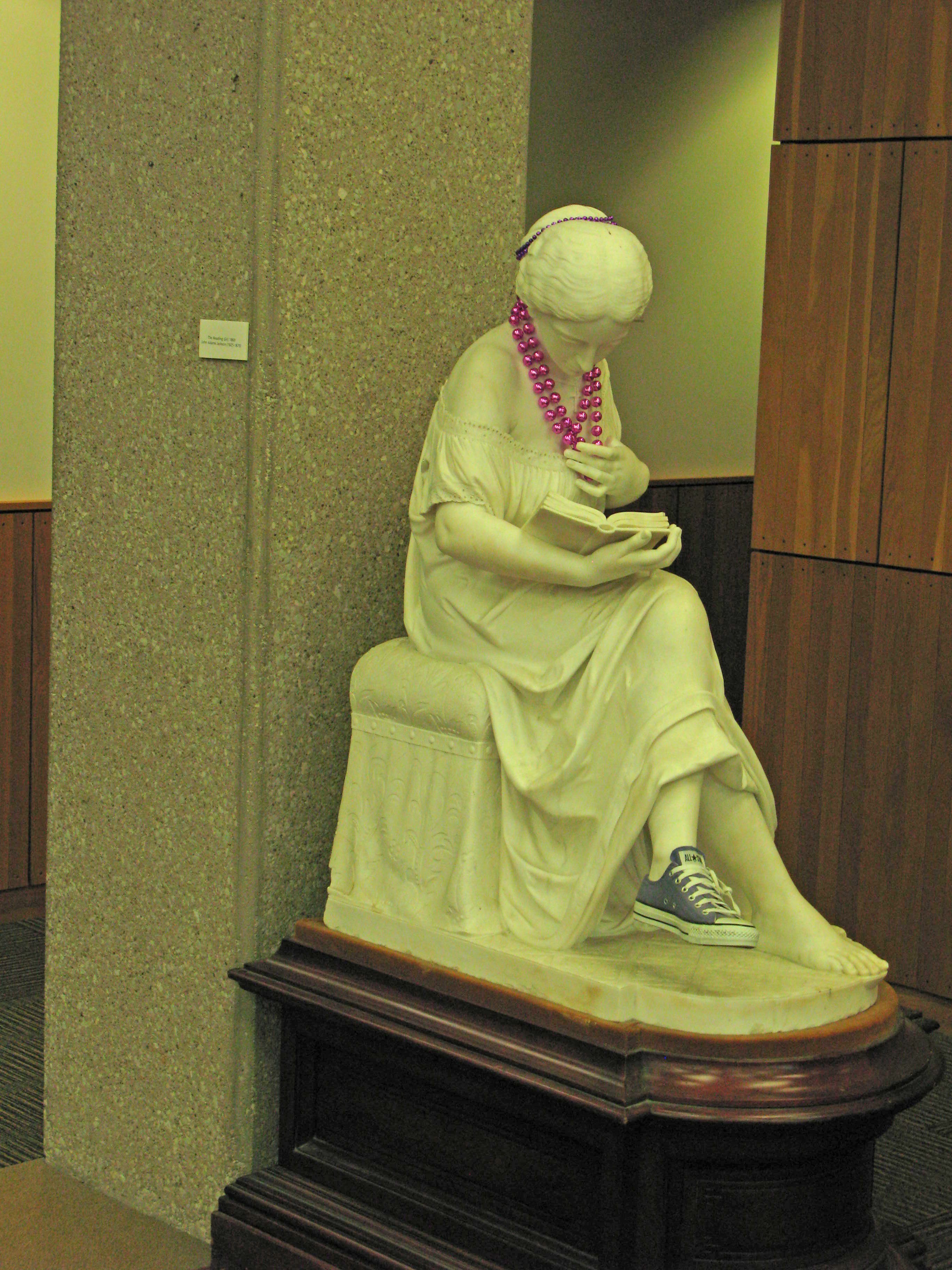
On the first floor of Mudd Library, one encounters The Reading Girl, “a statue created by John Adams Jackson (1825–1879) in 1869,” according to OberWiki. Apparently no one interferes with students (or others) who adorn that marble lady with a variety of items of clothing and/or jewelry from time to time. One campus source considers the sneaker (size six) to be a permanent part of the statue. Indeed, my beloved purchased a tee shirt at the library circulation desk featuring an image of the statue, sneaker and all. What relation, if any, Oberlin’s Reading Girl may have with other reading girls, such as Pietro Magni’s La Leggitrice, now in the National Gallery, I’m unable to say.

But Oberlin does take itself seriously, and that seriousness is reflected in a news story carried in The New York Times on the very Sunday we were wandering around the Ohio Campus as Emma packed her things. Somebody at the Times should have been fired for writing the headline: “Warning: the Literary Canon Could Make Students Squirm.” Oberlin and several other colleges and universities around the country are considering whether to mandate trigger warnings on syllabi that contain material some students might find threatening, a trend that is getting a good deal of attention in the popular press.

Proponents of the idea stress that the intent is not to proscribe any and all material any student might find offensive. The idea of the first such policy (at UC Santa Barbara) was simply to provide students with a headsup warning about the possibility that a particular book or film might “tap into memories of trauma.” But the argument about such policies has tended towards framing as a rights discourse (free speech vs. the right not to be harmed) or an argument about the values of liberal arts education. Unfortunately both framings are easily coopted into already large structures of cliché.

So before it gets to be impossible to talk about trigger warnings in ordinary academic contexts without automatically entering the house built by culture war, perhaps one might pause to say that there is a very old question at issue here that has almost nothing in common with the familiar issues of present academic culture. The idea of education as therapy is neither new nor radical. It isn’t the same as the old-fashioned idea that education shapes character, but it is a cousin to it. Education as therapy conceives that souls can be restored to health by right learning. Sorry about the old-fashioned lingo; we’re talking about a very old idea here.

When The Lady Philosophy first appears to Boethius in in his prison cell as he awaits trial for treason, she finds the philosopher medicating himself with poetry, which (as she contends) only makes him worse. Boethius has forgotten who he is and hence needs reeducation in the basics of Neoplatonism, his former grounding. He needs particularly to reunderstand why it is that nothing bad can happen to a good person. I speak here of Boethius the character in The Consolation of Philosophy (c. 524 C. E.). Boethius the author may have needed to reinhabit the house of Socrates as well, especially since he was eventually put to death in a particularly gruesome manner.

So–education as therapy isn’t new. It wasn’t invented by feminists or others who can easily be dismissed as calling for the latest iteration of political correctness. And the point of Boethius’s reeducation shouldn’t be seen as a blanket rejection of poetry, especially since much of The Consolation of Philosophy, itself, is poetry. Not to speak of psychoanalysis (particularly the Jungian kind) one might remember as well John Stuart Mill’s claim in his autobiography that he cured himself of depression by reading the poetry of Wordsworth: the point being that different times and conditions might arguably call for different remedies, and that use of any particular remedy might entail avoidance of others.

Unfortunately, the Oberlin trigger warning guide (which mercifully has been withdrawn) seems made to order for deconstruction by anti-PC critique. Here’s a part that’s been widely referenced. I’m quoting from a Jenny Jarvie piece in The New Republic:

Oberlin College has published an official document on triggers, advising faculty members to “be aware of racism, classism, sexism, heterosexism, cissexism, ableism, and other issues of privilege and oppression,” to remove triggering material when it doesn’t “directly” contribute to learning goals and “strongly consider” developing a policy to make “triggering material” optional. Chinua Achebe’s Things Fall Apart, it states, is a novel that may “trigger readers who have experienced racism, colonialism, religious persecution, violence, suicide and more.”

Ironic that students might need to be inoculated against Things Fall Apart, which we all read in the last century as an antidote to our colonial prejudices, nourished by Joseph Conrad and others. Part of the difficulty here is the reduction of education to things called learning goals, the darling of today’s assessment driven school environment. If assessment is all that matters, education becomes a process of ticking off items on a list. But the real trouble with trigger warnings is that their use sets up a filter that may impede students’ engagement with a broad range of learnings that have a transformative potential. Here education as character formation and education as therapy may cross, but it is important not to blur the distinction between them.

The trouble with reading Achebe when we did is that we stopped reading Conrad. I’m not talking about specialists, now, but about the broad range of college students who as a matter of general education need to understand the sensibilities of the age of Conrad and E. M. Forster if they are to understand their own. It is as important to read Conrad as it is to read Achebe contra Conrad if one’s goal is a discourse that recognizes that even oppressors have sensitivities, experience guilt, etc. Achebe’s portrayal of Okonkwo’s British antagonists is perhaps as limited as Conrad’s portrayal of the Fang people. Both have the character of ex parte.

Dropping Conrad in favor of Achebe was an exercise in Education as therapy. We wanted to be sure our students didn’t become colonialists; hence, therapy for their immersion in post-colonial culture. But in depriving them of Conrad we may have deprived them of a serious opportunity to think about what it means to be “one of us,” potentially a character building experience. I realize that’s Lord Jim, not Heart of Darkness, but you get my drift. And there is a sense in which humanistic education (what we’re talking about after all) must entail immersion in the destructive element. From what Emma tells me, Oberlin (her place) is not only aware of that necessity but is also aware of its risks.

And if the Oberlin trigger warning policy is at this point a failure, or perhaps even a remedy seeking a wrong, there is another therapeutic education program reported in last week’s New York Times Magazine that seems to be destined for success. In an essay entitled “Who Gets to Graduate” Paul Tough reports on a program of small interventions at the University of Texas at Austin designed to help students from working class families overcome internalized cultural expectations that seem to retard their academic progress.

[W]hether a student graduates or not seems to depend today almost entirely on just one factor — how much money his or her parents make. To put it in blunt terms: Rich kids graduate; poor and working-class kids don’t. Or to put it more statistically: About a quarter of college freshmen born into the bottom half of the income distribution will manage to collect a bachelor’s degree by age 24, while almost 90 percent of freshmen born into families in the top income quartile will go on to finish their degree.

The chief reason for this trend seems to be that low income and working class students tend to over-interpret small failures as meaning that they are inferior and don’t belong at college. Developmental and remedial programs seem to reinforce the trend rather than arrest it. Researchers at Austin have designed a series of small interventions intended to foster in these students a sense of being part of a community of high-achieving scholars so that they can more easily take small failures in stride in the same way that their more privileged peers do.

Can souls be returned to health by right learning? Ought we to think of humanistic education as a search for the soul’s weal? No matter how instrumental our conception of education becomes, such questions seem unavoidable. The difficulty is, as always, that our conceptions of the soul’s weal are guarded by fierce ideological angels. It’s refreshing to encounter these contemporary resolves to wrestle with such ageless angels who visit our dreams sometimes when we least expect them.

making certain it goes on

Richard Rorty begins a well known essay entitled “Love and Money” by recalling how E. M. Forster’s authorial voice early in Howard’s End observes that the poor are unthinkable, not because poor people are bad or inferior but because poverty reduces all of life to the issue of brute survival. It’s perhaps a mournful fact, but a fact nonetheless, that the pursuits of those whom Forster terms “gentlefolk” are possible only when survival is not the primary or foreground issue. I’m still teaching school at seventy-six. I still enjoy it, and it still seems to work for me. My students are senior honors students, but not by and large humanities majors. Still, they seem eager. They seem to enjoy the books and the conversations we have. I have had occasion to be proud of many of them over the years as they have gone on to do useful work in the world.

I, myself, have had three educations since I first sat in a college classroom, three turns towards new and unexpected framings of the issues of my life and work. I’m thinking now that I am embarked on a fourth, and that is the background of this essay, if not its subject. I have led a privileged life. My students are gentlefolk, in Forster’s sense, who are training themselves for the occupations and pursuits our society has until recently considered appropriate for gentlefolk, but I now worry that they may be entering a world of work in which leisure and the intellectual pursuits into which they have been socialized may be in short supply.

A recent New York Times carried yet another story about the plight of the humanities. It’s a constant theme of our present-day discourse of education reform, so called, a lot of talk in which there is precious little enlightenment and a growing load of clichés touting whatever is the latest digital fad. But education at all levels is being changed by market and sociological forces in combination with (and I think directed by) a set of political choices, some of which seem very unwise to me and some of which I think are beyond foolish and downright evil. But today I am thinking of this:

To take a Walk in the Gardens of the Palace of the Tuilleries, and describe the Statues there, all in marble, in which the ancient Divinities and Heroes are represented with exquisite Art, would be a very pleasant Amusement, and instructive Entertainment, improving in History, Mythology, Poetry, as well as in Statuary. Another Walk in the Gardens of Versailles, would be usefull and agreable. But to observe these Objects with Taste and describe them so as to be understood, would require more time and thought than I can possibly Spare. It is not indeed the fine Arts, which our Country requires. The Usefull, the mechanic Arts, are those which We have occasion for in a young Country, as yet simple and not far advanced in Luxury, altho perhaps much too far for her Age and Character.

I could fill Volumes with Descriptions of Temples and Palaces, Paintings, Sculptures, Tapestry, Porcelaine, &c. &c. &c. — if I could have time. But I could not do this without neglecting my duty. The Science of Government it is my Duty to study, more than all other Studies Sciences: the Art of Legislation and Administration and Negotiation, ought to take Place, indeed to exclude in a manner all other Arts. I must study Politicks and War that my sons may have liberty to study Painting and Poetry Mathematicks and Philosophy. My sons ought to study Mathematicks and Philosophy, Geography, natural History, Naval Architecture, navigation, Commerce and Agriculture, in order to give their Children a right to study Painting, Poetry, Musick, Architecture, Statuary, Tapestry and Porcelaine.

Written by then President John Adams in a letter to his wife dated 12 May 1780, this famous statement by one of the founders of our republic is an index both of where we stand as present-day Americans in relation to a past that we can claim, and of our distance from that past. I am thinking of it today less because of the thick matrix of cultural assumptions it entails, and more because, though he mentions commerce and agriculture as appropriate areas of study for his sons, Adams nowhere mentions economics. Of course the dismal science hardly existed in Adams’s time and would not be ridiculed as such for another fifty years (by Thomas Carlyle in a tract arguing for the reintroduction of slavery in the West Indies). It’s also interesting that Adams doesn’t mention the study of languages, whether ancient or modern, the former thought useful for young men in Adams’s time and the latter thought by some to be appropriate for young women. Of course, Adams doesn’t mention women’s education at all. Furthermore (and this is a big furthermore), Adams does not speak of education as a training ground for getting a job and making money, the only educational value present day culture seems to recognize. His conception of education is cultural rather than instrumental. The sciences of government and politics, the great structuring sciences of Adams’s time, he saw as appropriate to public men, as are the disciplines he assigned to his children. The next disciplines, those assigned to the third generation in his list, are appropriate to men of leisure, that is to humans primarily concerned with private pursuits.

There is a set of urgent questions we should be asking ourselves about education in our era, starting with these: On the most general level, what stake does one generation have in educating the next? And more specifically relevant to our time, what stake does a democratic society have in educating the young? Adams was no democrat and would likely have prefaced any answers he gave with an assertion that education is categorically superior to ignorance. Though his juxtaposition of practical arts and sciences with others he thought of as primarily decorative is familiar enough to us today, one should not forget in reading Adams’s letter that its catalogue is entirely humanistic. For Adams, education shaped humans in their public capacities, teaching them, as he said elsewhere, not only how to make a living but how to live—and how best to manage and govern the human world. In an earlier letter, dated 22 April 1776, Adams had written to James Warren:

We may please ourselves with the prospect of free and popular Governments, but there is great Danger that these Governments will not make Us happy. God grant they may. But I fear, that in every Assembly, Members will obtain an Influence, by Noise not Sense, by Meanness not Greatness, by Ignorance not Learning, by contracted Hearts not large Souls.

The relevance of these thoughts to the questions I’ve cited in relation to our own time seems clear enough. The distance between us and Adams cannot simply be measured by his world’s tolerance of genocide, slavery, and the subjugation of women (or his distaste for democracy). It must also be measured by our world’s tolerance of noise, meanness, ignorance, and contracted hearts.

I’m not arguing against democracy, but I fear one very plausible conclusion to the claims I am making: that our democracy in the United States of America may be nearing exhaustion. I’ve written before about Sarah Kendzior. Dr. Kendzior has recently published an essay in Al Jazeera that poignantly evokes the post-employment America being delivered to her generation by capital and our present-day governing elites. What do a lawyer, a computer scientist, a military analyst, and a teacher have in common? she asks:

They are trained professionals who cannot find full-time jobs. Since 2008, they have been tenuously employed – working one-year contracts, consulting on the side, hustling to survive. They spent thousands on undergraduate and graduate training to avoid that hustle. They eschewed dreams – journalism, art, entertainment – for safer bets, only to discover that the safest bet is that your job will be contingent and disposable.

Unemployed college graduates are told that their predicament is their own fault. They should have chosen a more “practical” major, like science or engineering, and stayed away from the fickle and loathsome humanities. The reality is that, in the “jobless recovery”, nearly every sector of the economy has been decimated. Companies have turned permanent jobs into contingency labour, and entry-level positions into unpaid internships.

This is the world we inheritors of the commonwealth of John Adams are bequeathing to our posterity; a posterity who have already arrived to face penury, blight, and the ruin of their hopes. And this doesn’t in any way account for our multitudes of working poor who lack education, or those imprisoned in our multibillion dollar incarceration industry or locked into cycles of poverty, violence, and oppression in the parts of our blighted cities we have decided to throw away.

I am a member of the American generation that is sometimes scapegoated as the cause of our present decline. Our society is aging, we are told, and too many resources have been pledged to the elderly. Unfortunately, scrapping federal programs that presently allow some elderly people some comfort and perhaps a dignified death—we have already all but destroyed our country’s pension system—unfortunately, destroying the safety net, so called, will do nothing to change the economic disaster that is faced by today’s rising generations. The problem is not that wealth redistribution to the elderly is depriving the young of opportunity. The problem is that today’s predatory capitalism, which seeks to hide its unparallelled greed in the forest of globalization, has destroyed the productive capitalism that for generations served as the primary wealth-redistribution instrument of our society through decent jobs, with decent salaries and benefits. We may presently be socializing the last American generation to be educated for the world we used to know, not in some golden age but back before 2008 when the credit bubble burst for the American middle classes and we were forced to comprehend the true extent of the economic inequality that had been growing in western societies since the 1970s. John Adams could be optimistic about the future he and his fellow citizens were building “in a young Country, as yet simple and not far advanced in Luxury.” The reality we must face is that we have created far too much luxury for a tiny few at the price of desolation for the many.

There are needed reforms in higher education. Though digital culture has already changed higher education radically, much of the promise of digital culture still needs to be explored and made good. But at present the glaring problem that nobody knows quite how to face is that we are educating an entire generation for a world of disappearing opportunity. In the present historical trough, all education faces redundancy as the scramble for survival becomes the primary datum for the great mass of humanity. Dr. Kendzior continues:

If you are 35 or younger – and quite often, older – the advice of the old economy does not apply to you. You live in the post-employment economy, where corporations have decided not to pay people. Profits are still high. The money is still there. But not for you. You will work without a raise, benefits, or job security. Survival is now a laudable aspiration.

And survival is complicated by the familiar scapegoating of millennials as self absorbed complainers who deserve their fate. But they don’t. The failure isn’t theirs. The failure is with a system of political economy that has allowed the commonwealth to be sucked dry. A few individuals and corporations are hoarding huge piles of cash while real productivity stagnates. Skilled labor is being relentlessly casualized. Infrastructures are being starved and allowed to deteriorate for want of maintenance. Manufacturing is being relocated in search of slave labor and the absence of regulation. We face a time when the American engine of consumption will sputter and die for want of demand. There may be hope for change long term. Gar Aplerovitz has outlined a number of hopeful programs that could redemocratize wealth, but these are just in the beginning stages. I don’t have any real hope that we can solve our present political/economic crisis by tax reform or even through the electoral process. Any new government we elect will be the creature of massed capital as matters stand—only a catastrophe on the order of the depression of the 1930s seems likely to change things.

Meanwhile, there are now at least two generations of Americans, not to mention those in older generations who have lost employment and/or benefits and may never be able to replace them, for whom the primary issue is not how to fix our rigged system but how to survive in it. Survival is also the agenda of many institutions, indeed of our entire public sector: that’s the reality today. And that creates a toxic social environment in which betrayal and victim blaming are normalized. The right would like us not to speak of class warfare. Fair enough. We’ve long ago outstripped mere class warfare and entered an era of wholesale class predation in which hoarded wealth is cannibalizing every resource it can use up: from land, water, and animals to what remains of people’s livelihoods and pensions. I’ve just read Cormac McCarthy’s post holocaust novel, The Road, in which a father and son are fleeing to nowhere, hiding from bands of cannibals, scrounging food and shelter, occasionally killing others in order to avoid being killed themselves. We’re not that bad off, but if things get much worse for us we could be as bad off as we were in 1932.

My title comes from a poem by the late Richard Hugo, the poem he chose as the title poem for his collected poems. It’s a dream of fishing, as so many of Hugo’s poems are, in clear mountain water for the deep source of the given world. A source that may be lost to the characters in Cormac McCarthy’s novel:

Once there were brook trout in the streams in the mountains. You could see them standing in the amber current where the white edges of their fins wimpled softly in the flow. They smelled of moss in your hand. Polished and muscular and torsional. On their backs were vermiculate patterns that were maps of the world in its becoming. Maps and mazes. Of a thing which could not be put back. Not be made right again. In the deep glens where they lived all things were older than man and they hummed of mystery.

I think it turns out that the humanities serve the same broad cultural and ethical purposes they have always served and that our stake in educating new generations is not merely that we hope our civilization may persist, but that we cherish the world in its becoming and hope that becoming may persist above all, even in and amongst the shadows cast by gigantic piles of dead and hoarded wealth.

Meanwhile, Dr. Kendzior urges her fellow graduates to work their hardest and do their best, to hustle and scrounge and play the odds, to organize and push for collective change, and to husband self-respect and compassion.

Small hope in these recommendations, but perhaps the only short-term hope there is.