
fight for fifteen, part two

In my last post I described my participation in last month’s Adjunct Action rally in Saint Louis. Adjunct Action is a project of the Service Employees International Union (SEIU). I’ve since participated in two meetings between adjuncts and upper administration on the Saint Louis University (SLU) campus and learned with some considerable sadness that the effort to organize adjuncts at Webster University across town has failed for the present.

I am an adjunct, though not a typical one. I teach only one course, a senior seminar. As a retiree I have benefits such as health insurance, and I do not need to make my living as an adjunct. I am what is termed a volunteer professional in the current iteration of the Jesuit Just Employment Policy, which we adjuncts at Saint Louis University are asking our administration to adopt. But I have met many young adjuncts since I first became involved in this movement who are making their living as adjuncts, teaching (some of them) upwards of eighteen classes a year at several universities and colleges in order to make ends meet in their busy lives, serving as part of the pool of just-in-time casual labor on which most universities rely to do most teaching of basic courses, and sometimes more, these days.

I have found these young people to be bright, energetic, competent, and savvy. It is not their fault that their academic careers did not open with tenure-track jobs upon their graduation with terminal degrees. It is a mournful fact that the majority of graduates of today’s graduate schools find that their academic careers end with the acquisition of terminal degrees. Marc Bousquet has documented the phenomenon exhaustively in his 2008 book, How the University Works. This result is produced by an insidious system that protects the privilege of “professional” faculty, who don’t have to teach much (which is just as well since many of them find teaching distasteful) and the sometimes redundant graduate programs that employ them as specialists, and of the now vastly inflated administrator class in colleges and universities.

The relegation of responsibility for core mission to a cheap and disposable cadre of casual employees benefits institutional bottom lines as well, which benefit leaves trustees and legislative overseers free to pursue more important concerns such as athletics, property, and alumni relations. In short, today’s university system is designed to serve the interests of everyone but students, their parents, who often pay exorbitant amounts to send their children to colleges and universities whose faculties and administrations hold them in contempt, and the casual faculty itself.

If you think this is extreme, take a look at at a piece in yesterday’s Huffington Post, in which Keith M. Parsons details his message to a group of college freshmen. My Western Civ professor years ago ended the year by telling us ignoramuses that he had “enjoyed” casting his pearls before us swine. This is about the level of Professor Parsons’ discourse. Professor Parsons claims that his students are adults and therefore need only to be led to the fountain of learning (a rhetorical confusion if his audience is a student audience—to whom is he preaching?). Why not treat his students as adults and speak to them as adults. Why the condescension, the posturing, the self-aggrandizement?

I am your professor, not your teacher. There is a difference. Up to now your instruction has been in the hands of teachers, and a teacher’s job is to make sure that you learn. Teachers are evaluated on the basis of learning outcomes, generally as measured by standardized tests. If you don’t learn, then your teacher is blamed. However, things are very different for a university professor. It is no part of my job to make you learn. At university, learning is your job — and yours alone.

To be clear, I am seriously opposed to high-stakes testing and its consequences, particularly the sort of teaching to the test that is becoming standard in schools. But arrogance is arrogance—Professor Parsons is a beautiful illustration of the fact. And begging his pardon, learning is a shared job, in university as in school. To assume the mantle of professor is to assume a huge responsibility. Professor Parsons, rather than accepting that responsibility and taking it seriously, seems intent only upon asserting his superiority to the great unwashed. But Professor Parsons is not an anomaly. He represents the norm, or one aspect of it. He represents the regular part of the professoriate, tenured (or tenurable), privileged in the sense of being allowed relative autonomy to practice his craft (which somehow doesn’t exactly include teaching), and relatively well paid.

But here is how the casual faculty lives and works. Their wages are kept low; the academic job market is a buyer’s market after all, and individual adjuncts have no power to negotiate better wages. (The norm for adjunct compensation at SLU is $3000 per course.) Adjunct employment is restricted at part-time, which restriction avoids the necessity for paying benefits and the possibility of de-facto tenure in the case of adjuncts employed year in and year out. Many universities are now employing their own PhD graduates as adjuncts for a year or two, sometimes more. This is especially true for universities who created PhD programs during the 1970s when post World War II expansion seemed to promise endless economic growth on campus. Many of these mediocre graduate programs no longer have a market justification, but of course their faculties have to be kept busy.

A normal adjunct is employed to teach, and the mere fact that now more than half of the teaching in colleges and universities is done by low-paid adjuncts indicates more than any other fact or set of facts just how seriously colleges and universities take their teaching responsibility. The contempt with which university trustees, administrators, and professional faculties view the basic teaching function is, I believe, primarily to be measured by the fact that what is becoming a majority of the university teaching faculty is being forced into academic peonage. Adjuncts are typically disdained by regular faculty. They do not attend faculty meetings as a rule. They have no vote on matters of policy that concern them. And the best that administrators seem to be able to come up with as an improvement to this system of peonage is to continue it in one form or another, perhaps offering adjuncts yearly contracts with some benefits and a better wage but continuing to enforce their serfdom.

Higher education in America is under grave stress. On the one hand there is much to criticize in the behavior of our major universities and elite colleges. And on the other, every few weeks now we read of wantonly destructive policy changes aimed at these treasured institutions by venal trustees and politicians out to score points with Americans who are presumed to have no affinity for learning or to disestablish academic institutions in the interest of right-wing ideology, junk science, or no science at all. But a more important problem may be that colleges and universities expanded too far too fast after World War II and produced a system that would inevitably have proved unsustainable at the end of the baby-boomer generation. Professor Parsons and others like him for whom the professoriate is an entitlement rather than a responsibility are protected from market forces by the scores of adjuncts who have neither status nor tenure nor job security but do the work of generalists in today’s system of higher education.

Adjuncts are organizing all over the country now, and are winning concessions from university administrations. This is important, I believe, because I am persuaded that higher education in America is in decline and the competition to control the decline is serious and fierce. I am further persuaded that adjuncts are the voiceless in today’s scheme of higher education. I see SEIU Adjunct Action as potentially giving adjuncts a voice, potentially a place at the negotiating table as we as a people attempt to manage the dislocation and human destructiveness of a declining system.

—and that is why I have joined up.
Emma’s place, and some random thoughts about education as therapy

Too long away. Sometimes I get burnt out, Maybe that has something to do with what I’m writing here, now. My experience last weekend may be implicated as well.

I’ve acquired a stake in Oberlin College. My beloved and I are de facto god parents to a rising sophomore there. I’ve written about Emma before in these pages. Last weekend we accompanied her mother to Oberlin to collect her and her things for the post-freshman year return home to Iowa City. It was good to see Emma in “her place,” as she called it a couple of times, good to meet her Oberlin friends and to get a first hand impression of the college.

Its quality stands out: four libraries, a world class art museum, a large and beautiful campus that is the chief feature of the town surrounding it, a highly qualified and well-compensated faculty (Oberlin has a 9:1 student faculty ratio), all for three thousand students each year, some six hundred of whom study in the Oberlin Conservatory of Music, a world class institution in its own right. It was also nice to speculate that the college seems not to take itself too seriously.

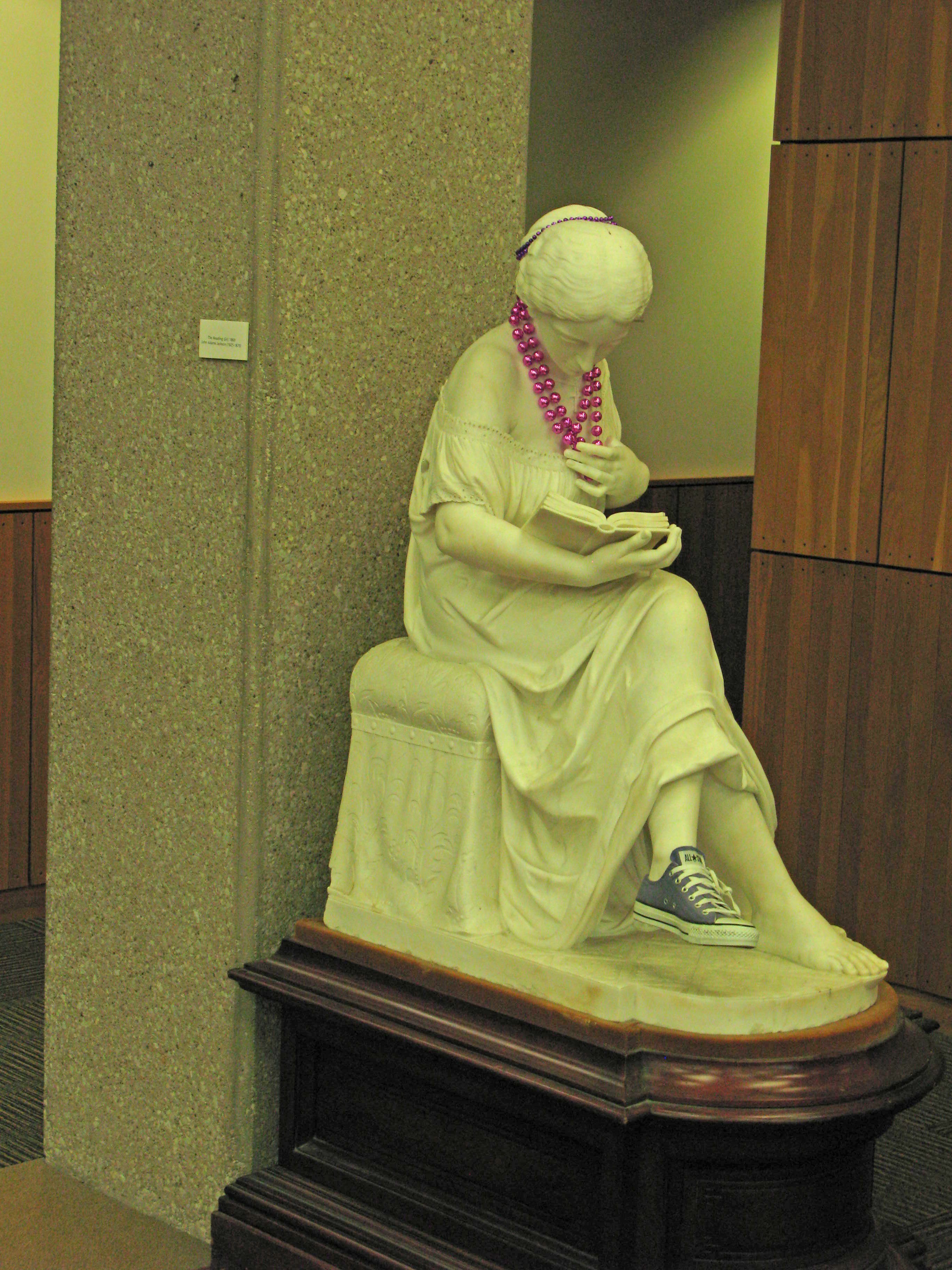
On the first floor of Mudd Library, one encounters The Reading Girl, “a statue created by John Adams Jackson (1825–1879) in 1869,” according to OberWiki. Apparently no one interferes with students (or others) who adorn that marble lady with a variety of items of clothing and/or jewelry from time to time. One campus source considers the sneaker (size six) to be a permanent part of the statue. Indeed, my beloved purchased a tee shirt at the library circulation desk featuring an image of the statue, sneaker and all. What relation, if any, Oberlin’s Reading Girl may have with other reading girls, such as Pietro Magni’s La Leggitrice, now in the National Gallery, I’m unable to say.

But Oberlin does take itself seriously, and that seriousness is reflected in a news story carried in The New York Times on the very Sunday we were wandering around the Ohio Campus as Emma packed her things. Somebody at the Times should have been fired for writing the headline: “Warning: the Literary Canon Could Make Students Squirm.” Oberlin and several other colleges and universities around the country are considering whether to mandate trigger warnings on syllabi that contain material some students might find threatening, a trend that is getting a good deal of attention in the popular press.

Proponents of the idea stress that the intent is not to proscribe any and all material any student might find offensive. The idea of the first such policy (at UC Santa Barbara) was simply to provide students with a headsup warning about the possibility that a particular book or film might “tap into memories of trauma.” But the argument about such policies has tended towards framing as a rights discourse (free speech vs. the right not to be harmed) or an argument about the values of liberal arts education. Unfortunately both framings are easily coopted into already large structures of cliché.

So before it gets to be impossible to talk about trigger warnings in ordinary academic contexts without automatically entering the house built by culture war, perhaps one might pause to say that there is a very old question at issue here that has almost nothing in common with the familiar issues of present academic culture. The idea of education as therapy is neither new nor radical. It isn’t the same as the old-fashioned idea that education shapes character, but it is a cousin to it. Education as therapy conceives that souls can be restored to health by right learning. Sorry about the old-fashioned lingo; we’re talking about a very old idea here.

When The Lady Philosophy first appears to Boethius in in his prison cell as he awaits trial for treason, she finds the philosopher medicating himself with poetry, which (as she contends) only makes him worse. Boethius has forgotten who he is and hence needs reeducation in the basics of Neoplatonism, his former grounding. He needs particularly to reunderstand why it is that nothing bad can happen to a good person. I speak here of Boethius the character in The Consolation of Philosophy (c. 524 C. E.). Boethius the author may have needed to reinhabit the house of Socrates as well, especially since he was eventually put to death in a particularly gruesome manner.

So–education as therapy isn’t new. It wasn’t invented by feminists or others who can easily be dismissed as calling for the latest iteration of political correctness. And the point of Boethius’s reeducation shouldn’t be seen as a blanket rejection of poetry, especially since much of The Consolation of Philosophy, itself, is poetry. Not to speak of psychoanalysis (particularly the Jungian kind) one might remember as well John Stuart Mill’s claim in his autobiography that he cured himself of depression by reading the poetry of Wordsworth: the point being that different times and conditions might arguably call for different remedies, and that use of any particular remedy might entail avoidance of others.

Unfortunately, the Oberlin trigger warning guide (which mercifully has been withdrawn) seems made to order for deconstruction by anti-PC critique. Here’s a part that’s been widely referenced. I’m quoting from a Jenny Jarvie piece in The New Republic:

Oberlin College has published an official document on triggers, advising faculty members to “be aware of racism, classism, sexism, heterosexism, cissexism, ableism, and other issues of privilege and oppression,” to remove triggering material when it doesn’t “directly” contribute to learning goals and “strongly consider” developing a policy to make “triggering material” optional. Chinua Achebe’s Things Fall Apart, it states, is a novel that may “trigger readers who have experienced racism, colonialism, religious persecution, violence, suicide and more.”

Ironic that students might need to be inoculated against Things Fall Apart, which we all read in the last century as an antidote to our colonial prejudices, nourished by Joseph Conrad and others. Part of the difficulty here is the reduction of education to things called learning goals, the darling of today’s assessment driven school environment. If assessment is all that matters, education becomes a process of ticking off items on a list. But the real trouble with trigger warnings is that their use sets up a filter that may impede students’ engagement with a broad range of learnings that have a transformative potential. Here education as character formation and education as therapy may cross, but it is important not to blur the distinction between them.

The trouble with reading Achebe when we did is that we stopped reading Conrad. I’m not talking about specialists, now, but about the broad range of college students who as a matter of general education need to understand the sensibilities of the age of Conrad and E. M. Forster if they are to understand their own. It is as important to read Conrad as it is to read Achebe contra Conrad if one’s goal is a discourse that recognizes that even oppressors have sensitivities, experience guilt, etc. Achebe’s portrayal of Okonkwo’s British antagonists is perhaps as limited as Conrad’s portrayal of the Fang people. Both have the character of ex parte.

Dropping Conrad in favor of Achebe was an exercise in Education as therapy. We wanted to be sure our students didn’t become colonialists; hence, therapy for their immersion in post-colonial culture. But in depriving them of Conrad we may have deprived them of a serious opportunity to think about what it means to be “one of us,” potentially a character building experience. I realize that’s Lord Jim, not Heart of Darkness, but you get my drift. And there is a sense in which humanistic education (what we’re talking about after all) must entail immersion in the destructive element. From what Emma tells me, Oberlin (her place) is not only aware of that necessity but is also aware of its risks.

And if the Oberlin trigger warning policy is at this point a failure, or perhaps even a remedy seeking a wrong, there is another therapeutic education program reported in last week’s New York Times Magazine that seems to be destined for success. In an essay entitled “Who Gets to Graduate” Paul Tough reports on a program of small interventions at the University of Texas at Austin designed to help students from working class families overcome internalized cultural expectations that seem to retard their academic progress.

[W]hether a student graduates or not seems to depend today almost entirely on just one factor — how much money his or her parents make. To put it in blunt terms: Rich kids graduate; poor and working-class kids don’t. Or to put it more statistically: About a quarter of college freshmen born into the bottom half of the income distribution will manage to collect a bachelor’s degree by age 24, while almost 90 percent of freshmen born into families in the top income quartile will go on to finish their degree.

The chief reason for this trend seems to be that low income and working class students tend to over-interpret small failures as meaning that they are inferior and don’t belong at college. Developmental and remedial programs seem to reinforce the trend rather than arrest it. Researchers at Austin have designed a series of small interventions intended to foster in these students a sense of being part of a community of high-achieving scholars so that they can more easily take small failures in stride in the same way that their more privileged peers do.

Can souls be returned to health by right learning? Ought we to think of humanistic education as a search for the soul’s weal? No matter how instrumental our conception of education becomes, such questions seem unavoidable. The difficulty is, as always, that our conceptions of the soul’s weal are guarded by fierce ideological angels. It’s refreshing to encounter these contemporary resolves to wrestle with such ageless angels who visit our dreams sometimes when we least expect them.

birthrights and summer nights

We’re getting the old house in as good shape as we can in anticipation of a barbecue this weekend. Our book group is meeting at our house at three, and a crowd of other friends are coming at five thirty on Saturday. Our god daughter, Emma, will be here with her mom—they are honorary members of the book group.

Normally, we would have barbecued on Independence Day, but Emma couldn’t come on the fourth this year. She’s working lots of hours as a lifeguard this summer and saving as much as she can in her college fund. In August she matriculates at Oberlin College. We’re very proud of her. She graduated with high honors from Iowa City High School in May. She’s not going to Oberlin for music, and we don’t know what she will decide to do with her life, What we do know is that she will do the deciding, just as she chose Oberlin because of its diverse faculty and student body and because she felt after visiting a good many schools that Oberlin offered the kind of challenge she is inclined to take on now.

For the past several days I’ve been trying to think of something to say about why I love my country, but that immediately puts me at odds with many people I know and love who believe that the country I love, the creation of a liberal establishment, needs to be dismantled in the name of freedom and creativity. I am now to understand that greed is not only good but socially redemptive as well; to accept the destruction of the fundamental institutions of a great nation, everything from public universities to highways and bridges in the name of privatization or that will-o-the-wisp, reform; and to adjust to a public sphere in which swaggering thugs strut about brandishing assault rifles.

So I’ll wave no flags this year. Instead, I’ll think about what it was like to be as young as Emma, when the things I most loved to do came easily. I’ll remember swimming in the lake, canoeing out to a floating pier at Lake Junaluska as Pat Boone’s voice crooned “April Love” out over the water. I worked there in the summer of 1956 as a singer. We created a stir by protesting the segregated swimming pool. I’ll think about rides up the mountain in my roommate’s convertible, and rides back down after dark with the girl I fancied then. I’ll think about how open the world seemed. I didn’t think of that openness as an unearned privilege, but of course it was. I had a ticket to the American meritocracy—that was my birthright.

But tonight after ice cream at Ted Drewes on old Route 66, I’m not inclined to be analytical or judgmental. I’m enjoying a fine summer in the last days of my seventy-fifth year. My garden is grown up as never before. My cup runneth over, because you see I’m still privileged. The world remains open to my concerns and desires. Pat Boone is still singing out over the lake somewhere; and somewhere fine young people who are kin to me, their bodies lithe, their faces devoid of guile, paddle out to a floating pier, tie up their small boats, and share the evening. They’ll swim, some of them will kiss or exchange other endearments; they’ll talk and their talk will be fine summer talk, talk for the time being, talk of the wondrous open world they share. And that’s a good thing.

It’s the best thing I have to celebrate this Independence Day season, except perhaps for the crowds lined up at and around Ted Drewes, some waiting to buy at the windows where young people who will go to college with Ted Drewes’ assistance serve us concretes and banana splits—just ahead of me a beautiful little girl has helped her father collect two huge banana splits to be shared with their family of four as they speak Spanish together. And some across the street sitting on the wall in front of a bank, leaning against it, eating ice cream, some like us who simply lean against the iron rail of Ted Drewes’ parking lot and watch our neighbors as we consume two identical butterscotch mini-concretes. All around us the blessing of openness, of a parking lot one can get in and out of, of camaraderie at the service window (I have met foreign diplomats, Salvation Army executives, priests, scholars, and baseball players there, among others), of the gift of one more blessed summer evening.

—the gift of one more blessed summer evening.