
Another summer day

I’ve been to the mountaintop, he said, and I’ve seen the promised land. Then, the very next day, he was shot dead.

For me the occasion was marked forever as I arrived at my church for choir practice on the fourth of April, 1968 to words more or less barked at me by an acquaintance in the bass section with whom I had often sparred about politics: “Well, we’ve killed that son of a bitch! What do you think of that?” Now that Dr. King is as close to being a national saint as anybody ever gets in this country, those words and the events that occasioned them stand in my memory as a poignant memento.

I lived in Durham, NC at the time. When I arrived there almost three years earlier in August, 1965, I turned on the evening news to witness a Ku Klux Klan rally in which a number of costumed hooligans were brandishing guns. This wasn’t taking place halfway across the country but just across town at a watering hole known as the Confederate Inn. Many have wondered if Dr. King foresaw his own death. He seems to speak of it in this, his last great speech. Certainly, given the violence of those years it was a pretty good bet, if not a sure one, that he would be assassinated.

And it ought to be said any time one mentions Dr. King’s death that in life he was much hated by those on the political right in this country and still is by many. Newspapers still get letters opposing the naming of public things for him. The federal holiday that honors his memory has had a mixed history. Those on the right who pretend to honor him often misrepresent his accomplishments and/or parts of his career. But my purpose isn’t to argue about Dr. King. There is something nearer to hand.

Last summer about this time I wrote about trying to explain to myself why I love my country. Part of the thrust of that essay was contained in this paragraph:

For the past several days I’ve been trying to think of something to say about why I love my country, but that immediately puts me at odds with many people I know and love who believe that the country I love, the creation of a liberal establishment, needs to be dismantled in the name of freedom and creativity. I am now to understand that greed is not only good but socially redemptive as well; to accept the destruction of the fundamental institutions of a great nation, everything from public universities to highways and bridges in the name of privatization or that will-o-the-wisp, reform; and to adjust to a public sphere in which swaggering thugs strut about brandishing assault rifles.

Similar groups of thugs have recently forestalled federal agents attempting to enforce a court order in Nevada and are now attempting to reorganize and go to Texas to “secure the border.” There was a time when groups like these militias could be dismissed as part of the political lunatic fringe, but my country has now so embraced lunacy as to confer a kind of normalcy upon them. And we are a long way past threatened destruction of the country’s great institutions. That destruction is well advanced. In my last summer’s essay I used the memory of an old Pat Boone song sounding across a lake as an image of what I love about my country. Now Pat Boone has taken to writing hate-filled media pieces about President Obama.

What I have to say about my country this summer isn’t very optimistic. It used to be possible for us Americans to absorb and transcend the horror of our political violence, even in Texas, where a large fund of right-wing bigotry and hate is presently being ramped up again by vicious pols inside and outside the state, where a humanitarian crisis involving hundreds of innocent children is being held hostage by the same logic that has shut our national government down. The Republican party failed in its last attempt at formally shutting government down but has largely succeeded informally, and it has done so by plunging the country into perpetual chaos in order to blame the president for it.

Nobody will ever convince me that the present strategy of the Republican party isn’t racist. It works in precisely the same studied manner employed by Lee Atwater in the Willie Horton attack ads against Michael Dukakis. Its designers understand that the Republican base can be aroused by appeals that give its members permission to express socially impermissible hatreds by using language that masks their real nature. But when a mob of middle class white people prevents busloads of brown-skinned children from entering a town in California, all the while chanting USA! USA!, it’s pretty clear what’s going on. And when those same children are described as disease infested, etc., at a town hall meeting, it’s pretty clear what’s going on. And when the whole sorry spectacle is hyped by wannabe’s like Sarah Palin and Rick Perry as a way to stoke hatred of the president, it’s pretty clear what’s going on.

None of this is news any more. But there’s a bit of a new twist in claims such as this one from Jeff Stone, the chairman of the Riverside County Board of Supervisors as he spoke to a crowd at a town meeting in Murrieta, California after the mob action—“Obama needs to enforce the border and stop this action of exploiting traumatized women and children for his own political gain,”—when it is Mr. Stone and others who think as he seems to think who are exploiting traumatized women and children. Such statements are beneath contempt, but they are also signs of the times in Dr. King’s promised land.

It’s just business

When I hear somebody use the expression I’ve taken for a title, I think one of two things. Either some monstrous evil is about to be justified by appeal to the sacredness of profit, or it’s time to hold on to your wallet. I should likely leave this topic alone, since I’ve been trying not to write about political firecrackers. But there are so many things wrong with the SCOTUS Hobby Lobby decision that one hesitates to try to list them. Still, among the concatenation of fact, falsehood, and argument swirling around the decision’s aftermath a few things seem to me to be of particular importance.

It’s been known for some time that Hobby Lobby’s owners are connected with right-wing organizations whose goal is to push “a Christian agenda into American law,” as Eli Clifton has reported in Salon. Time has reported this week that the Green Family (Owners of Hobby Lobby) were recruited to act as poster children for this particular lawsuit against a portion of the Affordable Care Act. They had a family prayer meeting about the matter before they decided to act, but in the final analysis they signed their company up to front for a political action that originated with The Becket Fund for Religious Liberty.

The Becket Fund is a right-wing Washington law firm that specializes in “religious freedom” cases. To be fair, Becket has defended persons and organizations of a variety of faiths. On the other hand, the Fund has made significant recent contributions to the current trend that interprets religious freedom as a Christian license to discriminate against individuals and has been allied with others, including Hosanna-Tabor Evangelical Lutheran Church and School v. EEOC, about which I’ve written earlier, the recently enacted Arizona SB 1062 that would have provided religious exceptions to protections in federal public accommodations law and specifically permitted discrimination on the basis of sexual orientation, vetoed by Governor Jan Brewer, and now in Burwell v. Hobby Lobby.

It appears as well that the Green family’s participation in this present case was not the sincere religious matter it has been portrayed to be by media and by the Supreme Court. The Greens are heavily invested through their pension fund in pharmaceutical companies that manufacture IUDs and the specific birth control medications to which the Greens affected to object as well as drugs used to induce abortions. The story was first reported by Molly Redden in Mother Jones and has been confirmed by Rick Ungar in a piece published today in Forbes, and elsewhere.

The Greens have a perfect right to invest pension funds in whatever way they choose, as long as their investments meet their fiduciary obligations. But they do not have a right, it seems to me, to support the manufacture of the very devices and medications to which they claim a religious objection that qualifies them for an exemption from the Affordable Care Act’s employer mandate. Conservatives have rushed to defend the Greens, claiming among other things that they were not responsible for these investments, didn’t know about them, and didn’t profit from them. Ungar pretty much demolishes those arguments and sums up as follows:

You simply can’t say that you will give your all in defense of your closely held beliefs when it suits you while seeking to make money in violation of those beliefs. You also cannot pretend you were simply negligent in learning what investments you hold if you are going to hold yourself out as an example of righteousness.

These observations underscore the extent to which this lawsuit is a move in the political chess game that is being played out over the Affordable Care Act. Justice Alito admitted in his majority opinion that the SCOTUS doctrine that corporatiions are people is a fiction, but claimed it is a useful fiction designed to protect the people who own corporations from harm.

[T]he purpose of extending rights to corporations is to protect the rights of people associated with the corporation, including shareholders, officers, and employees. Protecting the free-exercise rights of closely held corporations thus protects the religious liberty of the humans who own and control them.

Whether Justice Alito was aware that he had contradicted himself here in including employees in one sentence among those protected by the “familiar legal fiction” of corporation=person and excluding them in the next I cannot judge. But the contradiction makes clear the perversity of the fiction.

There is a second perverse fiction involved in Burwell v. Hobby Lobby, and that is the fiction of sincerely held religious beliefs. The Greens’ beliefs as described in Burwell v. Hobby Lobby are at the very least problematic scientifically, but now it turns out that their sincerity is open to question as well. Women, it is claimed, may not use certain contraceptives with the Greens’ support, but it is perfectly all right for the Greens to profit from the manufacture of these same contraceptives.

To be sure, the court more or less invited the President and Congress to extend the arrangement devised for non-profits who claim a religious exception to for-profit corporations such as Hobby Lobby. I suspect that this will be done, and that the cost of covering Hobby Lobby employees for the contraceptives to which Hobby Lobby objects will ultimately be passed on to you and me. And perhaps this means can be extended to the many other corporations now in queue for the religious exception. I will be glad to pay it, but this eventuality merely invites the religious right to espouse another putatively righteous cause.

It’s tempting to dismiss this entire matter as just another example of the contemporary practice of religion as identity politics, though I have no dog in that hunt. But now that this deplorable Supreme Court decision has entered the realm of precedent it is being interpreted with some justice, as in Justice Ginsburg’s dissent but also on the right, as opening the door to all sorts of new exceptions to established law on the basis of religious scruple, which need not have a grounding in fact and may, perhaps, even be feigned. As Justice Ginsburg has wisely pointed out, the court has “ventured into a minefield,” exposing itself to the necessity of deciding perhaps thousands of supposed “religious freedom” cases ad hoc.

ramblin’ boy

Here’s my two cents about Pete Seeger.


You needed to hear him live, to see him and witness the display of energy, artistry, and sheer chutzpah that was a Pete Seeger concert. After that you felt you knew him a little, didn’t need to ask him for an autograph or speak to him in the press of fans that had surrounded him even on stage. I heard him at Duke, one evening in spring 1968 I think it was. Page auditorium was sold out. People were sitting in the aisles and on the stage so that he had only a small circle to walk around in. He sang flat out two hours and then did some encores, just him. No band, no light show, no overproduction, nothing except what came out of his skinny body, that long-necked banjo, his big twelve-string guitar, and the sweet wooden flute he sometimes played. He was huge.

He was an American original, perhaps the best of a generation of American specialty pop singers who gravitated towards a multiplicity of ethnic genres they weren’t born to, made them their own, made them new, added to them, turned them to the purposes of social and political protest. He started no movements, not even the folk-music revival, but he emerged as a folk hero, a leader, and a moral force at the time when roots music was beginning to be big business. Following Paul Robeson and Woody Guthrie, He remained a proud leftist throughout his life. Though he left the Communist party after the excesses of Stalin, as many did, he remained a communist with a small c, as he once said. And unlike many ex-Communists of his period, he did not turn to cold-war advocacy, to neo-conservatism, or to any of the other forms of easy super-patriotism available in the second half of the twentieth century.

Nor did he shy away from controversy. Along with Guthrie and Lee Hays, his wife Toshi, and his small children, Seeger was assaulted by a mob after his appearance along side Paul Robeson at Peekskill, New York in 1949. In 1951 e was convicted of contempt of congress and sentenced to a year in jail after refusing to answer questions put to him by the House Un-American Activities Committee, though the conviction was quashed. Later, he and the rest of the Weavers were blacklisted and placed under FBI surveillance throughout the McCarthy era. The John Birch society sometimes picketed his concerts. During the civil-rights movement and the Viet Nam War protest, he was always in the front lines. The story is apocryphal that he attempted to cut off Bob Dylan’s electrical supply with an axe when Dylan appeared with a rock band at the Newport Folk Festival in 1965. But why not, after all? Dylan had abandoned not only acoustic music, but social protest as well. From his Viet Nam era protest to his attempts to clean up the Hudson river to his recent leadership in the Occupy movement, Seeger has always been true to his roots in the radicalism of the thirties’ labor movement.


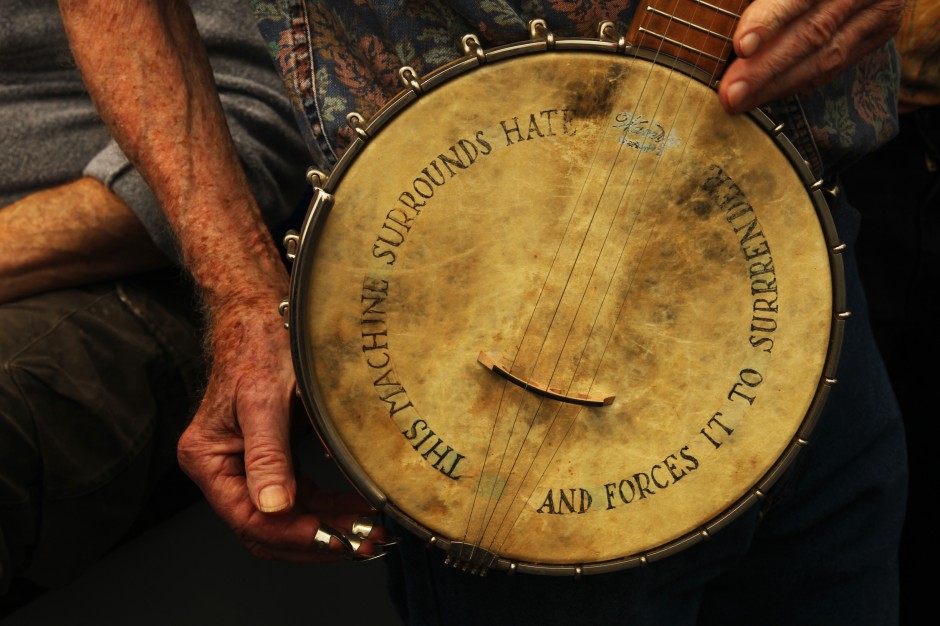
He also “put together” a good many songs, as he sometimes said. And some of his best known songs are associated with other singers who covered them and whose recordings became more famous than his: The Byrds for “Turn, Turn,” Peter, Paul, and Mary for “If I Had a Hammer,” which Seeger wrote with Lee Hays; though not “Waist Deep in the Big Muddy.” Many obituaries cite it, partly to point up the adversarial side of Seeger’s career and partly, I think, because Seeger never ceased to own that song. My personal favorite Seeger song is mentioned, or quoted, in none of the obituaries I have read. It is this one, the words by Idris Davies. Seeger found them in an essay entitled “Welsh Poets” by Dylan Thomas, that appears in the volume Quite Early One Morning. It features not the famous hate surrounding banjo but the dark sound of Seeger’s twelve-string guitar. The back story involves a Welsh coal mining disaster and the failure of the British general strike of 1926. The Birds’ version is more famous, but I like Seeger’s own.

Seeger first recorded “The Bells of Rhymney” on a live album made at a 1957 Carnegie Hall concert he and Sonny Terry presented together. In the notes to that album, he documents the guitar tuning and fingerings he used for the song and says some charming things about it, one of which is that the tune is pretty much the same as “Twinkle, Twinkle, Little Star.” My vote for the best Seeger obituary goes to this one. And it doesn’t change my love for “The Bells of Rhymney” to admit that I can still hear him singing “You can’t scare me, I’m stickin’ to the union!” I could wish him rest, but I can’t think of him resting any more than I can think of him dead. He was no twinkling star—he burned bright and hot, and if he’s now burned out there’s no black hole. He’s off rambling somewhere With Guthrie and Hays and his other pals, like it says in the Tom Paxton song he loved to sing.

caveat emptor all over again

It’s getting harder and harder to defend the Affordable Care Act.

That difficulty underscores the fact that health care in our society is not a right but a commodity. Recent observers have noted that President Obama has backed away from moral arguments for health care reform in favor of transactional ones. That seems to me to spell defeat for the very idea of the ACA as reform in the humanitarian sense we still hoped for six years ago.

I recently wrote that I think the intention and potential of the ACA were and would be to improve our present system of private insurance, to increase coverage and ensure greater fairness. But yesterday’s Washington Post reported that

Thousands of primary-care doctors and specialists across the country have been terminated from privately run Medicare Advantage plans, sparking a battle between doctors who say patient care is being threatened and insurers that insist they have to reduce costs and streamline their operations.

After the Supreme Court decision that allowed states to opt out of Medicaid expansion, many states, though not a majority, did so—and led by the American Legislative Exchange Council have now enacted and/or proposed a host of repressive state laws designed to deny health care to as many citizens as possible. Then with the rollout of the new health care exchanges, insurance carriers began to cancel plans that didn’t meet new federal guidelines for minimum coverage and blamed their bad faith on the government, spawning a spate of horror stories that made perfect raw material for the Republican hate-Obama industry. Then some large low-wage employers ceased to provide health insurance for their workers, dumping them into the new health care exchanges and plans that require government subsidies to be “affordable.” Not to mention those large employers who for one reason or other have sought “religious” exemptions from the parts of the ACA affecting women’s health. And now this: thousands of doctors terminated from perfectly good Medicare Advantage plans providing medical care for the frail and the elderly, cutting them off from access to their doctors, interrupting years old doctor-patient relationships.

It’s unconscionable, but to Jack Larson, United Healthcare chief executive for Medicare and retirement, the Medicare Advantage provider making the largest cuts in its physician network, these changes are business as usual.

I’m not diminishing at all the short-term disruption when someone loses access to their physician. That’s a hard thing. . . . But we do believe that to have a quality health-care system we need to seek those physicians who have exceptional quality related to cost.

For years Medicare Advantage programs were a cash cow for insurance providers bacause the government paid these plans more per patient than it spent on regular medicare patients. But the ACA cuts payments to Medicare Advantage by $156 billion over the next decade and uses the savings to pay for other parts of the new system. Physicians are protesting individually and through the AMA and other medical organizations. Patients’ groups will likely organize as well. I’m joining the first one that comes to my door.

Thus far I’ve received no notice of any changes in my Medicare Advantage plan. However, I have received several letters from my provider offering me the opportunity to participate in an “entirely voluntary” program of home visits by doctors working for a subcontractor. I’ve not responded and don’t intend to respond. I’ve done some research on the subcontractor and it appears that it is a company that employs problematic physicians (hacks at worst) and that the intent is to get my insurance provider in between me and my own physician. I’m already bombarded by questionnaires after every doctor’s visit, checking up on my experience. I always respond to these because I don’t want any failure of mine to compromise my doctor. I think all this is worse than insidious, but it is likely the best face of present-day managed care. For various reasons my Advantage plan is a very good one.

Returning to the health-care arguments that animated the Clinton/Obama debates prior to the election of 2008 is a bit like returning (assuming that one could do such a thing) to Prague Spring after its brutal suppression. And the ACA? What began as a noble effort to provide access to health care for all Americans became in the working out of it a Rube Goldberg contraption full of unexamined assumptions and naïve expectations about how the strengths of the American capitalist establishment could be marshaled in a good cause requiring action through the state. There may have been a time when such a thing could have worked in America to promote the general welfare, but not now. What has been created in fact is a new complex of opportunities for gaming the system in the interest of predatory capital; with of course the usual losers, in this case physicians as well as patients.

The reasons why the ACA didn’t include a public option get clearer and clearer. They are the same as the reasons why a single-payer system is impossible in this country and why Medicare was designed and is administered for inadequacy—and of course that inadequacy has created the presently large market for supplements and PPOs. In a recent press conference the President was heard to say that we adopted the ACA as the least disruptive of alternatives for health care reform. So far “least disruptive” looks pretty disruptive, and it’s clear that the intent was not to disrupt the patrons of the system: clients (physicians and patients) pretty much be damned.

So how do we measure the success of this program? Sure, you can’t now be turned down for coverage for preexisting conditions, and parents can keep their children on parental policies for a longer time. But the cancellations of recent weeks and months are just as arbitrary as rescissions (now supposedly illegal) were in the former dispensation, and it’s now reasonable to ask, I think, whether in the final analysis the ACA will have been worth its human cost when it will end up leaving 31m people still uninsured.

I think the ACA will survive, and in some as yet to be foreseen future perhaps it can be made better. A popular left wing source seems to indicate that public approval is growing. On balance these are probably good things; but given the ACA’s flaws, with ALEC and the Republican party attempting to sabotage it on every hand and large insurers gaming it in order to continue their present obscene profit growth, it’s hard to imagine that it has the slightest chance to become the universal health care system we once imagined.