everything old is new again

Today I went searching for something John Dos Passos wrote in The Big Money about the execution of alleged murderers Nicola Sacco and Bartolomeo Vanzetti. I had read the USA trilogy, which contains The Big Money, back in the 1950s, when its radicalism seemed a little dated, given that of Allen Ginsberg. I didn’t know it at the time, but Dos Passos had already completed a transition from 30s radical to 50s neocon, as so many American writers of his generation did. Still, the passage in question has stuck with me over the years as a cry of hopeless rage on the order of Ginsberg’s Howl.

they have clubbed us off the streets they are stronger they are rich they hire and fire the politicians the newspapereditors the old judges the small men with reputations the collegepresidents the wardheelers (listen businessmen collegepresidents judges America will not forget her betrayers) they hire the men with guns the uniforms the policecars the patrolwagons

all right you have won you will kill the brave men our friends tonight

there is nothing left to do we are beaten

….they have built the electricchair and hired the executioners to throw the switch

all right we are two nations

America our nation has been beaten by strangers who have bought the laws and fenced off the meadows and cut down the woods for pulp and turned our pleasant cities into slums and sweated the wealth out of our people and when they want to they hire the executioner to throw the switch . . .

I found it in plenty of places; a poignant blog by Kevin Drum came up among them. “Everything old is new again,” Drum writes at the end, echoing the Peter Allen song. And it all seems to coalesce into a huge pile of significance today as I read reports of a federal secret police unit raging round the city of Portland, Oregon detaining and maiming peaceful protestors and fast backward to the re-institution of the federal death penalty by a venal Attorney General and a Supreme court that can hardly be trusted to avoid equal venality.

I add these abominations to the list of crimes the president and his minions (among whom I include his enablers in the United States Senate) have got away with: cheating to win the 2016 election and then covering it up, the latest chapter in that sorry story being the Roger Stone commutation; wholesale scapegoating of immigrants including the now infamous separation policies, concentration camps, and other efforts to subvert immigration statutes, undermining our nation’s public health service as part of an overall attack upon the provisions of the Affordable Care Act with the result that we now have the worst of the worldwide coronavirus epidemics whose death toll is now over 140,000 and rising; attempting to seize control of messaging to the nation about the current pandemic first by holding daily press briefings that were little more than campaign rallies and when that didn’t work launching a series of attacks on Anthony Fauci and when that began to backfire demanding that hospitals and states bypass the CDC and submit coronavirus data to the White House; subverting half a century of foreign policy in eastern Europe to further the geopolitical ambitions of Vladimir Putin while ignoring Putin’s cash bounties for the lives of American soldiers. The list goes on and on. George Will has charged that our country “is now being administered by a gangster regime.” I agree.

The Sacco and Vanzetti execution was clearly a miscarriage of justice by legal standards that constituted norms only yesterday. We can now add those norms to the list our present regime seeks to overturn. Support for that regime continues to wane as the coronavirus pandemic grows worse, but leaders, supporters, and enablers of the regime continue to laud and to pursue its criminal agenda, all the while attempting to ratchet up its authority. As of today I am no longer interested in the niceties of analysis. Like George Will I hope for an electoral tsunami in November so profound that it destroys this present regime and the Republican Party with it.

While I intend to vote for Joe Biden, I believe Biden will have to relent about Medicare for All and abandon his historic commitments to the banking and insurance industries. He will also have to confront his record of uncritical support of policing This present Republican regime has exhibited the death throes of late capitalism, particularly its violence against struggling minorities. Perhaps late capitalism will maintain itself by force among us; it can only do so by displaying its illegitimacy for all the world to see. Democratic socialism is the way of any viable path out of our present decadence. What stands against democratic socialism is massing now to support the continuation of our present kleptocracy. Its playbook will include the time-honored tactics of smear and voter suppression, which loom particularly large this election cycle because of the pandemic. Added to the usual tools of voter suppression now are lack of federal support for election reform and the current effort by Republicans to destroy the US Postal Service, which will be charged with transporting the millions of mail-in ballots expected to be cast. But the most disturbing elements of that emerging Republican playbook are a federal secret police of unknown size and the thousands of militarized police forces throughout the country who through their national union have now declared support for the Republican gangsters and their president.

The Fraternal Order of Police supported Obama and Biden in past elections but endorsed Trump over Clinton in 2016 claiming that she ‘snubbed’ them. It is time for Biden to repudiate police militancy if he is to represent the hopes and dreams of the thousands of Americans who have now taken to the streets. This will be a massive task, but it might begin with a truth and reconciliation commission, modeled on the South African experience but with some added legal authority. A more massive task will be to restore the rule of law. It isn’t true that we’ve never before been where we are now as a people, or that the character of our times “isn’t who we are.” But it is true that we have never before confronted so massive a task as it will be to establish justice in a land that can no longer forget its sins nor sweep them under the rug.

America our nation has been beaten by strangers who have bought the laws and fenced off the meadows and cut down the woods for pulp and turned our pleasant cities into slums and sweated the wealth out of our people and when they want to they hire the executioner to throw the switch . . .

But we are the strangers who beat our nation bloody. We are the crooks and liars who bought the laws and fenced off the meadows and cut down the woods for pulp. We turned our pleasant cities into slums and sweated the wealth out of our people, and we didn’t care as long as it wasn’t us who got herded into those slums and factories and sweatshops. And we have now got this miserable excuse for a government because we voted for it. And it may be too late to vote it out. We can now certainly not vote it out before countless more Americans die. We have hired the executioner to administer the lethal dose.
What is to be done?

Politics comprises, or ought to comprise, serious human attempts to answer Chernyshevsky’s famous question, political because Chernyshevsky was political but also because Lenin used the question as the title of a 1901 book. I raise it now because my country has chosen a vicious demagogue as its next president. All of us who opposed him will need a time of venting or of grief—indeed I take the determined efforts I am reading here and there to find solace in the putative strength of American institutions as manifestations of denial, one of the stages of the same. But after the venting and the depression, the question demands an answer.

When I wrote about Trump last summer I had not yet taken seriously the possibility that he might actually be elected, but as the campaign wore on (and particularly after observing the apparent strength of his support in rural Missouri on a recent trip to the Ozarks) I began to take seriously the fear that continued to gnaw around the edges of my consciousness. I remain afraid. Next year I will be eighty, and I have to say that I had not thought to spend my old age engaged in political activism. But we don’t choose our choices.

As I look back through my observations about Trump in my last post I’m surprised at my own prescience; not that I claim any special gift of or for it. But I left my remarks with a question about why large numbers of Americans were supporting Trump when that support meant “harm to those who differ from us, hatred and destructive public policies that promulgate hatred of the most vulnerable among us, reversal of the access to public life achieved by women and minorities over the past fifty to sixty years, restoration of white supremacy and patriarchy.” “Perhaps,” I speculated, “these are the means to making America great again envisioned by Trump and his followers.” And “[if] so,” my question was, “how did a substantial number of Americans come to think these things, to wish these things?”

I now have more insight into the complexity of my question than I did last May, but I neither have nor wish a definitive answer, particularly not an answer that that might incline me to blame some demographic or other group for the debacle. Racism, xenophobia, white nationalism, and misogyny are all part of the mix, but Trump’s election does not represent a triumph of these things either as actions or as moral sentiments. Yes, they remain part of the complex intentionality that characterizes the American right and the alt-right the world over, but it’s too easy simply to blame these bugbears for my political party’s losses in this week’s election.

That those losses were substantially our own fault is now obvious. Clinton, much as I admire her, was the wrong candidate. Democrats nominated her for the wrong reason. It was her turn, we thought—surely the country would agree. And the naïveté of our early euphoria carried us through the election season as we continued to believe in our own invincibility, denying disconfirming polls and the convictions of our most progressive colleagues, until the trend began to establish itself in the early election returns and we discovered the enormity of our error. Still, there’s plenty of blame to go around, and unless we Democrats wish to confirm the image the right has of us standing in a circle and shooting at each other, we’ll get over ourselves and get busy thinking our way out of the box we have put ourselves in.

I’m attracted to Bernie Sanders’ call for those of us on the left to find ways of working with the right where we have commonalities of interest but to oppose the odious proposals and policies that are bound to come with all the vigor we can muster. We fucking fight! as Aaron Sorkin said in a letter to his daughters, adding “there’s a time for this kind of language and it’s now.” But beyond the need to resist, we liberals need to recognize that we have lost the friendship of many in the working class because we are elitists. It does no good for us to claim that those others have been turned against us by a rightist elite committed to a vile and exploitative economic ideology, just as it will do us no good to gloat as Trump fails to bring back the coal and steel and auto industries with their well paying jobs.

What we need to realize, I believe, is that all of us Americans who occupy present positions in our country’s declining middle class have a common interest in finding and supporting some form of restorative politics, some way to restore what we have lost to globalization for the future’s sake, and some humane ways of dealing with the present precarity of Americans who, through no fault of their own, find themselves part of a burgeoning congeries of economic and social waste, consigned to the fringes of society as unproductive and useless. Folks on the right need to realize that displaced working class folk, of whatever ethnicity, are an important reason why they will now be called on to govern the country.

Perhaps the rightist elite will try to fulfill its economic promises to the working class. But I think it more likely that Trump and his followers will engage in large scale public scapegoating that will entail stepping up and publicizing the program of deportation of undocumented immigrants the Obama administration has more or less tried to hide and instituting a new program of repression targeting Muslims and shutting down the refugee program. These actions can be undertaken quickly and offered up by way of saying to the Trump base, ‘See, what I’m doing for you.’ I’m sure that Mexico will not pay for Trump’s wall, but I’m almost equally sure the Republican congress will find the money to build it.

If these things materialize the left will be drawn into more and more forceful resistance. What is beginning now in the streets will continue. The Dakota pipeline protest will continue and intensify. Protest politics will loom large in Trump’s America. Perhaps a new occupy movement will emerge, perhaps new leaders. The Black Lives Matter movement will enlarge, and these efforts will trigger retaliation in the name of law and order from our new president who apparently has never met a slight he didn’t hate. And of course if Trump pursues the foreign policy agenda he has threatened we could easily be drawn into larger and more costly military adventures abroad that in turn could engender more protests here at home.

To reiterate, I believe Trump will seek to implement policy changes he can achieve quickly and on his own, or with quick and dirty legislation, at first—since the economic changes he is promising will for the most part require the long term. Before that will come the cabinet appointments. The judicial appointments will likely come later, but all Trump’s appointments are likely to engender protests from the left unless Trump learns some moderation he has not so far exhibited. I think protest is necessary, especially in the short term, but I think the long term calls for a number of kinds and levels of organizing and reaching out to the working class folks with whom we Democrats have lost touch in the attempt to build a new progressive coalition.

I think this necessity requires cleaning the Democratic house. The present hierarchy needs to step aside. Its day is over, and the time has come for new leadership. Robert Reich has called for this, and I think he is right. I think new leadership will come from the progressive wing of the party, perhaps led by somebody we don’t yet see; but we need to be looking for that new leader. Bernie Sanders and Elizabeth Warren will be harbingers of new leadership, and for a while will function as leaders of the progressive movement within the party. But the new leadership we need will come from a younger generation, I believe: if not from millennials, at least from their parents. In the interim we all have work to do. Part of that necessary work is reaching out to disaffected working class voters, seeking an alliance based on our shared interest in social justice (perhaps without using the term).

For myself, I’m going to do some specific things. For the past several years I’ve been active in union organizing. The destruction of the trade union movement, a process in which both political parties have been complicit, has done more to shred the fabric of our society than any other single thing, I believe, because it destroyed political connections between disparate social groups and pitted public and private sector union members against one another. This year I’m not working for the union because I was left out of the bargaining unit at Saint Louis University when we won the union election and because I retired at the end of last academic year. But I’m going to find a way to be active in the union movement again, perhaps in the fight for fifteen along with my friends at McDonald’s and my colleagues in the home health care industry and my former colleagues among contingent faculty or perhaps in some other way. I’m also going to continue to support my beloved’s role in the League of Women Voters and write this blog and work on behalf of my church’s social justice mission and support the Saint Louis Urban Debate League that seeks to enhance the public school experience of our inner city youth, etc., etc.

These things are good works that need doing. I can do them, will do them: and whatever else I find I can turn my hand to that pits community against demagoguery and division.

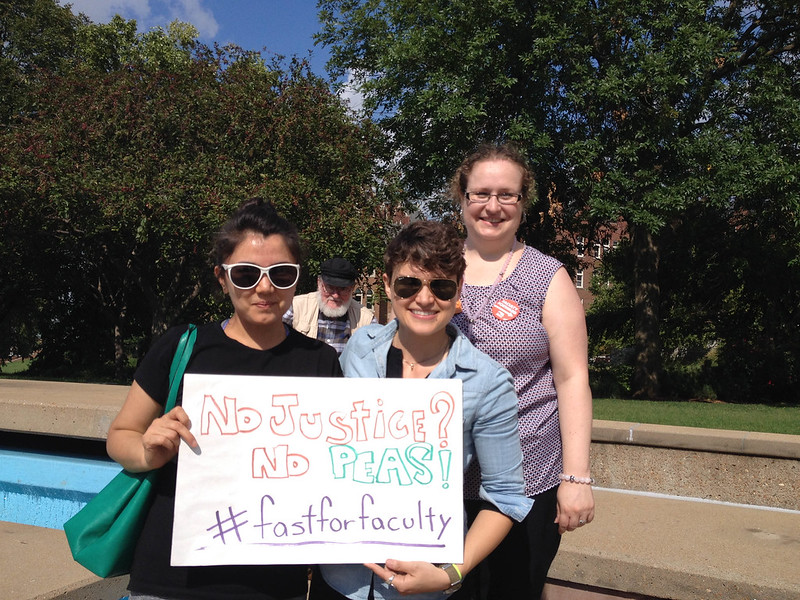
I’d have written “pease.”

Yesterday I participated in the Adjunct Action Fast for Faculty on my campus at Saint Louis University. Here I am photo bombing some of my young friends at that event late in the afternoon.

IMG_0451.jpg

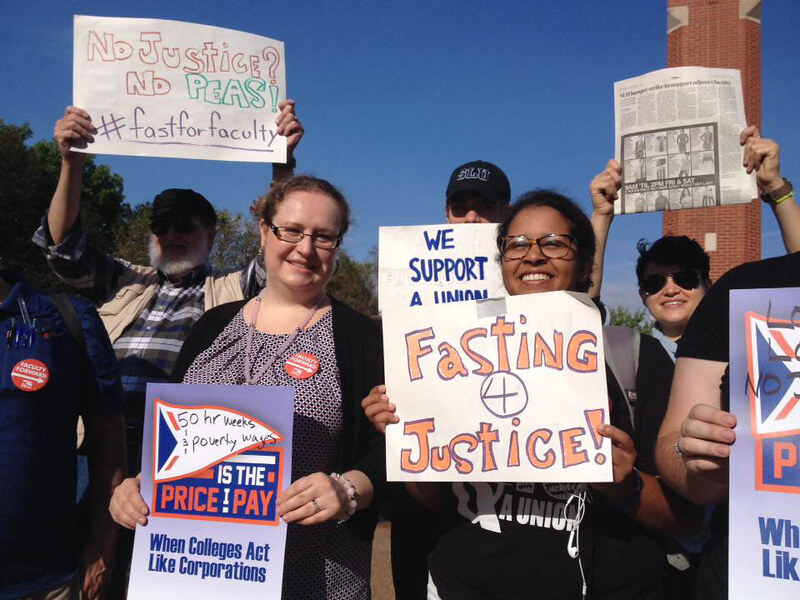
And here’s a shot of a number of us in the early morning hours. I’m in the background holding up a silly poster—good silliness, to be sure. Of course, if I had made the poster I’d have written “pease” (q. v.).

11181865_528496013983309_7428248693347719987_n.jpg

We talked to members of the university community at the clock tower and collected a respectable number of signatures from folks who were willing to support our efforts to negotiate for better wages and working conditions for adjunct faculty at the Jesuit colleges and universities. A Just Employment Policy has been in effect at Georgetown University for ten years now. We’re hoping that similar policies can be adopted throughout the Jesuit system.

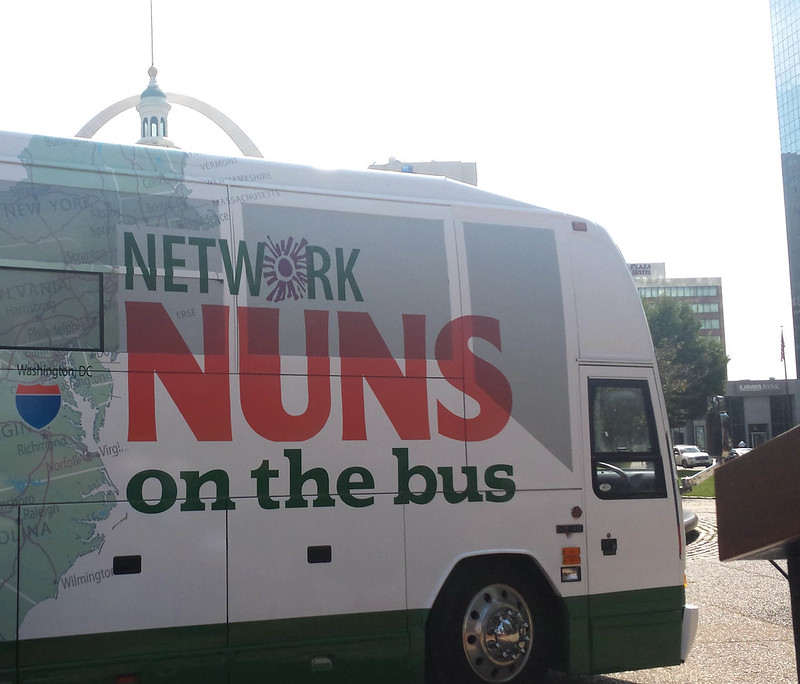
We’re also hoping that Pope Francis’ visit to this country will help to energize our effort, perhaps even endorse it; and in the spirit of that hope we joined the Nuns on the Bus at the opening rally of their current bus tour, which began in St. Louis today in the shadow of the Dred Scott courthouse framed by the Gateway Arch, that iconic and problematic image the American dream. Sister Simone Campbell referenced the image in her opening remarks to the crowd in Kiener Plaza and linked it to the theme of the bus tour: “Bridging divides: transforming our politics.”

I didn’t have a camera with me at the Nuns’ event, but I did manage an inadequate cell phone photo that shows the bus parked behind the speakers’ platform and the Courthouse dome and Arch in the background.

2015-09-10 10.50.47.jpg

Fortunately, however, there are lots of good pictures of the event at the Nuns’ Network site at Flickr. There is also a good piece on NPR that summarizes the event, including my remarks, as well as providing more photos. And here’s the Nuns’ own summary on tumblr. I get quoted in it, though you have to look around to find the quotes.

I made a short speech about our effort in the Jesuit universities and afterwards recorded more remarks for the Nuns on the Bus Network archive. Then I signed the bus, along with a good many others, before returning to campus for the rest of the day. In the evening I attended another event with the Nuns at the college church. Quite a large crowd had assembled, and for an hour and a half we participated in small and large discussions about the various divides we know and what efforts we know of that are attempting to breach them. It was a heady experience, the room full of good energy, people clamoring to speak.

As I thought about it afterwards, I remembered the Truth and Reconciliation commission from the early days of the new South Africa. Like that effort, this bus tour doesn’t aim at ideological victory but rather at accommodation and community. I’m thinking that the Nuns intend to lay the takings from this long conversation of theirs, that will take them to a score of American cities, on Pope Francis’ heart in some way as he arrives in this country later this month.