In my last post I described my participation in last month’s Adjunct Action rally in Saint Louis. Adjunct Action is a project of the Service Employees International Union (SEIU). I’ve since participated in two meetings between adjuncts and upper administration on the Saint Louis University (SLU) campus and learned with some considerable sadness that the effort to organize adjuncts at Webster University across town has failed for the present.
I am an adjunct, though not a typical one. I teach only one course, a senior seminar. As a retiree I have benefits such as health insurance, and I do not need to make my living as an adjunct. I am what is termed a volunteer professional in the current iteration of the Jesuit Just Employment Policy, which we adjuncts at Saint Louis University are asking our administration to adopt. But I have met many young adjuncts since I first became involved in this movement who are making their living as adjuncts, teaching (some of them) upwards of eighteen classes a year at several universities and colleges in order to make ends meet in their busy lives, serving as part of the pool of just-in-time casual labor on which most universities rely to do most teaching of basic courses, and sometimes more, these days.
I have found these young people to be bright, energetic, competent, and savvy. It is not their fault that their academic careers did not open with tenure-track jobs upon their graduation with terminal degrees. It is a mournful fact that the majority of graduates of today’s graduate schools find that their academic careers end with the acquisition of terminal degrees. Marc Bousquet has documented the phenomenon exhaustively in his 2008 book, How the University Works. This result is produced by an insidious system that protects the privilege of “professional” faculty, who don’t have to teach much (which is just as well since many of them find teaching distasteful) and the sometimes redundant graduate programs that employ them as specialists, and of the now vastly inflated administrator class in colleges and universities.
The relegation of responsibility for core mission to a cheap and disposable cadre of casual employees benefits institutional bottom lines as well, which benefit leaves trustees and legislative overseers free to pursue more important concerns such as athletics, property, and alumni relations. In short, today’s university system is designed to serve the interests of everyone but students, their parents, who often pay exorbitant amounts to send their children to colleges and universities whose faculties and administrations hold them in contempt, and the casual faculty itself.
If you think this is extreme, take a look at at a piece in yesterday’s Huffington Post, in which Keith M. Parsons details his message to a group of college freshmen. My Western Civ professor years ago ended the year by telling us ignoramuses that he had “enjoyed” casting his pearls before us swine. This is about the level of Professor Parsons’ discourse. Professor Parsons claims that his students are adults and therefore need only to be led to the fountain of learning (a rhetorical confusion if his audience is a student audience—to whom is he preaching?). Why not treat his students as adults and speak to them as adults. Why the condescension, the posturing, the self-aggrandizement?
I am your professor, not your teacher. There is a difference. Up to now your instruction has been in the hands of teachers, and a teacher’s job is to make sure that you learn. Teachers are evaluated on the basis of learning outcomes, generally as measured by standardized tests. If you don’t learn, then your teacher is blamed. However, things are very different for a university professor. It is no part of my job to make you learn. At university, learning is your job — and yours alone.
To be clear, I am seriously opposed to high-stakes testing and its consequences, particularly the sort of teaching to the test that is becoming standard in schools. But arrogance is arrogance—Professor Parsons is a beautiful illustration of the fact. And begging his pardon, learning is a shared job, in university as in school. To assume the mantle of professor is to assume a huge responsibility. Professor Parsons, rather than accepting that responsibility and taking it seriously, seems intent only upon asserting his superiority to the great unwashed. But Professor Parsons is not an anomaly. He represents the norm, or one aspect of it. He represents the regular part of the professoriate, tenured (or tenurable), privileged in the sense of being allowed relative autonomy to practice his craft (which somehow doesn’t exactly include teaching), and relatively well paid.
But here is how the casual faculty lives and works. Their wages are kept low; the academic job market is a buyer’s market after all, and individual adjuncts have no power to negotiate better wages. (The norm for adjunct compensation at SLU is $3000 per course.) Adjunct employment is restricted at part-time, which restriction avoids the necessity for paying benefits and the possibility of de-facto tenure in the case of adjuncts employed year in and year out. Many universities are now employing their own PhD graduates as adjuncts for a year or two, sometimes more. This is especially true for universities who created PhD programs during the 1970s when post World War II expansion seemed to promise endless economic growth on campus. Many of these mediocre graduate programs no longer have a market justification, but of course their faculties have to be kept busy.
A normal adjunct is employed to teach, and the mere fact that now more than half of the teaching in colleges and universities is done by low-paid adjuncts indicates more than any other fact or set of facts just how seriously colleges and universities take their teaching responsibility. The contempt with which university trustees, administrators, and professional faculties view the basic teaching function is, I believe, primarily to be measured by the fact that what is becoming a majority of the university teaching faculty is being forced into academic peonage. Adjuncts are typically disdained by regular faculty. They do not attend faculty meetings as a rule. They have no vote on matters of policy that concern them. And the best that administrators seem to be able to come up with as an improvement to this system of peonage is to continue it in one form or another, perhaps offering adjuncts yearly contracts with some benefits and a better wage but continuing to enforce their serfdom.
Higher education in America is under grave stress. On the one hand there is much to criticize in the behavior of our major universities and elite colleges. And on the other, every few weeks now we read of wantonly destructive policy changes aimed at these treasured institutions by venal trustees and politicians out to score points with Americans who are presumed to have no affinity for learning or to disestablish academic institutions in the interest of right-wing ideology, junk science, or no science at all. But a more important problem may be that colleges and universities expanded too far too fast after World War II and produced a system that would inevitably have proved unsustainable at the end of the baby-boomer generation. Professor Parsons and others like him for whom the professoriate is an entitlement rather than a responsibility are protected from market forces by the scores of adjuncts who have neither status nor tenure nor job security but do the work of generalists in today’s system of higher education.
Adjuncts are organizing all over the country now, and are winning concessions from university administrations. This is important, I believe, because I am persuaded that higher education in America is in decline and the competition to control the decline is serious and fierce. I am further persuaded that adjuncts are the voiceless in today’s scheme of higher education. I see SEIU Adjunct Action as potentially giving adjuncts a voice, potentially a place at the negotiating table as we as a people attempt to manage the dislocation and human destructiveness of a declining system.
—and that is why I have joined up.
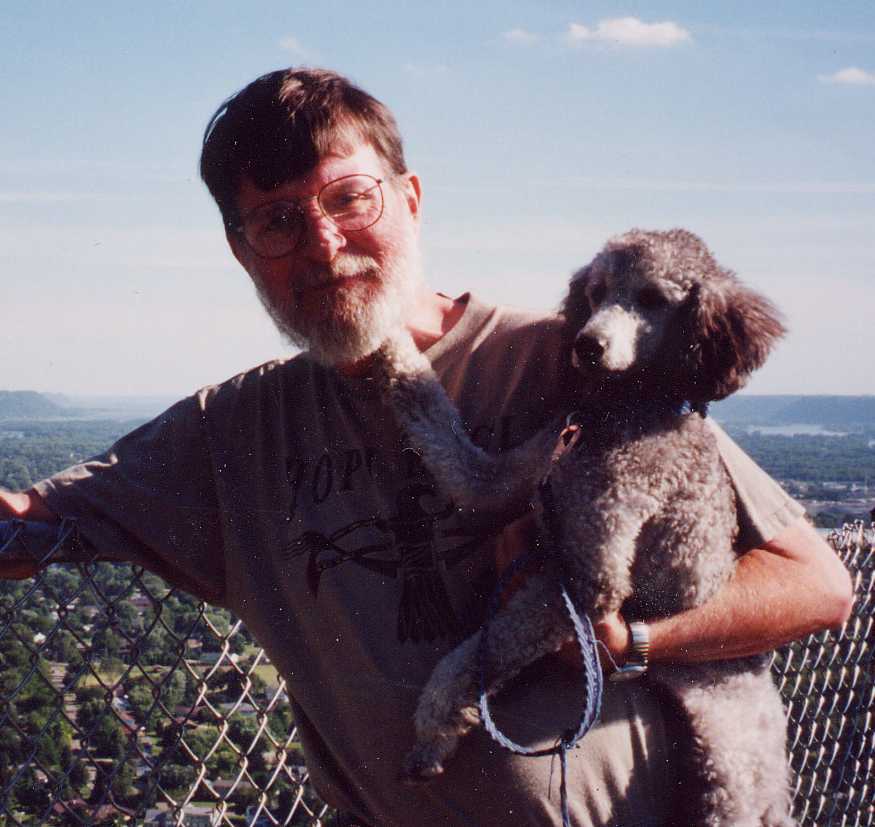
 Kathleen called me from a conference in Washington D. C. in late May that year to tell me that she had found a new dog. She described him to me and asked, “Can I keep him?” The question was pro forma, and I knew it. We were pretty sure of one another then. So I answered her question with a question. “What’s his name?” I asked. “Murphy,” she replied. He has been my constant companion since we all moved in together in late August, 2002. Here’s one of my favorite pictures of him perched on the bed in our bedroom.