God did it . . .

In a recent op ed in The Washington Post Hungarian scholar, Miklos Haraszti, has suggested that our United States Constitution, because it is hard to change, might provide a check against the rise of an authoritarian regime in this country. But Haraszti isn’t seriously hopeful. He rather means, I think, to warn Americans about what is at stake in the rise of the cult of Trump.

The world is looking at the United States now in a way that we never thought would be possible: fretting that the “deals” of its new president will make the world’s first democracy more similar to that of the others. I wish we onlookers could help the Americans in making the most out of their hard-to-change Constitution. We still are thankful for what they gave to the world, and we will be a bit envious if they can stop the fast-spreading plague of national populism.

But what if Trump is able simply to shrug off constitutional restraint as he seems to be doing now with the emoluments clause? Who will hold him accountable? His election and the associated takeover of much of the machinery of governance in this country by a newly authoritarian Republican party (and I speak here of state legislatures and governorships as well as the national congress, much of our system of courts, and perhaps the Supreme Court) threatens not only our multicultural democracy as I have argued elsewhere, but also threatens systematically to undermine our federal system. We should have seen this when Republicans repeatedly shut our government down. We should have seen it when they refused to fund necessary infrastructure spending, as our highways, bridges, waterways, and systems of land-management deteriorated, perhaps beyond repair. We should have seen it when Republicans refused to support our armed services and veterans, indeed privatized much of our military, all the while proclaiming their patriotism. We should have seen it when they refused to confirm President Obama’s nominees to key federal posts and when they refused even to consider the president’s nomination of Merrick Garland to the Supreme Court.

But if we didn’t see the threat to federalism in these things, we should certainly have seen it in the Republican destruction of New Orleans and much of the State of Louisiana following Hurricane Katrina. Naomi Klein provides an instructive window into that destruction in the opening section of The Shock Doctrine: The Rise of Disaster Capitalism, as she describes the talk at a Red Cross shelter in Baton Rouge in the immediate aftermath of the storm.

The news racing around the shelter that day was that Richard Baker, a prominent Republican congressman from this city, had told a group of lobbyists, “We finally cleaned up public housing in New Orleans. We couldn’t do it, but God did.” Joseph Canizaro, one of New Orleans’ wealthiest developers, had just expressed a similar sentiment: “I think we have a clean sheet to start again. And with that clean sheet we have some very big opportunities.” All that week the Louisiana State Legislature in Baton Rouge had been crawling with corporate lobbyists helping to lock in those big opportunities: lower taxes, fewer regulations, cheaper workers and a “smaller, safer city” which in practice meant plans to level the public housing projects and replace them with condos. Hearing all the talk of “fresh starts” and “clean sheets,” you could almost forget the toxic stew of rubble, chemical outflows and human remains just a few miles down the highway.

Destruction of Louisiana was continued by Governor Bobby Jindal, who was ultimately defeated, but much of it remains. At the center of it was the economic gospel of Milton Friedman, whose devastation of both nature and culture Klein documents around the world. According to Friedman disaster provides economic opportunity, as in New Orleans whose school privatization Friedman praised at the end of his career. And sometimes, if God doesn’t clear the slate for Friedman-style entrepreneurship, it may be permissible or even necessary for humans to undertake the task. Autocracy will be a condition of necessary economic reform, since people will hardly vote to destroy their livelihoods in a democratic socialist state. Friedman’s complicity in the excesses of the Pinochet regime in Chile are among many things that have tarnished his reputation as a humanitarian.

We might have seen a threat to federalism in the Kansas Legislature’s attempt to destroy a state supreme court that thwarted its design to defund the state’s public schools. Ultimately the people of Kansas restrained Governor Brownback and the Legislature, whose attempt to subvert the law was made clear by public interest groups. But Kansas remains a state in which Republican rule seeks the destruction of the public sector and establishment of autocracy. So, with North Carolina, whose recently elected Democratic governor’s powers have been usurped by a Republican General Assembly, meeting in special session called before the former Republican governor left office. North Carolina’s voter suppression law was struck down in federal court and the decision was upheld by the Supreme Court. The State’s extreme gerrymandering was also struck down in federal court, but a recent Supreme Court order has suspended the special elections ordered by the lower court’s decision, pending appeal.

We might have seen a threat to federalism in the multiplication of voter suppression laws around the country designed to perpetuate Republican rule and support authoritarian regimes throughout the Midwest, and in the Supreme Court’s casuistic gutting of voting rights and campaign finance legislation. As I write this Republicans are designing total repeal of the Affordable Care Act which President Elect Trump, in defiance of fact, the medical profession, the majority of American voters, and even the insurance industry, claims to have been a disaster for too long. What is trending here is a state of affairs in which the governed are deprived of the constitutional means to withdraw consent from their governors. Some millions of citizens may be deprived of health insurance as well if the ACA is repealed, and that’s only the beginning if Republicans act on the intentions of some to destroy Social Security, Medicare, and Medicaid. In some cases the Republicans’ determination to commit destruction and throttle dissent proceeds with desperate glee and an unabashed mean-spiritedness that borders on joy. An Iowa legislator terms an attempt to deprive college students of benefits he thinks are excessive the “suck it up buttercup” bill. A Missouri legislator gleefully introduces legislation to deprive university faculties of tenure claiming the practice is un-American, no matter its venerability. A former student tweets, “Liberal tears bring me so much joy.”

What seems to be driving the trend is a combination of toxic belief in certain fundamentalisms: the prosperity gospel, the economics of Hayek and Friedman, white supremacy, economic nationalism (which in some ways conflicts with Hayek and Friedman), the social pathologies we saw on display at the Trump rallies, hatred of liberalism and its institutions including schools and universities, nostalgia for a small-town or rural past with its ethnic inequities and tensions erased, etc., but the political dissolution of the modern liberal state is an international phenomenon that is only partly understood. I think Tony Judt made a good beginning in Ill Fares The Land, but he didn’t live to complete the work. Be that as it may, we Americans have legitimately elected a strongman. We may also have given him the means to perpetuate himself in office if he desires to do so. He isn’t Hitler, who was never elected, but he already exhibits many of the inclinations of other authoritarians who have become well-nigh unimpeachable dictators. I’ve mentioned Pinochet. The Italian, Berlusconi, comes to mind as well. Berlusconi was finally unsuccessful as a politician, and he wasn’t the mass murderer Pinochet was. But he did a good deal of damage, and he is often mentioned as a parallel to Trump, particularly with respect to his corruption, his fights with media, and his flamboyant style. The constitution cannot protect us if Trump decides to shrug it off and the congress does not intervene. Given Both Trump and the present congress’s thuggish predilections, it seems far more likely to me that Trump will shrug off the constitution than that congress will act to restrain him.

I conclude at the end of these thoughts that regardless of the strength our constitution has exhibited over the past 227 years we may be facing a crisis that puts our system at peril as it has never before been imperiled. In the final analysis that system rests as much upon good will as it does upon law and tradition. By good will I don’t mean what political fashion sometimes terms Kumbaya-ism. I mean rather the ability to determine the right thing on the basis of established norms and practices—and then to do it. I mean the ability to discern and preserve the good of the whole community. These are things we stand to lose, may already have lost, in the age of Trump.


Advent II: Looking for America

If I have left the impression that I think all evangelical Christians supported the election of Donald Trump, I should correct it. Here are two statements, one by a Baptist layman and another by the president and past president of Fuller Seminary expressing dismay over Trump’s election that is kin to my own. Nor do I want to convey the impression that I think the mix of racism, misogyny, and xenophobia that permeated the Trump rallies is necessarily characteristic of evangelical Christianity or of Catholicism. What follows is a meditation on what I take to be the spirit of these two statements. I have no idea how to translate it into anything else.

On the other hand, I am convinced that a vote for Trump was not an innocent act. We will discern that lack of innocence in the coming months as the Trump presidency unfolds. It will have two primary goals, I think: to enlarge the cult of Trump, and to act out what Katherine Kramer has termed The Politics of Resentment. We won’t see the wholesale return of “American jobs,” but we will see plenty of scapegoating of the politically and socially vulnerable, who will be blamed for the country’s alleged ills, and an attempt to dismantle the liberal establishment. Look at Wisconsin, Kansas, Louisiana, Michigan, and other states that have experienced large-scale destruction and/or stagnation of the public sector for models of what could happen nationwide. Trump’s scapegoating of Boeing is also deeply disturbing. Coupled with the corporate welfare Trump and Pence have promised United Technologies in relation to Trump’s inflated claim of “saving Jobs” at Carrier, it bespeaks the capriciousness of a would-be dictator.

One of my students a couple of years back remarked that we are living in a time of great change. I didn’t disagree because I never did that with students, but I thought then and am thinking today (as I noted in a previous Advent piece) that a time of great change may already be past, a trajectory such as that Richard Rorty describes in an essay entitled “Trotsky and the Wild Orchids”–one defined by the Bill of Rights, the Reconstruction Amendments, the building of the land-grant colleges, female suffrage, the New Deal, Brown v. Board of Education, the building of the community colleges, Lyndon Johnson’s civil rights legislation, the feminist movement, and the gay rights movement. Following Dr. King. It may be that the arc of history bent towards justice for a stretch of time in the last century, but if so it has now snapped back with a vengeance in the rise of Donald Trump. Those of us who opposed him now have to figure out how win elections in a poisoned political environment.

And it may also be important in the short term for those of us who have been part of the liberal establishment and still celebrate its accomplishments to figure out how to prevent, or at least to slow, its destruction: to preserve public education, the national parks, the continent’s infrastructure, the professions, civil rights, the elements of democracy we have taken for granted since the great depression, the social safety net, the press, the middle class, to say nothing of civility and common decency in our national leadership. Trump and the Republican leadership promise us liberals not only destruction, but also authoritarianism, cruelty, crudity, and inauthenticity on a scale we have not seen in American public life for a long time, perhaps since the time of Lincoln. Last June as I wandered about the mall in our nation’s capital I couldn’t help thinking that I can’t imagine how or why anyone would seek public office with a goal of destroying the institutions that surrounded me. Yet here we are. An apparent majority of our nation’s governing faction currently rejoices in its intention to do just that.

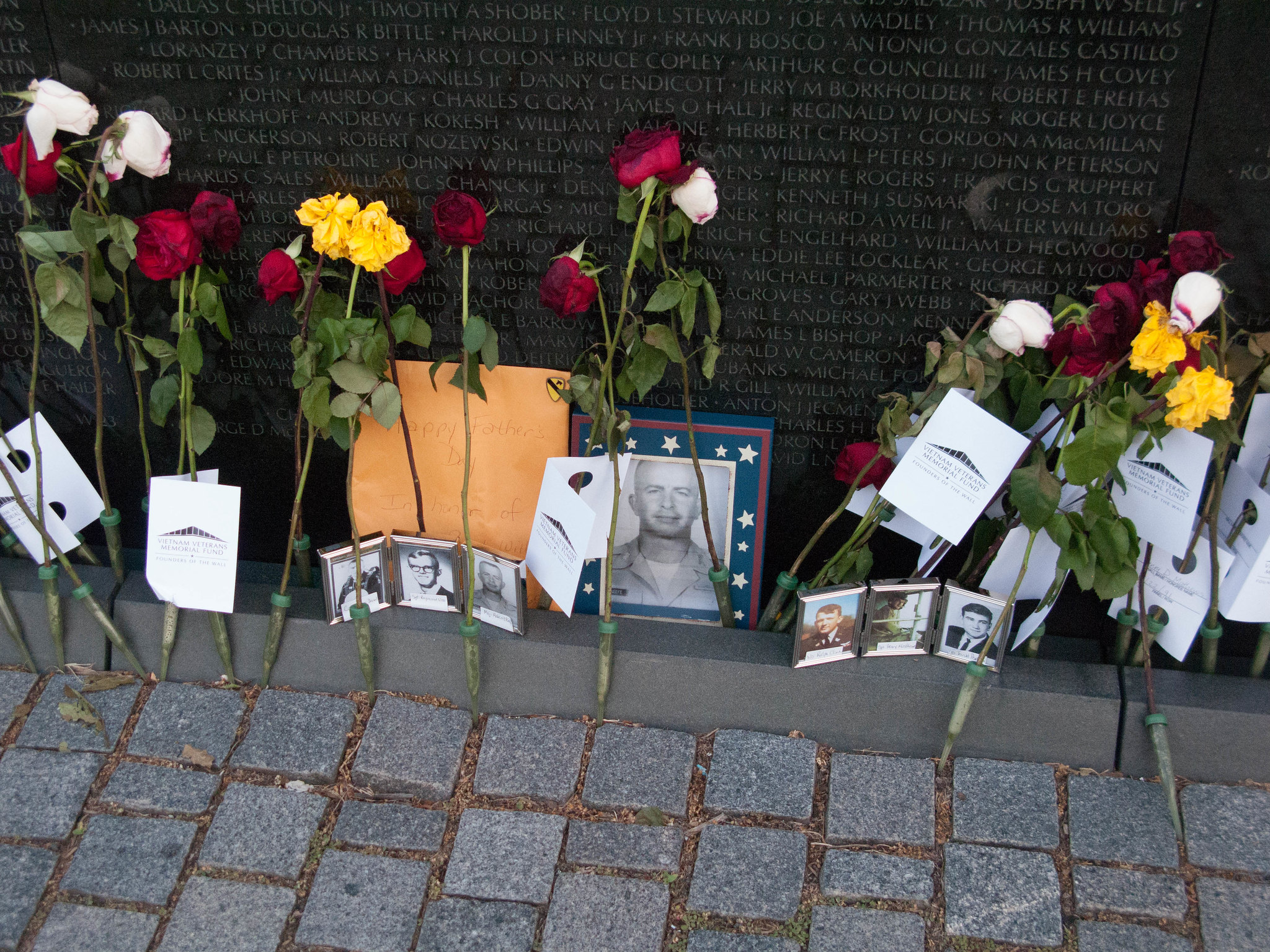
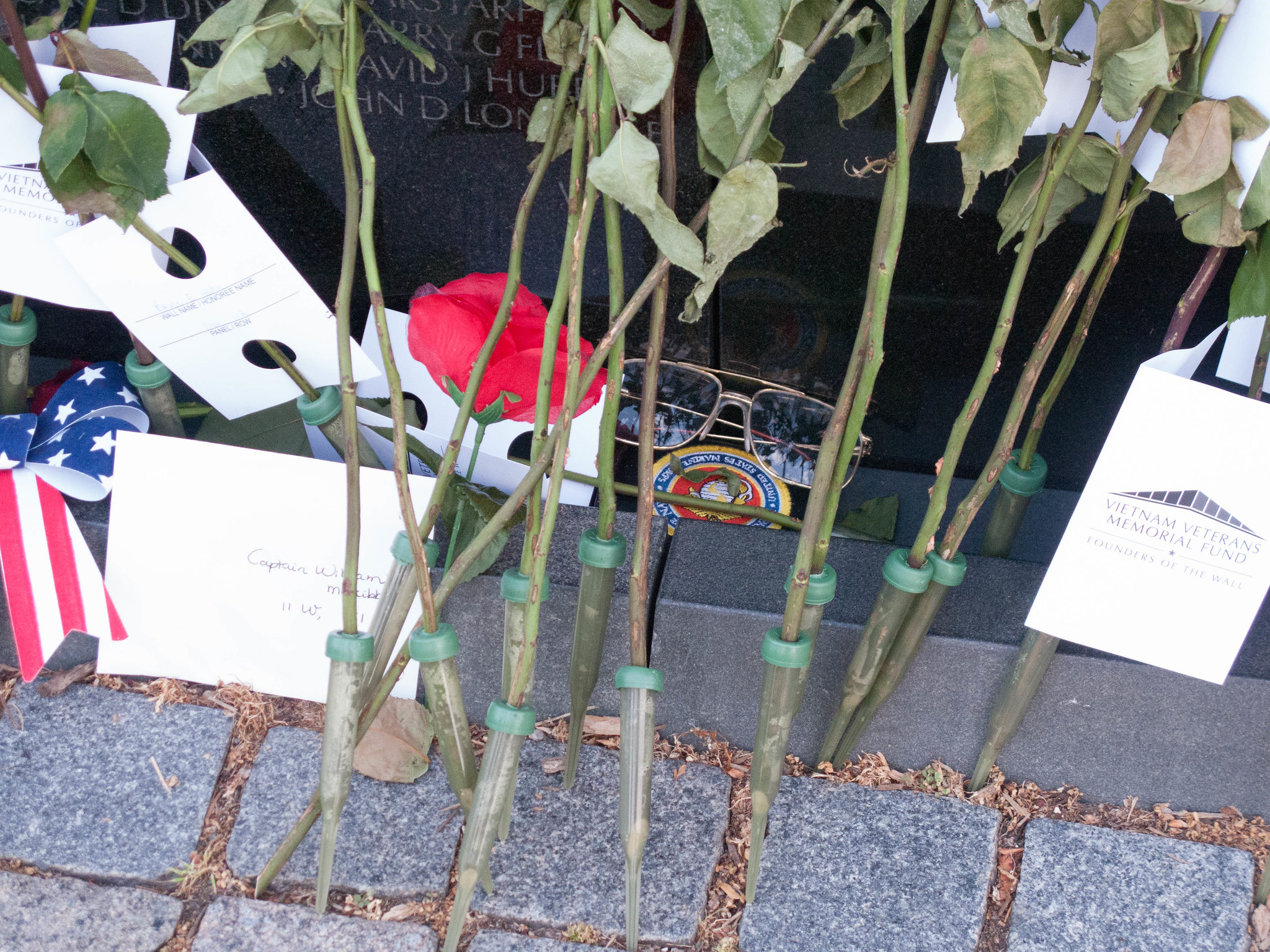
We were in Washington over the Father’s Day weekend, and it was on Father’s day that we visited the Vietnam Veterans Memorial. Here is how it looked, with garlands of flowers and personal memorials along every inch of the long memorial wall that is its centerpiece.

IMG_2220.jpg

IMG_2224.jpg

It continues to draw huge crowds, and this Father’s Day I estimated thousands of friends and families of the dead of that war had left remembrances there. Some were little shrines that included effects of the persons remembered, family pictures, glasses, driver’s licenses, wallets, medals and insignia. It was heart wrenching to see them there in a way no photograph can convey.

IMG_2222.jpg

IMG_2219.jpg

I opposed the war in Vietnam, made no secret of my opposition, participated in protests; but I also spent three years at the height of the conflict teaching school at Fort Bragg, North Carolina where I knew, befriended, and was befriended by many Vietnam veterans, some of whom were in between tours. One of my students (younger than I was—I was young then too) had done three tours in Viet Nam and wanted to go back. He had some things on his conscience from his first tour for which he had continued to try to atone. I have often wondered what became of him. Then there were the days I arrived on post to an atmosphere supercharged with dread and grief because there had been a parachute malfunction that caused a training death. And it wasn’t just that someone had died; the atmosphere was quite different during the days when the post was absorbing news of the MacDonald murders. Airborne soldiers folded and packed one another’s parachutes for each jump. I learned something about solidarity on those death days, something I think I saw again last Father’s Day.

In 1987 I reviewed My Father, My Son for The Dallas Morning News, a book by Elmo Zumwalt, Jr. and his son, Elmo Zumwalt, III. It tells of the their terrible struggle and grief as Elmo, III slowly died of lymphoma caused by exposure to Agent Orange, whose use as a defoliant his father had ordered in Vietnam. (Elmo III’s son Elmo IV, was born with a severe nervous disorder linked as well to his father’s exposure to dioxin.) At book’s end in 1986, Elmo III was recovering from a successful bone marrow transplant that extended his life another two years. At the end of my review I quoted a short statement from a letter he wrote his father at that time that I thought illustrated how Vietnam had given them a particular bond.

Both in Vietnam and with my cancers, we fought battles and lost. Yet, we always knew even when the battle was clearly desperate, that our love could not be compromised.

Young Zumwalt never blamed his father for his illness, always thought his father was right to order the use of Agent Orange. But by the time of his death in 1988 the Supreme Court had removed the last obstacle to implementing a multi-million-dollar settlement between veterans and the Agent Orange manufacturers. My Father, My Son is still worth reading. The Zumwalt story is almost an epitome of the entire war and its complex chain of consequences that continue to play themselves out in our country’s moral history. The Vietnam Veterans Memorial reminded me not only of that complexity but also of the way Vietnam veterans were treated upon their return home, one of the most shameful episodes in that moral history.

Our country’s present rightist elite have ruthlessly and, I think, cynically exploited a moral divide between Americans in relation to which there is good will on both sides. What many of us on the left know is that we don’t deserve the resentment that right wing elites have channeled towards us. But we also need to realize that some of our attitudes towards conservatives are stereotypical and that the divide between “us and them” will not be understood or ameliorated by wonkery because it’s more than political. Indeed it goes to the heart of who we are as Americans. As I walked along the veterans memorial wall I thought of Simon and Garfunkel’s “America.”

“Kathy, I’m lost”, I said,
Though I knew she was sleeping.
“I’m empty and aching and
I don’t know why.”

Counting the cars
On the New Jersey Turnpike
They’ve all come
To look for America. . . .

I love this song for its catalogue of ordinary ironies and its evocation of a time when I thought I had America right. I’m thinking now of a friend who I think voted for Trump but still offered to hug my neck as we realized we had things we could talk about in the aftermath of the election. We Americans are, we were then, who we are—all of us, as Mrs. Antrobus says of women in Wilder’s The Skin Of Our Teeth. “We’re not what politicians or poll takers say we are, and we’re especially not the ideological idiots pundits and social media say we are. We’re ourselves.’ Perhaps we could find America again together if we met spiritually somewhere near the Vietnam Veterans Memorial and began to talk about how we got there.

Advent I: Who is an American?

Some years back I attended a funeral in one of my city’s conservative Catholic churches. On this particular day, the celebrant in inviting the faithful to communion went out of his way to explain to us non-Catholics that we were not welcome at the Lord’s table. We were told to remain in our pews and pray for the unity of God’s Church. I was a bit taken aback at the blatancy aand harshness of this priest’s inhospitality, but the rubric was not unfamiliar. I grew up in a town dominated by two Protestant sects that each believed only its members were destined for heaven.

I’ve never understood such exclusivity. If we are to believe John Dominic Crossan, the unique things about Jesus were that he healed freely without enquiring whether his patients were deserving and that he ate with anybody. The remarkable thing about Jesus’ feeding the five thousand may not be the miraculous multiplication of the five loaves and two fishes but rather Jesus’ specific prohibition of gatekeeping on the part of his disciples. No one seems to have been excluded from Jesus’ healing ministry on that day, or from the meal that followed. On the other hand scripture is replete with examples of Jesus’ eating with ‘publicans and sinners;’ and If we are to believe the gospel accounts, Jesus shared his last meal in the flesh with the disciple he knew would betray him to the Romans and also with a disciple he correctly predicted would deny knowing him before morning.

I have found myself returning to Jesus, A Revolutionary Biography again and again over the years since I first read it, and I find myself returning to it again this year as a discipline for the four weeks of Advent. I have never believed that the question ‘Who is a Christian’ is answered by The Baltimore Catechism or the thickets of proof texts some evangelical Christians use as weapons to protect the territory of faith from incursion by the ritually unclean or by persons whose beliefs particular sects judge to be incorrect. I think with Crossan that scripture does not provide a unitary picture of Jesus; there is no view of him that one can adopt with scriptural certainty, no view that is supported by the entire body, even, of canonical scripture without leaving a scriptural remainder that might support another conflicting view. Indeed, the Bibles as Christians and Jews have fashioned them over the centuries do not support a unitary conception of God, and on that one fact hang all our diverging communities of doxa and praxis. If one adds the Quranic tradition to the mix as we do, for instance, when we speak of the Abrahamic religions, further complications arise.

But I am presently thinking of something I’m describing to myself as the sociology of religious certainty, from which I stand aside as a dissenter and sometime critic. Advent is good for me because it forces me to examine again for the near eightieth time (since I will be eighty soon), my reasons for standing aside and the images of Jesus and of God to which my experience and affection have inclined me. I like the Christian Science appellation for God, father/mother. It could just as well be turned around, mother/father. The metaphor calls attention to itself and moves my mind to the thought of a god without gender, whose attributes I like to think are creativity, empathy, nurturing, and a disinclination to self-glorification. One difficulty I have with some contemporary feminist images of God is that they retain the triumphalism of traditional imaging, having removed gender references only. I’m still back there with Micah, who set it down that God requires justice, mercy, and humility of us humans.

I am a cultural Christian, a Christian humanist, and I have reasonably specific reasons for claiming these things. Christianity provides me with much of my fundamental vocabulary, with the linguistic tools I need to cope with the world as it seems to me to be. I could be a complete pragmatist, like Richard Rorty whom I admire, but for a profound awareness of sin, in myself and in the world I inhabit. I am a humanist in the sense of understanding that the world I experience is a text, composed of many subtexts, some of which I know and some of which remain opaque to me. In this I am not alone. Not even Kant or Einstein could read the world entire. It should be obvious by now that I am describing a position that posits uncertainty as a fundamental. I might have certainty if I had reached the end of the unknown, but to know everything is not a human possibility. I can hear a voice telling me to have faith, but that instruction merely requires me to accept someone else’s partial and interested description of the world and its history. I prefer uncertainty. I particularly prefer uncertainty to the dogmatism and exclusivity of much contemporary Christianity.

And now I am confronted with a new messiah, Donald Trump, who has drawn upon the savior language of past centuries in advancing his rise to prominence, who is recommended to me by an apparent majority of evangelical Christians in my country. “I alone can protect you,” he has told his ardent supporters as he encouraged them to brutalize dissenters at his rallies. Trump’s position as president elect is in part the product of mass dramas recalling medieval Good Friday sermons that whipped up the faithful to brutalize Jews and their communities in pogroms that were a standard feature of European history well down into the twentieth century; that resembled the whipping up of lynch mobs in this country, most of which targeted African Americans but not all. In the East St. Louis riots of 1917 some ten whites were killed along with upwards of one hundred blacks, though the true death tolls will never be known precisely.

My point is that Trump populism was and is of a piece with these past excesses. We saw them at the Trump rallies. If you voted for Trump, this is what you voted for, regardless of how you may try to sugar-coat it. You voted to enable violence against those aliens, those illegals, and you voted to “Lock her up” (or perhaps to kill her) on the basis of a pack of lies invented by unscrupulous people with no purpose beyond their own aggrandizement. The Trump rallies were spectacles designed to force an answer to another question: ‘Who is an American?’ And the answer is rhetorical: ‘Not those others, not those brown people, not those aliens with strange names who don’t worship Jesus.’ The Islamic conception of Jesus is very like that of Judaism, but most Americans are utterly ignorant of Islam, or worse, are informed by anti-Islamic bigotry masquerading as history or news.

Advent invites me to ponder the last things: heaven, hell, death, and judgment. In my eightieth rethinking I am struck by the realization that the last things are not last. The holy is last. But the problem with the holy is that we have located it in the person of a cosmic despot who demands worship and abject obedience. As Christians we have assimilated Jesus to this despot, and before Jesus there was Moses. In the tale of Moses’ conversion the holy had already been imaged as a despotic ruler; as in the tale of St. Paul’s conversion the assimilation of Jesus to cosmic despotism had already taken place. There is a deep truth in the stories of Moses and the burning bush, and of of St. Paul’s blinding. The holy sometimes breaks into common experience when least expected, like a thief in the night, as St. Paul said of the coming of the day of the Lord. But the small among us might have done without the murders, torturings, enslavements, deportations, and other excesses that have come in the wake of our hanging holy robes on bishops, kings, and dictators through the Christian centuries.

Donald Trump has behaved from the beginning of his candidacy for the Presidency, and is behaving now, like the leader of a cult, and his following has many of the trappings of cultic discipleship. Either sense of cult will do here. Trump demands worship and abject obedience. He punishes subordinates who fall short. He has in a few short months gathered a cult following, still a minority of Americans but a very effective one. Will he be able to turn at least the Republican party into the Church of Donald Trump? I don’t know. I decline to join. But the faux holy has been a force to reckon with throughout the history we know. It has broken out into the common life of nations many more times than once in Germany since the Great War. And I fear it is upon us again.

What is to be done?

Politics comprises, or ought to comprise, serious human attempts to answer Chernyshevsky’s famous question, political because Chernyshevsky was political but also because Lenin used the question as the title of a 1901 book. I raise it now because my country has chosen a vicious demagogue as its next president. All of us who opposed him will need a time of venting or of grief—indeed I take the determined efforts I am reading here and there to find solace in the putative strength of American institutions as manifestations of denial, one of the stages of the same. But after the venting and the depression, the question demands an answer.

When I wrote about Trump last summer I had not yet taken seriously the possibility that he might actually be elected, but as the campaign wore on (and particularly after observing the apparent strength of his support in rural Missouri on a recent trip to the Ozarks) I began to take seriously the fear that continued to gnaw around the edges of my consciousness. I remain afraid. Next year I will be eighty, and I have to say that I had not thought to spend my old age engaged in political activism. But we don’t choose our choices.

As I look back through my observations about Trump in my last post I’m surprised at my own prescience; not that I claim any special gift of or for it. But I left my remarks with a question about why large numbers of Americans were supporting Trump when that support meant “harm to those who differ from us, hatred and destructive public policies that promulgate hatred of the most vulnerable among us, reversal of the access to public life achieved by women and minorities over the past fifty to sixty years, restoration of white supremacy and patriarchy.” “Perhaps,” I speculated, “these are the means to making America great again envisioned by Trump and his followers.” And “[if] so,” my question was, “how did a substantial number of Americans come to think these things, to wish these things?”

I now have more insight into the complexity of my question than I did last May, but I neither have nor wish a definitive answer, particularly not an answer that that might incline me to blame some demographic or other group for the debacle. Racism, xenophobia, white nationalism, and misogyny are all part of the mix, but Trump’s election does not represent a triumph of these things either as actions or as moral sentiments. Yes, they remain part of the complex intentionality that characterizes the American right and the alt-right the world over, but it’s too easy simply to blame these bugbears for my political party’s losses in this week’s election.

That those losses were substantially our own fault is now obvious. Clinton, much as I admire her, was the wrong candidate. Democrats nominated her for the wrong reason. It was her turn, we thought—surely the country would agree. And the naïveté of our early euphoria carried us through the election season as we continued to believe in our own invincibility, denying disconfirming polls and the convictions of our most progressive colleagues, until the trend began to establish itself in the early election returns and we discovered the enormity of our error. Still, there’s plenty of blame to go around, and unless we Democrats wish to confirm the image the right has of us standing in a circle and shooting at each other, we’ll get over ourselves and get busy thinking our way out of the box we have put ourselves in.

I’m attracted to Bernie Sanders’ call for those of us on the left to find ways of working with the right where we have commonalities of interest but to oppose the odious proposals and policies that are bound to come with all the vigor we can muster. We fucking fight! as Aaron Sorkin said in a letter to his daughters, adding “there’s a time for this kind of language and it’s now.” But beyond the need to resist, we liberals need to recognize that we have lost the friendship of many in the working class because we are elitists. It does no good for us to claim that those others have been turned against us by a rightist elite committed to a vile and exploitative economic ideology, just as it will do us no good to gloat as Trump fails to bring back the coal and steel and auto industries with their well paying jobs.

What we need to realize, I believe, is that all of us Americans who occupy present positions in our country’s declining middle class have a common interest in finding and supporting some form of restorative politics, some way to restore what we have lost to globalization for the future’s sake, and some humane ways of dealing with the present precarity of Americans who, through no fault of their own, find themselves part of a burgeoning congeries of economic and social waste, consigned to the fringes of society as unproductive and useless. Folks on the right need to realize that displaced working class folk, of whatever ethnicity, are an important reason why they will now be called on to govern the country.

Perhaps the rightist elite will try to fulfill its economic promises to the working class. But I think it more likely that Trump and his followers will engage in large scale public scapegoating that will entail stepping up and publicizing the program of deportation of undocumented immigrants the Obama administration has more or less tried to hide and instituting a new program of repression targeting Muslims and shutting down the refugee program. These actions can be undertaken quickly and offered up by way of saying to the Trump base, ‘See, what I’m doing for you.’ I’m sure that Mexico will not pay for Trump’s wall, but I’m almost equally sure the Republican congress will find the money to build it.

If these things materialize the left will be drawn into more and more forceful resistance. What is beginning now in the streets will continue. The Dakota pipeline protest will continue and intensify. Protest politics will loom large in Trump’s America. Perhaps a new occupy movement will emerge, perhaps new leaders. The Black Lives Matter movement will enlarge, and these efforts will trigger retaliation in the name of law and order from our new president who apparently has never met a slight he didn’t hate. And of course if Trump pursues the foreign policy agenda he has threatened we could easily be drawn into larger and more costly military adventures abroad that in turn could engender more protests here at home.

To reiterate, I believe Trump will seek to implement policy changes he can achieve quickly and on his own, or with quick and dirty legislation, at first—since the economic changes he is promising will for the most part require the long term. Before that will come the cabinet appointments. The judicial appointments will likely come later, but all Trump’s appointments are likely to engender protests from the left unless Trump learns some moderation he has not so far exhibited. I think protest is necessary, especially in the short term, but I think the long term calls for a number of kinds and levels of organizing and reaching out to the working class folks with whom we Democrats have lost touch in the attempt to build a new progressive coalition.

I think this necessity requires cleaning the Democratic house. The present hierarchy needs to step aside. Its day is over, and the time has come for new leadership. Robert Reich has called for this, and I think he is right. I think new leadership will come from the progressive wing of the party, perhaps led by somebody we don’t yet see; but we need to be looking for that new leader. Bernie Sanders and Elizabeth Warren will be harbingers of new leadership, and for a while will function as leaders of the progressive movement within the party. But the new leadership we need will come from a younger generation, I believe: if not from millennials, at least from their parents. In the interim we all have work to do. Part of that necessary work is reaching out to disaffected working class voters, seeking an alliance based on our shared interest in social justice (perhaps without using the term).

For myself, I’m going to do some specific things. For the past several years I’ve been active in union organizing. The destruction of the trade union movement, a process in which both political parties have been complicit, has done more to shred the fabric of our society than any other single thing, I believe, because it destroyed political connections between disparate social groups and pitted public and private sector union members against one another. This year I’m not working for the union because I was left out of the bargaining unit at Saint Louis University when we won the union election and because I retired at the end of last academic year. But I’m going to find a way to be active in the union movement again, perhaps in the fight for fifteen along with my friends at McDonald’s and my colleagues in the home health care industry and my former colleagues among contingent faculty or perhaps in some other way. I’m also going to continue to support my beloved’s role in the League of Women Voters and write this blog and work on behalf of my church’s social justice mission and support the Saint Louis Urban Debate League that seeks to enhance the public school experience of our inner city youth, etc., etc.

These things are good works that need doing. I can do them, will do them: and whatever else I find I can turn my hand to that pits community against demagoguery and division.