into my own again

I wrote this essay two years ago in the fall. West Texas is on my mind again, perhaps because I’m going there in a few days for my fifty-ninth high school reunion. I want to write an essay about why I love my country. This isn’t it, but I thought I’d post it again for a while because whatever love I have, whether I like it or not, grows out of some hardscrabble not unlike that around my grandparents’ little house in Las Cruces, shown here in a photograph I talk about.

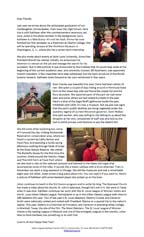
Recently I was sent a collection of family photographs. Among them is this snapshot taken outside the farmhouse in Las Cruces, New Mexico, where my father and his brothers and sister did much of their growing up. My father is the tall one in the middle with his hands on my grandmother’s shoulders. Her youthful appearance startles me. The elderly woman on the far left is my great grandmother, Melissa Peterson. The farm in Las Cruces was a homestead. Only my uncle Bill (standing just behind Mrs. Peterson and my aunt Frances) was born there. My father, his brother Randolph (the one with the silk handkerchief in his pocket), and his sister were born at an earlier homestead near Sayre, Oklahoma. There’s no date on this photo, but I think it was taken in 1930 or ’31. The subjects seem to be dressed in their best, on their way somewhere.

Except for my father they would all live long lives. Mrs. Peterson lived to be 82; my grandmother and two of her children would live almost a century, reaching the age of 99. Uncle Randolph, the eldest of my grandmother’s children, would live to be 94. And except for Mrs. Peterson they would all find themselves far away from Las Cruces at the end of their lives, most of their experience shaped largely by their country’s mid-century adventures in the far east. All of my grandmother’s children went to college. As I look at these images of them, see the hardscrabble under their feet and the house with its look of temporariness, I am thinking how remarkable that is.

I’ll not tell all I know of their stories now. My father and my uncle Bill were already in medical school, I think; uncle Randolph on his way up the corporate ladder in what would become AT&T. My aunt Frances would marry a man who became a Brigadier and travel widely. My grandmother, once her children were launched, would travel widely as well, living in Honolulu for a while and finally settling in Seattle. But the various fulfillments of these separate destinies were long ahead of them all in 1930—what strikes me in this photo is the seeming anticipation in their demeanor, and a certain innocence.

My title is borrowed from a poem of Robert Frost’s that anticipates the end of a long life as a time of certainty. The poem’s speaker imagines that friends he left behind, should they catch him up at the end of life’s journey, would discover him to be not “changed from him they knew— / Only more sure of all [he] thought was true.” These are the thoughts of a young man, part of Frost’s first book, A Boy’s Will, published when the poet was thirty-eight years old. At this distance they seem a recipe for closed mindedness.

**********

I recalled the lines from Frost as I was thinking about some lines from a much longer ago dead poet, Henry Howard, Earl of Surrey:

Martial, the things that do attain
The happy life, be these, I finde.
The richessse left, not got with pain:
The frutefull ground, the quiet minde:

After I factor out the mindset of the landed aristocrat, there remains in this translation of Surrey’s the still attractive classical ideal of the quiet mind; though Surrey’s own mind was less than likely to be quiet. Like Martial he lived in turbulent times. He led a dangerous life as a Catholic in the twilight of Henry VIII’s reign and was ultimately executed as a traitor. He was perhaps 30 years old when he died.

But the ideal of the quiet mind need not be thought youthful, nor need it presuppose certainty. It is a stoic ideal, conceived as a response to uncertainty and frustration, a consciousness that seeks its own in the midst of political and other stresses; and it’s sometimes held up as a goal of liberal education, a mind both copious and quiet, “liberally furnished with objects of contemplation,” to paraphrase Dr. Johnson, another latter day stoic, who between herculean labor and coping with Tourette’s syndrome and other afflictions, had plenty of mental noise in his life.

I’ve just finished a week’s reading that included, in addition to various consumables (by which I mean newspapers, blogs, media, etc.), John Gardner’s Grendel, which my class discussed last week, S. C. Gwynne’s Empire of the Summer Moon, a popular meditation on the the winding down of the Indian wars in the southwest (yet another retelling of the story of Cynthia Ann Parker, the exploits of her son, Quannah, and the capitulation of the People), and Wendell Berry’s Home Economics.

I turned to Gwynne on the recommendation of friends I encountered in my home town of Abilene, Texas where I recently attended the 57th reunion of my high-school graduating class and was struck by the realization that my grandparents had arrived in western Oklahoma around 1901 in the aftermath of the turbulent events Gwynne’s narrative brings to mind. From Gardner I took away (again—I’ve read Grendel many times now) what seems the quite reasonable claim that Whitehead was right to assign the name of God to that which limits action and energy and therefore calls forth “the entire multiplicity of eternal objects.”

And I turned again to Berry because I am trying to formulate for myself a rationale for the liberal arts in contemporary university education. I’ve previously written about Berry’s essay, “The Loss of the University.” But now I’m more interested in his thoughts on sustainability and his claim that community has economic value, because it seems to me that whatever case we make for the liberal arts in our day has got to take into account the material conditions required for their study and the material benefits of the same. If we can’t make the case that the liberal arts have practical, economic value, it is hard to argue that they have cultural or spiritual value. As Berry puts it with respect to community, “Can there be a harvest festival where there is no harvest?”

**********

Two years ago I asked my class to read Alasdair MacIntyre’s After Virtue. It’s a beautiful book, though I don’t agree with much of it, including its core argument. MacIntyre says, in a preface to the third edition, that he was not yet a Thomist at the time he wrote the book (1981); but what I think I loved about After Virtue when I first read it in the mid-eighties was its insistence on the importance of a conception of human nature. Without such a conception (and I like Aristotle and Thomas about this too) the Enlightenment notions of liberty and equality are pretty empty. Something more is required, it seems to me, as a ground for these notions than the naked assertion of self-interest—some notion of human good, potential or real, immediate or lost. Adam Smith, often cited as the godfather of neoliberal economics, believed in a moral sentiment, physically present in human being.

The enlightenment tradition has tended to emphasize private judgment, private enterprise, etc., as opposed to centralized coordination. This was liberating in the eighteenth century, when people could still be put to death for witchcraft. Now, when “The notion that every action is is both a private experience and a a public utility,” as Whitehead says, has all but died out, individual beliefs and practices tend to be asserted as near absolute private entitlements. We see this on both sides of the political spectrum, but it has particularly emerged recently in the argument against government mandated health care. Obamacare, so called, infringes on my right of self-determination. Government, so we are told, has no right to tell me, as a sovereign individual, that I have to purchase health insurance. It’s the old seat-belt argument.

Here is Aquinas’s fifth proof of God, the one I like the best:

The fifth way is taken from the governance of the world. We see that things which lack intelligence, such as natural bodies, act for an end, and this is evident from their acting always, or nearly always, in the same way, so as to obtain the best result. Hence it is plain that not fortuitously, but designedly, do they achieve their end. Now whatever lacks intelligence cannot move towards an end, unless it be directed by some being endowed with knowledge and intelligence; as the arrow is shot to its mark by the archer. Therefore some intelligent being exists by whom all natural things are directed to their end; and this being we call God.

I don’t like this because I think it succeeds as a proof. Its conclusion in no way follows from its premises. As an argument, it’s an exercise in question begging. But it’s beautiful, and beauty is truth in a way; though Keats claimed too much for the idea.

Still, my point here is that without such a conception of intelligence grounded in the material stuff of the world, the enlightenment conceptions of liberty and equality degenerate into empty assertions of individual autonomy that are easily transformed into the right to bear arms, the right not to purchase health insurance, the right not to wear a seat belt, etc. And politics aside, without such a conception the fundamental issues of ethics and aesthetics degenerate into cost benefit analysis that deserves comparison with the excesses of medieval scholasticism, or into empty claims about the timeless worth of things that we know only as inferences and extrapolations.

**********

At this point in my life I am more uncertain than I have ever been about the things I hold dear, though I am pretty comfortable in my skin. I tend to think that certainty, not uncertainty, is the enemy of life. None of us knows when he will die–that’s the fundamental uncertainty–and I don’t need to be certain about the ideas that I use, because my practice constantly confirms their usefulness. Unlike MacIntyre I embrace and celebrate democratic pluralism. To be sure, it gives us Sarah Palin and the gun toting folks in Arizona and elsewhere. But it also gives us what I identify, following Richard Rorty, as liberal hope.

Uncertainty seems basic to the hope for a better world. An uncertain person, such as I am, tends to embrace bounded ambition in regard to the potential for historical accomplishment, or social progress. But the person who seeks certainty seeks an establishment, a city on a hill, the end of history. I think history and the end of history both abide in the moment, and I am content with that. I embrace the long tradition of uncertainty in Christian mysticism. (See, for instance, “The Cloud of Unknowing.”) Rather than doctrine, I embrace prayer. I find common prayer particularly efficacious, though I have no belief in, or knowledge of, a personal god.

I am not uncomfortable with any of this, perhaps because I am a poet and grounded in poetry. I read, for instance, the ending of “Little Gidding,” as it draws together the poet’s personal quest with Dante and Julian of Norwich, as a method of being. Here are the lines:

We shall not cease from exploration
And the end of all our exploring
Will be to arrive where we started
And know the place for the first time.
Through the unknown, unremembered gate
When the last of earth left to discover
Is that which was the beginning;
At the source of the longest river
The voice of the hidden waterfall
And the children in the apple-tree
Not known, because not looked for
But heard, half-heard, in the stillness
Between two waves of the sea.
Quick now, here, now, always?
A condition of complete simplicity
(Costing not less than everything)
And all shall be well and
All manner of thing shall be well . . .

And I think of truth as but one of the conditions of thoughts that one loves. The difficulty of Truth and Truth establishments is that they drive truth (small t) out of the room. In this regard I am remembering something from Hannah Arendt, in one of her letters to Mary McCarthy, “The chief fallacy is to believe that Truth is a result which comes at the end of a thought-process. Truth, on the contrary, is always the beginning of thought; thinking is always result-less. That is the difference between ‘philosophy’ and science. Science has results, philosophy never. Thinking starts after an experience of truth has struck home, so to speak. . . .”

I’ve learned a lot from MacIntyre, even though I don’t agree with him about much. I particularly don’t agree that Aristotle needs vindication. Aristotle remains with us, as Plato does, perfectly available to the next thinker who might wish to use him as Aquinas used him, just as the Homeric poems remain available to poets. I’m not entirely sure of this, but I think MacIntyre’s use of Aristotle may be perverse. It’s not an adventurous use in any case, as Whitehead’s use of Plato is adventurous, for instance.

“In my end is my beginning.” All my grandmother’s children went to college. I loved college so much that I’ve never wanted to leave. Though I’ve knocked around a bit and seen a bit of the world, I remain primarily a mental traveler, like Joyce Cary’s “randipole Billy Blake,” perhaps not unlike my grandmother’s children, too—on my way somewhere unknown, unknowing.
Emma’s place, and some random thoughts about education as therapy

Too long away. Sometimes I get burnt out, Maybe that has something to do with what I’m writing here, now. My experience last weekend may be implicated as well.

I’ve acquired a stake in Oberlin College. My beloved and I are de facto god parents to a rising sophomore there. I’ve written about Emma before in these pages. Last weekend we accompanied her mother to Oberlin to collect her and her things for the post-freshman year return home to Iowa City. It was good to see Emma in “her place,” as she called it a couple of times, good to meet her Oberlin friends and to get a first hand impression of the college.

Its quality stands out: four libraries, a world class art museum, a large and beautiful campus that is the chief feature of the town surrounding it, a highly qualified and well-compensated faculty (Oberlin has a 9:1 student faculty ratio), all for three thousand students each year, some six hundred of whom study in the Oberlin Conservatory of Music, a world class institution in its own right. It was also nice to speculate that the college seems not to take itself too seriously.

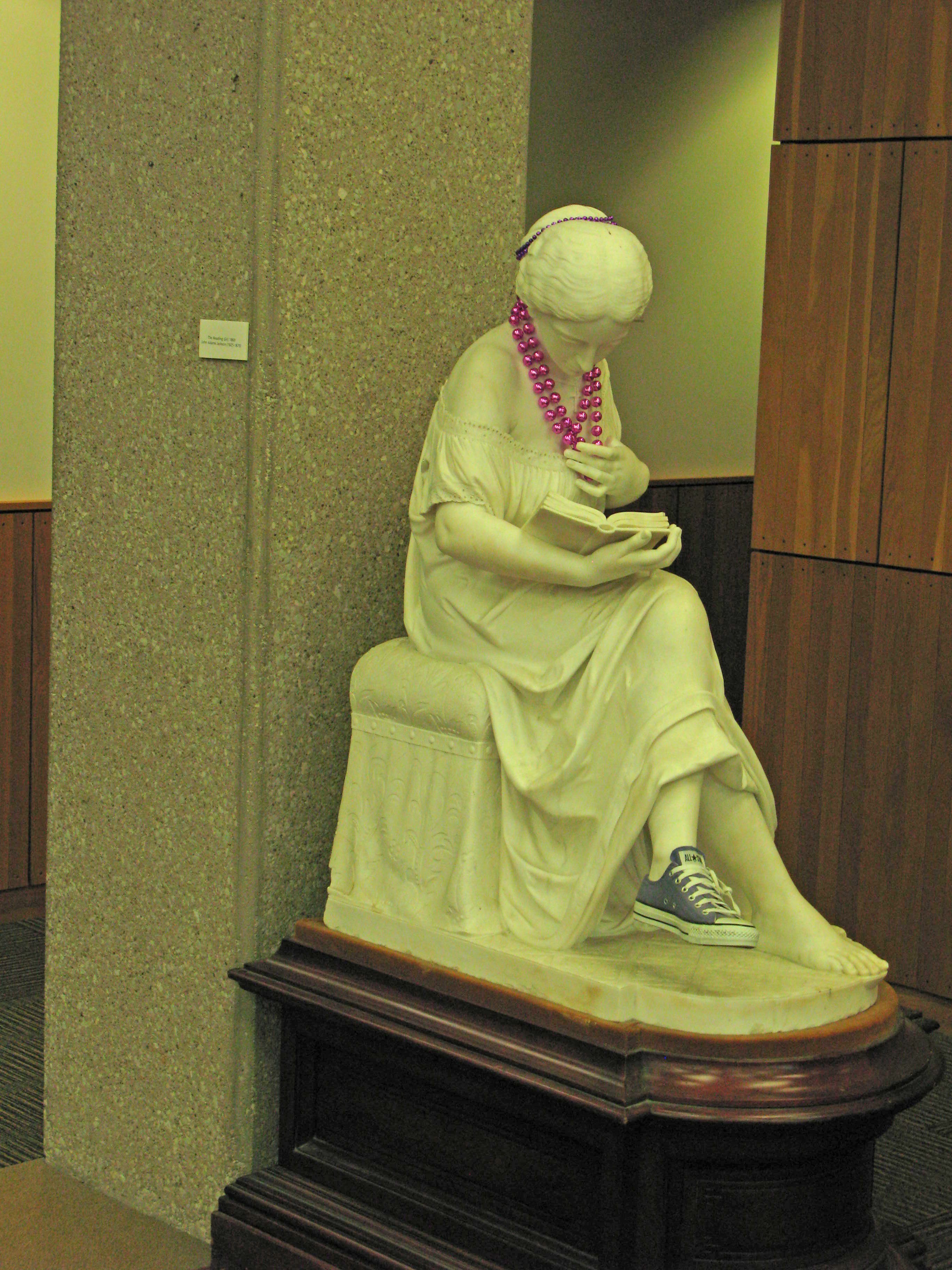
On the first floor of Mudd Library, one encounters The Reading Girl, “a statue created by John Adams Jackson (1825–1879) in 1869,” according to OberWiki. Apparently no one interferes with students (or others) who adorn that marble lady with a variety of items of clothing and/or jewelry from time to time. One campus source considers the sneaker (size six) to be a permanent part of the statue. Indeed, my beloved purchased a tee shirt at the library circulation desk featuring an image of the statue, sneaker and all. What relation, if any, Oberlin’s Reading Girl may have with other reading girls, such as Pietro Magni’s La Leggitrice, now in the National Gallery, I’m unable to say.

But Oberlin does take itself seriously, and that seriousness is reflected in a news story carried in The New York Times on the very Sunday we were wandering around the Ohio Campus as Emma packed her things. Somebody at the Times should have been fired for writing the headline: “Warning: the Literary Canon Could Make Students Squirm.” Oberlin and several other colleges and universities around the country are considering whether to mandate trigger warnings on syllabi that contain material some students might find threatening, a trend that is getting a good deal of attention in the popular press.

Proponents of the idea stress that the intent is not to proscribe any and all material any student might find offensive. The idea of the first such policy (at UC Santa Barbara) was simply to provide students with a headsup warning about the possibility that a particular book or film might “tap into memories of trauma.” But the argument about such policies has tended towards framing as a rights discourse (free speech vs. the right not to be harmed) or an argument about the values of liberal arts education. Unfortunately both framings are easily coopted into already large structures of cliché.

So before it gets to be impossible to talk about trigger warnings in ordinary academic contexts without automatically entering the house built by culture war, perhaps one might pause to say that there is a very old question at issue here that has almost nothing in common with the familiar issues of present academic culture. The idea of education as therapy is neither new nor radical. It isn’t the same as the old-fashioned idea that education shapes character, but it is a cousin to it. Education as therapy conceives that souls can be restored to health by right learning. Sorry about the old-fashioned lingo; we’re talking about a very old idea here.

When The Lady Philosophy first appears to Boethius in in his prison cell as he awaits trial for treason, she finds the philosopher medicating himself with poetry, which (as she contends) only makes him worse. Boethius has forgotten who he is and hence needs reeducation in the basics of Neoplatonism, his former grounding. He needs particularly to reunderstand why it is that nothing bad can happen to a good person. I speak here of Boethius the character in The Consolation of Philosophy (c. 524 C. E.). Boethius the author may have needed to reinhabit the house of Socrates as well, especially since he was eventually put to death in a particularly gruesome manner.

So–education as therapy isn’t new. It wasn’t invented by feminists or others who can easily be dismissed as calling for the latest iteration of political correctness. And the point of Boethius’s reeducation shouldn’t be seen as a blanket rejection of poetry, especially since much of The Consolation of Philosophy, itself, is poetry. Not to speak of psychoanalysis (particularly the Jungian kind) one might remember as well John Stuart Mill’s claim in his autobiography that he cured himself of depression by reading the poetry of Wordsworth: the point being that different times and conditions might arguably call for different remedies, and that use of any particular remedy might entail avoidance of others.

Unfortunately, the Oberlin trigger warning guide (which mercifully has been withdrawn) seems made to order for deconstruction by anti-PC critique. Here’s a part that’s been widely referenced. I’m quoting from a Jenny Jarvie piece in The New Republic:

Oberlin College has published an official document on triggers, advising faculty members to “be aware of racism, classism, sexism, heterosexism, cissexism, ableism, and other issues of privilege and oppression,” to remove triggering material when it doesn’t “directly” contribute to learning goals and “strongly consider” developing a policy to make “triggering material” optional. Chinua Achebe’s Things Fall Apart, it states, is a novel that may “trigger readers who have experienced racism, colonialism, religious persecution, violence, suicide and more.”

Ironic that students might need to be inoculated against Things Fall Apart, which we all read in the last century as an antidote to our colonial prejudices, nourished by Joseph Conrad and others. Part of the difficulty here is the reduction of education to things called learning goals, the darling of today’s assessment driven school environment. If assessment is all that matters, education becomes a process of ticking off items on a list. But the real trouble with trigger warnings is that their use sets up a filter that may impede students’ engagement with a broad range of learnings that have a transformative potential. Here education as character formation and education as therapy may cross, but it is important not to blur the distinction between them.

The trouble with reading Achebe when we did is that we stopped reading Conrad. I’m not talking about specialists, now, but about the broad range of college students who as a matter of general education need to understand the sensibilities of the age of Conrad and E. M. Forster if they are to understand their own. It is as important to read Conrad as it is to read Achebe contra Conrad if one’s goal is a discourse that recognizes that even oppressors have sensitivities, experience guilt, etc. Achebe’s portrayal of Okonkwo’s British antagonists is perhaps as limited as Conrad’s portrayal of the Fang people. Both have the character of ex parte.

Dropping Conrad in favor of Achebe was an exercise in Education as therapy. We wanted to be sure our students didn’t become colonialists; hence, therapy for their immersion in post-colonial culture. But in depriving them of Conrad we may have deprived them of a serious opportunity to think about what it means to be “one of us,” potentially a character building experience. I realize that’s Lord Jim, not Heart of Darkness, but you get my drift. And there is a sense in which humanistic education (what we’re talking about after all) must entail immersion in the destructive element. From what Emma tells me, Oberlin (her place) is not only aware of that necessity but is also aware of its risks.

And if the Oberlin trigger warning policy is at this point a failure, or perhaps even a remedy seeking a wrong, there is another therapeutic education program reported in last week’s New York Times Magazine that seems to be destined for success. In an essay entitled “Who Gets to Graduate” Paul Tough reports on a program of small interventions at the University of Texas at Austin designed to help students from working class families overcome internalized cultural expectations that seem to retard their academic progress.

[W]hether a student graduates or not seems to depend today almost entirely on just one factor — how much money his or her parents make. To put it in blunt terms: Rich kids graduate; poor and working-class kids don’t. Or to put it more statistically: About a quarter of college freshmen born into the bottom half of the income distribution will manage to collect a bachelor’s degree by age 24, while almost 90 percent of freshmen born into families in the top income quartile will go on to finish their degree.

The chief reason for this trend seems to be that low income and working class students tend to over-interpret small failures as meaning that they are inferior and don’t belong at college. Developmental and remedial programs seem to reinforce the trend rather than arrest it. Researchers at Austin have designed a series of small interventions intended to foster in these students a sense of being part of a community of high-achieving scholars so that they can more easily take small failures in stride in the same way that their more privileged peers do.

Can souls be returned to health by right learning? Ought we to think of humanistic education as a search for the soul’s weal? No matter how instrumental our conception of education becomes, such questions seem unavoidable. The difficulty is, as always, that our conceptions of the soul’s weal are guarded by fierce ideological angels. It’s refreshing to encounter these contemporary resolves to wrestle with such ageless angels who visit our dreams sometimes when we least expect them.

Twelfth Night

Love and joy come to you,
And to you your wassail too;
And God bless you and send you
A Happy New Year . . .

Today is the twelfth day of Christmas; the festival ends some hours from now, on Twelfth Night. In times past the celebrations would have included mumming and wassailing that would have been going on for days, as barriers of class and rank relaxed temporarily and the Lord of Misrule commanded festivities in the courts and great houses of Europe. The popular carol we know as “The Twelve days of Christmas” is a remnant of this past.

According to legend, it was the beauiful Princess Rowen, daughter of the legendary Saxon mercenary, Hengist, employed by equally legendary British King Vortigern, who introduced the custom of Wassail to Britain. Approaching King Vortigern with a golden bowl filled with wine, she offered to toast his health, saying “Lauerd King, wassheil” to which the king was instructed to reply with the word, “drincheil” before imbibing. Vortigern was so beguiled that he sought the lady in marriage and immediately began to give away pieces of his kingdom to her relatives. I first encountered this story in Geoffrey of Monmouth’s Historia Regum Britanniae, but Geoffrey had translated it almost verbatim from another pretty much legendary poet we know as Layamon.

Christmas revels have been variously intertwined with pagan celebrations of the new year pretty much from the beginning. In the English speaking world, January 1 was first appointed as the beginning of the new year by William the Conqueror in honor of his own coronation, and secondarily as the traditional date of Christ’s circumcision. The practice, which came to be known as circumcision style dating soon gave way, however, to the older practice it had replaced, which began the new year with the Annunciation, and appointed March 25 as the day of celebration.

The confusion of dates and dating is partly a result of confusing solar and lunar calendars; our present New Year’s day more or less inaugurates the solar year. In 1582 Pope Gregory XIII appointed January 1 as the beginning of the new year, and that date was adopted widely on the European continent. In Britain and the British colonies, however, March 25 continued to be celebrated as the beginning of the new year until 1752, in the American colonies as elsewhere. Present-day arguments about Christmas in the United States have mostly to do with developing pressures to celebrate or to deplore multiculturalism, but the winter festival has always been a time of cultural dissonance.

We recall, too, how the winter festival comes bearing the faces of Janus, the Roman god who looks forward and back, for whom the month of January is named. Light in darkness, ease after war, joy after pain, love and hate, springtime and harvest, youth and age, the coming and going of things. And there is that other as well. “Pity would be no more/if we did not make somebody Poor”—Blake calls it the human abstract, the source of discontent and its like, indifference. The watchmen on the heights at Advent looked backwards towards the death of time and called us to a new wakefulness, a new sensitivity (not different from the old) to the issues of life and death that are woven into the fabric of our being whether we like it or no.

Shall we survive the winter? It is always a question of how much warmth we can husband about us, but if it is we who are to survive it is always a question, too, of how much warmth we can share. Such warmth (which is also warmth of heart) is not a commodity but the pearl of great price. We are given it for a time only that we may give it away.

Next Winter comes slowly, Pale, Meager, and Old,
First trembling with Age, and then quiv’ring with Cold;
Benumb’d with hard Frosts, and with Snow cover’d o’er,
Prays the Sun to Restore him, and Sings as before.

Are change and decay, like growth and presence, built into the nature of things? And do we do them honor in this time when the world turns upside down—is that what it means to celebrate the death of time? “I should be glad of another death,” says Eliot’s Magus. This, in solsitio brumali, the very dead of winter.

Cultural dissonance ought not to blind us to the hospitality and generosity we honor and hopefully extend to others at this season. These have been part of the winter festival as we know it, both Christian and Pagan, for many centuries. The mumming and wassail are reminders that generosity and hospitality are owed among humans. To deny them is not only to deny compassion to others, but also to deny what is best in oneself, to make oneself a worse person. That’s the lesson Ebenezer Scrooge learns, what legendary Wenceslas (about whom I wrote last year) already knew, the lesson Dives in Jesus’ parable fails to comprehend. At bottom, it isn’t a rational lesson; indeed some forms of theology may be its enemy. There are problems with the idea of setting aside a season for honoring generosity and hospitality, but perhaps we need to be reminded that these virtues and their grounding in love of one’s companions are basic to civilized life.

As I say, it’s the twelfth day of Christmas, but Twelfth Night can be understood to conclude a festival time that begins with All Hallows Eve and is perhaps associated in the remote past with the ancient Celtic Samhain and the Roman Saturnalia. Death and rebirth, “Sorrow to sorrow as the sparks fly upward“: all of which might serve to remind us of Shakespeare’s play, which features reversals and misrule of many kinds, though it ends happily as we like to think the twelve days of Christmas do. After all it’s the Bard’s best fool but one who reminds us at the close that the world began a great while ago.

Here’s our holiday letter. Just click on the image to open it. Love and joy to all.

last Advent

So, what horizon do I look towards as Advent closes?

Perhaps not a new miraculous birth, but a couple of posts ago I wrote about some signs of the times that give me pause. Here’s one that gives me hope. Just hours ago my long-time Internet friend, Hadar Aviram, swam the length of the Sea of Galilee. I can’t even imagine swimming nine and a half hours, and Hadar is quick to point out that she did not do it all by herself, having been assisted by members of her family and friends. You can read various narratives and see some photos here.

Hadar’s swim raised funds for Beit Dror, an Israeli shelter for homeless LGBT teens. According to the shelter’s website, it is “the first and only center designed to meet the needs of out-of-home GLBT youth in Israel, and one of the few similar institutions in the world operated by governmental organizations.” Opened in 2002, Beit Dror has a modest program at present, but its goals call for expanding programs and services. Hadar’s fundraising goal was a modest $2000, which she has substantially exceeded. I want to tell another story now, but I’ll come back to this.

My calendar shows that December 29, 1957 was a Sunday. I’m thinking it must have been that evening I found myself driving back to Dallas from Waxahachie, where I had a church job. I’m sure it was late, after an evening service. I was driving my four-year-old Oldsmobile 88, a lemon for sure; I had to shift the Hydramatic manually. I had traded a beautiful De Soto coupe for it, but it had a twelve-volt electrical system, whereas the De Soto had an old-fashioned six volts, which made for dim lights at night and bad radio reception.

The Oldsmobile had bright lights and a great radio. That evening, December 29, 1957 (if that’s when it was), I was listening to Monitor, the NBC weekend radio service, as host Dave Garroway mused ironically about quirky things in between news episodes with Chet Huntley, and skits by Bob and Ray and Mike Nichols and Elaine May and other Monitor regulars. At one point, Garroway chuckled about how Americans had been down recently because the Soviets had launched Sputniks one and two and made us feel inferior, or at least a little insecure. Indeed the Soviets’ capture of the lead in the space race, a race we Americans didn’t even know we were running until we found ourselves losing it, had become a major political issue at the end of 1957. Sputnik two had carried a dog and weighed a thousand pounds. We Americans didn’t even have a Rocket capable of launching such a behemoth.

But we had launched a Santa Claus, as Garroway pointed out with a gentleness that gave the cliché some cover, who had been sighted many times orbiting the earth (or at least our part of it) just days before, as he had since time immemorial. I was twenty that year, old enough to have been stung in a bad car deal, and it still embarrasses me a little to acknowledge that for a moment I took some consolation and perhaps a bit of hope from Garroway’s sentimental ramble. We had launched Santa Claus, that particularly American myth figure, whom my Grandmother had taught me to think was the spirit of Christmas: brash, jolly, generous, full of good will, and fearless—all that and a lover of children, somehow the guarantor of the good middle-class world many of our parents in my generation had died, we thought, to preserve in the preceding decade.

The Soviets might have the better of us for a little with their beeps in the night and thousand-pound flying dog houses; they may have stolen Eastern Europe and China from the good world. But Americans knew we were not totalitarians in the depths of our hearts. We were still a long way from achieving racial and economic justice, but we had repudiated McCarthyism. Our understanding of life and the world and the social contract we had based upon it offered more of the goods of life, more liberty and prosperity than any other. It disturbed us a little that some outside our country thought of us as ugly Americans, but we wished them well as we did our best to spread the same liberty and prosperity we enjoyed around the planet. Or so we thought, some of us at least.

Why think of this now? Perhaps because I hope my fellow citizens have not lost the naïve impulse towards human good will I took from Dave Garroway on my evening road home that fifth day of Christmas so many years ago. It’s problematic, to be sure. We err in its service, as I have often erred. But it’s the best thing about us as a people. Still, if the last century taught us anything it taught us the limits of our mythology. If we are to remain major stakeholders in the evolving world we shall need a better vision of ourselves than that offered by present versions of American ambition. We ultimately won the space race, only to abandon it. Neil Armstrong’s first step on the moon proved to be somewhat less than a giant leap for all humans.

So who or what else might escape the surly bonds of earth and point the way for us towards a usable future? What present brightest and best might dawn on our darkness and lend us aid? I take present hope from young people like Hadar Aviram. You can read about her at the websites I’ve linked. I don’t know why Hadar chose the day of the winter solstice for her swim, but it seems fitting. It draws together both the adventurous and philanthropic aspects of the winter festival as it is celebrated in many traditions; for it isn’t just Christmas, or even the ancient Yule—it’s ecumenical whether we like it or not and always has been. It crosses seas and deserts. I will never ponder another Advent without thinking of this one and of Hadar’s Swim. Then too, there are profound ethical and human issues involved in the very existence of Beit Dror. You can read about some of those at the shelter’s website as well.

Finally, I’m thinking of the orchestra that Daniel Barenboim and Edward Said founded. To proclaim such things, to support such enterprises as Beit Dror and the Divan Orchestra, is to preach the gospel of peace, however one does it; though how fine a gesture to swim the Sea of Galilee! And I’m thinking of the words of Isaiah as James Jenyns fit them up for Handel’s music: How Beautiful are the feet of them . . . who cross such seas. Deer walk upon our mountains now, as the poet says. Great white bears still swim amongst the polar ice floes. And the universe rolls on into what heavens, what still unspeaking and unspoken Word to one who has seventy six winters and fewer tomorrows than he used to have? There is more in heaven and earth than is dreamt of in anyone’s philosophy.