Getting to Albuquerque II

Under some rubric listing quaint, old-fashioned expressions, I might list the word receipt. I was puzzled as a child that my Grandma Long used receipt to mean recipe, until I learned as an adult that the two words have overlapping etymologies. In receipt of is another quaint expression to my ear, sometimes regarded as stuffy and falsely formal. Nevertheless, I am in receipt of two letters that have caused my heart to swell; though both speak of hardship.

The two letters are included in a cache of my Grandma Long’s keepsakes for which I am grateful to my cousin, Marion Choate. Marion’s mother was my Aunt Frances, my father’s younger sister. So let’s start back with the photo of my father’s family I have cited previously. A note attached tells me it was taken on January 1, 1911, but that can’t be correct because my uncle Bill, the baby in my grandmother’s arms, was born March 1, 1912. Perhaps January 1, 1913 is the correct date.
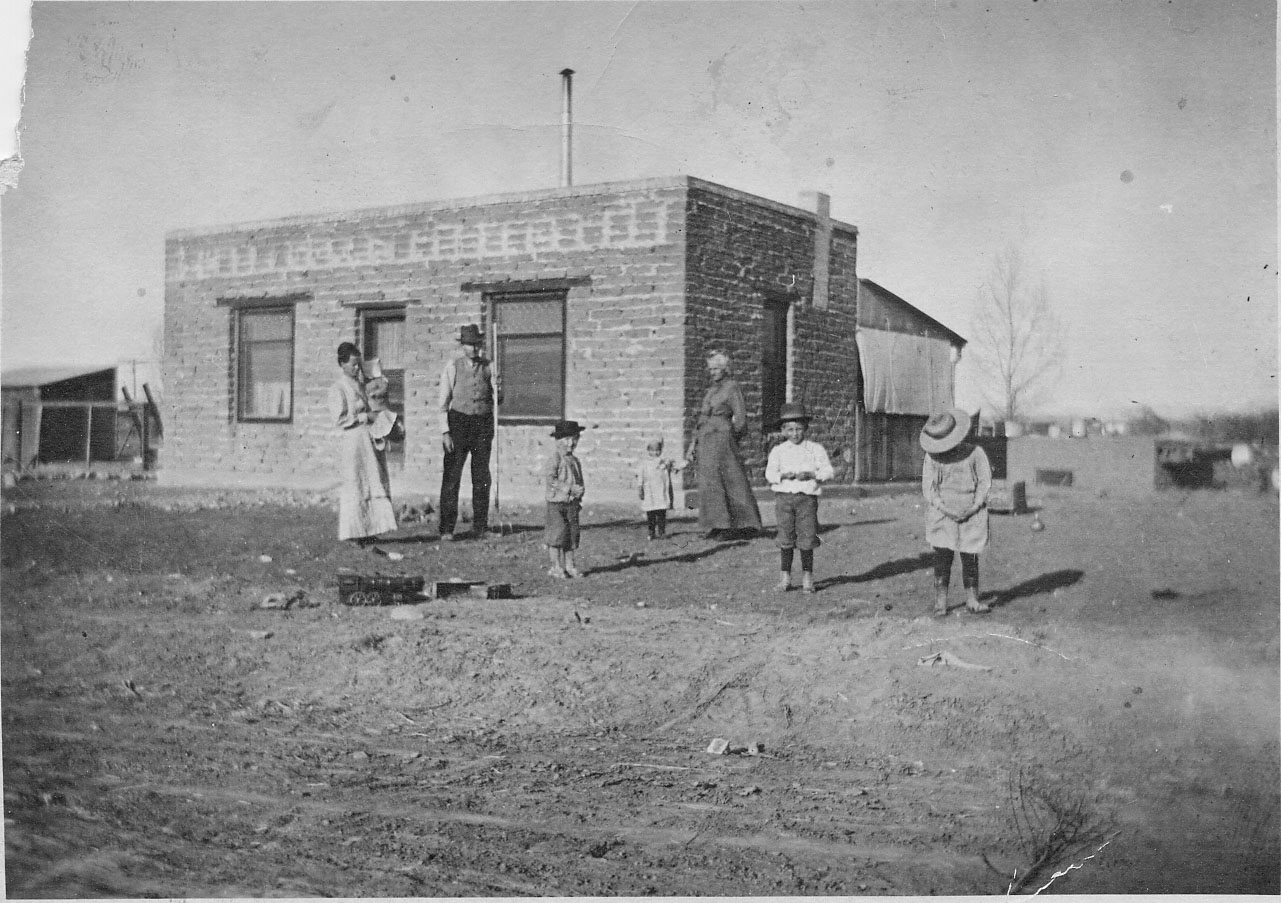
The Longs of Las Cruces, circa 1913. Peter Peterson, my maternal great grandfather who had died in Oklahoma in 1910, is absent. My grandmother is holding my Uncle Bill, the baby of the family. My father is the boy in the middle between my grandfather and great grandmother Melissa Peterson who is holding my Aunt Frances’s hand. Next comes my uncle Randolph and finally, a neighbor boy whose hat covers his face. All photos are “live.” Click images to enlarge.

I don’t know the exact date of my family’s arrival in Las Cruces, but the earliest deed to the property in this photograph that I find among my grandmother’s keepsakes is dated January 20, 1912. The land was apparently not a homestead in the strict sense. Though my grandmother’s papers include several documents pertaining to the farm property, the process by which she and my grandfather acquired it is still not clear to me. In this photo it appears a hardscrabble place, but here’s how one of his obituaries describes my grandfather and his farm.

Mr. Long was born in 1879 at Minneapolis, Minn., thus being 39 years of age at the time of his death. Later the family moved to Missouri, Mr. Long moving from there to Oklahoma, where he was engaged in the newspaper business for a number of years, until seven years ago when he came to the Rio Grande Valley for the benefit of his health.

Mr Long took a small place on the outskirts of town and in spite of the handicap of il [sic] health had made a success of it and had one of the nicest little homes in the valley at the time of his death. He acquired a reputation as a very successful grower of vegetables and as one who was peculiarly conversant with farming conditions in the valley.

I could guess that my grandfather arrived in New Mexico very early in 2012. The ill health referenced in the obituary was tuberculosis; though my grandfather died in the flu epidemic of 1919 as I’ve noted previously. He had tried a sanitarium in Colorado before going to New Mexico. In the early twentieth century not much could be done for tuberculosis, though it was thought that dry climates were better for the afflicted than wet ones. I make it also that my grandfather arrived in New Mexico in advance of his wife and children, who by this reckoning might have arrived between January and March 1912.

I’m not comfortable with these dates, however, think the family could all have arrived the previous year and it could have taken them a while to get settled on the farm. When I last visited with my Uncle Randolph, around 1992, he told me that my grandfather had gone to New Mexico first and that my grandmother and the children first traveled by train to San Antonio, Texas and then traveled from there to Las Cruces in a covered wagon. My memory is that Uncle Randolph said these events occurred in 1911. The difficulty with my projected dates in 1912 as the time of the family’s trek to the Rio Grande Valley is that at that time my grandmother would have been in the last stage of her pregnancy with my Uncle Bill. Some light may be shed on this question and others by a letter I found among my grandmother’s keepsakes from my great grandmother, Melinda Akers Long, whose grave I was unable to find last fall. I’ll quote the entire text, though it is a bit lengthy.

R. 4. Hico Texas
May 23 – 1912

Dear Olin & Adda

Your letter of the 18th came this week. I am quite strong again and am enjoying Texas very well. Marian and I took a buggy ride this afternoon to see the new baby girl at Cashiou’s. We also had quite a chat with Mrs. Autrey as we came home. Hico school will close tomorrow and then Vernon will be at home. He has done well in school and is so large and strong that he can do considerable work at home. He chops cotton pulls weeds and cuts wood evenings and Saturdays and of course can accomplish more when school is out. Atticus is also very large for his age and talks so plain that he does not seem like a baby. He carries a little hoe in the field and tries to use it much of the time.

Well, I certainly am glad that you are in your own house and are able to work. I hope nothing will successfully tempt you to do more than you ought and hinder your complete recovery. Marian found several ripe strawberries this evening so you can guess what we will be doing.

You may know it seems somewhat better to be here with Marian and well than to be at Sayre sick and the neighbors waiting on me.

Lovingly,
Mama

First things first—my great grandmother was chronically ill. Though she claims to have recovered, she would barely live out the year. The cause of death listed on her death certificate is “La Grippe [influenza] complicated with bronchitis—pneumonia.” I’m guessing that she, too, had tuberculosis. The date of this letter suggests that she had just recently heard from her son that he and his family were settled, but her comment about being “in your own house” leaves open the possibility that the Las Cruces Longs had arrived previously and stayed in rented quarters for a time.

I also learn that my grandfather was known as Olin, a fact that is confirmed by another letter from an aunt in Kansas at the time of his mother’s death in 1913. I’ve mentioned the hardship reflected in these letters. My great grandmother’s mention of cotton indicates that her daughter, Marian Curtis, and her family were not merely engaged in subsistence farming in Texas but were raising a money crop as well; and her recounting of the activities of her grandson, Vernon, who was seven (or possibly eight) years old in 1912, says a great deal about how much human labor was required by their way of life. The other grandson, Atticus, who had been named for his father’s brother, would die late in 1913 of an unspecified illness that had lasted seven months. Atticus died in Pecos, Texas, at his namesake’s home. That his parents had sent him west to live with his uncle suggests to me that he may have contracted tuberculosis as well. The image of a dying boy trying to chop cotton with a small hoe speaks poignantly of the lives of these folk.

And all these folk, the Longs, the Petersons, and the Curtises had first settled in and around Sayre, Oklahoma between 1900 and 1905. At that time what would become Beckham County had just been opened to Anglo settlement. Quannah Parker still lived at his Cache establishment not far away. The place had been part of Comancheria and before that Apacheria—before the expansionist Comanches drove the Apaches off the plains. But the Southwest was changing fast. The Longs, Petersons, Curtises, and folk like them would inherit much of it.

To be continued . . .
Getting to Albuquerque

August, 1960: an unbearable day—the temperature well over a hundred degrees on the concrete runway at Dallas Love Field where I am pitching bags off a conveyor belt onto a luggage cart, unloading one of the Vickers Viscount aircraft that Continental Airlines flew in those days. Next to me a mechanic jokes with a coworker as he takes a wad of chewing gum out of his mouth and stuffs it into the guts of a turboprop engine he’d been having trouble with. “That ought to get ‘er to Albuquerque!” he opines.

True story. I have no idea what happened to that airplane, though I certainly hope it got to Albuquerque safely. I should probably have reported that mechanic to somebody, my boss maybe—but I was too frazzled and tired and drenched with sweat (besides being too low in the pecking order) to think that. I’m a bit ashamed that I didn’t report him, though not as ashamed as I ought to be, and I soothe my conscience with the absence from my memory of any stories of plane crashes from around that time.

Thirty years later I published an essay entitled “The Ultimate West.” It has several weaknesses, the chief of which is an excessive literariness, to which I am still prone. I’m not ashamed of it though, and I’m thinking of a particular paragraph I wrote then about childhood trips to Albuquerque from Abilene, Texas: when my mother would put my brother and me in our 1939 De Soto and drive us there in one day. It still seems remarkable to me that she did that. We would usually stop in Clovis for lunch, which consisted of roast beef sandwiches at a restaurant in a small downtown hotel. I remember parking meters and brick streets in Clovis, but another memory, another kind of memory predominates.

Getting to Albuquerque was for me the most powerful of symbols. Texas was plain, New Mexico exotic and cosmopolitan. In Albuquerque I went to school with Mexicans and an occasional Indian, whereas my Texas schools protected my Scotch Irish ethnicity against cultural pollution and forced me to memorize Bible verses, which I still think of as Baptist, at school.

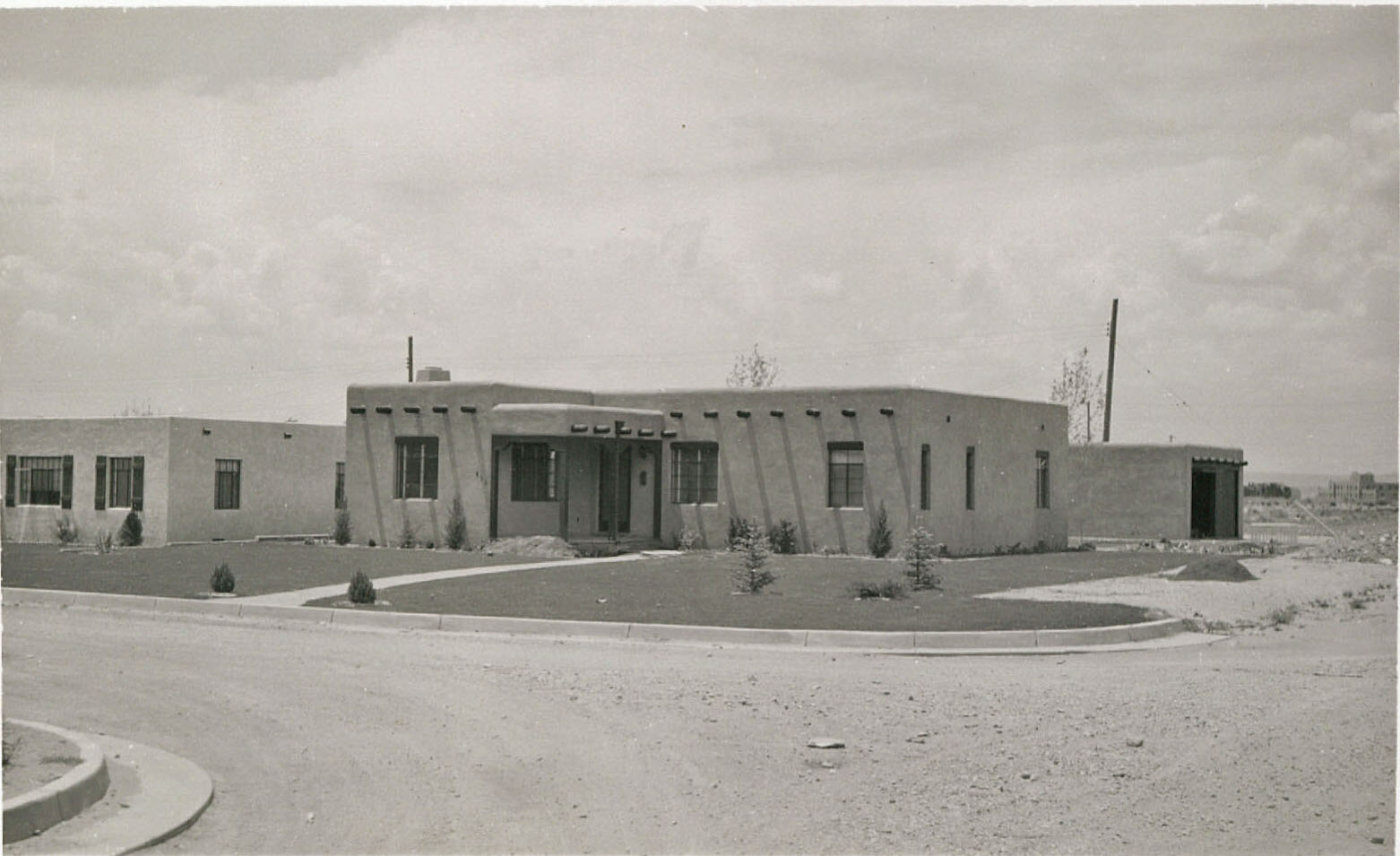
I did a lot of growing up in Abilene. It had been my mother’s family home since 1926, the place where she and my father met, fell in love, and married. We lived in Abilene with my grandparents during the early years of World War II when my father was in the Philippines. We moved there more or less permanently in 1948 after his death had been confirmed. But both my brother and I had been born in Albuquerque, I in 1937 and he in 1940. We both started school there; though I had a longer exposure to school in Albuquerque than he did, from first through fourth grade. The road trips I recalled in my 1990 essay took place between 1943 when we moved back to Albuquerque from Abilene and occupied the house my parents had built on Tulane Place near the university, and January, 1948 when we resettled in Abilene.

My parents’ Albuquerque house as it looked when it was it was new (circa 1939). All photos are “live.” Click images to enlarge.

And of course there were as many road trips to Abilene as to Albuquerque in my childhood—but although I have many cherished memories of visiting and living in Abilene as a small child and continue to love my adopted home town, it is the road trips to Albuquerque that my memory assigns to a special place among my magic things. “I could feel my heart rise in me as we passed the state line at Farwell and it mysteriously got an hour earlier.” Not even the seemingly endless succession of wolf and coyote skins strung on the barbed wire fences along the roadways dampened my enthusiasm. But in spite of the fact that Albuquerque gave me a childhood sense of something like cultural diversity, what I didn’t understand as a child was that both in Northern New Mexico and in West Texas I was living in places where perhaps a hundred fifty years of history had been erased. It is my connections with that history that I continue to ponder and with which I still strive to come to terms.

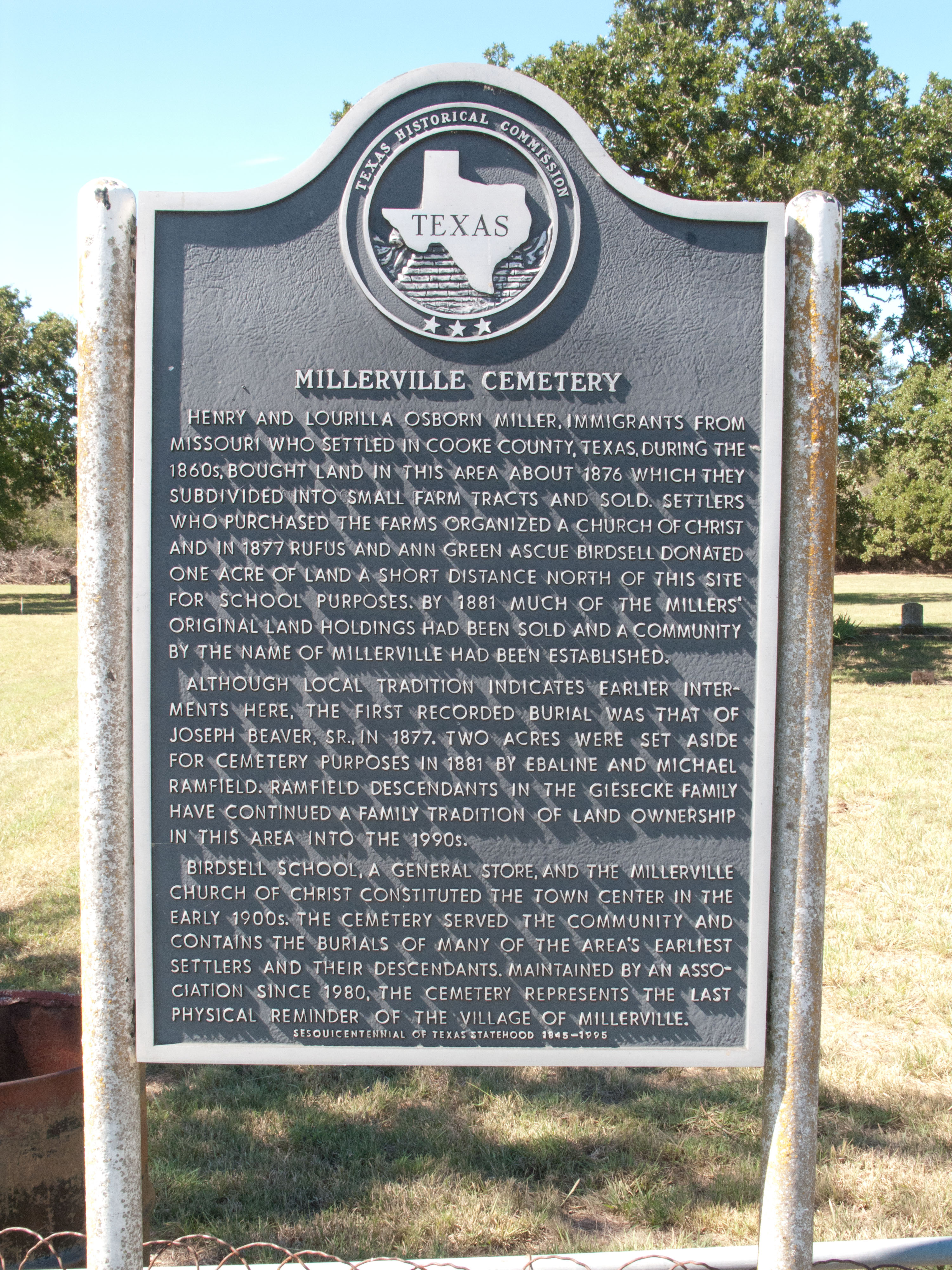
Historic marker at Millerville (TX) Cemetery.

Last fall, on my way to my annual high school class reunion, I made another road trip, in a rented car, to the Texas ghost towns of Duffau and Millerville, not far from the present day town of Hico, on the edge of the Texas hill country. I made the trip to search for my great grandmother’s grave. She is buried in Millerville Cemetery, according to her death certificate. I didn’t find her grave, but I suspect it may be one of a good many graves in the old cemetery that are marked with field stones bearing no inscriptions, or that it may never have been marked at all. Her name had been Melinda Ava Akers. She was born in 1843 in Westmoreland County, Pennsylvania, and had moved with her extended family to Bloomington, Illinois, some time before 1870. She was just shy of seventy years old at the time of her death in 1913. Her journey from Pennsylvania to Texas had been long and meandering.

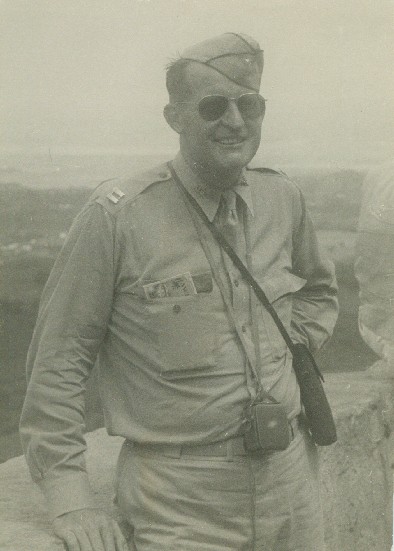
My great grandfather, John H. Long, outlived Melinda by twenty-five years, married again, and died in Los Angeles, California in 1937. I should like to know more about him and my great grandmother and his second wife, one Mary Floyd Marcoux, though I now know a good deal more than I ever did growing up, when I don’t think I ever heard their names. Apparently, my great grandmother’s death certificate mentions only one child, her daughter Marian. But Marian was the youngest of four siblings, two of whom, Florence and Raymond, are buried in New Florence, Missouri, and one of whom, James Olin, was my grandfather. Here is a photo of John Long, for which I am grateful to my cousin, Carol Flanagan. I have no idea where it was taken or when, though the subject looks to be middle aged. I’ve not been able to find a photograph of my great grandmother. John Long was six years younger than Melinda Akers when they were married in 1876. I have no idea how they met or where, though I have traced John Long to his birth in Peoria County, Illinois, not far from Bloomington. He and Melinda show up together with their then two children, Florence and James Olin, in the United States Census of 1880 in Minneapolis. Their southwards migration through towns in Iowa, Kansas, and Missouri (where they lost their two children, Florence and Raymond), would bring them to Beckham County, Oklahoma, some time prior to 1905 when my grandfather, James Olin, and Adda Belle Peterson were married at Guthrie.

Adda Belle Peterson and James Olin Long on their wedding Day.

I knew none of this growing up, perhaps because we lost contact with my father’s family after World War II. For a long time Grandma Long would come to visit every few months, but finally the visits stopped when she moved to Hawaii for a while—she too was a wanderer. The extended family of Longs and Petersons lived in Oklahoma until 1911 but seem to have split up after that, with John and Melinda and their daughter Marian, who had married a man named Orlando Curtis, going to Texas, and my grandparents and Melissa Peterson settling finally in Las Cruces, New Mexico. Here’s a photo of the Las Cruces clan, I think from 1913; Peter Peterson, my maternal great grandfather who had died in Oklahoma in 1910, is absent. My grandmother is holding my Uncle Bill, the baby of the family. My father is the boy in the middle between my grandfather and great grandmother Melissa Peterson who is holding my Aunt Frances’s hand. Next comes my uncle Randolph and finally, a neighbor boy whose hat covers his face. I never knew my grandfather, James Olin, who died in the flu epidemic of 1919, but I spent a number of happy childhood times at the Las Cruces farm—we didn’t call it a homestead, and of course I’m remembering it as it may have been thirty years after this photo was taken. I chiefly remember sleeping on a screened-in porch on cool summer nights and waking every so often as a train hooted by on the tracks close by. My memory is that the porch faced the railroad, though that could be wrong. I also remember the farm as a garden. Grandma Long kept bees and dairy cattle in addition to chickens. She raised vegetables and I don’t know what else. There was a lot of alfalfa grown in that part of the world in those days. I associate the smell of alfalfa with Grandma Long’s farm and find that smell exhilarating still.

And I think that farm was a sustainable enterprise as long as Las Cruces remained rural and as long as climate cycles allowed. Of course, all the farms in that place were irrigated. The irrigation ditch that brought water to them from the Rio Grande was the chief feature of downtown Las Cruces in those days. My mother once told me that my father and a friend wrote a book about what she called ditchwater Spanish, which my father spoke fluently she said. That expression, ditchwater Spanish, suggests to me that my father and other boys, not all of them Anglo, must have played in and around that irrigation ditch much as I and my friends sneaked away and played in the dry creeks of Abilene. I have the address of the Las Cruces farm but think it exists no more. A 1998 photo shows only the railroad right of way. I’ll go to Las Cruces and look for it one of these days. My favorite of the handful of photos I have of the place is one I’ve used before, because it shows my grandmother and her four grown children. I should say too that I am grateful for all my photos of the Long Homestead to my cousin, Lorian Choate, and her husband, Brett Martin. Another I love just for the way it shows the house, is this winter picture.

But central to the lives of all of us who gathered from time to time at that farmhouse was the fact that we were inheritors of what we now sometimes call Indian removal. We were the first couple of generations of Americans who profited directly from that experiment in ethnic cleansing. But we didn’t think of our lives that way, and part of the reason we didn’t was that history had been cleansed for us as well, in Texas by the banishment of everything native American including the people, and in New Mexico by commodification. Our story, the story of our times and our places in them, was a story of migration into a place that had been empty of human culture before our arrival, or so we thought. Our stories of heroic journeying, cowboying, and the like, neglected to mention the people who had been there before us as human agents engaged in civilized life.

To be continued . . .

into my own again

I wrote this essay two years ago in the fall. West Texas is on my mind again, perhaps because I’m going there in a few days for my fifty-ninth high school reunion. I want to write an essay about why I love my country. This isn’t it, but I thought I’d post it again for a while because whatever love I have, whether I like it or not, grows out of some hardscrabble not unlike that around my grandparents’ little house in Las Cruces, shown here in a photograph I talk about.

Recently I was sent a collection of family photographs. Among them is this snapshot taken outside the farmhouse in Las Cruces, New Mexico, where my father and his brothers and sister did much of their growing up. My father is the tall one in the middle with his hands on my grandmother’s shoulders. Her youthful appearance startles me. The elderly woman on the far left is my great grandmother, Melissa Peterson. The farm in Las Cruces was a homestead. Only my uncle Bill (standing just behind Mrs. Peterson and my aunt Frances) was born there. My father, his brother Randolph (the one with the silk handkerchief in his pocket), and his sister were born at an earlier homestead near Sayre, Oklahoma. There’s no date on this photo, but I think it was taken in 1930 or ’31. The subjects seem to be dressed in their best, on their way somewhere.

Except for my father they would all live long lives. Mrs. Peterson lived to be 82; my grandmother and two of her children would live almost a century, reaching the age of 99. Uncle Randolph, the eldest of my grandmother’s children, would live to be 94. And except for Mrs. Peterson they would all find themselves far away from Las Cruces at the end of their lives, most of their experience shaped largely by their country’s mid-century adventures in the far east. All of my grandmother’s children went to college. As I look at these images of them, see the hardscrabble under their feet and the house with its look of temporariness, I am thinking how remarkable that is.

I’ll not tell all I know of their stories now. My father and my uncle Bill were already in medical school, I think; uncle Randolph on his way up the corporate ladder in what would become AT&T. My aunt Frances would marry a man who became a Brigadier and travel widely. My grandmother, once her children were launched, would travel widely as well, living in Honolulu for a while and finally settling in Seattle. But the various fulfillments of these separate destinies were long ahead of them all in 1930—what strikes me in this photo is the seeming anticipation in their demeanor, and a certain innocence.

My title is borrowed from a poem of Robert Frost’s that anticipates the end of a long life as a time of certainty. The poem’s speaker imagines that friends he left behind, should they catch him up at the end of life’s journey, would discover him to be not “changed from him they knew— / Only more sure of all [he] thought was true.” These are the thoughts of a young man, part of Frost’s first book, A Boy’s Will, published when the poet was thirty-eight years old. At this distance they seem a recipe for closed mindedness.

**********

I recalled the lines from Frost as I was thinking about some lines from a much longer ago dead poet, Henry Howard, Earl of Surrey:

Martial, the things that do attain
The happy life, be these, I finde.
The richessse left, not got with pain:
The frutefull ground, the quiet minde:

After I factor out the mindset of the landed aristocrat, there remains in this translation of Surrey’s the still attractive classical ideal of the quiet mind; though Surrey’s own mind was less than likely to be quiet. Like Martial he lived in turbulent times. He led a dangerous life as a Catholic in the twilight of Henry VIII’s reign and was ultimately executed as a traitor. He was perhaps 30 years old when he died.

But the ideal of the quiet mind need not be thought youthful, nor need it presuppose certainty. It is a stoic ideal, conceived as a response to uncertainty and frustration, a consciousness that seeks its own in the midst of political and other stresses; and it’s sometimes held up as a goal of liberal education, a mind both copious and quiet, “liberally furnished with objects of contemplation,” to paraphrase Dr. Johnson, another latter day stoic, who between herculean labor and coping with Tourette’s syndrome and other afflictions, had plenty of mental noise in his life.

I’ve just finished a week’s reading that included, in addition to various consumables (by which I mean newspapers, blogs, media, etc.), John Gardner’s Grendel, which my class discussed last week, S. C. Gwynne’s Empire of the Summer Moon, a popular meditation on the the winding down of the Indian wars in the southwest (yet another retelling of the story of Cynthia Ann Parker, the exploits of her son, Quannah, and the capitulation of the People), and Wendell Berry’s Home Economics.

I turned to Gwynne on the recommendation of friends I encountered in my home town of Abilene, Texas where I recently attended the 57th reunion of my high-school graduating class and was struck by the realization that my grandparents had arrived in western Oklahoma around 1901 in the aftermath of the turbulent events Gwynne’s narrative brings to mind. From Gardner I took away (again—I’ve read Grendel many times now) what seems the quite reasonable claim that Whitehead was right to assign the name of God to that which limits action and energy and therefore calls forth “the entire multiplicity of eternal objects.”

And I turned again to Berry because I am trying to formulate for myself a rationale for the liberal arts in contemporary university education. I’ve previously written about Berry’s essay, “The Loss of the University.” But now I’m more interested in his thoughts on sustainability and his claim that community has economic value, because it seems to me that whatever case we make for the liberal arts in our day has got to take into account the material conditions required for their study and the material benefits of the same. If we can’t make the case that the liberal arts have practical, economic value, it is hard to argue that they have cultural or spiritual value. As Berry puts it with respect to community, “Can there be a harvest festival where there is no harvest?”

**********

Two years ago I asked my class to read Alasdair MacIntyre’s After Virtue. It’s a beautiful book, though I don’t agree with much of it, including its core argument. MacIntyre says, in a preface to the third edition, that he was not yet a Thomist at the time he wrote the book (1981); but what I think I loved about After Virtue when I first read it in the mid-eighties was its insistence on the importance of a conception of human nature. Without such a conception (and I like Aristotle and Thomas about this too) the Enlightenment notions of liberty and equality are pretty empty. Something more is required, it seems to me, as a ground for these notions than the naked assertion of self-interest—some notion of human good, potential or real, immediate or lost. Adam Smith, often cited as the godfather of neoliberal economics, believed in a moral sentiment, physically present in human being.

The enlightenment tradition has tended to emphasize private judgment, private enterprise, etc., as opposed to centralized coordination. This was liberating in the eighteenth century, when people could still be put to death for witchcraft. Now, when “The notion that every action is is both a private experience and a a public utility,” as Whitehead says, has all but died out, individual beliefs and practices tend to be asserted as near absolute private entitlements. We see this on both sides of the political spectrum, but it has particularly emerged recently in the argument against government mandated health care. Obamacare, so called, infringes on my right of self-determination. Government, so we are told, has no right to tell me, as a sovereign individual, that I have to purchase health insurance. It’s the old seat-belt argument.

Here is Aquinas’s fifth proof of God, the one I like the best:

The fifth way is taken from the governance of the world. We see that things which lack intelligence, such as natural bodies, act for an end, and this is evident from their acting always, or nearly always, in the same way, so as to obtain the best result. Hence it is plain that not fortuitously, but designedly, do they achieve their end. Now whatever lacks intelligence cannot move towards an end, unless it be directed by some being endowed with knowledge and intelligence; as the arrow is shot to its mark by the archer. Therefore some intelligent being exists by whom all natural things are directed to their end; and this being we call God.

I don’t like this because I think it succeeds as a proof. Its conclusion in no way follows from its premises. As an argument, it’s an exercise in question begging. But it’s beautiful, and beauty is truth in a way; though Keats claimed too much for the idea.

Still, my point here is that without such a conception of intelligence grounded in the material stuff of the world, the enlightenment conceptions of liberty and equality degenerate into empty assertions of individual autonomy that are easily transformed into the right to bear arms, the right not to purchase health insurance, the right not to wear a seat belt, etc. And politics aside, without such a conception the fundamental issues of ethics and aesthetics degenerate into cost benefit analysis that deserves comparison with the excesses of medieval scholasticism, or into empty claims about the timeless worth of things that we know only as inferences and extrapolations.

**********

At this point in my life I am more uncertain than I have ever been about the things I hold dear, though I am pretty comfortable in my skin. I tend to think that certainty, not uncertainty, is the enemy of life. None of us knows when he will die–that’s the fundamental uncertainty–and I don’t need to be certain about the ideas that I use, because my practice constantly confirms their usefulness. Unlike MacIntyre I embrace and celebrate democratic pluralism. To be sure, it gives us Sarah Palin and the gun toting folks in Arizona and elsewhere. But it also gives us what I identify, following Richard Rorty, as liberal hope.

Uncertainty seems basic to the hope for a better world. An uncertain person, such as I am, tends to embrace bounded ambition in regard to the potential for historical accomplishment, or social progress. But the person who seeks certainty seeks an establishment, a city on a hill, the end of history. I think history and the end of history both abide in the moment, and I am content with that. I embrace the long tradition of uncertainty in Christian mysticism. (See, for instance, “The Cloud of Unknowing.”) Rather than doctrine, I embrace prayer. I find common prayer particularly efficacious, though I have no belief in, or knowledge of, a personal god.

I am not uncomfortable with any of this, perhaps because I am a poet and grounded in poetry. I read, for instance, the ending of “Little Gidding,” as it draws together the poet’s personal quest with Dante and Julian of Norwich, as a method of being. Here are the lines:

We shall not cease from exploration
And the end of all our exploring
Will be to arrive where we started
And know the place for the first time.
Through the unknown, unremembered gate
When the last of earth left to discover
Is that which was the beginning;
At the source of the longest river
The voice of the hidden waterfall
And the children in the apple-tree
Not known, because not looked for
But heard, half-heard, in the stillness
Between two waves of the sea.
Quick now, here, now, always?
A condition of complete simplicity
(Costing not less than everything)
And all shall be well and
All manner of thing shall be well . . .

And I think of truth as but one of the conditions of thoughts that one loves. The difficulty of Truth and Truth establishments is that they drive truth (small t) out of the room. In this regard I am remembering something from Hannah Arendt, in one of her letters to Mary McCarthy, “The chief fallacy is to believe that Truth is a result which comes at the end of a thought-process. Truth, on the contrary, is always the beginning of thought; thinking is always result-less. That is the difference between ‘philosophy’ and science. Science has results, philosophy never. Thinking starts after an experience of truth has struck home, so to speak. . . .”

I’ve learned a lot from MacIntyre, even though I don’t agree with him about much. I particularly don’t agree that Aristotle needs vindication. Aristotle remains with us, as Plato does, perfectly available to the next thinker who might wish to use him as Aquinas used him, just as the Homeric poems remain available to poets. I’m not entirely sure of this, but I think MacIntyre’s use of Aristotle may be perverse. It’s not an adventurous use in any case, as Whitehead’s use of Plato is adventurous, for instance.

“In my end is my beginning.” All my grandmother’s children went to college. I loved college so much that I’ve never wanted to leave. Though I’ve knocked around a bit and seen a bit of the world, I remain primarily a mental traveler, like Joyce Cary’s “randipole Billy Blake,” perhaps not unlike my grandmother’s children, too—on my way somewhere unknown, unknowing.