 Progress Missouri has posted a new report on the activities of the American Legislative Exchange Council (ALEC) in Missouri. As of March 2013, 45 corporations and six non-profits — for a total of 51 private sector members — have publicly announced that they are cutting ties with ALEC, according to a report from ALEC Exposed. But the organization continues to make inroads into the politics of states like ours. The Progress Missouri report makes quite a read. What’s most disturbing about it, from my perespective, is that the ability of this organization of corporations to affect legislation is roughly parallel to the ability of huge pharmaceutical and agribusiness corporations to control and corrupt research about, and increasingly the production, and distribution of, food and drugs. If ALEC’s influence is waning, the influence of pharma and international agribusiness continues. And it is interesting, to say the least, to read a defense of ignorance such as this one at a blog whose subtitle is “free minds and free markets.”
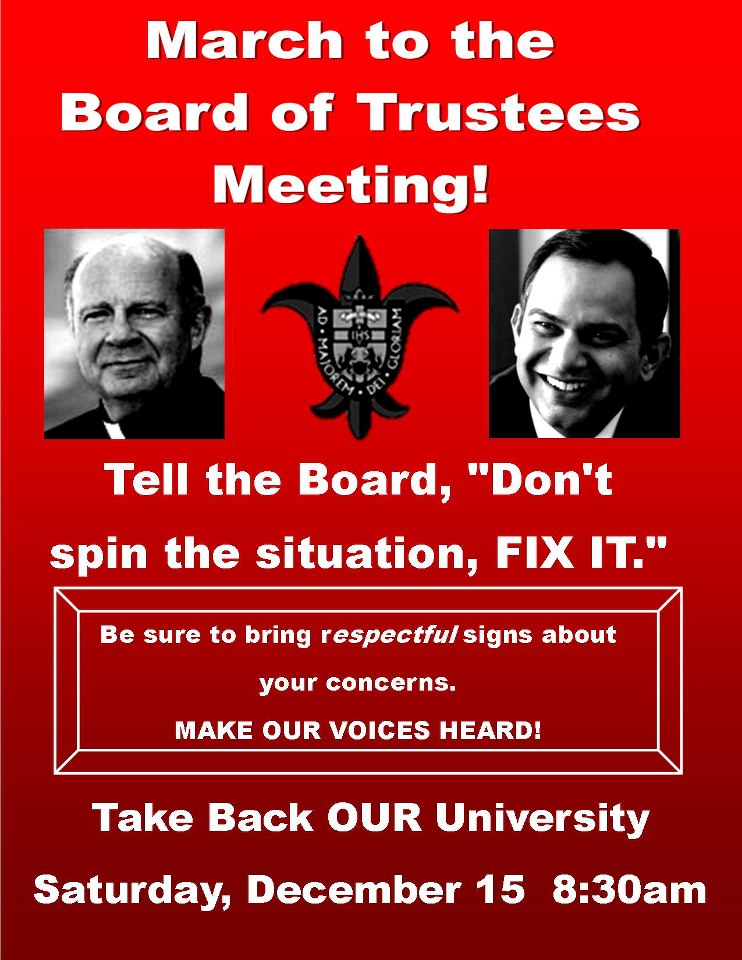
Meanwhile, SLU Students for No Confidence are reporting a disturbing incident at last evening’s meeting of the SLU Student Government Association. Apparently two faculty members were ejected from the meeting. I’ll quote the rather lengthy anonymous eyewitness report posted just a short while ago:
I arrived at approximately 5:02pm. The opening prayer was being given when I arrived, and I did not enter the room until after the prayer had ended. I stood outside with a small number of people who had also arrived during the prayer. As I stood outside, I noticed a uniformed officer standing in the vicinity of the Senate Chambers. I noted this as odd at the time, but did not think much of it after that (I did not look over this individual closely, but I assume is was a DPS Officer). I entered the Senate Chambers shortly before Vice President Alberty began taking attendance. Prior to my arrival, one faculty member I recognized was already present in a corner of the Senate Chambers. Shortly after I arrived, a second faculty member joined the first in that same corner. After attendance was taken, there was some discussion about adjusting the night’s agenda due to Fr. Biondi’s presentation.
At around 5:20pm, Fr. Biondi arrived in the company of Fr. Stark. He and SGA President Blake Exline began speaking shortly following his introduction by President Exline. The conversation occurred in hushed tones, but was clearly audible. He was requesting that the two previously mentioned faculty members be removed from the meeting, citing their presence as “inappropriate†because the SGA was a meeting of “student representatives.†The two faculty members had not caused any sort of a disruption. They were sitting quietly in a corner. Following Fr. Biondi’s request, President Exline immediately turned toward the two faculty members and asked them to leave. No protest was made by President Exline, by the SGA Executive Committee, by the SGA Advisors, or by the SGA Senators. The faculty members left willingly and without protest. The entire situation lasted less than 20 seconds from Fr. Biondi speaking with President Exline, to the two faculty members exiting the Senate Chambers. It happened so quickly I believe most people in the room did not even initially realize what had happened. My own initial reaction was to walk out of the room in protest, but I believed at the time that I would be better off remaining in the room. I admit my own regrets in not standing up and protesting the removal of two faculty members from a meeting which is open to the public, as I believe that I failed to live up to my own expectations.
Following the removal of the two faculty members, the presentation by Fr. Biondi progressed smoothly. There were no interruptions of any sort. Fr. Biondi was presented with questions which had been submitted to the Executive Committee the week before by SGA Senators. I will not provide a play-by-play of the presentation, as that would be far too long and I did not have anything with me to use for taking notes.
I will, however, mention one particularly prominent portion of Fr. Biondi’s response to the second question presented to him, which asked him why he believed the No Confidence movement had started and why it grew the way it did. The majority of his answer was slanted against the faculty of SLU, and intended to make the faculty appear irrational and vengeful. Eventually, he reached the point in the No Confidence narrative when the first major protest took place in the Quad. It was at this point that he referred to the students who were participating as being manipulated by the faculty who were taking part in the movement, and even went so far as to say that students were going because their professors (who controlled their grades) were taking part in the movement. His clear and obvious inference was that students were participating in the No Confidence protest because they hoped to get a good grade from their professor.
This week’s University News is just out. I was hoping for more information about the SGA meeting, particularly with regard to what else President Biondi may have said—but see nothing. Perhaps the online edition will provide some details in due course.
CORRECTION: This week’s University News is not out yet. I was looking at last week’s edition. Perhaps by the end of the day.