I have several home towns, and I expect I’m not different from many Americans. Lots of us have lived in a good many places long enough that we acquired a sense of belonging there that never quite leaves, so that we’re surprised and sometimes saddened to return and see changes, feeling that we’ve lost something when some landmark disappears, or thrilled and excited to note that some wonderful new thing has arrived in our absence.
Ten days ago I went home to Denton, Texas, in many ways my favorite home town; though I was not born there and didn’t attend high school there, and therefore can’t exhibit two important markers of a normal hometown claim. Still, I love Denton; it remains a funky little college town in spite of growth that places it inside what is now called the metroplex by many residents of the Dallas/Forth Worth area. And it continues unique in my mind and memory, partly because of its funkiness and partly because of its excellence.
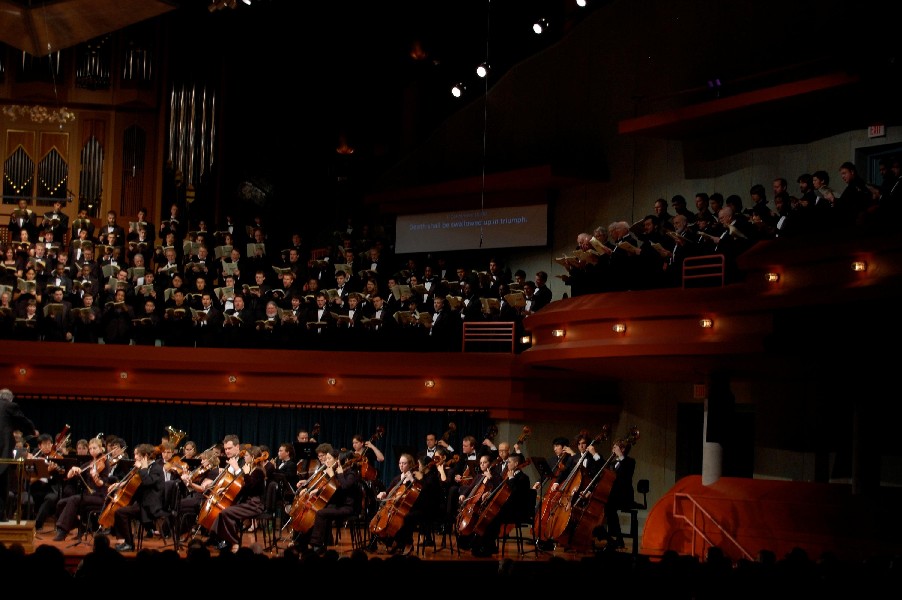
The excellent, first. I attended a performance of Brahms’ Ein Deutsches Requiem at Winspear Hall on the campus of the University of North Texas, long known for its fine College of Music. The conductor was my friend, Henry Gibbons, who is retiring from that college after after a career that has spanned thirty-plus years. The Brahms concert was his retirement celebration. The hall was packed, his colleagues were there, the stage and parts of the balcony were filled with an ensemble made up of UNT massed choirs, the Denton Bach Society (of which I was once a singing member), and the UNT orchestra.
It was a performance about which I cannot be objective. I will not attempt to review it. But I thought the choral singing superb, possessed of a clarity both of purpose and execution that startled me in the opening measures of the first movement and thrilled me to the point of tears many times. I sang with Hal Gibbons for seventeen years. Perhaps he will not mind if I characterize him as a musical humanist and suggest that his reading of the Brahms seemed to me to flow from a profound understanding of the Germanic character of the work and of Brahms’ music as a realization and fulfillment of its text.
Recordings are now available in CD and DVD format. The Denton Bach Society website offers information about ordering them — I have ordered both. If you click the thumbnail above (thumbnails in this blog are always live links) you’ll be able to see somewhat less than half the ensemble. I didn’t take this picture, but I think the photographer chose this angle to avoid including a central sound reflector, which was rather brightly lit, in the photo. On the left you can see part of Winspear Hall’s magnificent new organ, completed last year.
Now, the funky. Readers of this blog may remember that I’ve written before about a Denton neighborhood known as Fry Street. For a while I attempted to further the goals of a Denton organization that called itself Save Fry Street. Well, that organization disbanded and closed down its quite good website after a fire destroyed a number of Fry Street institutions, or what remained of them after the human beings moved out, having been evicted by a predatory developer. I took a look at the absence that is now the corner of Fry and Hickory, climbed the staircase to the roof at what is left of Cool Beans and had a beer in the middle of it. The sight was so depressing that I couldn’t stay long.
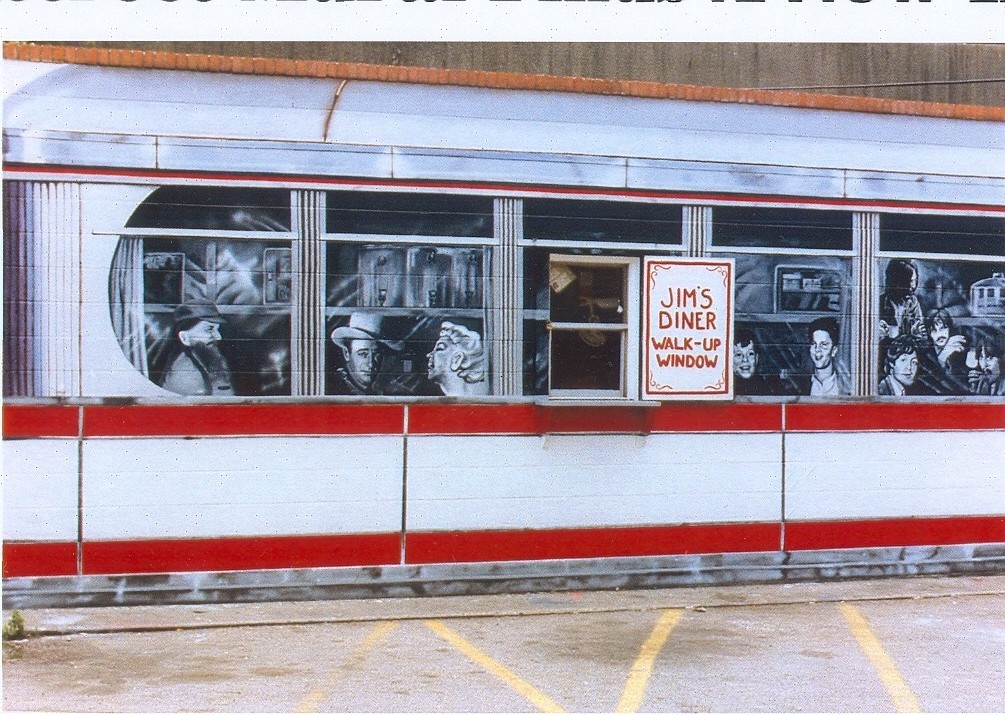
But later that evening I visited the Greater Denton Arts Council and watched as several panels were unveiled from the mural that once had appeared on the outside north wall of Jim’s diner. Here’s a photo that shows how the mural looked early on before Jim’s built a porch that adjoined it, which Bagheri’s (an Italian restaurant that replaced Jim’s) kept, along with the mural.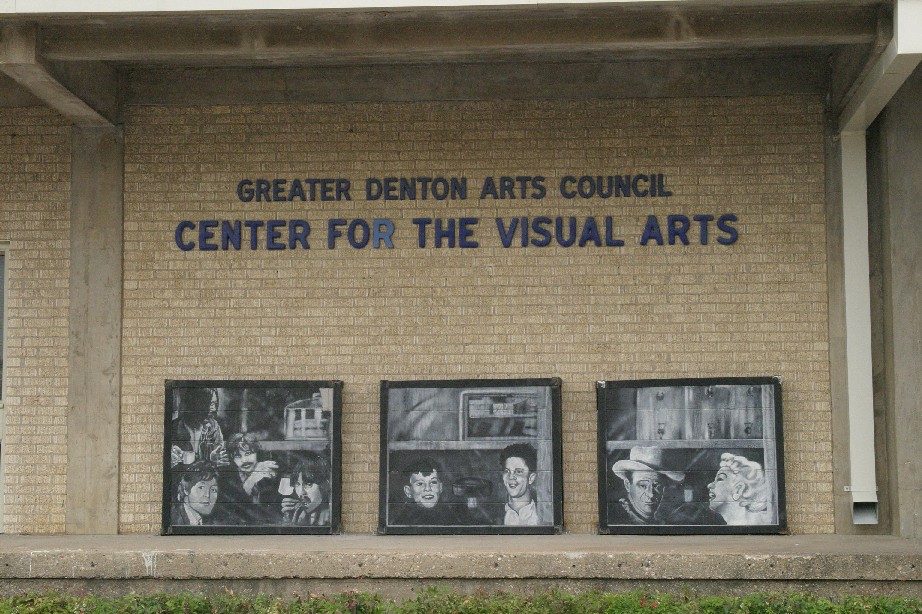 Pieces of the mural were saved from the June, 2008 fire and ultimately donated to the Arts Council. Three panels, created from those pieces of wall, are now permanently and prominently mounted at the northwest corner of the Visual Arts Center at Hickory and Bell, as you can see in the second photo. A fourth panel, made from the door whose inside you see in the photo of the mural that was, will be displayed inside the Center. I wondered why at first and then realized that the door was made of wood — a minor miracle that it was preserved.
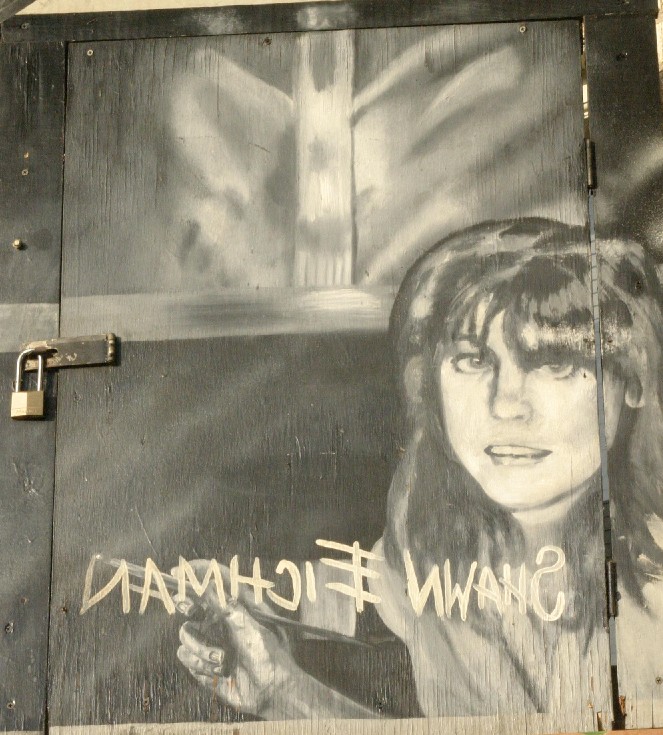 I spoke with the president of GDAC, and with old friends who live in the historic district that adjoins Fry Street, during the reception that followed the unveiling. What I could glean of the news from Fry Street in those brief conversations suggests to me that there’s not much remaining of the developer’s plans that precipitated the destruction and that new plans for the area are waiting for people to think them up as well as for the arrival of bettter economic times. I also heard of changed minds and hearts on the city council and at UNT (Fry Street sits at the northeast corner of the UNT campus. Both UNT and Denton city government at one time supported the depredations of United Equities). I think if I were one of the proprietors of the Save Fry Street website I’d be thinking of putting it up again. That voice may be both necessary and relevant in the coming months. I’ve just learned of a recent documentary about this history that looks promising as well.