
Oh Freedom

Today’s news reports announce that the Supreme Court has struck down section four of the Voting Rights Act on the grounds that its coverage formula, which determines what areas of the country must receive prior approval for any changes in voting laws (most recently revisited by Congress in 1975) is out of date. Of course that’s not the whole story. The court has not ruled narrowly. This decision is an outrageous piece of judicial activism masquerading as something else.

Last evening we watched “Brother Outsider,” the award winning documentary about the life and career of Bayard Rustin. The ten-year-old film is circulating again in honor of the fiftieth anniversary of the 1963 march on Washington, which Rustin organized. The screening was presented by the Missouri History Museum and was attended by a large and diverse crowd. It was good to see such a high level of interest for this classic memoir of the civil rights movement of the 1960s.

Most present-day evocations of the famous march focus on Dr. King’s “I Have a Dream” speech, which, though it climaxed the program, was hardly the first event of note or the only speech before the Lincoln memorial that day fifty years ago. One candid moment in “Brother Outsider,” for instance, shows Rustin walking directly behind Bob Dylan and Joan Baez singing Dylan’s “When the Ship comes In.” Rustin is casually smoking a cigarette and seeming not to listen. And what has largely been forgotten about that day is the list of demands that Rustin delivered in a speech that preceded Dr. King’s, along with the fact that the march’s full title was “March on Washington for Jobs & Freedom.” It was the brain child of A. Philip Randolph, but it could never have happened without Rustin. And the presence of both men at the center of it underscores something else we have forgotten as a people: that the civil rights movement was as much about economic justice and equality of access to the goods of our society as it was about ending Jim Crow laws.

And it’s worth noting that even during the program on the mall dissent raged between members of SNCC, particularly John Lewis, and more moderate members of the civil rights coalition over the language of Lewis’s speech. A pretty good short history of the march is here, and here’s the text of the speech that Lewis delivered that day; Lewis’s unedited speech is quoted in in material I have cited previously. Fifty years later, we live in the midst of the resegregation of America. Looking back on the 1963 march, one witness, Evelyn Cunningham, exclaimed:

I must’ve cried for an hour and a half at one point during the march. Part of it was sheer happiness, part of it was pride, and part of it was my family. I’m steeped in my respect for my people. After the march, I thought, ‘Oh my God, we’re almost there’ — God, was I wrong.

If you think resegregation is too strong a word, perhaps you should reflect on the high rate of incarceration among persons of color in this country along with the systematic attack on voting rights being orchestrated through state legislatures by the American Legislative Exchange Council. Resegregation is now widely documented, both in schools and in our civic life. The process is being exacerbated by the growth of income inequality, and Texas is moving a voter suppression measure into place as I write.

The President and many members of Congress have spoken out against the high court’s decision, but I don’t think the present congress will be able to act in support of voting rights. So what I am left with today is a host of memories and a good deal of anger. It was good to relive parts of the civil rights movement last evening in company with many good folk. This morning I have listened to the great Odetta Holmes’s recording of her matchless rendition of “Oh Freedom,” a spiritual that Bayard Rustin also sang beautifully. It would be fine to be able to think that my country has embraced civil rights—pretty to think so, to draw on another memory. No, it would be beautiful. It’s just not true.
Another Memorial Day

Last October I wrote about a photo of my father and his immediate famiily that was taken at the Long homestead in Las Cruces, New Mexico around 1930. That photo came my way at about the time I was reading Gwynne’s Empire of the Summer Moon, a reflection on the closing of the Indian wars in the southwest, the part of the southwest where I grew up and thought of those bitter conflicts as part of an ancient past. But it wasn’t ancient, isn’t ancient today.

A family history research project led me to a greater sense of connection with and proximity to the southwestern frontier than I had ever experienced before. I had visited the graves of Quanah Parker and Geronimo at Ft. Sill as a youngster, but I didn’t know then and have only recently understood that those graves are about eighty miles as the crow flies from Sayre, Oklahoma where my father was born at his family’s first homestead. That proximity and connection does not incline us to place wreaths on Indian graves at Ft. Sill. But perhaps it should.

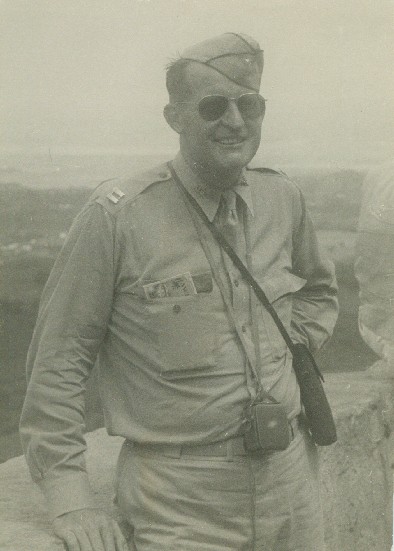
When I first started this blog, I wrote about my father, who died in World War II. I’ve always liked this picture of him, taken at Ft. Bliss during training exercises before he and his comrades in the New Mexico Militia were sent to the Philippines as the United States 200th Coast Artillery in August 1941. He was a physician and a volunteer—at the time his unit was federalized physicians couldn’t be drafted—though he didn’t want to go overseas and hoped for a long time that the unit would be reprieved. I’ve always thought service in the National Guard was part of a payback for help with medical school—my father graduated from medical school in 1932—though I’ve never confirmed my suspicion. We saw him off with his unit on the train at El Paso a couple of days after my birthday that summer of 1941. He told me to take care of my mother. Here’s a bit more of what I wrote back then, paraphrased a little.

“More recently, I’ve read many of his letters to my mother. They describe his westward journey, first by train and then by ship, to the east, his arrival, much experience in the first heady weeks of his encounter with the MacArthur establishment. He didn’t like MacArthur, but I think he loved the old brown shoe army and relished being even a very lowly Captain, as he puts it in one letter, in that foreign outpost which must have had a certain old fashioned clubbiness and esprit. Then, of course, things turned sour. The letters are fewer from mid October on, and stop altogether in late November. One letter arrived after Pearl Harbor, written from a tent on Bataan in February, 1942. He died in 1944, somewhere in the South Pacific on an unmarked prisoner ship that was torpedoed by the U. S. Navy. The story of the sinking made the papers back home, with tales of escaping prisoners being beaten to death by Japanese marines. Of course that wasn’t anywhere near the whole horror of it.

“I learned more about the Japanese death ships when I read Dorothy Cave’s Beyond Courage a few years back. Apparently the Japanese used prisoner ships, marked with a red cross, to ship munitions, but there seems also to have been an intention to exterminate prisoners by transporting them on unmarked ships. Cave’s book also confirmed my impression from family and other history that my father and his comrades had been abandoned by their government when it was decided that the war in Europe took precedence over the far east. I learned too that my mother had been a member of an advocacy group during the war, that attempted to pressure congress and the president to rescue the folk in the Philippines. I found a collection of newsletters among her effects after her death. I also found a check for $100 that my father wrote to someone with a Filipino name. It was presented to my mother for payment after the war. The letter that accompanied it explained that my father had written it for black market medical supplies that he managed to smuggle into the prison at Camp O’Donnell.

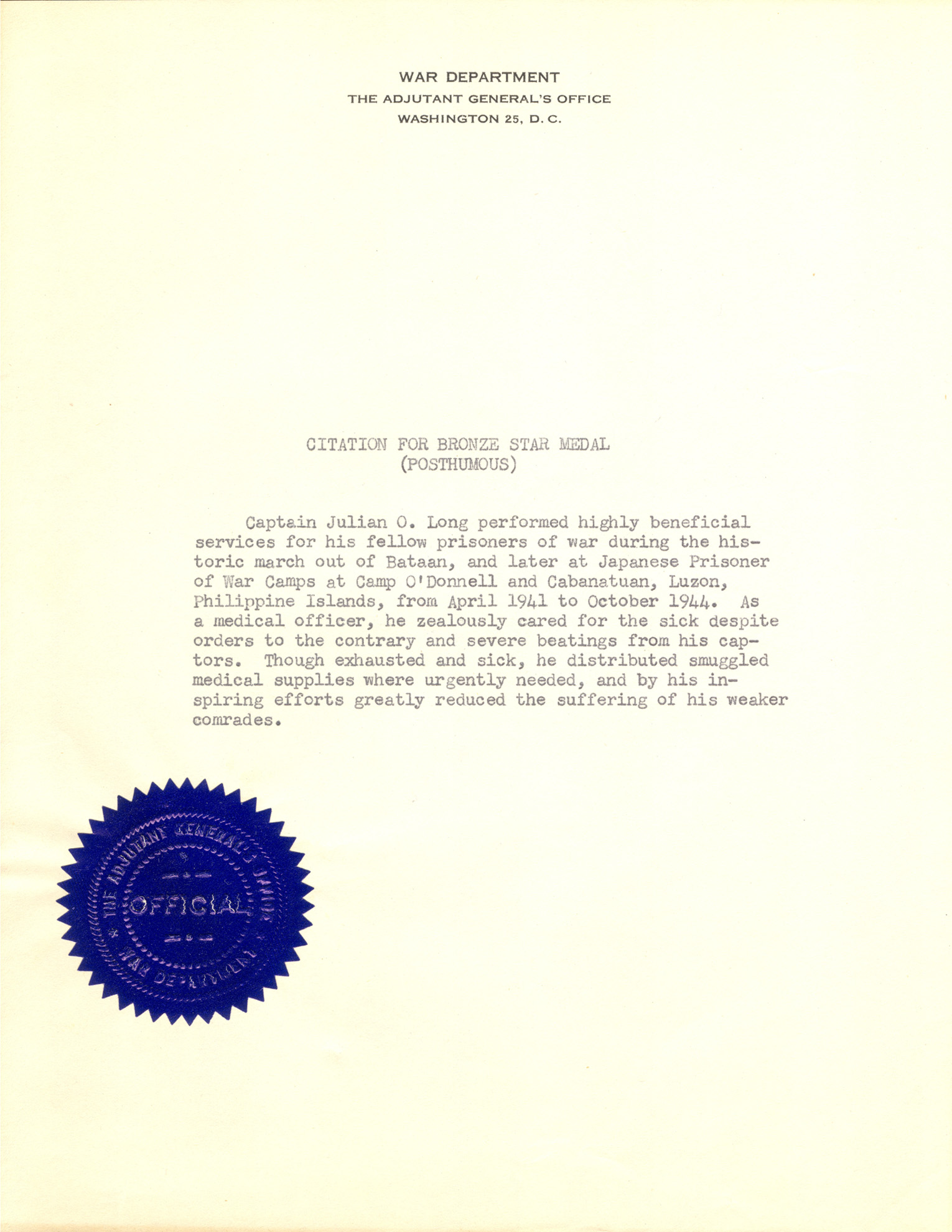
“After his death was confirmed, they promoted him to Major and gave him some medals. One was a Bronze Star, the highest military decoration awarded to noncombatants. He also received a Presidential Citation, signed by Franklin Roosevelt, which my mother always cherished. I didn’t know much of this as a child. I thought my father’s Purple Heart more important than the Bronze Star, bigger and more imposing. And for a long time I refused to believe he was dead. I fantasized that he would come around the corner of my school one day and grab me up in his arms.” There’s an error in the Bronze Star citation. It dates my father’s internment from April 1941 and should read April 1942.

My father’s regiment was sent to the Philippines because its personnel spoke Spanish. It was a multicultural unit that included native Americans as well as hispanics and anglos like my father. It had been a horse cavalry unit only recently. I remember a closet full of my father’s cavalry uniforms and riding boots. It’s a nice irony that less than fifty years after the close of the Indian and range wars, and in a place where both had been pretty fierce, there was a military regiment that included soldiers whose recent ancestors had likely fought each other over territorial and other claims, some of them genocidal, now a unit engaged in a common struggle far from home and united in part by a common language that wasn’t English.

Great Debaters

Here’s a story that makes us proud. It’s about Destiny Crockett, this year’s valedictorian at Clyde C. Miller Academy in our city, a city public school that has been a good friend to the St. Louis Urban Debate League. It is also about Destiny’s partner, Cameron Smith, a fine student as well, and the success the two of them have achieved as debaters this year, winning Missouri state championships and achieving Top 16 status at the UDL national debate competition last month. In June they’ll compete in the National Forensic League’s national Tournament as the first St. Louis team to qualify for that event.

My beloved, Kathleen Farrell, is on the SLUDL board of directors. We have watched these young people for three years now, watched them grow and succeed, and we have watched debate help them do it. These things have been beyond heartening to witness, and it is also beyond heartening that Destiny and Cameron’s sucess has unfolded in an urban St. Louis city school, which sits just north of the Delmar divide in this still divided city that is nonetheless ahead of its time. A recent essay on our city, written by anthropologist, Sarah Kendzior, and originally published by Al Jazeera, has been widely attacked, but I think it is spot on. Clyde C. Miller Academy, SLUDL, Destiny and Cameron, and their fellow debaters in this new city league are signs of hope in a city that still nourishes the dream of social justice.

Destiny will go to Princeton in the fall—she has already spent two summers there participating in debate camps and other programs. Cameron will attend Wylie College in Marshall, Texas, the site of the 2007 film The Great Debaters. Denzell Washington has recently endowed the debate program at Wylie. We wish Destiny and Cameron success and happiness in their colege careers and beyond. As Sarah Kendzior points out, the American dream may still be alive in this small city on the banks of the Mississippi. Certainly Cameron and Destiny seem to be achieving it.

Those lovesick blues, I just lost ’em . . .

I’ll be leaving this on the front page for a while. It’s not a review—you can’t review your friends’ work. Rather, it’s more in the nature of an appreciation. Appreciations are OK, and we once thought them legitimate criticism in the hands of say William Hazlitt, not to compare myself with that adorable genius.

A couple of years back I wrote about my friends, Pattie and Jack Le Sueur from Durham North Carolina. Jack had recently retired from the North Carolina Arts Council, and when I asked him if he and Pattie intended to continue performing around the Research Triangle area as they had since the nineteen-seventies, Jack told me that he was entering “legacy mode”—no more live performing, but that he had in mind to produce some recordings he and Pattie had made over the years.

The first of these (I say first hoping there will be more) is now available, a double CD/DVD set entitled Pattie and Jack Le Sueur and Cedar Creek Live at Learned Place. I hadn’t known about Learned Place, but here’s a history written by proprietors, Deborah Jakubs & Jim Roberts, that’s included with the discs. As you can see it’s as much about Pattie and Jack and the album as it is about the venue. I’ll quote it all in hopes it will interest readers as it interests me.

Learned Place Music was inspired by chance encounters and our growing friendship with Pattie and Jack Le Sueur, first admiring their performances at the wonderful Cedar Creek Gallery in Creedmoor, then conversations at kids’ soccer games. Having expressed admiration for their music, we were invited to hear them play an opening set at Peter Kramer’s farm in Orange County featuring a trio then barely known in the US – the Krüger Brothers. Not only did we hear the amazing Krüger Brothers for the first time, but we also met the full Cedar Creek band, with the multi-instrumentalist and fine singer Rick LaReno on banjo and lead guitar and Mike Foster on bass. Our sons were soon taking private lessons with Rick, and we became groupies of Pattie & Jack Le Sueur and Cedar Creek. And the Krüger Brothers, who have several times collaborated musically with Pattie and Jack and Cedar Creek. [You can read about the Krüger Brothers here. JL].

These friendships inspired us to begin sharing our home for acoustic music performances, what we dubbed Southern Roots music. We are now in our tenth year of the Learned Place Music series and have hosted over 50 concerts. Pattie & Jack Le Sueur and Cedar Creek took part in many of these performances until they ended their collaboration in 2009. This album, with songs recorded between 2003 and 2006, shows both the evolution of the band and the concert series. Through it all is the astonishingly beautiful singing of Pattie Le Sueur, punctuated by some great lead singing by Jack and Rick. In all our experience, it is hard to imagine a finer singer than Pattie. Were it not for day jobs and family commitments, these folks could have been making a mark on the musical world anywhere. But they chose Durham, and we are grateful. Their music is timeless and beautiful and rendered extraordinarily well in this collection.

This is a great collector’s item for fans of Pattie & Jack Le Sueur and Cedar Creek, for the faithful supporters of Learned Place Music, and for anyone devoted to fine acoustic music.

The album contains 34 songs. My favorites at the moment are the second two songs on the first disc: “The One Who knows,” a Dar Williams song about breaking away and letting go that Pattie calls contemplative. It displays some of the best things Pattie does as a singer, quiet and thoughtful things that require mastery both of her voice and of the microphone, as well as maturity and interpretive insight. My other favorite is “Lark in the Morning,” a wistful Kate McLeod song about loss and the memory of love–how’s that for country?–that Pattie and the boys in the band almost turn into a dance hall stomp. I say almost because the song their way still retains its seriousness. It just doesn’t protest too much. For a sentimental listener like me this song is the true gold, in the vein of A. P. Carter, et al.

Rick LaReno does some fine guitar picking in “Lark in the Morning” and many other songs on the album. For the second disc opener LaReno turns a performance of folk chestnut, “The Fox,” into an occasion for some splendid guitar riffs. He also sings well, especially in John Gorka’s “Gypsy Life,” and plays fine Scruggs style banjo. Mike Foster, the bass player, doesn’t get the spotlight much, but provides the solid bottom of the music that never rings false, sings harmony vocals, and sometimes contributes a bit of percussion by thumping his big resonator guitar.

Pattie and Jack’s son, Jon Le Sueur, a professional musician and filmmaker in his own right, plays guitar and accompanies his mother on “A Stor Mo Chroi,” a traditional Celtic lament; and daughter Sarah Le Sueur joins in the choruses of country favorites “New Night Dawning” by John Poythress and Tammy Kidd and Delbert McClinton’s “Two More Bottles of Wine.” Michael Borstleman and Jens Krüger fill out the ensemble with mandolin and banjo as needed.

All in all this new album is a great romp that spans genres from traditional folk to contemporary country and rockabilly. There’s even a good yodeling song, Jimmy Rogers’ “When the Cactus is in Bloom,” that shows off Pattie’s skill as a vocal acrobat. Jack’s “Administrator’s Blues” is included and his lovely wedding song, “Two Paths,” but not his “Waisting My Time,” which I miss; though I already have that song on Pattie and Jack’s earlier CD, Two Paths.

The back and forth banter as Pattie introduces the songs provides more good fun. At one point she quips that Jack is in administration, and Jack fires back that she (of course) is not, eliciting a big laugh all around. One has the sense that the jokes are as familiar to these friends as the songs are. There seems an easy camaraderie between them all, performers and audience alike. Jack plays mostly second guitar, filling in the rhythms and the harmonies, sitting back and letting others take stage. He was always good at that, though I’m sure that much of the thinking that shapes these performances is his.

On the whole this album seems exceptionally well-produced. The sound quality and the mixing are excellent, and the video quality is high. There are some flaws here and there, places where feedback intrudes, an intonation problem or two. But I think such things are to be expected in recordings made at live performances. What one gains from such recordings is a special kind of presence, something more than passion, a kind of focused immediacy, what Hazlitt called gusto. These are fine musicians at the height of their powers performing music that has become part of their being—for an audience of friends and neighbors to whom they are physically present.

Buy this album. It’s available from jack.lesueur@earthlink.net. Prices are $20 for the DVD, $15 for the CD, or $30 for both—plus shipping, of course. I’ve got both, so that I can watch indoors and listen in my car; and I plan to buy more copies for gifts to friends and family.