
secure in our persons

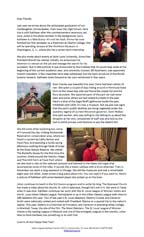
Between the years of 1969 and 1972 I had a brief love-hate relationship with a 1959 Porsche. The model on the right is from 1958 and somewhat cleaner than the car I owned, but in all other respects that’s my car. Also during those years I commuted back and forth four days a week from Durham, N. C., where I lived, to Fort Bragg, N. C., where I was attached to a branch of North Carolina State University.

My work was in the evenings. Usually I finished teaching at 9:30 and drove back to Durham after that. I didn’t drive the Porsche much because it wasn’t entirely dependable and I had visions of being stranded in the dark on the lonely farm road between Spring Lake and Lillington. But on one particular night, when circumstance had dictated that I drive the Porsche, I had an interesting encounter.

Somewhere on that dark stretch of road I mention, full of curves and declivities that could fill up with fog and make for chancy driving, especially in an old vehicle with a six-volt electrical system, I noticed that a car behind me kept moving up uncomfortably close to my rear bumper and then falling back. At some point I began to move over as far as I could to the right edge of the road (which had no shoulders) and blink my lights to invite the car to pass, but to no avail.

Finally I saw a flashing blue light and pulled off the road onto a grassy patch. After I showed the policeman my bona fides, I was asked what I was doing on the road at night. And though I had every right to be where I was and knew I had broken no law, I explained politely that I worked at NCSU Ft. Bragg and was on my way home to Durham after an evening of teaching my classes.

The policeman then told me that he had stopped me because I seemed to be driving erratically, weaving about on the road, and he had feared I might be drowsy. Both he and I knew that I had only been weaving about because his intrusive headlights had alarmed me, but I thanked him for the warning nevertheless. He returned my bona fides, reminding me to be careful, and allowed me to go on my way.

I had been profiled. I was driving a strange foreign car on a N. C. farm road at night where I didn’t belong. I don’t know what that young police officer thought he would find in my car, but he was surprised not to find it and a bit chagrined, I thought. These days I would likely have been ordered to get out of my car, perhaps required to submit to a search. That was then.

XXX

The dog days finally arrived in St. Louis last week as the streets of Ferguson cooled down. Sunday’s Post Dispatch carried a full page ad from the National Association of Police Organizations expressing support for Officer Darren Wilson and portraying police nationwide as suffering public servants intent upon the protection of citizens and grief stricken that “a life was cut short in this case.” It’s a well-crafted letter, but its claim of solidarity with the motto “To Serve and Protect” rings false to me in light of the spectacle we have witnessed in this city. To my mind the militarized and provocative police response to citizen outrage over the killing of Michael Brown is of a piece with the killing, itself; and both are cases which display the disturbing fact that citizen control of police has become a mere myth. Police are out of control, and the law protects them.

To be sure there were looters among the protesters. Shots were fired. Molotov cocktails were thrown. Some journalists abused their freedom. But most arrests were for procedural violations, mouthing off at police, stepping off a sidewalk, failure to move rapidly when ordered to do so by police. A few carefully crafted photo ops showing Captain Ron Johnson of the Missouri Highway patrol hugging protesters hardly weigh in the balance existentially, however much they may have done from a public relations standpoint. In spite of the change on the ground after Governor Nixon replaced local police with the Highway patrol, what we have seen in this city, and what we continued to see as protests continued, is far more correctly characterized by a statement from a Los Angeles police officer quoted in Daily Kos several days ago [emphasis added].

Regardless of what happened with Mike Brown, in the overwhelming majority of cases it is not the cops, but the people they stop, who can prevent detentions from turning into tragedies. […]

Even though it might sound harsh and impolitic, here is the bottom line: if you don’t want to get shot, tased, pepper-sprayed, struck with a baton or thrown to the ground, just do what I tell you. Don’t argue with me, don’t call me names, don’t tell me that I can’t stop you, don’t say I’m a racist pig, don’t threaten that you’ll sue me and take away my badge. Don’t scream at me that you pay my salary, and don’t even think of aggressively walking towards me. Most field stops are complete in minutes. How difficult is it to cooperate for that long?

Much has been written about the lack of transparency in official responses to the shooting of Michael Brown, but lack of transparency is hardly the issue when Ferguson police have seemed inclined to shield Oficer Wilson and to portray Michael Brown as a criminal. And in the final analysis whether Brown was armed, how many times he was shot, whether his hands were up, indeed all the aspects of this miscarriage of justice that “shock the conscience,” will carry little, if any, weight in law. For present law is so skewed in favor of police power as to make it well-nigh impossible to hold a police officer accouuntable for injuring or killing a citizen, no matter how egregious the officer’s conduct may have been.

The stern likelihood is that there will be no justice for Michael Brown. The probability is that Officer Wilson, who (as the Post Dispatch pointed out in an early editorial) is being given all the benefit of the due process his actions denied Michael Brown, will be found to have acted within established guidelines for police conduct. What actually happened in the Brown/Wilson confrontation may remain in dispute. And even if clear and irrefutable evidence emerges that Wilson shot Brown after Brown had made a gesture of surrender, a court would only have to find that Wilson had a “reasonable perception of being threatened with bodily harm” in order to exonerate him.

Even if the officer made a mistake in shooting, that will not be enough to support criminal charges so long as his mistake was reasonable — a determination in which the officer will receive some benefit of the doubt because of the split-second judgments that he had to make.

Or again:

Experts on police shootings say the investigation, including the grand jury deliberations, will focus on whether Wilson had a reasonable perception of being threatened with bodily harm. The experts say it does not matter how many bullets Wilson fired. Police are trained to shoot at the center of mass and stop the threat.

The Supreme Court established the reasonable expectation standard in the 1989 Graham v. Connor decision, denying redress under the fourteenth Amendment to a diabetic victim of police brutality who had been assaulted in a situation where he had committed no crime, had sustained multiple injuries including a broken foot, and then had been unceremoniously dumped in his front yard by police when they could find no crime to charge him with. The court also narrowed the fourth amendment protection in this case requiring that the defendant prove that police had injured him “maliciously and sadistically for the very purpose of causing harm,” in effect requiring proof of premeditation, a standard so high as to render citizen redress almost impossible. The consequence of this deplorable decision has been to give police carte blanche to abuse citizens. And of course the most egregious abuse this decision has fostered has fallen upon members of socially marginalized groups, racial and ethnic minorities, the mentally ill, the elderly.

Nevertheless it appears that there is popular support for the standard. St Louis Police shot and killed Kajieme Powell a few days ago, an apparently mentally ill man who behaved erratically, brandished a knife, and called out to police to kill him. Acording to a witness, “The man was agitated and animated. He said, ‘Kill me!’ They didn’t have any alternative.” Nobody seems to be questioning that assessment. Police killed the man, declared the incident to be suicide by cop, and that was that. The Supreme Court’s mapulation of law regarding the bill of rights over the past half century or more now allows police to kill citizens even when police behavior “shocks the conscience.” And with a handy citizen witness whose conscience was not shocked by the Powell shooting, everything seems perfectly copacetic. (See James Boyd White, Justice as Translation, 103ff., re “shocks the conscience”).

Senator Claire McKaskill intends to conduct hearings into the police militarization that was on display in Ferguson over the past few weeks. We should all support those hearings. But unless Congress and the courts act to restrict police power to conduct searches and seizures, there’s very little hope of changing the culture of policing or the relationship between police and citizens. Here’s the fourth amendment.

The right of the people to be secure in their persons, houses, papers, and effects, against unreasonable searches and seizures, shall not be violated, and no warrants shall issue, but upon probable cause, supported by oath or affirmation, and particularly describing the place to be searched, and the persons or things to be seized.

Long before the appearance of privacy issues that inform most popular concern over the fourth amendment these days, citizens of this country were no longer secure in our persons. And after all is said and done about the many economic, societal, and historical injustices that may have combined to produce the spectacle we have witnessed in Ferguson, Missouri over the past several weeks, it is the loss of the right to be secure in our persons that ought to disturb us the most.

ramblin’ boy

Here’s my two cents about Pete Seeger.


You needed to hear him live, to see him and witness the display of energy, artistry, and sheer chutzpah that was a Pete Seeger concert. After that you felt you knew him a little, didn’t need to ask him for an autograph or speak to him in the press of fans that had surrounded him even on stage. I heard him at Duke, one evening in spring 1968 I think it was. Page auditorium was sold out. People were sitting in the aisles and on the stage so that he had only a small circle to walk around in. He sang flat out two hours and then did some encores, just him. No band, no light show, no overproduction, nothing except what came out of his skinny body, that long-necked banjo, his big twelve-string guitar, and the sweet wooden flute he sometimes played. He was huge.

He was an American original, perhaps the best of a generation of American specialty pop singers who gravitated towards a multiplicity of ethnic genres they weren’t born to, made them their own, made them new, added to them, turned them to the purposes of social and political protest. He started no movements, not even the folk-music revival, but he emerged as a folk hero, a leader, and a moral force at the time when roots music was beginning to be big business. Following Paul Robeson and Woody Guthrie, He remained a proud leftist throughout his life. Though he left the Communist party after the excesses of Stalin, as many did, he remained a communist with a small c, as he once said. And unlike many ex-Communists of his period, he did not turn to cold-war advocacy, to neo-conservatism, or to any of the other forms of easy super-patriotism available in the second half of the twentieth century.

Nor did he shy away from controversy. Along with Guthrie and Lee Hays, his wife Toshi, and his small children, Seeger was assaulted by a mob after his appearance along side Paul Robeson at Peekskill, New York in 1949. In 1951 e was convicted of contempt of congress and sentenced to a year in jail after refusing to answer questions put to him by the House Un-American Activities Committee, though the conviction was quashed. Later, he and the rest of the Weavers were blacklisted and placed under FBI surveillance throughout the McCarthy era. The John Birch society sometimes picketed his concerts. During the civil-rights movement and the Viet Nam War protest, he was always in the front lines. The story is apocryphal that he attempted to cut off Bob Dylan’s electrical supply with an axe when Dylan appeared with a rock band at the Newport Folk Festival in 1965. But why not, after all? Dylan had abandoned not only acoustic music, but social protest as well. From his Viet Nam era protest to his attempts to clean up the Hudson river to his recent leadership in the Occupy movement, Seeger has always been true to his roots in the radicalism of the thirties’ labor movement.


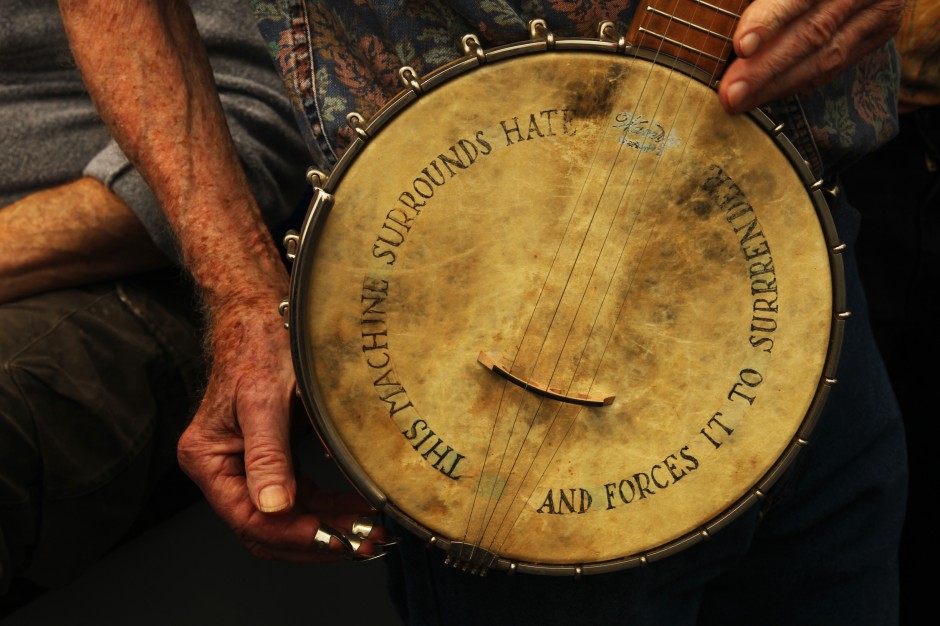
He also “put together” a good many songs, as he sometimes said. And some of his best known songs are associated with other singers who covered them and whose recordings became more famous than his: The Byrds for “Turn, Turn,” Peter, Paul, and Mary for “If I Had a Hammer,” which Seeger wrote with Lee Hays; though not “Waist Deep in the Big Muddy.” Many obituaries cite it, partly to point up the adversarial side of Seeger’s career and partly, I think, because Seeger never ceased to own that song. My personal favorite Seeger song is mentioned, or quoted, in none of the obituaries I have read. It is this one, the words by Idris Davies. Seeger found them in an essay entitled “Welsh Poets” by Dylan Thomas, that appears in the volume Quite Early One Morning. It features not the famous hate surrounding banjo but the dark sound of Seeger’s twelve-string guitar. The back story involves a Welsh coal mining disaster and the failure of the British general strike of 1926. The Birds’ version is more famous, but I like Seeger’s own.

Seeger first recorded “The Bells of Rhymney” on a live album made at a 1957 Carnegie Hall concert he and Sonny Terry presented together. In the notes to that album, he documents the guitar tuning and fingerings he used for the song and says some charming things about it, one of which is that the tune is pretty much the same as “Twinkle, Twinkle, Little Star.” My vote for the best Seeger obituary goes to this one. And it doesn’t change my love for “The Bells of Rhymney” to admit that I can still hear him singing “You can’t scare me, I’m stickin’ to the union!” I could wish him rest, but I can’t think of him resting any more than I can think of him dead. He was no twinkling star—he burned bright and hot, and if he’s now burned out there’s no black hole. He’s off rambling somewhere With Guthrie and Hays and his other pals, like it says in the Tom Paxton song he loved to sing.

Twelfth Night

Love and joy come to you,
And to you your wassail too;
And God bless you and send you
A Happy New Year . . .

Today is the twelfth day of Christmas; the festival ends some hours from now, on Twelfth Night. In times past the celebrations would have included mumming and wassailing that would have been going on for days, as barriers of class and rank relaxed temporarily and the Lord of Misrule commanded festivities in the courts and great houses of Europe. The popular carol we know as “The Twelve days of Christmas” is a remnant of this past.

According to legend, it was the beauiful Princess Rowen, daughter of the legendary Saxon mercenary, Hengist, employed by equally legendary British King Vortigern, who introduced the custom of Wassail to Britain. Approaching King Vortigern with a golden bowl filled with wine, she offered to toast his health, saying “Lauerd King, wassheil” to which the king was instructed to reply with the word, “drincheil” before imbibing. Vortigern was so beguiled that he sought the lady in marriage and immediately began to give away pieces of his kingdom to her relatives. I first encountered this story in Geoffrey of Monmouth’s Historia Regum Britanniae, but Geoffrey had translated it almost verbatim from another pretty much legendary poet we know as Layamon.

Christmas revels have been variously intertwined with pagan celebrations of the new year pretty much from the beginning. In the English speaking world, January 1 was first appointed as the beginning of the new year by William the Conqueror in honor of his own coronation, and secondarily as the traditional date of Christ’s circumcision. The practice, which came to be known as circumcision style dating soon gave way, however, to the older practice it had replaced, which began the new year with the Annunciation, and appointed March 25 as the day of celebration.

The confusion of dates and dating is partly a result of confusing solar and lunar calendars; our present New Year’s day more or less inaugurates the solar year. In 1582 Pope Gregory XIII appointed January 1 as the beginning of the new year, and that date was adopted widely on the European continent. In Britain and the British colonies, however, March 25 continued to be celebrated as the beginning of the new year until 1752, in the American colonies as elsewhere. Present-day arguments about Christmas in the United States have mostly to do with developing pressures to celebrate or to deplore multiculturalism, but the winter festival has always been a time of cultural dissonance.

We recall, too, how the winter festival comes bearing the faces of Janus, the Roman god who looks forward and back, for whom the month of January is named. Light in darkness, ease after war, joy after pain, love and hate, springtime and harvest, youth and age, the coming and going of things. And there is that other as well. “Pity would be no more/if we did not make somebody Poor”—Blake calls it the human abstract, the source of discontent and its like, indifference. The watchmen on the heights at Advent looked backwards towards the death of time and called us to a new wakefulness, a new sensitivity (not different from the old) to the issues of life and death that are woven into the fabric of our being whether we like it or no.

Shall we survive the winter? It is always a question of how much warmth we can husband about us, but if it is we who are to survive it is always a question, too, of how much warmth we can share. Such warmth (which is also warmth of heart) is not a commodity but the pearl of great price. We are given it for a time only that we may give it away.

Next Winter comes slowly, Pale, Meager, and Old,
First trembling with Age, and then quiv’ring with Cold;
Benumb’d with hard Frosts, and with Snow cover’d o’er,
Prays the Sun to Restore him, and Sings as before.

Are change and decay, like growth and presence, built into the nature of things? And do we do them honor in this time when the world turns upside down—is that what it means to celebrate the death of time? “I should be glad of another death,” says Eliot’s Magus. This, in solsitio brumali, the very dead of winter.

Cultural dissonance ought not to blind us to the hospitality and generosity we honor and hopefully extend to others at this season. These have been part of the winter festival as we know it, both Christian and Pagan, for many centuries. The mumming and wassail are reminders that generosity and hospitality are owed among humans. To deny them is not only to deny compassion to others, but also to deny what is best in oneself, to make oneself a worse person. That’s the lesson Ebenezer Scrooge learns, what legendary Wenceslas (about whom I wrote last year) already knew, the lesson Dives in Jesus’ parable fails to comprehend. At bottom, it isn’t a rational lesson; indeed some forms of theology may be its enemy. There are problems with the idea of setting aside a season for honoring generosity and hospitality, but perhaps we need to be reminded that these virtues and their grounding in love of one’s companions are basic to civilized life.

As I say, it’s the twelfth day of Christmas, but Twelfth Night can be understood to conclude a festival time that begins with All Hallows Eve and is perhaps associated in the remote past with the ancient Celtic Samhain and the Roman Saturnalia. Death and rebirth, “Sorrow to sorrow as the sparks fly upward“: all of which might serve to remind us of Shakespeare’s play, which features reversals and misrule of many kinds, though it ends happily as we like to think the twelve days of Christmas do. After all it’s the Bard’s best fool but one who reminds us at the close that the world began a great while ago.

Here’s our holiday letter. Just click on the image to open it. Love and joy to all.

last Advent

So, what horizon do I look towards as Advent closes?

Perhaps not a new miraculous birth, but a couple of posts ago I wrote about some signs of the times that give me pause. Here’s one that gives me hope. Just hours ago my long-time Internet friend, Hadar Aviram, swam the length of the Sea of Galilee. I can’t even imagine swimming nine and a half hours, and Hadar is quick to point out that she did not do it all by herself, having been assisted by members of her family and friends. You can read various narratives and see some photos here.

Hadar’s swim raised funds for Beit Dror, an Israeli shelter for homeless LGBT teens. According to the shelter’s website, it is “the first and only center designed to meet the needs of out-of-home GLBT youth in Israel, and one of the few similar institutions in the world operated by governmental organizations.” Opened in 2002, Beit Dror has a modest program at present, but its goals call for expanding programs and services. Hadar’s fundraising goal was a modest $2000, which she has substantially exceeded. I want to tell another story now, but I’ll come back to this.

My calendar shows that December 29, 1957 was a Sunday. I’m thinking it must have been that evening I found myself driving back to Dallas from Waxahachie, where I had a church job. I’m sure it was late, after an evening service. I was driving my four-year-old Oldsmobile 88, a lemon for sure; I had to shift the Hydramatic manually. I had traded a beautiful De Soto coupe for it, but it had a twelve-volt electrical system, whereas the De Soto had an old-fashioned six volts, which made for dim lights at night and bad radio reception.

The Oldsmobile had bright lights and a great radio. That evening, December 29, 1957 (if that’s when it was), I was listening to Monitor, the NBC weekend radio service, as host Dave Garroway mused ironically about quirky things in between news episodes with Chet Huntley, and skits by Bob and Ray and Mike Nichols and Elaine May and other Monitor regulars. At one point, Garroway chuckled about how Americans had been down recently because the Soviets had launched Sputniks one and two and made us feel inferior, or at least a little insecure. Indeed the Soviets’ capture of the lead in the space race, a race we Americans didn’t even know we were running until we found ourselves losing it, had become a major political issue at the end of 1957. Sputnik two had carried a dog and weighed a thousand pounds. We Americans didn’t even have a Rocket capable of launching such a behemoth.

But we had launched a Santa Claus, as Garroway pointed out with a gentleness that gave the cliché some cover, who had been sighted many times orbiting the earth (or at least our part of it) just days before, as he had since time immemorial. I was twenty that year, old enough to have been stung in a bad car deal, and it still embarrasses me a little to acknowledge that for a moment I took some consolation and perhaps a bit of hope from Garroway’s sentimental ramble. We had launched Santa Claus, that particularly American myth figure, whom my Grandmother had taught me to think was the spirit of Christmas: brash, jolly, generous, full of good will, and fearless—all that and a lover of children, somehow the guarantor of the good middle-class world many of our parents in my generation had died, we thought, to preserve in the preceding decade.

The Soviets might have the better of us for a little with their beeps in the night and thousand-pound flying dog houses; they may have stolen Eastern Europe and China from the good world. But Americans knew we were not totalitarians in the depths of our hearts. We were still a long way from achieving racial and economic justice, but we had repudiated McCarthyism. Our understanding of life and the world and the social contract we had based upon it offered more of the goods of life, more liberty and prosperity than any other. It disturbed us a little that some outside our country thought of us as ugly Americans, but we wished them well as we did our best to spread the same liberty and prosperity we enjoyed around the planet. Or so we thought, some of us at least.

Why think of this now? Perhaps because I hope my fellow citizens have not lost the naïve impulse towards human good will I took from Dave Garroway on my evening road home that fifth day of Christmas so many years ago. It’s problematic, to be sure. We err in its service, as I have often erred. But it’s the best thing about us as a people. Still, if the last century taught us anything it taught us the limits of our mythology. If we are to remain major stakeholders in the evolving world we shall need a better vision of ourselves than that offered by present versions of American ambition. We ultimately won the space race, only to abandon it. Neil Armstrong’s first step on the moon proved to be somewhat less than a giant leap for all humans.

So who or what else might escape the surly bonds of earth and point the way for us towards a usable future? What present brightest and best might dawn on our darkness and lend us aid? I take present hope from young people like Hadar Aviram. You can read about her at the websites I’ve linked. I don’t know why Hadar chose the day of the winter solstice for her swim, but it seems fitting. It draws together both the adventurous and philanthropic aspects of the winter festival as it is celebrated in many traditions; for it isn’t just Christmas, or even the ancient Yule—it’s ecumenical whether we like it or not and always has been. It crosses seas and deserts. I will never ponder another Advent without thinking of this one and of Hadar’s Swim. Then too, there are profound ethical and human issues involved in the very existence of Beit Dror. You can read about some of those at the shelter’s website as well.

Finally, I’m thinking of the orchestra that Daniel Barenboim and Edward Said founded. To proclaim such things, to support such enterprises as Beit Dror and the Divan Orchestra, is to preach the gospel of peace, however one does it; though how fine a gesture to swim the Sea of Galilee! And I’m thinking of the words of Isaiah as James Jenyns fit them up for Handel’s music: How Beautiful are the feet of them . . . who cross such seas. Deer walk upon our mountains now, as the poet says. Great white bears still swim amongst the polar ice floes. And the universe rolls on into what heavens, what still unspeaking and unspoken Word to one who has seventy six winters and fewer tomorrows than he used to have? There is more in heaven and earth than is dreamt of in anyone’s philosophy.