
snakes may safely graze

No spiel promised: A caller from the democratic congressional hoo-ha, just now, promised “no spiel,” then cozied up with a couple of comments designed to make me feel part of the in-group, I guess, and wound up by suggesting that I contribute $209 to the cause of keeping the congress Democratic. Myomy! I’d have been more inclined not to hang up if the leaders of my party, Pelosi, Reed, Feinstein, etc., would rein in their egos and get to work.

Rick Warren: Beating a horse that perhaps ought to be dead, I intend to listen very carefully to Rick Warren’s prayer on inauguration day. I don’t like Warren, don’t like religion hucksters generally–from Joyce Meyer to Deepak Chopra. And I think my guy could have chosen any number of better people to deliver the invocation before he, himself, delivers the most important speech of his career thusfar. Nor do I think the choice is clarified by the claim that we have to listen to folks with whom we disagree. But what the hell–this is America, God love us:

in every language even deafanddumb
thy sons acclaim your glorious name by gorry
by jingo by gee by gosh by gum

No child left: Two interesting pieces in today’s Washington Post (here and here) tell an ironic tale about education in the land of the free. The Shrub of legacy-seeking touts his putative achievements in the realm of education reform whilst a political pressure group lobbies a DC area school system for lower grading standards, complaining that “students [are] at a disadvantage when they seek college admission or scholarships.” I’m remembering a Czech graduate student who worked for me back in the last century. She told me one day that she was grateful to have come to the United States for graduate school because education in her country consisted of “dictionary learning” only; whereas she found herself surrounded by intellectual stimulation and creativity at our large, public, provincial, American university. That’s what we stand to lose by the pursuit of education as measurement and measuring up, what Jill Ker Conway found at Harvard in the ’50s and details in her book, True North (1994). My guy got a very good education that also included Harvard. His education secretary-in-waiting notwithstanding, I very much hope he doesn’t sign on to the Nicklebee ideology.

All we like sheep: As part of my holiday reading binge, which is by no means done yet, I read last week a wonderful little book entitled Three Bags Full (2005), characterized by author Leonie Swann as “A Sheep Detective Story.” It reminded me that The Good Shepherd remains a powerful a myth of leadership, and rightly so. A classical evocation of the myth (designed to do honor to a secular prince and not to God as is sometimes thought) occurs in Bach’s hunt cantata, #208. Everyone knows the tune, but it isn’t every day one gets to hear it performed by authentic sheep. Read through the comment thread attached to this lovely performance of “Schafe können sicher weiden.”
Mack Harrell

I studied singing with Mack Harrell in the late 1950s, and that experience remains one of the high points of my life. Tomorrow is the anniversary of his death.

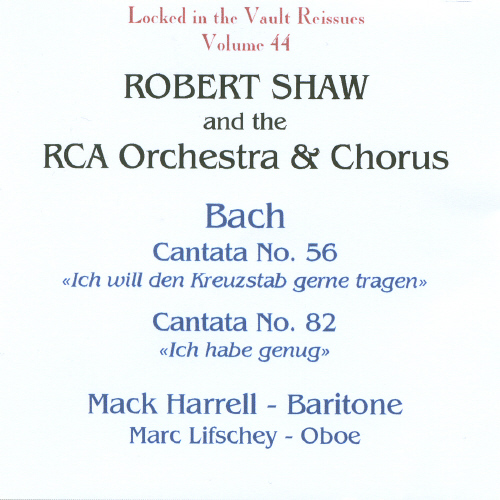
I’ve been collecting his recordings seriously for a few years now, mostly on CD reissues, but I do own original CD releases of the famous studio recording of The Rake’s Progress, with Stravinsky conducting, and the 1951 Carnegie Hall recording of Wozzeck. I also own a mint stereo copy of the 1958 RCA LP recording of Bach Cantatas 56 and 82 with Robert Shaw.

Today this video came my way, and I must say it makes me very happy. I’m indebted to Mickey Clark’s YouTube page for it. Clark remasters 78 RPM recordings from the 1940s. You can find out about him from his website, MC Productions. Here’s a link to the video, in case you’re reading the RSS feed, and here’s the video, itself.

The portion of the “Offertorium” of the Fauré Requiem offered here sounds almost as though it could have been written with Harrell’s voice in mind, and it illustrates the kind of singing for which he was most known, embodying persuasive and elegant musicianship and careful attention to text. He began his musical studies as a violinist and told me once he believed that experience made him a better singer than he might have been otherwise. The Bach cantatas remain highly regarded to this day, both for Harrell’s performance and for that of oboist, Marc Lifschey.

Of the Bach recording a Time reviewer wrote in 1960: “The last album recorded by Baritone Harrell before his death at 50 last January. The two cantatas here offered—Nos. 56 and 82—are among the simplest and most serene of the 200-plus Bach wrote. Harrell’s reading is rich, secure and wonderfully responsive to the texts’ reverent moods.” I spent the summer of 1959 with him in Aspen, after he knew that he would die soon (he had inoperable cancer). That summer he sang many things that he especially loved, and one of them was Bach Cantata 82, “Ich habe genug,” with the Juilliard String Quartet. I don’t recall who the oboist was, but the performance was prophetic, perhaps.

The Wozzeck is also a famous recording. Here’s how the Time reviewer spoke of the Carnegie Hall performance from which it was made.

In Carnegie Hall, Conductor Mitropoulos made room onstage, between orchestra and podium, for his singers to move around. He also bade them leave their formal clothes at home, dress in simple garb as an aid to realism. With the deft vocal characterization of Berg to help, they made Wozzeck live even in concert version. As Wozzeck, Baritone Mack Harrell was simple and piteous and convincing; Tenor Ralph Herbert was chillingly cold-blooded as the doctor. Soprano Eileen Farrell was superb as the anguished but faithless Marie. When the last scene came to its tragic close, the audience sat as if stunned (Berg gives them no curtain-lowering chord as a signal for applause). Then they brought the house down.

The cheers and bravos brought Conductor Mitropoulos and his soloists out twelve times. Agreed Critics Olin Downes of the New York Times and Virgil Thomson of the Herald Tribune: the whole cast should be moved downstreet for a stage version at the Metropolitan Opera. And the sooner the better.

Harrell sang at the Metropolitan Opera for 13 seasons and at other opera houses in the United States and Europe for 20 years. He also taught singing at The Juilliard School and at Southern Methodist University. Maybe I’ll tell some stories about him later on and talk about some of his other recordings. Not long ago I acquired a CD reissue of an ancient LP that came out originally on the Remington label. On it he sings the Niles gambling songs and some other wonderful things. Especially wonderful are the bombastic Hugo Wolf “Abschied,” and Massenet’s “Crépuscule,” a little gem.