Reading Evening Prayer in an Empty Church

Since Jim Lee has outed me, I’m going to announce that I have self published a book of poems. It’s entitled “Reading Evening Prayer in an Empty Church” after a poem with the same title that appears towards the end. I never thought to do this, but after reaching the age of eighty-one with publications scattered here and there and no book to my credit, I decided, what the hell. I am now eighty-two, and it still seems like a good idea.

As I explain in the rather lengthy acknowledgments essay, I think I am unlikely at my age and remove from colleagues to find a publisher willing to take a chance on a book of this kind. But since I am my own publisher, I have felt free to create a book that not only contains all my poems to date that I think are fit to print, both published and unpublished, but also makes me happy as I hold it in  my hand. I’m still writing poems, but I think I’ll save what I have to say about that for my new publisher page.

With all the usual reservations about Amazon, I chose Kindle Direct Publishing (KDP) to print my book. KDP requires a minimal cash outlay, since it is a print on demand service, and it has the further advantage of providing a more or less blank slate to an author with the requisite skills in design, photography, etc. Not an entirely blank slate, to be sure, but one that was sufficiently blank for me. The book is now available at Amazon.com. And, there is even a Kindle edition, which I recommend with some reservations. I lost patience with the KDP template at some point during the time I was creating the Kindle edition and left a few blots here and there in it; though I don’t think the blots render the Kindle edition unreadable. On the other hand, I recommend the paperback edition shamelessly.

Three dear friends, Richard Sale, Stephen E. Smith, and Shelby Stephenson consented to write blurbs for the back cover. You can read them if you follow the link embedded in the image at the head of this post. I finished the book last November, but various health issues have prevented me from announcing it until now.

Go Litel bok . . .

Big pig, little pig

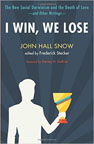
I Win, We Lose:
The New Social Darwinism and the Death of Love, and Other Writings

by John Hall Snow
edited by Frederick Stecker
229 pp., Wipf and Stock, $34

White Trash:
The 400-Year Untold History of Class in America

by Nancy Isenberg
476 pp., Viking, $28


During the years I worked at Fort Bragg I had various old cars as companions along the country roads of North Carolina. I’ve already written about my 1959 Porsche in another context. But I drove and fiddled with a Karman Ghia coupe for a while as well. The Karman Ghia had a tendency to throw fan belts, and I always carried a couple of spares with me.

One night when I was on my way home to Durham the little VW engine began to overheat. I pulled over, turned the car off, and opened the rear boot to let the engine cool a little. Then I got out some tools and sat down on the shoulder with my legs underneath the back of the car.

My head was fairly close to the edge of the boot cover, too, as I bent into the engine compartment; and that turned out to be important in a few minutes when I was startled by some strange noises coming my way from an open field just off the road. I straightened up suddenly, banged my head on the boot cover and knocked myself out.

When I awoke after what I took to be just a few minutes, I didn’t worry about what had startled me, and I was too shaken up to finish the work on my car. I locked things up, hitchhiked back to the base, took some aspirin for my headache, called home, and spent the night on a cot in my office that I kept there for just such emergencies.

The next morning early I hitchhiked back to my car. When I got there I saw that there was a small herd of medium sized hogs in what I had taken for an empty field the night before. They had been turned out to forage in the stubble of whatever crop had been harvested in that field and were still snorting around quite contentedly.

That was my introduction to the practice of turning hogs loose to forage in fields and woods. I didn’t know then but do now that the practice has a long and complex history that has been productive of culture of various kinds. It has given us songs about the Revolutionary and Civil Wars and the War of 1812, songs about cowboying, prospecting, going to Texas, being seduced by fancy men, and other profundities, in addition to providing us with lots of feral hogs. It has also given us the expression, “Root, hog, or die”—self reliance or nothing, you’re on your own old buddy—which might have meant something to me on the road back then if I had thought of it. Here’s a verse from an old song, for which I am indebted to Wikipedia.

I’m right from old Virginny wid my pocket full ob news,
I’m worth twenty shillings right square in my shoes.
It doesn’t make a bit of difference to neither you nor I
Big pig or little pig, Root, hog, or die.

The speaker would appear to be a slave, “worth twenty shillings right square in [his] shoes.” Though it dates the song 1856, the year of its first copyright, Wikipedia traces the expression “Root, hog, or die” to a time “well before 1834,” that date being the date of the publication of Davy Crocket’s Autobiography, which quotes the expression as “an old saying.”

Before he became enshrined in Texas history as one of the heroes of the Alamo, Crocket had a considerable career as a politician in Tennessee and served in the United States House of Representatives. He was a tireless defender of squatter’s rights and of the landless poor. Nancy Isenberg attributes the saying to Crocket that “It’s grit of a fellow that makes a man.”

In her new book, White Trash: The 400-year Untold History of Class In America, Isenberg also writes of the complex and racially charged history of social Darwinism among us, whose cultural roots are probably older than any songs about them. Indeed, the cluster of ideas we subsume under the social Darwinist rubric has been around in America since before we had a term for it, before Darwin’s Origin of Species (1859), and before the career of Herbert Spencer, who gave the phrase “survival of the fittest” its characteristically modern spin.

On the other hand, the Rev. John Hall Snow’s analysis of social Darwinism, as revealed in a new book edited by the Rev. Frederick Stecker, doesn’t explore its folkloric or other cultural antecedents, perhaps because Snow seems less interested in social Darwinism’s American history and more interested in the corporate consequences of the faith (after it had become a faith), particularly in its having resulted in a culture of winners and losers. Indeed the most telling and interesting sections of I Win, We Lose concern how winning came to be the American conception of “survival of the fittest.”

Fr. Stecker found the manuscript of this little book among Fr. Snow’s literary remains together with a number of unpublished sermons. Indeed, some of the most valuable parts of this book are to be found in the sermon excerpts that Fr. Stecker includes as commentary on the main text. I’ve read Fr. Snow’s other books since reading I Win, We Lose. Two of them, The Gospel in a Broken World and A Vocation to Risk specifically address issues of preaching to times of great change: the first in relation to the massive social changes wrought by the 1960s and the second in relation to late twentieth century culture, which Fr. Snow perceived to be in spiritual decline. The effects of social Darwinism and the American culture of winning are themes to which Fr. Snow returned again and again in his writing and preaching.

The importance of winning grows out of competitiveness through the introduction of an adversarial component into all human relationships, according to Snow. The chapters of Snow’s book detail the effects on education, racial justice, marriage, institutional life, and environmental ethics of a cultural paradigm that views social life in all its forms as a series of sites for competition. Winning is promoted and winners are rewarded with major or minor celebrity, money, etc. This is the meaning of success in America. Losing, normally identified with performance that falls short of accepted standards of achievement, but also with wage earning and poverty, is rewarded with shame. The social consequences have been devastating, as Snow details them. His understanding of the losses to public education brought about by the competition paradigm, which Snow alleges have “removed the last vestiges of true learning from the educational process” prefigure present day concerns about high stakes testing and the unfortunate social consequences of our so-called meritocracy, for instance.

For the culture of winning requires that most will be losers. “Winners are defined by the symbolic power of what they own as well as what and how much they consume.” And as the win/lose ethos expands into the creed of American exceptionalism it comes to require “the aggressive accumulation of natural resources, wealth, and technical-scientific information for the single purpose of denying them to the rest of the world as the guarantee of the survival of those currently self-defined as the most fit, namely the richest and most powerful.” Acceptance of this view and the corollary views it requires in contemporary American life puts Christians in a particularly difficult position, because “No vision of reality could be more in conflict with what Christians believe,” according to Fr. Snow. Yet American Christians have defended slavery, Indian removal, the destruction of Appalachia and other environmental devastation by extractive industry, as well as the pervasive growth of destructive technologies the world over, as beneficial and necessary to the survival of “the most comfortable, elegant, liberated life-style in the history of the world . . . .”

Professor Isenberg has other fish to fry. She traces the history of American scapegoating of the poor and the persistence of destructive class-consciousness in America to English colonial policy and practice. Our former British rulers viewed their North American colonies not merely as a source of wealth but also as a dumping ground for human trash, for the hordes of landless paupers, “vagrants, idlers, highwaymen, Irish rebels, known whores and convicts” that filled England (particularly English cities) with what the better classes termed human rubbish. It was settled British colonial policy to transport these persons to the new world for centuries, a fact amply illustrated by the history of Jamestown as Isenberg tells the story. After 1776 the newly constituted United States adopted and extended this policy through the various stages of continental expansion. But far from being valued as pioneers and settlers, the landless poor remained objects of scorn, in some cases more scorned than people of color, described as sallow, diseased, and malformed, an inferior breed of human beings.

It is a widespread conviction that Jefferson’s ringing affirmation of human equality at the opening of the Declaration of Independence entitles Americans to believe that we have created a society without invidious class distinctions. But that belief is everywhere deconstructed by the actions of Americans past and present. We tend to perceive and address the cognitive dissonances entailed by the belief by reference to the category of race in our present-day life and to erase other manifestations both from our perception of and discourse about inequality; yet we have never successfully discriminated between the natural inequalities that abound in our experience of one another and forced or artificial inequalities that are social constructions. This blurring has contributed to our history of demagogic exploitation of inequality for political purposes. Professor Isenberg provides a wealth of examples of the political exploitation of inequality from colonial times to the present in a thick social history that lends substance to Fr. Snow’s argument. Just as race has marked many as socially inferior in our history, so extreme poverty has marked others as deserving of exclusion from the goods obtained through our social contract. Historically, those identified as white trash have been regarded as naturally inferior to their more affluent betters, along with people of color, especially in the South, and their putative natural inferiority has a long history of association with partisan attempts to exclude them permanently from society’s benefits. In its most extreme form, the belief in the natural inferiority of some humans has resembled fascism in all but name.

I owe recognition of the relevance of one of his sermons to our own historical moment to Fr. Snow’s daughter, Lydia Field Snow, who called attention to it in a recent Facebook post. I quote only part of the passage to which she refers.

The precise situation that creates fascism is where society is demoralized, where the conscientious are paralyzed with guilt and leadership believes that it is no longer accountable to anyone, where social disorder is everywhere and that this disorder is everywhere met with more police using more force. It occurs when the law is set aside in the name of order and humans find that the fear, the tension, the chaos, and the guilt become unbearable. It is at that moment when the human spirit is tempted to say suddenly, No! Wrong is right, evil is good, ugliness is beauty, repression is true freedom, and the important thing is to be on the side of the strong. This is nature’s law—the weak, the stupid, the ugly, all those people who are not like me are destined to be destroyed, they are a drag on us, the truly strong. We’ve wasted enough time on them—let’s get it over with—why put up with their nonsense?”

There was a time when I didn’t believe the Republican Party really wanted to destroy the social contract. That was then, before they paraded a collection of proto fascists through a series of elections that ended up requiring all those who survived to pledge ever more stringent scenarios of social harm and that produced a final round of so-called rallies that fostered a lynch-mob ethos. Faced with the recent consequences of that ethos, we shall hardly need the renewed rallies to sustain the country’s angry mood. Our President ran for office in the familiar role of outsider, attacking government as ‘the problem’ in the tradition of Ronald Reagan. But his authoritarian approach to governing promises a police state, and as it develops it isn’t hard to predict a time when his régime will declare itself free of all obligation to ordinary human decency and give itself carte blanche to complete destruction of the social contract. And one further thing is clear. His appeal is deeply rooted in the American culture of winning. Here’s the President speaking to that point.

You’re going to be so proud of your president if I get in—and I don’t care about that—we’re going to start winning again, we’re going to win so much, we’re going to win at every level, we’re going to win economically, we’re going to win with the economy, we’re going to win with military . . . we’re going to win with every single facet, we’re going to win so much you may even get tired of winning, and you’ll say, “Please! Please! It’s too much winning! We can’t take it anymore! Mr. President! It’s too much!” And I’ll say, ˜No it isn’t! We have to keep winning! We have to win more! We’re going to win more! We’re going to win so much!

There’s some cognitive dissonance between the spectacle of Americans winning on such a scale and the destruction of the social contract that the Republican hard core desires, but winning in the presidential rallies was and is imaged as Fr. Snow described it: We need not concern ourselves with “the weak, the stupid, the ugly, all those people who are not like [us].” As the Republican program unfolds, particularly as the Affordable Care Act is repealed and great numbers of citizens lose access to health care while the middle class and the wealthy are given substantial tax breaks, it will become clear that Republican scapegoating doesn’t stop with Muslims and other immigrants but targets the poor as a social class as well. As Representative Roger Marshall (R—Kansas) put it in a recent interview: “Just like Jesus said, ‘The poor will always be with us,’ . . . There is a group of people that just don’t want health care and aren’t going to take care of themselves . . . .”

Shelby Stephenson

My old friend, Shelby Stephenson, is the new Poet Laureate of North Carolina. The N&O story covering his installation last Monday offers a clip of the poet reading from his long poem Fiddledeedee, first published in 2001 and reissued just last month by Press 53 in Winston Salem. It was a good choice for that Audience, describing in moving cadences the springs of his imagination.

Shelby’s accomplishments are many: a dozen or so published books and countless magazine publications; thirty-one years as editor of Pembroke Magazine at UNC Pembroke, where he rose to the rank of full professor over a long and illustrious academic career; winning the Bellday Prize and the North Carolina Award for Literature; induction into the North Carolina Literary Hall of Fame, to name just a few.

We met, I think, in 1978, when the Stephensons moved to Southern Pines, NC, where they remained for many years before moving back to Johnston County and the farm where Shelby grew up. I have eaten oysters and barbecue, sung songs, argued about poetry and philosophy, jogged, commiserated, and more with Shelby Stephenson over the years. We’ve lived a long way from one another for a long time now. But if you are fortunate enough to have such a friend as Shelby, you don’t let time or distance deprive you of the friendship. I’m happy for him now, and I very much hope our paths cross again before long.

And I may have been the first person to write about Shelby’s poetry. He has always said that I was. Maybe the best way for me to recognize his present achievement is to reprint what I wrote. The piece pretty much explains its own circumstances: Shelby and Sam Ragan reading together at the Southern Pines Library. Sam Ragan would be named Poet Laureate of North Carolina in 1982 and hold the laureateship until his death in 1996, the last of the NC Laureates to receive a lifetime appointment. Here is what I wrote about them both almost thirty-seven years ago, as published in the Southern Pines Pilot on April 26, 1978.

* * *

It is a mournful truth that poetry, perhaps the eldest of the arts, has never made its fortune in the modern world. Our time, which has seen the elevation in prestige and economic value of professions which would have seemed unlikely of success in the last century, has seen the decline of poets in influence and social regard.

But poetry has by no means died. Sturdy souls that they are, poets have simply gone underground. Their works are to be seen, of course, in the few major-house publications which print serious verse and in a small group of surviving prestige literary magazines. But in the main poets are writing for the thousands of independent publishers and literary magazines which have grown up in the last ten years, publishers like Moore of Durham, magazines with names like Vantage Point, Aspect, The Stone. These for the most part have limited circulation, a decided regional or individualistic feel and an anti-slick, anti-establishment voice.

COSMEP, the Committee of Small Magazine Editors and Publishers, maintains a traveling bookstore representing little magazines from all across the country. This store, called the COSMEP Van Project, has been in our area this week.

To celebrate the project’s arrival, the Sandhills Arts Council sponsored a poetry reading last Sunday in the Southern Pines Library combined with a tour of the book van. Poets Sam Ragan and Shelby Stephenson read from their own works, many of which have appeared in works printed by small presses.

Sam Ragan explained that the difference between a major and a minor poet was that the major poet would never use the word “rue,” as minor poets do, and that major poets always read from their own works as he and Shelby Stephenson did.

Sam Ragan is well known as a writer and publisher, perhaps less well known as a poet. This is unfortunate, for his verse possesses great beauty and economy of expression. It is a reticent poetry, depending upon unadorned images, things in themselves, which sometimes gather into landscapes.

I can see through the tree’s limbs.
Beyond the girl
In the green bathing suit,
Beyond the sea oats and sand,
Where the sea rolls,
Breaking white, as far out
As where fishing boat
Sits motionless in the sun.

Mr. Ragan quotes William Faulkner about the literary art, saying that he wishes to arrest time in his verses, which he thinks of as frozen moments. This is the lyric impulse, and it suggests iconic poetry dominated by visual imagery. A survey of the poet’s recent book, To the Water’s Edge, will reveal much that is visual, but the first interest in these poems is in the play of the poet’s mind over the objects and events of memory and perception.

Driving down No. 1 at night
The headlights catch the gleam Of beer cans,
They look like cat’s eyes.

When lilacs last in the junkyard bloomed.

This passage opens “Notes On the Margins of Our Times,” a poem made of vignettes from the social history of the sixties, each moralized with a fragment of familiar verse, song, or speech, sometimes quoted, sometimes paraphrased. The landscape of this poem is an inward one, finally, through which things pass sometimes unaltered from themselves, sometimes changed by ironies sensitive or sensible:

Do not go bojangles into that good night.

Sam Ragan’s poetry is invested with a love of common things and common order, against which the horrific, the startling, the grotesque, assume proportions assigned by common sense:

It was a bad trip,
And when he couldn’t fly
They picked up his body
Where it had splintered on the sidewalk.

Flights of fancy, always understated, stand out in relief, too, from the general steadiness as when in “Sandhill Summer” the poet imagines the surging of an ancient sea in the sound of wind in tall pines. “I sleep,” he says, “in the shadow of ghost winds.”

Shelby Stephenson’s verse is heavier and sweeter than Sam Ragan’s. Mr. Stephenson likes long sentences and heavy rhythms rich with words and sometimes thick with music. Here are some lines from “Winter Ritual,” a poem about hog killing.

Hog tails hang down after the maul.
Men swill homemade scuppernong brandy,
Rake thick sleeves across mouths
Cutting the sun’s slash on the tin barn-roof—

Someone has speculated that musical English poetry tends to fall into the’ patterns of Anglo-Saxon. True or not, the first line of this passage is an almost Anglo-Saxon line, with its alliterative linkages and dual syntactic units breaking it into half-lines. The rest of the passage is heavily consonantal and assonant, and the whole demands to be intoned rather than merely read. Here, a complex boyhood experience of violence and death is also creative, and the adult poet examining the childhood memories from hog-killing days seems most of all to find it all intoxicating, the blood and meat, the sausage and entrails, the swilling and the boiling-strong stuff for a small boy.

The primary emotion animating Mr. Stephenson’s verse is nostalgia, but there is in it such a tempering of humor and good sense that the poems generally avoid sentimentality. One poem, “Goat Pills,” talks about castrating a goat named Billy—without any Freudian confusion. It is always clear that the goat is a goat, and as such he is the main actor in a comedy of violent high-spirits which ends as he runs up the hood of Uncle’s Buick spraying goat pills all over the place:

striking handles and knobs, discovering places Uncle says
we cannot find
when he messes up the seat
of his Palm Beach pants on one, just one!

In this poem, too, the children save the goat pills in bottles and dispense them as hangover medicine to unsuspecting uncles and cousins. Never a dull moment down on the farm.

Together with a strong feeling for the land and its influences in the lives of men and women who live daily with it, there is in Shelby Stephenson’s verse a recognizable strain of frontier humor of the kind one associates with Twain and Faulkner. For these poems too, are boyhood poems, whose lessons are enhanced for us readers by the poet’s pose of innocence, accepting all experience almost without judgment. Nonetheless the boy is not forever; nor is the farm. In a poem entitled “Clematis Post” Stephenson talks of how a basketball post serves in succeeding decades of his life as a post for cleaning game and as a makeshift trellis. In the midst of dying there is life.

Hidden in my growing a growing is.
Every spring the turning leaves
scrape from brown-dry stems the hanging scraps of winter.

Sam Ragan reads as he speaks, with generous literacy, but also with the gentle cadences of eastern North Carolina. Shelby Stephenson closes his eyes and sings. One may read them for himself in the literary magazines, but there is a wealth of other poetry in the listening, which reference to text fails to disclose—a fact which strengthens this writer’s conviction that poetry is language for the ear.

We were glad to entertain the COSMEP Van Project and to celebrate its presence with a reading by two fine North Carolina poets.

* * *
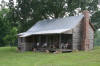
In 2005 Shelby inscribed a copy of Fiddledeedee to Kathleen and me when we visited him and Linda on their farm near Benson, NC, south of Raleigh. I own most of Shelby’s books by now, but I’m still partial to his first, Middle Creek Poems. And my favorite lines of Shelby’s are those I’ve quoted from the poem “Clematis Post,” which he included in that 1979 collection. Maybe Shelby likes those lines as well. He published that poem again in abbreviated form in his 2013 chapbook, Play My Music Anyhow, with the title, “All That’s Left.” His newest book is called The Hunger of Freedom. My copy should arrive from Amazon tomorrow. I look forward to finding out what else is left.