Students first?

Yesterday’s email brought a message that featured the smiling face of Bill Cosby asking me to join Michelle Rhee’s Students First organization. I deleted the email without responding, but today I’m having second thoughts.

As the Chicago teacher strike continued and the scapegoating of teachers was ramped up in the mainstream media, I decided I should say a bit more about why I do not support Rhee’s effort and others like it. Now that the strike has been suspended, I think it is even more important that those of us who still believe in American public education speak out.

First of all, Rhee, herself. Her tenure as chancellor of the DC schools was a colossal failure. Now she has reinvented herself as a consultant and media darling who earns big bucks for speaking to various echo chambers around the country. Michelle Rhee is to the politics of education what Sarah Palin is to politics generally. She has repeatedly falsified her record in promoting herself, recently in Great Britain.

Rhee’s organization is one of a network of well-funded efforts to undermine public schools. Some of these organizations make no secret of their ties to moneyed interests intent on replacing public schools with for-profit charters. With PR that is long on slogans, these interests have nothing of value to offer in the way of real help to struggling schools, historically abandoned by successive waves of flight from the nation’s cities.

What they do have to offer is a program of privatization. A test of their ideas is now underway in Michigan. Behind it is the educational equivalent of corporate predation with its ethic of “creative destruction.” The Obama administration has based its “Race to the Top” program on this dubious program, and this in spite of a strong protest from the National Academy of Sciences. Race to the Top appears to be failing in Tennessee, the program’s signature client.

I take Students First as the most recently organized and perhaps most visible effort to privatize public schools. It identifies teachers’ unions as the cause of blight in urban school systems because teachers’ unions are its most serious opponents in the public sphere. Moreover, it should not escape notice that the school privatization cabal shares a strategic methodology with the American Legislative Exchange Council. Just as ALEC has “written” the legislation for many states who have enacted voter suppression laws, so the Teacher Advancement Project and the National Institute for Excellence in Teaching (and now Students First) have “written” programs to suppress and marginalize teachers.

None of this is to say that there are not good charter schools, though for-profit charter schools have a sorry history. Nor is this to say that there are not fine private schools among us. One of the strengths of American education has always been its mix of public and private efforts. What is new in our time is flight from public education that began with attempts to escape integration, continued with the establishment of Christian and country day schools and has now eventuated in the home schooling and charter school movements. And what is most distressing about this recent experience is the normalization of antipathy to public education.

Higher education is implicated in this trend. Correct me if I’m wrong. It has been fashionable, and continues to be so, among college and university educators, to denigrate public education at least since the 1950s. It is an article of faith amongst university educators outside colleges of education that professional programs in education are substandard and inferior. It is this complex of prejudices that has created the hegemony of English departments in colleges and universities, and it is a canard. I told a story about an education prof in my last post that was prejudicial. That prof, who believed that administrators made teachers good, did not represent the norm. More representative was another prof, with whom I was privileged to work for many years, whose curiosity, intellect, and spiritual insight endeared him to a generation of graduate students at the University of North Texas, and to me.

I also mentioned Roosevelt High School in St. Louis in my last post. Any liberal who supports Michelle Rhee’s program should spend some time at Roosevelt or at Vashon High School in North St. Louis. The idea that the problems these schools face can be solved by firing a few high-priced veteran teachers and replacing them with cheap substitutes is hogwash. Liberals might wish, as well, to examine the history of Imagine for profit charters in St. Louis, currently being closed amid reports of poor performance and financial impropriety. And nobody, liberal or otherwise, should be surprised by the corruption of Imagine schools or of schools like them in other cities. The for profit charter system is yet another corporate scheme to transfer public monies into private-sector coffers. It’s a scam like the publishing scams that have bloated the cost of textbooks and scholarly journals and are now coopting online education.

Meanwhile, there are partnership programs cooperating quietly with public schools that actually do put students first. One of them is the network of urban debate leagues. I have a good deal of experience with the St. Louis Urban Debate league and have seen its results. I recently wrote about a St. Louis high school student who is a debater. Debate enhances the likelihood that students who participate will graduate from high school. Among key findings of a new study that will soon be reported in the Journal of Adolescence are these:

  • Among the highest risk students, 72% of debaters graduated as compared with 43% of non-debaters.
  • The level of participation in debate (number of rounds debated) is a strong predictor of high school completion. Students who debate more, are more likely to graduate.
  • All students who debated, including those at-risk, scored higher on the ACT and were more likely to achieve college readiness benchmarks in English, Reading and Science.

Public education needs more programs like the UDL to restore valuable and life-enhancing activities such as music, dance, and art, that have been axed from many school programs in favor of teaching the test. Public education doesn’t need lessons in neoliberal economics or more demagoguery from political hacks like Rahm Emanuel, who is only the most recent politician to promote himself by attacking schools. And public education especially doesn’t need Michelle Rhee and her organization.

Shame on Bill Cosby.

Sunday at home

It’s a wet, dreary Sunday as hurricane Isaac plays itself out over the midwest. The RNC has played itself out as well. Good riddance to both, though we need this rain. Another academic year has begun. I met new groups of students this week, new to me anyway, and enjoyed them. When I turned 75 a week ago I wondered if my mind would turn again to Montaigne’s question, que sais-je? But I guess not. I’m still far too engaged with he world to stop and take stock.

Here’s the entrance to the Missouri Botanical Garden as we saw it over the fourth of July weekend this year during the Lantern Festival, a collaborative effort between the garden and a group of Chinese artists. There’s a video here, if you want to see more of what it was like at night, a magical experience. And here’s a picture I took of the Gateway Arch that same weekend. We went for a boat ride on the river with out-of-town guests one morning and in the afternoon attended a naturalization ceremony at the old court house (slideshow here).

As I write today, my beloved is talking with her sister in Phoenix in the next room. I’ve just been invited to a fund raiser for a friend of a friend who has been stricken with leukemia. That will take place after a trip we will make to Texas the first weekend in October to attend my 57th high school class reunion. We’re having them every two years now, reunions that is, we being the geezers in the class of 1955 at Abilene High School. As soon as things dry out I’m planning a comprehensive effort of home maintenance. We need some concrete work and tuckpointing here at the old house. A deal of clearing out and discarding needs to be done as well.

There’s a great deal to be said for ordinary life in the city: buying and preparing food, mowing the grass, sleeping and waking, work. I look forward to sitting on my back porch and watching the sun set as fall draws on. The view out my back way is a cityscape and not a very romantic one at that, lots of wires and the poles that carry them, other people’s back yards—but I love it. We live in a neighborhood of row houses. I like to wonder what it was like a hundred years ago when our house was new and women swept their sidewalks in the early mornings.

There’s a wonderful 1876 map of the city that shows our area before it was built up. Henry Shaw‘s Tower Grove Park is there, and the early Botanical Garden; but the residential areas in the surrounding environs are yet to be built. Our street, a major north/south artery then and now, runs a block past the Compton Hill Reservoir and stops. Our area, half a mile south, is open fields. A map of 1911 shows our street and our block, where our house had been built in 1904.

I expect our immediate neighborhood housed brewery workers in those early days. Pestalozzi Street, immediately to the north of us, runs right down to the old brew hall at Anheuser Busch, no longer locally owned. After a long decline, our neighborhood is regentrifying. Our block is now almost entirely rehabbed. We no longer sweep our sidewalks; there are no more coal furnaces or fireplaces

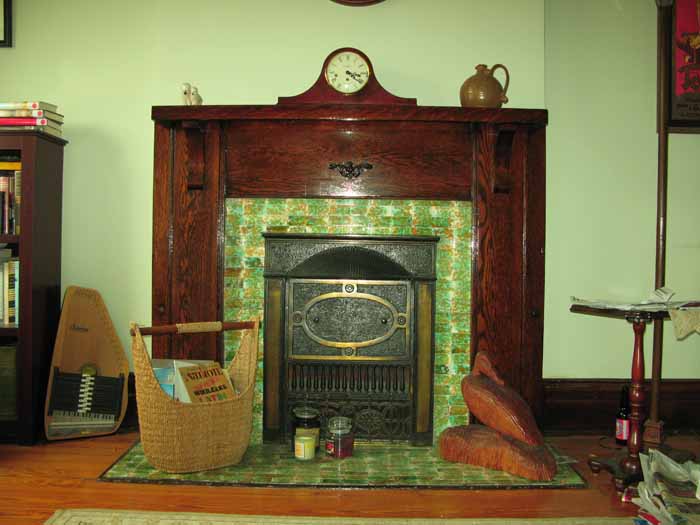
Our house was piped for natural gas from the beginning and seems to have had at least one gas light, although it was originally wired for electric lighting as well. An old gas outlet has been capped at the top of the front stairwell, the original entrance to the second-story flat. My beloved hangs a wreath on it. We have the original gas units in the upstairs and downstairs fireplaces, though we’ve never tried to use them. I keep thinking I’d like to have modern gas units, but the old ones are beautiful. Here’s the downstairs fireplace as it looks today.

So it’s good to be breathing in and out and able to savor these good things. We may even go to the pumpkin patch outside Iowa City next month after we get back from our other adventures.

From Mahler to Jolie Blonde . . .

Last evening my beloved and I attended the funeral of a friend, Joe Kleeman, who had played bass in the Saint Louis Symphony Orchestra for many years. Pretty much the whole celebration was music. The Choir of Bethel Lutheran Church, where Steven Mager is music director, was supplemented by a group of SLSO musicians, including Concertmaster, David Halen.

Perhaps because of the music, and perhaps because I am still reacting to the death of Doc Watson, I came home in a mood to listen to something; but instead of classical music I decided to watch a DVD I have had for a while of the first series of Transatlantic Sessions, organized by fiddler Aly Bain for the BBC back in 1995.

I had got the DVD because one of the songs on it had disappeared from YouTube. I had posted “Maiden’s Prayer” here long ago, from the sixth program in the BBC series and told a story about the supposed origin of that fiddle tune. Some time after I posted it, the tune disappeared into the void of closed accounts. But last night I watched and heard it again. In fact, I watched two thirds of the Transatlantic Sessions DVD before giving in to sleep.

Among wonderful things in this music are several performances by Iris DeMent, including “Our Town,” the music from the last episode of Northern Exposure, Jay Ungar’s “Ashokan Farewell,” in whicn Ungar and Bain lead what amounts to an entire fiddle section, and many performances by DoBro player, Jerry Douglas, who plays throughout. You’ll hear him on this Performance of Jolie Blonde, together with Michael Doucet, Ricky Skaggs and others.

One YouTube comment declares this song to be the author’s “favorite waltz in all the world.” “[D]on’t you Cajuns call this the Cajun National Anthem?” he asks. I don’t know that it’s my favorite waltz, but I love it a lot, enough that I just ordered the second season of Transatlantic Sessions from Music Scotland. One of Joe Kleeman’s daughters wrote of her dad that he would listen to Mahler, take a sip of his drink and exclaim, “God, this is beautiful!” It’s a long way from Mahler to “Jolie Blonde,” but as I watched Transatlantic Sessions and sipped some reasonable bourbon, I felt like toasting Joe.

p

Snakes-to-go

This is another post in a series that honors my long ago major professor’s habit of coming into the classroom some Fridays and saying “Let’s talk about snakes,” which meant we would spend the class talking about whatever was on our minds.

Ashes-to-go: My church is in the news today because we, along with partners in Isaiah 58 Ministries, offered ashes-to-go at the corner of Grand and Arsenal as we have for the past good many years. This year’s program made the front page of the St. Louis Post Dispatch and was featured in The Washington Post in a piece that circulated widely crediting our Pastor, The Rev. Teresa K. M. Danieley, with the original idea. Apparently the idea was not Pastor Teresa’s but originated in a Bible study group of which she was part. Pastor Teresa has asked the Post to publish a correction and has published a disclaimer at Facebook. But that hasn’t prevented a person from California, who claims to have originated the program, himself, from writing flaming posts on Pastor Teresa’s Facebook page. Perhaps he should write to God.

Planned parenthood: Two days ago in The Washington Post Melinda Henneberger opined that the birth control controversy is playing out to benefit Democrats. Says Henneberger:

The beauty of the current birth-control conversation for Democrats is that they not only have public opinion on their side but have cannily managed to make contraception a front-burner election-year campaign issue — by complaining that Republicans are making it front-burner election-year campaign issue.

I couldn’t be happier, and I’m happier still if Andrew Sullivan is right in a piece to which Henneberger refers, in claiming that President Obama lured Republicans into the birth-control swamp by design.

Cardinal Dolan: Timothy Dolan is back in this country, where he celebrated Mass for Ash Wednesday at St. Patrick’s Cathedral in New York and distributed some ceremonial bags of food to the hungry. Though he wore Lenten purple and affected to care little for the trappings of his new status as Cardinal, saying “The fact that I’m wearing red amounts to a hill of beans,” his vestments were still pretty grand and he wore a red zucchetto. Much is being made of Dolan’s new status in St. Louis, where he is regarded almost as a native son. But the writer of one letter to the editor in today’s paper isn’t entirely thrilled:

It is impressive indeed to see St. Louis proud of Ballwin native Timothy Dolan, who was “elevated” to the status of “prince” of the church and member of the “club” of cardinals who are charged with electing the pope’s successor (“He’s got a million of ’em,” Feb. 18). His humor, wit and understanding of the people are rare and often unseen qualities in much of the existing male hierarchy of the Roman Catholic Church.

As a Catholic, however, I continue to be mystified by the lack of understanding by the hierarchy of the humble servant mentality of Jesus Christ. Magnificent jeweled pectoral crosses, gold rings, flamboyant tailor-made vestments, days of celebration and dining out do not seem to fit in with the simplicity and humility of Jesus, the carpenter who washed the feet of His disciples. Nor does (sic) the terms “elevated” or “prince” describe Jesus, who came to serve and not to be served.

It will be interesting to see what Dolan does with his newly expanded superstardom. I am inclined to agree with Andrew Sullivan who has written, in a piece to which I have already referred, that Dolan and other American Bishops have staked out positions on social issues that do not reflect “Christian engagement with a changing world” but rather presage a retreat into fundamentalism; but I think it would be more accurate to characterize the Bishops’ retreat from social justice as a retreat into majesterium; though a few bags of food doled out to presumably hungry folk makes a good photo op, I’ll admit.