more about SLU

The Saint Louis University News last Thursday (04/25/2012) carried an account of SLU President Lawrence Biondi’s appearance at the SLU Student Government Association meeting the day before. That account, which unfortunately doesn’t appear online at present, mentions that faculty members were asked to leave the meeting (as reported first by SLU Students for No Confidence, then by local media and The Chronicle of Higher Education) but also provides the only detailed summary of the President’s remarks I have been able to find.

According to the University News it seems fair to say that Biondi defended the faculty evaluation scheme that sparked no confidence votes last fall, defended ousted VPAA, Manoj Patankar, and had this to say about students and faculty who participated in the public protest outside last December’s meeting of SLU trustees:

This got out of control. I think some of you were manipulated by the faculty. Especially when there is a demonstration on the mall. Isn’t it curious that some of the students are related to the faculty member who is giving them a grade? Is there some kind of conflict of interest

The University News story also reports Biondi to have aasserted that:

[S]hared governance at SLU has always been in place, as student and faculty voices are always taken into account, but not every proposal can be accepted. Shared governance is voicing your ideas and opinions and letting discussions take place. Just because we reject some ideas does not mean there is no shared governance . . . There is no climate of fear. I’ve asked every faculty member on various committees if they feel as though they can’t speak their mind, and they say ‘no.’

In the past, Biondi has been fairly successful in constructing faculty echo chambers for his ideas, opinions, and ambitions. But in this instance faculty were quick to react negatively, with votes to censure the president taken in the Arts and Sciences Faculty Council and the University Faculty Senate. Senate President, Mark Knuepfer, has released a statement demanding Biondi’s resignation, and the Faculty Senate has released a report that includes these observations:

. . . [B]ecause of well-known cases of retribution and the President’s tirades about particular deans and faculty, deans often are reticent. It feels risky for them to openly express opinions that contest those of the President or the former VP for Academic Affairs. Some have said they worry about the well-being of their schools and their budget and personnel requests.

The penalties for dissent take many forms . . . : raises denied, laboratory resources restricted, highly-regarded deans and department chairs fired or forced to resign, lawsuits filed or threatened against individual faculty. Others fear retribution against their academic departments, programs, or schools through budget cuts, frozen hiring, or appointment of an unqualified dean over the objections of faculty.

This systemic dysfunction hinders the ability of faculty and academic units to further the University’s academic mission. Indisputably, such a culture of intimidation is incompatible with the principle of academic freedom, the bedrock of all other academic values. It is also morally and intellectually incompatible with our identity as a Catholic, Jesuit University.

None of this is new, as many have pointed out at the SLU Students for No Confidence Facebook page. The culture of intimidation is palpable and goes back decades. What is new is that it is being exposed—in the past the SLU central administration has been able to prevent public exposure of its cruelty and cynicism. And it is also new that SLU faculty have been able to find a unified voice in opposition. In the past it has been fairly easy for the SLU central administration to punish dissent for reasons the Faculty Senate report makes clear. Now, perhaps, the worm is turning. One can only applaud.
Two cheers for SLU faculty

A few weeks ago I posted about events at Saint Louis University. Since then we have been told that the executive committees of the Faculty Senate and the Trustees are talking to one another; but the discussions (if indeed there are such) are being kept secret on the advice of Fleishman-Hillard, a high-priced PR firm the Trustees have retained to help them manage the crisis on campus. Reasonably good summaries of recent events at SLU may be found here and here.

The SLU faculty have now produced a report detailing grievances against the University President and Vice President for Academic Affairs. It reveals the dark side of Saint Louis University with which inslders have always been familiar but which has until recently been hidden from the public at large. It’s good to see this excellent report, produced by many hands, some of whom have chosen to remain anonymous out of fear of reprisal. That discretion is well-advised, as we have it on good authority that enemies lists are presently being drawn up and punishments prepared. But the SLU faculty seem to have united after years of abuse during which the careers of those who have opposed the tyranny have been wrecked, their salaries frozen or lowered, their requests for earned leaves denied, their travel funds withheld—and that’s only the surface. By far the worst part of being punished at Saint Louis University is that one becomes a pariah, marginalized in one’s own department, shunned by colleagues and former friends. This excellent faculty report is most welcome—it’s just a good many years too late, perhaps permanently too late with respect to collegial relationships that have been destroyed.

Post Dispatch columnist, Bill McClellan, has referred to Fleishman-Hillard as “mess Busters” in a recent column, not failing to note that the firm is also consulting for the embattled Missouri HIstory Museum in the midst of scandal over a dubious land purchase. The cases are similar in that both involve secretive executives, captive boards, and official stonewalling in the face of public criticism. But there’s been no suggestion of graft at SLU, at least so far, though some prominent trustees regularly do business with the university. And McClellan, himself, points to another difference: “Unlike the History Museum, SLU is a private institution. [Trustee President Thomas H.] Brouster does not have to communicate with the public.”

But SLU does have to communicate with accrediting agencies. The SLU law school is presently out of compliance with a number of accreditation standards relating to President Biondi’s high-handed appointment of interim law dean, Thomas Keefe. And on another front an instructive parallel might be drawn with the University of Virginia, whose board’s high-handed firing of President Teresa Sullivan six months ago has now occasioned a warning from the Southern Association, citing the board for “compromising the university’s integrity, not having a formal policy for involving faculty in making decisions and not following its governance requirements, which forbid a small number of members from controlling the board”—ethical and governance violations that are only too familiar to members of the academic community at Saint Louis University.

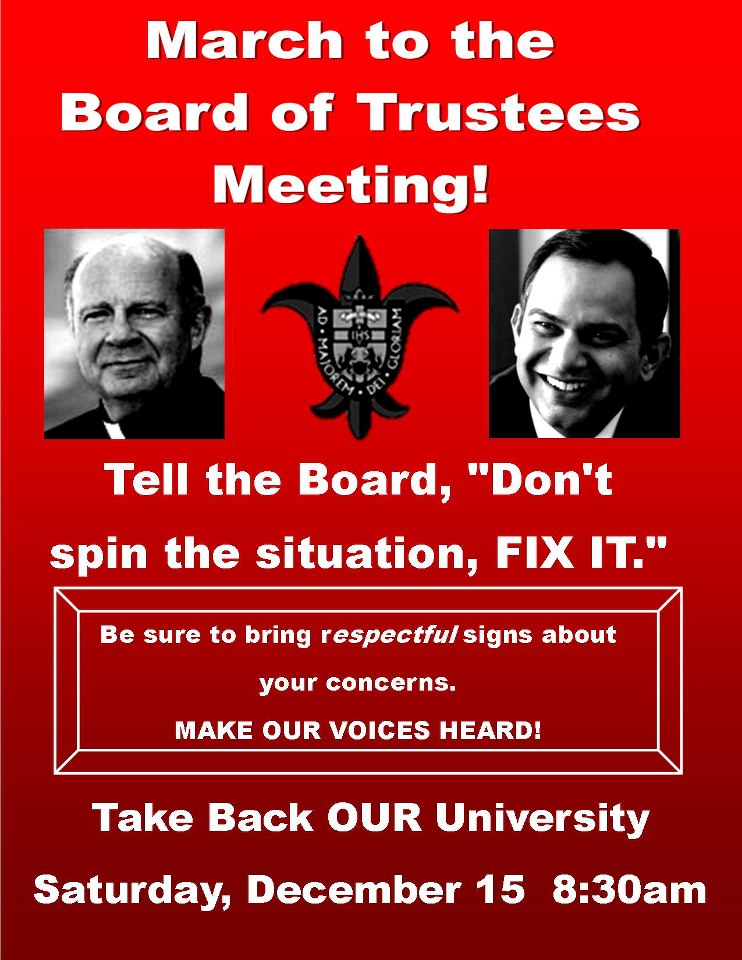
The SLU Trustees meet this Saturday, December 15. SLU Students for No Confidence are sponsoring a march. We’ll see what happens.

What I did on election day

I voted, of course, and I was glad to go to bed last Tuesday night with the knowledge that my guy had won a second term. But I also had good memories of having worked all afternoon on election day in a nonpartisan phone bank at one of our local TV stations. Here’s my beloved talking about it with Larry Conners, the Channel 4 news anchor. Our local League of Women Voters is one of the most active in the country. We have produced a voters’ guide in collaboration with the St. Louis Post Dispatch for some years now, and we all hope to continue the partnership with KMOV through future elections.

I worked election day afternoon until the polls closed at 7:00 p. m., answering calls from people with problems. The most common problems seemed to be with registration: people who had failed to file changes of address when they moved, weren’t sure whether they were registered, or didn’t know where their polling place was. In some cases I was able to tell callers how they could vote, but I had to explain to other callers that they had waited too long to register and would have to wait for the next election.

Though we did have difficulty at some polling places in the city, not uncommon in St. Louis. My beloved and I stood in line for two hours when we voted mid morning because our polling place was short staffed and had only three voting machines, a sharp contrast with 2008 when there had been plenty of staff and thirty or forty voting machines at the same site. I answered a good many calls in the afternoon from other voters who had encountered difficulties at the polls, all the way from illegal demands for picture IDs to the one caller who had gone to her polling place shortly after 6:00 p. m. and found it had closed early. We passed problems such as these on to a team of lawyers at the Election Protection group, but KMOV also sent investigative reporters to ferret out information about as many problems as time permitted them to investigate.

All in all it was a good day. I worked for some years as an election judge here until I passed my 70th birthday and decided to retire. During that time I saw a lot of incompetence and misconduct on the part of election officials—so, what I heard on the phone this past election day didn’t surprise me. Still, most citizens here voted without difficulty. It was pretty intense, working in the phone bank, pretty much one call after another for the last three hours or so. But I enjoyed the experience and will do it again if I’m offered the chance. It reminded me a little of working in voter registration drives and precinct politics when I was young.

Kudos to SLU students

Today, my hat’s off to Saint Louis University students.

To SLU Students for No Confidence, to the SLU Student Government Association: In supporting the regular faculty’s demand for an end to the tyranny of President Biondi and his clients in the SLU administration, you have acted with integrity, intelligence, and courage. And to The University News: your reporting of campus developments since the resignation of Dean Annette Clark has reflected, as always, a high degree of journalistic excellence and acumen.

The combined letters to the SLU trustees cite a wealth of administrative overreach, domination, and mismanagement as reasons for the votes of no confidence. The Faculty Senate’s letter cites particularly a “ubiquitous climate of fear engendered by the President among the faculty of retribution for voicing grievances” and the “unexplained dismissal of highly respected deans and department chairs who publicly challenged [Vice President for Academic Affairs, Manoj Patankar].” In this regard I read with sympathetic interest the words of former University Librarian, Gail Staines, who has also written in support of your efforts. Many of us who have witnessed the savaging of friends, colleagues, and loved ones at Saint Louis University over the past three to five years, can tell stories very similar to that of Dr. Staines.