town

I attended church today, and while I enjoyed seeing my friends and loved the eucharist as always, I found the lessons a bit edgy. We’re at the end of the sixth chapter of John’s gospel in the lectionary, and in today’s lesson Jesus protests that his way is the only way a bit heavy handedly with the result that many of his followers leave him and only the few most faithful remain. The epistle lesson was Paul’s injunction to the Ephesians that they put on the whole armor of God, language that I as a boy in the fourth grade was required to memorize in my public school class.

Perhaps it was that memory, or perhaps it was that we sang “I am the Bread of Life,” with its strong assertion of the exclusivity of the Christian way, as a communion hymn—whatever the specific trigger, I found myself thinking (as I often do these days) that we need a bigger tent. In a recent post I used Churches as a generic term for religious houses of all sorts. When I realized the error of my usage I decided not to edit myself and to talk about it. Having attained the age of 75 I often find myself thinking and sometimes speaking the language of my youth before I learned from my old friend Martha Webb that there are some women who really don’t like being lumped in with men as the linguistic default and further came to realize by reading Abraham Heschel and James Carroll that Judaism gets a bad rap in the gospels. Some Christian apologists draw a distinction between anti-Semitism and the anti-Judaism of the New Testament, but that seems to me to be interested pleading claiming a distinction that doesn’t count for much.

For these reasons, and for some others, I thought I’d repost a piece I wrote just after I began this blog. I’ve edited a bit, and I’m going to leave it up for a while because I constantly find myself reaching out for some spiritual balance as my country slides deeper into a slough of hateful sectarian partisanship. I can’t be any smarter than I was in this piece from five years ago.

. . .

Here’s a story. It begins in the parking lot of the Denton (TX) Islamic Society, a tiny congregation named so as to claim standing in the world outside the traditional Islamic realm. It was Sunday, the Christian Sabbath. Three hundred or so local citizens, Muslims, Christians, Jews, and others gathered in the back parking lot of the society’s tiny mosque in order to express our solidarity after someone had fire bombed the place. I didn’t visit the interior of the building because I didn’t know whether I should take off my shoes, and I don’t know today whether the Sabbath has any standing in Islam.

Tuesday the week before—I won’t put the date down—a thing occurred that I never dreamed I would live to see when terrorists crashed two hijacked airliners into the main towers of the World Trade Center in New York and destroyed them, together with other buildings nearby and the lives of several thousand souls. I should set it down that other terrorists also hijacked airplanes that were crashed into the Pentagon and the Pennsylvania countryside. These terrorists were almost immediately identified with Islamic fundamentalism by government and press–hence the bombing of our little mosque in Denton.

I’d been stunned since the destruction of the World Trade Center. Our very young President (he seemed so at the time) had told us we were at war. I had resisted that conclusion in my own heart since I watched the first news reports and believed them to be true. I couldn’t find any anger in myself, though perhaps it was there and I didn’t recognize it. What I remember now is that as the Imam began to chant the prayer with which we began the little service that afternoon, I wept.

Bishop James Stanton was with us, having come to town for a confirmation service at my church. His preaching had urged the proposition that we all needed to touch one another in the aftermath of our communal loss. Those of us who remained alive needed to touch, I think he meant. I thanked him for his sermon and his presence at the mosque, felt close to him for a moment and was surprised because I disagree with him more often than not. I was struck too by a dear old friend’s comment as we walked around the parking lot together, exchanging greetings after the service, when he said to me that he didn’t want to go to war without God (without something he could pose to himself in his own mind as God—those were his words). I can go along with Bishop Stanton that we seek to touch what grounds us in times of great crisis. I’m not sure I understand my friend’s anxiety about going to war without God.

The Imam chanted and then translated. His prayer expressed gratitude to God for his beautiful creation. ‘This is my Father’s world,’ as we sang in the Methodist Sunday School of my childhood, I thought—I will take the memory of that prayer, which I didn’t initially understand, as a symbol of our struggle to find community with inadequate language and inadequate minds as we stood there in the hot sun on that concrete parking lot, greeting one another with words expressing our knowledge that we are not one people. I believe we stood in grace there, however much God may have turned his attention from his beautiful creation as the World Trade Center exploded. The next evening I opened my class at the university with the statement that I’d be glad to hear thoughts and expressions in regard to our country—we’d been asked to do this by the president—and I let my students talk for an hour and a half. There was a variety of expression, including that of one student who left the room because the discussion disturbed him. Later I put my arm around him, and the other students welcomed him back for the remainder of the evening.

I can now report that my eldest child, who is 45 years old, is as likely to have another birthday as I am. He worked in the World Trade Center–when there was a World Trade Center. Fortunately for him and his coworkers and their families and friends including yours truly, his office didn’t open until 10:00. St. Paul says ‘here we have no continuing city, but we seek one to come.’ I’ve always loved that sentiment; somehow, it suggests to me the kindness of strangers. Maybe that’s why I felt at church the next week that our processions and triumphal evocations of God were not just pretentious but wrong headed. I thought of a Quaker meeting house I know and wondered if real piety waits upon grace without asking any questions.

I tend to think the moral universe is a human creation, more like a town than like the vast reaches of interstellar space. What I believe in outside that is grace and the human struggle for community, a version perhaps of what we used to call in my church ‘the summary of the law.’ I remembered my son’s words as he looked from his apartment in midtown Manhattan and described the smoke and the smell of the great explosions at the World Trade Center. That awful thing caused many New Yorkers to remember their town and to become citizens behaving like citizens in countless ways that filled the news reports in the aftermath. Perhaps something similar happened to us in Denton; perhaps we remembered our town, and remembering, perhaps we transcended our differences for a while.

And I’m remembering now a notion of Karl Jaspers’s, in a little book entitled Die Schuldfrage, that in the aftermath of the Nazi terror perhaps all who remained alive felt a sense of what he termed metaphysical guilt, a sense of estrangement from the body of humanity. I have felt and talked with others who have also felt, in the aftermath of the terror of what we now call nine-eleven, a sense of alienation from the body of humanity and the world, not guilt but something that makes us reach out for one another. Was God in those terrible explosions that destroyed so many innocent? Was God absent? I don’t know. I can’t believe God caused them in the sense that some religious zealots have claimed. To my mind the question is something like asking if God was in the Tsunami of 2004. All fear and trembling is not hierophany. Some of it, even the unthinkable, is the ordinary terror of the world. This makes us feel uneasy in our skins sometimes, to experience ourselves as painfully other. Some say that Jesus undid our alienation just as he healed the eyes of the man born blind; and perhaps it is significant that the mud Jesus placed on the blind man’s eyes is mixed with spittle, earth and human stuff.

The blind man’s answer when he is asked what occurred is enigmatic: ‘I only know that before I was blind and now I can see.’ The wind of God blows where it will. But in the interstices of the world, where we are who mostly lead ordinary lives, it often seems good that we touch each other, that we love as much as we can and do what we can to make the world better than it often manifestly is. We’d like to think that the world as God made it is as fresh as we’d like to find it on Easter morning. We’d like to think that the prophets and poets who have taught us to love our father’s world were right and that it is indeed a good and joyful thing to give thanks for it, even on a hot Texas parking lot in the aftermath of a fire bombing.
Notes from past weeks

I sometimes wonder if this blog has any use, much less any readers. I don’t write here regularly enough and tend not to keep resolutions to change for the better. Yesterday, though, I had a note in the mail from a chance reader in Germany inquiring about the inspiration for my poem “Flatbush Waltz.” I was flattered and answered quickly. I wrote the poem because I had fallen in love with Itzhak Perlman’s recording of that Andy Statmen tune. You can hear it here on YouTube.

Writing that poem also gave me occasion to search out a copy of a book I loved back in the 1970s, Thad Stem’s First Reader. Thad was one of a group of writers I knew in North Carolina in those years, who practiced their craft in the state’s network of newspapers, many of them small weeklies, an informal fraternity that that included Sam Ragan, Cliff Blue and others. The Late Tom Wicker got his start among them, writing for The Sandhill Citizen.

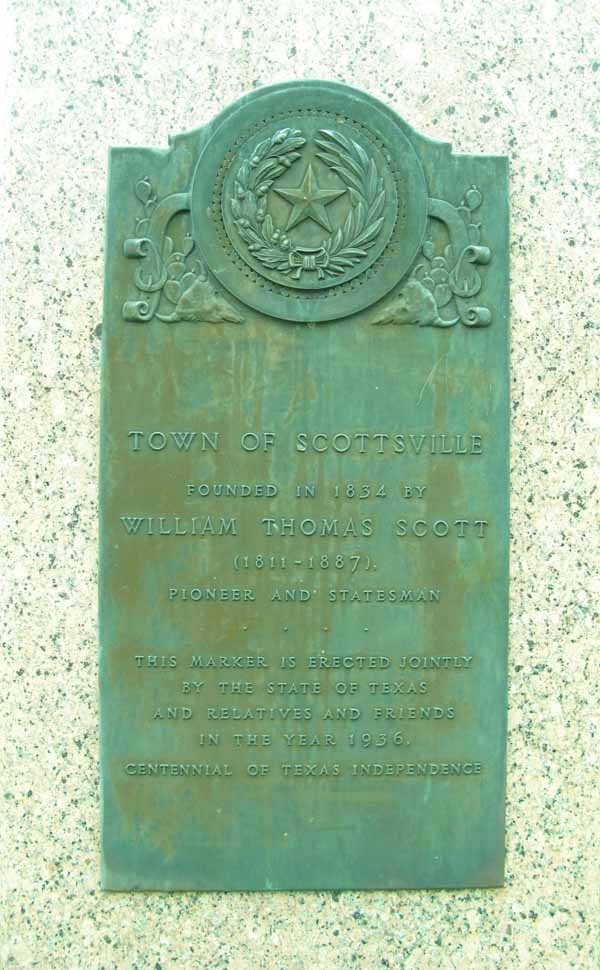
Over spring break, my beloved and I made a fast trip to Texas. On our way home we stopped off in Marshall for a few hours. Marshall is in Harrison County; my mother’s people settled there in 1834, hoping, I think, to escape the abolition of slavery in the United States by migrating to the fledgling Republic of Texas. They claimed large tracts of land adjoining Caddo Lake and eventually named the place Scottsville.


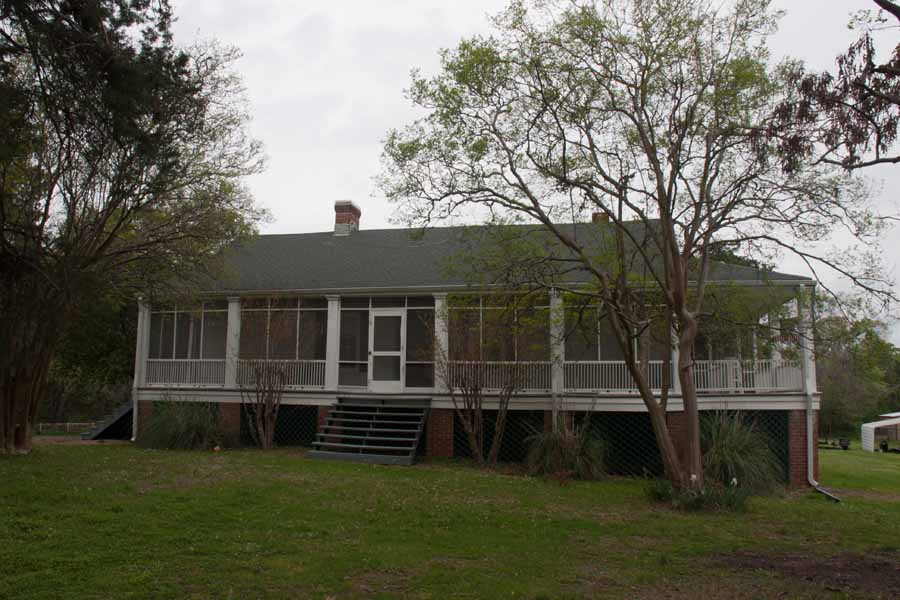
We found a few remnants of Scottsville on our visit: a cemetery dedicated to the memory of the Confederacy, and the Scott house, where My Grandfather was born in 1879. The old dwelling was originally built by W. T. Scott in 1840, according to a pamphlet kindly provided to us by Beverly Smith, whom we met at the Scott cemetery chapel. I grew up with a wealth of stories about the Scotts, some of them lurid; and I told a few of those stories in a piece I published back in 1992. I am thinking of telling them again, more thoroughly and at greater length.

And I said that was good

This needs poetry, but prose is all I have to give it, at least today. An old friend and colleague at St. Barnabas Church in Denton, Texas, has died—Bob Lockwood. The obituaries will tell you he was Robert Minturn Lockwood, III, M. D., whose profession as a radiologist hardly defined him. They will tell you of his devotion to Ann’s Haven Hospice in Denton, a pioneering effort in the hospice movement and one of the large works of his life. I didn’t know Bob at the time Ann’s Haven began and can’t speak of that, but his friends and acquaintances who are quoted in the newspapers speak eloquently of his service to the community and how it grew out of his grief over the death of his beloved first wife.

Bob was almost a renaissance man when I knew him, as close to that ideal as any son of the twentieth century could come: physician, scholar, poet, playwright, churchman, birder, naturalist, gentleman farmer—a longer list could be made. He was also an idealist with an almost Emersonian edge of Yankee shrewdness (though he wasn’t literally a Yankee) in spite of all the years he spent in Texas. He was a brilliant man who chose to find his destiny in the community of scholars assembled around two universities in the little town of Denton, Texas, a long way from Harvard and Penn Med. Circumstance was part of the reason why, but also a certain venturesomeness, I thought, coupled with a tendency to discount his accomplishments. Bob sometimes spoke of his career at Harvard as though he had been a failure and treated his medical credential as slight achievement. He was not a proud man, at least not when I knew him. When he retired he sold his radiology practice and went to work for the people who bought him out. But he also translated Brecht’s Theepenny Opera once, because he thought the popular adaptation (Blitzstein’s, I guess) was too tame. Bob’s father had been a professor of Latin and the Librarian of Haverford College, also the college’s informal historian and a devoted teacher. Students dedicated their yearbook to him in 1924. Maybe some of Bob’s interests, as well as the shaping of his character, began at home.

For the better part of ten years I knew Bob at St. Barnabas—many knew him better than I. But we served together for a year in a discernment process that brought us close, and we shared a heart-wrenching experience of the death of a beloved priest and friend that surprised us like a thief in the night. When I learned of Bob’s own death, I first turned to a poem he wrote in 1993 as a memorial to Charles Williams, the rector of our church at that time. Charles had been diagnosed with lung cancer just shy of his fiftieth birthday and was taken from us swiftly, in less than six months. Bob’s poem is a powerful reflection, not just upon Charles’s time with us and his death, but also upon how Charles talked with us about his death as he was dying—in a series of wonderful pastoral letters. Just before he died, Charles asked me to put together a small book of his sermons; I asked Bob if I could include his poem in the volume. I’ll not quote it entirely, just the conclusion.

And then you died—and were no longer there
       I saw your chest x-ray myself.
       It said DEATH—soon, no matter what.

So then, we cared for you (with a little help from the hospice).
And as you died
       you learned
       you grew
       you bloomed.
It was beautiful, it was terrible.
We wept.

Now please live on in us your friends
We are now more connected, more a Church, more the Body
Because you cared about us.

In the willow-meads of Tasarinan—may we meet again in the spring.

In his second life, the only life in which I knew him, Bob devoted himself to land and to practicing what we are now coming to call sustainability, raising chickens and bees, the farm where he lived with his second family a favorite resort of at least a couple of generations of children at St. Barnabas—a chosen place, a Vergilian place if you will—it’s useful at my age to learn what one thinks. I didn’t know Bob’s family, never went to his farm. He always came to church alone, as I do mostly now, myself, church being something my beloved and I do not share. I knew about Bob’s second life, the private part of it, only from conversations with him; but I believe the farm had been his renewal, or perhaps his last reinvention, of himself.

Now as I reread Bob’s poem I particularly think about its last line, an allusion to a place invented by Professor Tolkien in The Lord of the Rings. Treebeard sings of it in a wonderful song that recalls one of the Genesis creation stories:

In the willow-meads of Tasarinan I walked in the Spring.
Ah! the sight and the smell of the Spring in Nan-tasarion!
And I said that was good.

Tasarinan, in the legendarium of Tolkien’s Elves, is part of the lost flat world, now “under the waves,” that preceded middle earth in the same way that the legendary world of gods and heroes preceded classical antiquity, where the stories of that former world were regarded as history. As the members of the ring fellowship bid farewell to Treebeard midway in their journey, Treebeard speaks these poignant words: “I too must bid you now farewell. I do not think that we shall meet again. For the world is changing: I feel it in the water, I feel it in the earth, and I—I smell it in the air.” To which Elrond replies, “Maybe not in Middle-earth, Fangorn. But when the lands that lie under the wave are lifted up again, then in the willow meads of Tasarinan we may meet in the Spring.”

Did Charles and Bob read Tolkien together? I don’t know—I’m not sure I even want to know. But I think I understand that in wishing his dear friend and priest a pagan immortality, Bob meant to wish Charles a place in a time out of time wherein the difference between Pagan and Christian has been erased—and the world in which humans dwell with fire and water, beasts and great trees, no longer innocent, has found a new beginning.

—I can think of no better wish for Bob himself, or for us all.

memorials, days after

On Memorial Day my morning ritual was accompanied by occasional bursts of patriotic music from the bedroom next door where my beloved was watching the morning news. She likes to watch TV in bed as she reads the morning paper. I drink coffee in the adjoining study in front of my computer and read the news on line, but at one point I went into the bedroom to watch as Vice President Biden presided over the familiar wreath-laying at Arlington Cemetery. I thought how, as a summer exercise, Americans of many political persuasions still allow one another the benefit of the doubt on the two three-day weekends that frame the month of June.

And about allowing one another the benefit of the doubt, I hoped it remains true–that in our increasingly tribal society we have ways of practicing our citizenship that transcend our differences. I used to think the 1976 bicentennial celebration allowed us to do that in the aftermath of the terrible divisions over the war in Viet Nam. Now I’m not so sure—about that and a good many other things. In the past couple of days I have attended two events celebrating Memorial Day. Both events demanded my participation in the rhetoric of American exceptionalism. Both events shoved Lee Greenwood’s “God Bless the USA” in my face.

In the evening on Memorial Day, we watched Milk at my house. As that fine film reminds, the historical context of Harvey Milk’s death also includes the depredations of Anita Bryant. Bryant is still politically active, more’s the pity; though she seems to have fallen on bad times. A former website advertising her Oklahoma ministry is empty, and her MySpace page seems a rearguard action. It’s easy to see that Harvey Milk’s America and Anita Bryant’s are incommensurable. To my mind that same dissonance pretty much limns the difference between the Obama movement’s America and the Tea Party America of today.

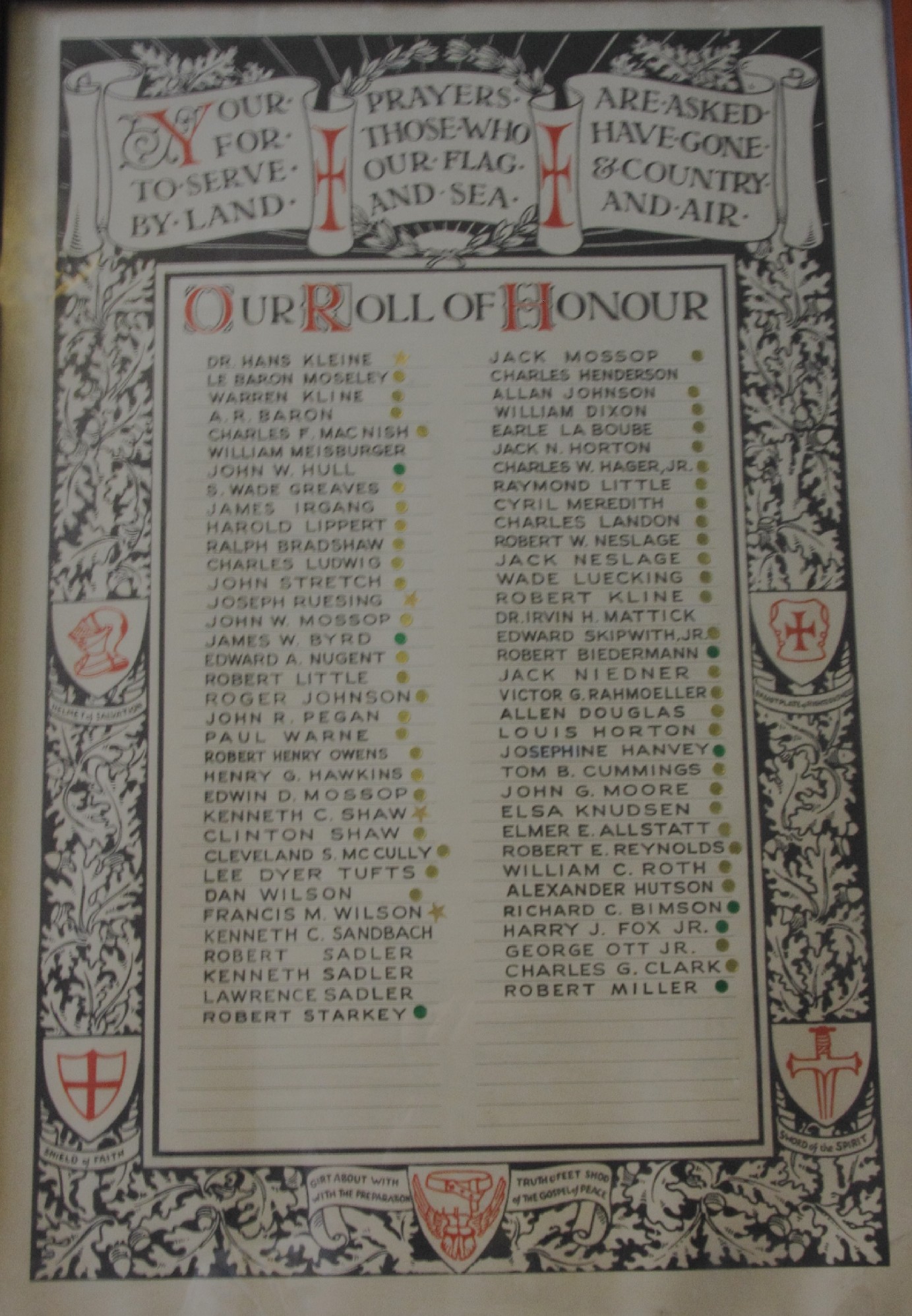
And speaking of rearguard actions, Sunday after church some of us gathered around a memorial to parishioners who had served in World War II. One of our fellow parishioners had found it in the church archives. A simple glass picture frame containing a handsome, hand-lettered sheet of paper listing sixty-nine names, most marked with stickers—mostly gold, though some are are stars and some not (we couldn’t figure out the color code). This memorial no longer hangs in my church, though I think it should, even though there is now no one among us who remembers any of the people listed. I note, too, that not all those listed are men. We will likely find a place to hang it again, and the antiquarians among us can perhaps discover who the people were. Maybe somebody will also discover why honour is given the British spelling. But why was this memorial plaque removed from whatever place it had in the church and placed in the archives? What was the thinking that led to its removal? As time obliterates memory, do memorials become curios?


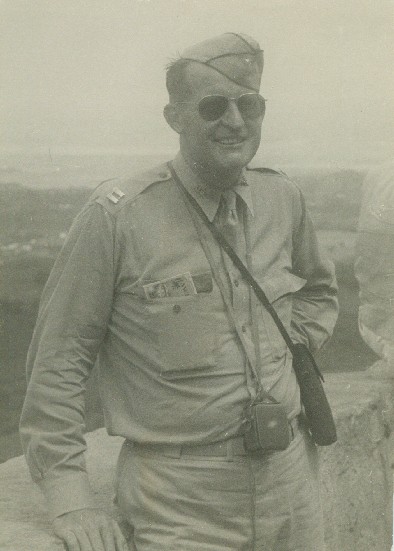
When I first started this blog, I wrote something about my father, who died in World War II. I’ve always liked this picture of him, taken at Ft. Bliss during training exercises before he and his comrades in the New Mexico Militia were sent to the Philippines as the United States 200th Coast Artillery in August 1941. He was a physician and a volunteer—at the time his unit was federalized physicians couldn’t be drafted—though he didn’t want to go overseas and hoped for a long time that the unit would be reprieved. I’ve always thought service in the National Guard was part of a payback for help with medical school—my father graduated from medical school in 1932—though I’ve never confirmed my suspicion. We saw him off with his unit on the train at El Paso a couple of days after my birthday that summer of 1941. He told me to take care of my mother. Here’s a bit more of what I wrote back then, paraphrased a little.

“More recently, I’ve read many of his letters to my mother. They describe his westward journey, first by train and then by ship, to the east, his arrival, much experience in the first heady weeks of his encounter with the MacArthur establishment. He didn’t like MacArthur, but I think he loved the old brown shoe army and relished being even a very lowly Captain, as he puts it in one letter, in that foreign outpost which must have had a certain old fashioned clubbiness and esprit. Then, of course, things turned sour. The letters are fewer from mid October on, and stop altogether in late November. One letter arrived after Pearl Harbor, written from a tent on Bataan in February, 1942. He died in 1944, somewhere in the South Pacific on an unmarked prisoner ship that was torpedoed by the U. S. Navy. The story of the sinking made the papers back home, with tales of escaping prisoners being beaten to death by Japanese marines. Of course that wasn’t anywhere near the whole horror of it.

“I learned more about the Japanese death ships when I read Dorothy Cave’s Beyond Courage a few years back. Apparently the Japanese used prisoner ships, marked with a red cross, to ship munitions, but there seems also to have been an intention to exterminate prisoners by transporting them on unmarked ships. Cave’s book also confirmed my impression from family and other history that my father and his comrades had been abandoned by their government when it was decided that the war in Europe took precedence over the far east. I learned too that my mother had been a member of an advocacy group during the war, that attempted to pressure congress and the president to rescue the folk in the Philippines. I found a collection of newsletters among her effects after her death. I also found a check for $100 that my father wrote to someone with a Filipino name. It was presented to my mother for payment after the war. The letter that accompanied it explained that my father had written it for black market medical supplies that he managed to smuggle into the prison at Camp O’Donnell.

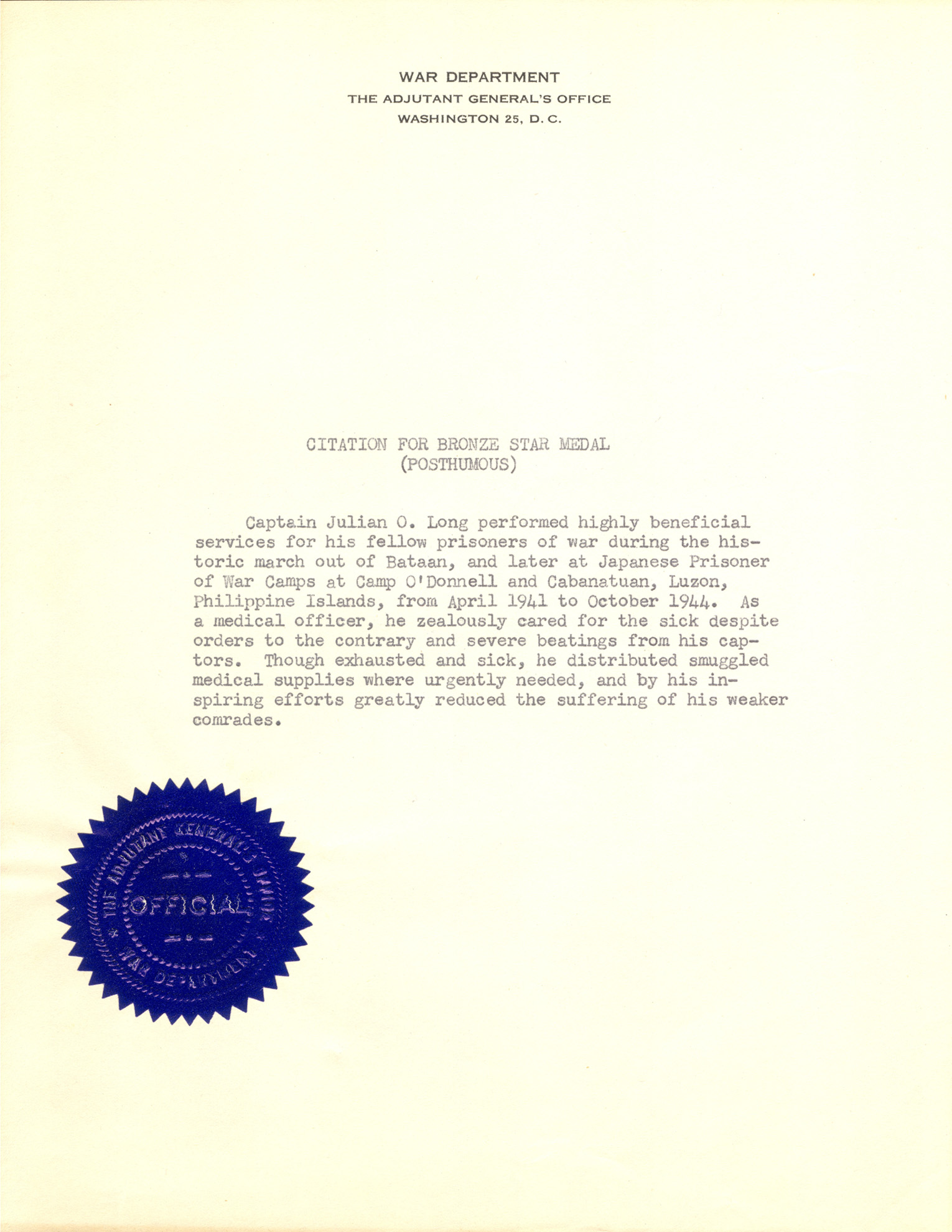
“After his death was confirmed, they promoted him to Major and gave him some medals. One was a Bronze Star, the highest military decoration awarded to noncombatants. He also received a Presidential Citation, signed by Franklin Roosevelt, which my mother always cherished. I didn’t know much of this as a child. I thought my father’s Purple Heart more important than the Bronze Star, bigger and more imposing. And for a long time I refused to believe he was dead. I fantasized that he would come around the corner of my school one day and grab me up in his arms.” There’s an error in the Bronze Star citation. It dates my father’s internment from April 1941 and should read April 1942.

My father’s regiment was sent to the Philippines because its personnel spoke Spanish. It was a multicultural unit that included native Americans as well as hispanics and anglos like my father. It had been a horse cavalry unit only recently. I remember a closet full of my father’s cavalry uniforms and riding boots. It’s a nice irony that less than fifty years after the close of the Indian and range wars, and in a place where both had been pretty fierce, there was a military regiment that included soldiers whose recent ancestors had likely fought each other over territorial and other claims, some of them genocidal, now a unit engaged in a common struggle far from home and united in part by a common language that wasn’t English.