Into my own

Recently I was sent a collection of family photographs. Among them is this snapshot taken outside the farmhouse in Las Cruces, New Mexico, where my father and his brothers and sister did much of their growing up. My father is the tall one in the middle with his hands on my grandmother’s shoulders. Her youthful appearance startles me. The elderly woman on the far left is my great grandmother, Melissa Peterson. The farm in Las Cruces was a homestead. Only my uncle Bill (standing just behind Mrs. Peterson and my aunt Frances) was born there. My father, his brother Randolph (the one with the silk handkerchief in his pocket), and his sister were born at an earlier homestead near Sayre, Oklahoma. There’s no date on this photo, but I think it was taken in 1930 or ’31. The subjects seem to be dressed in their best, on their way somewhere.

Except for my father they would all live long lives. Mrs. Peterson lived to be 82; my grandmother and two of her children would live almost a century, reaching the age of 99. Uncle Randolph, the eldest of my grandmother’s children, would live to be 94. And except for Mrs. Peterson they would all find themselves far away from Las Cruces at the end of their lives, most of their experience shaped largely by their country’s mid-century adventures in the far east. All of my grandmother’s children went to college. As I look at these images of them, see the hardscrabble under their feet and the house with its look of temporariness, I am thinking how remarkable that is.

I’ll not tell all I know of their stories now. My father and my uncle Bill were already in medical school, I think; uncle Randolph on his way up the corporate ladder in what would become AT&T. My aunt Frances would marry a man who became a Brigadier and travel widely. My grandmother, once her children were launched, would travel widely as well, living in Honolulu for a while and finally settling in Seattle. But the various fulfillments of these separate destinies were long ahead of them all in 1930—what strikes me in this photo is the seeming anticipation in their demeanor, and a certain innocence.

My title is borrowed from a poem of Robert Frost’s that anticipates the end of a long life as a time of certainty. The poem’s speaker imagines that friends he left behind, should they catch him up at the end of life’s journey, would discover him to be not “changed from him they knew— / Only more sure of all [he] thought was true.” These are the thoughts of a young man, part of Frost’s first book, A Boy’s Will, published when the poet was thirty-eight years old. At this distance they seem a recipe for closed mindedness.

• • •

I recalled the lines from Frost as I was thinking about some lines from a much longer ago dead poet, Henry Howard, Earl of Surrey:

Martial, the things that do attain
The happy life, be these, I finde.
The richessse left, not got with pain:
The frutefull ground, the quiet minde:

After I factor out the mindset of the landed aristocrat, there remains in this translation of Surrey’s the still attractive classical ideal of the quiet mind; though Surrey’s own mind was less than likely to be quiet. Like Martial he lived in turbulent times. He led a dangerous life as a Catholic in the twilight of Henry VIII’s reign and was ultimately executed as a traitor. He was perhaps 30 years old when he died.

But the ideal of the quiet mind need not be thought youthful, nor need it presuppose certainty. It is a stoic ideal, conceived as a response to uncertainty and frustration, a consciousness that seeks its own in the midst of political and other stresses; and it’s sometimes held up as a goal of liberal education, a mind both copious and quiet, “liberally furnished with objects of contemplation,” to paraphrase Dr. Johnson, another latter day stoic, who between herculean labor and coping with Tourette’s syndrome and other afflictions, had plenty of mental noise in his life.

I’ve just finished a week’s reading that included, in addition to various consumables (by which I mean newspapers, blogs, media, etc.), John Gardner’s Grendel, which my class discussed last week, S. C. Gwynne’s Empire of the Summer Moon, a popular meditation on the the winding down of the Indian wars in the southwest (yet another retelling of the story of Cynthia Ann Parker, the exploits of her son, Quannah, and the capitulation of the People), and Wendell Berry’s Home Economics.

I turned to Gwynne on the recommendation of friends I encountered in my home town of Abilene, Texas where I recently attended the 57th reunion of my high-school graduating class and was struck by the realization that my grandparents had arrived in western Oklahoma around 1901 in the aftermath of the turbulent events Gwynne’s narrative brings to mind. From Gardner I took away (again—I’ve read Grendel many times now) what seems the quite reasonable claim that Whitehead was right to assign the name of God to that which limits action and energy and therefore calls forth “the entire multiplicity of eternal objects.”

And I turned again to Berry because I am trying to formulate for myself a rationale for the liberal arts in contemporary university education. I’ve previously written about Berry’s essay, “The Loss of the University.” But now I’m more interested in his thoughts on sustainability and his claim that community has economic value, because it seems to me that whatever case we make for the liberal arts in our day has got to take into account the material conditions required for their study and the material benefits of the same. If we can’t make the case that the liberal arts have practical, economic value, it is hard to argue that they have cultural or spiritual value. As Berry puts it with respect to community, “Can there be a harvest festival where there is no harvest?”

• • •

Two years ago I asked my class to read Alasdair MacIntyre’s After Virtue. It’s a beautiful book, though I don’t agree with much of it, including its core argument. MacIntyre says, in a preface to the third edition, that he was not yet a Thomist at the time he wrote the book (1981); but what I think I loved about After Virtue when I first read it in the mid-eighties was its insistance on the importance of a conception of human nature. Without such a conception (and I like Aristotle and Thomas about this too) the Enlightenment notions of liberty and equality are pretty empty. Something more is required, it seems to me, as a ground for these notions than the naked assertion of self-interest—some notion of human good, potential or real, immediate or lost. Adam Smith, often cited as the godfather of neoliberal economics, believed in a moral sentiment, physically present in human being.

The enlightenment tradition has tended to emphasize private judgment, private enterprise, etc., as opposed to centralized coordination. This was liberating in the eighteenth century, when people could still be put to death for witchcraft. Now, when “The notion that every action is is both a private experience and a a public utility,” as Whitehead says, has all but died out, individual beliefs and practices tend to be asserted as near absolute private entitlements. We see this on both sides of the political spectrum, but it has particularly emerged recently in the argument against government mandated health care. Obamacare, so called, infringes on my right of self-determination. Government, so we are told, has no right to tell me, as a sovereign individual, that I have to purchase health insurance. It’s the old seat-belt argument.

Here is Aquinas’s fifth proof of God, the one I like the best:

The fifth way is taken from the governance of the world. We see that things which lack intelligence, such as natural bodies, act for an end, and this is evident from their acting always, or nearly always, in the same way, so as to obtain the best result. Hence it is plain that not fortuitously, but designedly, do they achieve their end. Now whatever lacks intelligence cannot move towards an end, unless it be directed by some being endowed with knowledge and intelligence; as the arrow is shot to its mark by the archer. Therefore some intelligent being exists by whom all natural things are directed to their end; and this being we call God.

I don’t like this because I think it succeeds as a proof. Its conclusion in no way follows from its premises. As an argument, it’s an exercise in question begging. But it’s beautiful, and beauty is truth in a way; though Keats claimed too much for the idea.

Still, my point here is that without such a conception of intelligence grounded in the material stuff of the world, the enlightenment conceptions of liberty and equality degenerate into empty assertions of individual autonomy that are easily transformed into the right to bear arms, the right not to purchase health insurance, the right not to wear a seat belt, etc. And politics aside, without such a conception the fundamental issues of ethics and aesthetics degenerate into cost benefit analysis that deserves comparison with the excesses of medieval scholasticism, or into empty claims about the timeless worth of things that we know only as inferences and extrapolations.

• • •

At this point in my life I am more uncertain than I have ever been about the things I hold dear, though I am pretty comfortable in my skin. I tend to think that certainty, not uncertainty, is the enemy of life. None of us knows when he will die–that’s the fundamental uncertainty–and I don’t need to be certain about the ideas that I use, because my practice constantly confirms their usefulness. Unlike MacIntyre I embrace and celebrate democratic pluralism. To be sure, it gives us Sarah Palin and the gun toting folks in Arizona and elsewhere. But it also gives us what I identify, following Richard Rorty, as liberal hope.

Uncertainty seems basic to the hope for a better world. An uncertain person, such as I am, tends to embrace bounded ambition in regard to the potential for historical accomplishment, or social progress. But the person who seeks certainty seeks an establishment, a city on a hill, the end of history. I think history and the end of history both abide in the moment, and I am content with that. I embrace the long tradition of uncertainty in Christian mysticism. (See, for instance, “The Cloud of Unknowing.”) Rather than doctrine, I embrace prayer. I find common prayer particularly efficacious, though I have no belief in, or knowledge of, a personal god.

I am not uncomfortable with any of this, perhaps because I am a poet and grounded in poetry. I read, for instance, the ending of “Little Gidding,” as it draws together the poet’s personal quest with Dante and Julian of Norwich, as a method of being. Here are the lines:

We shall not cease from exploration
And the end of all our exploring
Will be to arrive where we started
And know the place for the first time.
Through the unknown, unremembered gate
When the last of earth left to discover
Is that which was the beginning;
At the source of the longest river
The voice of the hidden waterfall
And the children in the apple-tree
Not known, because not looked for
But heard, half-heard, in the stillness
Between two waves of the sea.
Quick now, here, now, always?
A condition of complete simplicity
(Costing not less than everything)
And all shall be well and
All manner of thing shall be well . . .

And I think of truth as but one of the conditions of thoughts that one loves. The difficulty of Truth and Truth establishments is that they drive truth (small t) out of the room. In this regard I am remembering something from Hannah Arendt, in one of her letters to Mary McCarthy, “The chief fallacy is to believe that Truth is a result which comes at the end of a thought-process. Truth, on the contrary, is always the beginning of thought; thinking is always result-less. That is the difference between ‘philosophy’ and science. Science has results, philosophy never. Thinking starts after an experience of truth has struck home, so to speak. . . .”

I’ve learned a lot from MacIntyre, even though I don’t agree with him about much. I particularly don’t agree that Aristotle needs vindication. Aristotle remains with us, as Plato does, perfectly available to the next thinker who might wish to use him as Aquinas used him, just as the Homeric poems remain available to poets. I’m not entirely sure of this, but I think MacIntyre’s use of Aristotle may be perverse. It’s not an adventurous use in any case, as Whitehead’s use of Plato is adventurous, for instance.

“In my end is my beginning.” All my grandmother’s children went to college. I loved college so much that I’ve never wanted to leave. Though I’ve knocked around a bit and seen a bit of the world, I remain primarily a mental traveler, like Joyce Cary’s “randipole Billy Blake,” perhaps not unlike my grandmother’s children, too—on my way somewhere unknown, unknowing.
Gone to Texas

In a few days my beloved and I will travel to Texas together to be on hand for the 57th reunion of my high-school graduating class. I look forward to the journey partly as an escape from troubling strife at Saint Louis University, where the sway of a too powerful administration is being forcefully challenged on campus. I look forward to the journey into a past I share with old friends as well. Here is an essay about aspects of that past that come to mind at the beginning of most school years.

The first of it is mostly the concluding section of an essay entitled “The Ultimate West” that was published in Pembroke Magazine in 1993. My grandfather was from an old-time east Texas family. There’s a little township, now a suburb of Marshall, named Scottsville, for his people. My father went to the Philippines in August 1941, as a medical officer with what was called the Two Hundredth Coast Artillery from New Mexico, and never returned. My Texas home town, though I was born in Albuquerque and have always wanted to return there, is Abilene, Texas, almost in the geographic center of the state, but part of the region known as West Texas. The essay contains a section on ruined wild dogs who, according to John Graves,1 have moved into the niche in the food chain left by wolves who were systematically slaughtered in an earlier time.

‘What do I know?’ asks the skeptic, Montaigne, a question hardly heard today outside ideological disputes. As another school year opens, the seventieth for me since my early chlidhood, I ask myself again what I may have learned in all those years that is worth passing on. What I know best is a certain restlessness, which I believe to be fairly common in my generation, though less common than heart disease and ulcers. Perhaps I am spared these latter maladies by being muddle-headed and unsure of myself. Perhaps I lack character, but I can’t help feeling that my confusion is in some part the confusion of my age. Forty-odd years ago I missed seeing a planetary conjunction which was billed in the media as the truth about the Star of Bethlehem. But I and my family watched humans walk on the moon that year, on our black and white TV set in Durham, North Carolina.

In Texas, the easy certainties have always come from family, land, and religion. Habits arising from those easy certainties have broadened into the larger society amongst our timely and untimely adventures—there’s not much difference between old-time pious land grabbing and what we now call American exceptionalism—so that non-Texans take the Bushes and Rick Perry to be typical of the breed. But the frontier is gone, and though what remains of Texas chic still colors the old frontier myths with purple nostalgia, western imagery is a dead metaphor, dead as western movies. Today’s cowboys get shot out of the skies over Pakistan, or own sports franchises, or wage idiosyncratic campaigns for national office. Cowboying and land-grabbing have by and large failed us Americans as a nation, but the drama of the old-time land grabbers is still being played out in our political life as a kind of rear guard resistance to the present.

To be a West Texan is to have credit for a college course which might be called GREAT FRONTIER I as one’s birthright – the history of the Indian wars, the Alamo, the Spanish conquest and colonization of Cibola. This is particularly true for me, since I am half a New Mexican. But GREAT FRONTIER II, the history of the self-willed gallantry of Dixie, with its yankee and Elizabethan roots, is a story I can tell from family memory. Texas voted for secession 46,129 to 14,697 over Sam Houston’s opposition. Great great Granddaddy “Colonel” W. T. (Buck) Scott, with 104 slaves at the time, was in the vanguard of secessionists.2

On the other hand, Robert E. Lee was Commandant of ill-fated Camp Cooper, not far from Abilene, in the 1850’s, and I never knew it until I read it in A. C. Greene’s A Personal Country. We weren’t fighting the war of northern aggression in my family. Granddaddy was a Roosevelt Democrat and a union man. He loved to tell stories about his family and the old times, but he had put the south behind him in some crucial way, I think, when he came west in 1926.

My old friend, the late A. C. Greene, once wrote that every man has a village in his heart.3 He and I happen to share the same village, Abilene, Texas; though my Abilene is different from A. C.’s, haunted by different ghosts, and neither exists any longer. This memoir of mine recalls a past with which my own life and blood are continuous—in that village to be sure, but also in the wider story of an engrafted past I did not experience myself. I know that story first and chiefly not from books, but in the rise and fall of my grandfather’s voice.

As I sift my village memories, I know them to begin my sense of belonging, at least partly, to the culture of civilized things. One of the loveliest memories of all comes from a Christmas party given by Miss Nancy Craig Lasley, Abilene’s piano teacher. To be sure there were others who taught the keyboard in my village, but Miss Lasley was the chief, just as the Clack sisters and Selma Bishop were schoolmarms to the generations at Abilene High. This particular party was one of the last times Miss Lasley lit candles on her Christmas tree, around 1953. After music and punch and cookies, we students and guests and firemen—there had to be a fire truck handy—were allowed to take the candles from the tree and keep them. I still have mine, somewhere, with its little German silver holder. That’s my village, Mozart sonatas at Christmas in an old house on Grape Street, when Grape Street still had brick paving. I should like my memoir to end there, but it doesn’t.

In the continuing city that surrounds my village, there remains a great fund of uncivilized energy, and more, something far more fearful. I think my ancestors slaughtered the southwestern wolves because of the ruined dog in themselves. Great great Grandaddy W. T. shot Robert Potter, I was always told.4 As the originator of the crime of Potterism and an original of the expression ‘Gone to Texas,’ Potter may have needed killing, but where does the good fight end and something else take over? Potter himself might have asked the question.5 At some point even righteous anger becomes gratuitous. ‘What’s the matter with you Texans?’ I remember being asked after Charles Whitman shot sixteen people from the library tower at the University in Austin. ‘What’s the matter with you Greeks?’ cry Aeschylus and the tragedians. We reply that blind Homer long ago invoked the rage of doomed Achilles as the ground of poetry.

These days I sometimes find myself humming the old prophetic hymns I remember from Sunday evenings, when we let our hair down and recalled the claims of the historic church militant. “Doubt and fear and things of earth/in vain to me are calling./ None of these shall move me . . . !” Ten thousand years in the promised land, the greed, the visionary idealism, the tenacity, the dogmatism, the bravado that tells you to suck it up when somebody dies: “Methinks I see a strong and puissant nation,” but let that go. The old west may be the shine on God’s backside—or only a media event.

When I was a student at SMU, a friend’s father died back in Abilene. My friend called to tell me about it and when the funeral was, and to ask me to come and help him with his mother, who was pretty bad off. He asked me too, to bring him his car, which he had left with me the week before. I drove my friend’s car the 180 miles from Dallas to Abilene in under three hours, flat out ninety miles an hour most of the way. A semi almost ran me down near Ranger, driving on the wrong side of the road. I swerved into the ditch and kept on trucking, as the saying goes.

I don’t remember very much about the funeral, or consoling my friend’s mother, but I remember the ride in that 300 horsepower 1953 Olds Rocket 88 with a fourspeed hydramatic and power steering – my God, I remember that ride!

Notes

1See Hard Scrabble: Observations on a Patch of Land, New York: 1982.
2See William Thomas Scott, The Handbook of Texas Online. Texas State Historical Association, 1999; And Randolph B. Campbell, An Empire for Slavery: The Peculiar Institution in Texas, 1821-1865, Louisiana State University Press, 1991.
3In A Personal Country, New York, 1969.
4Who actually shot potter is problematic, but it likely wasn’t W. T. Scott. With respect to my grandfather’s stories I think he told us what he had heard, but that he had heard about his grandfather at least one story that might have been told of his maternal great-grandfather. W. T. and many of his kin came to Texas in the entourage of Wm. Pinckney Rose, ‘Old Rose,’ the ‘Lion of the Lakes,’ at a time when the country south of Caddo Lake was still part of a no man’s land along the Sabine River. W. T. had married one of Old Rose’s daughters and named one of his sons Preston Rose Scott, after Old Rose’s famous son. Old Rose may or may not have been the leader of a band of Regulators, and Robert Potter may or may not have been a Moderator, Regulators and Moderators being rival vigilante groups. But Old Rose and Potter seem to have fallen out over a piece of land, though the story of their enmity has all the earmarks of a family feud, the two having been born within sixteen miles of each other. Old Rose had been born in Oxford, North Carolina, in 1787, Potter, down the road in Brassfield township in 1799. It was in Granville County, around Oxford, where Potter’s exploits became legendary in 1831, though by that time, of course, Old Rose was in Mississippi. In her memoir, Harriet Ames Potter names John Washington Scott, one of W. T.’s brothers, as the actual killer of her lover, says Scott did the shooting while Rose held a gun on her. Apparently, J. W. Scott, like W. T., had also married one of Old Rose’s daughters. The official indictment, to which Ms. Ames swore (ultimately dismissed on grounds of “informality”), names Old Rose, Preston Rose, J. W. Scott, and some nine others. Potter was shot on March 2, 1842. Harriet Ames’s memoir, “The History of Harriet A. Ames during the early days of Texas, [written by herself in New Orleans at the age of 83]” has never been published. Elith Hamilton Kirkland notes that the memoir was “discovered” in 1936 “among Harriet’s relatives,” and that copies of it have circulated privately ever since. A copy is housed in the Library Archives of the University of Texas at Austin. I have relied on extracts quoted by Ernest G. Fischer for details from the memoir, as well as for some details of Potter’s life. See Love Is a Wild Assault, Fredericksburg, TX, 1959, and Fischer’s Robert Potter: Founder of the Texas Navy, Gretna, LA, 1976.
5About Potter, see this and this. On August 28, 1831 Potter, then a member of the United States House of Representatives from Oxford, North Carolina, attacked his wife’s cousin and another man he suspected of improper relations with his wife and castrated them both. He served six months in jail and paid a fine of $2000 for his crime. His wife eventually divorced him. He was reelected to a term in the North Carolina House of Commons, where had served before serving int he U. S. Congress, but was ultimately expelled from that body. In 1835, Potter migrated to Texas, where he continued his flamboyant life. My Old friend, the late sam Ragan who grew up in Oxford, NC, told me once that Potter had been convicted of misdemeanor assault because North Carolina at the time had no specific law under which to try him. After the fact the state passed such a law, and the crime of Potterism became illegal in North Carolina.

Labor Day

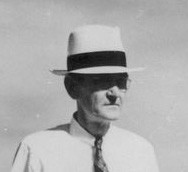
Today I am thinking about my grandfather. Here’s a picture of him as I remember him. He tended to dress this way even to work in his yard, keeping two hats, one old and one new, for each season, and two pairs of Edwin Clapp shoes, one old and one new. He seemed an old-fashioned gentleman to me as a child. I thought it quaint that he called my grandmother love and that he always paid his bills in person. I adored him.


I don’t know how often grandaddy replaced the items of clothing I’ve described (the shoes probably lasted a long time as they were made of kangaroo leather); but when the old items got to a serious point of wear he would replace them and the formerly new items would become old. The old items served him for work around the place after he retired, and I expect before as well, though I didn’t observe him as closely before retirement as I did after. He retired a bit early, after a heart attack, when I was four or five years old.

He was a printer by trade. When I was a small child he was the night foreman and ultimately the plant superintendent at the Abilene Reporter News in Abilene, Texas. I remember that he would take me to the composing room with him once in a while, set me on a bench by the window and let me watch him work. I still have a mental picture of him standing bent over the big stone-topped tables where the page frames were made with a type stick in his hand.

Grandaddy belonged to the International Typographical Union, then the oldest trade union in the country. He retired before lynotype machines changed newspaper production much, and he didn’t like lynotype operators. He claimed they were ignorant, and of course they weren’t craftsmen. He didn’t live to see the ultimate dissolution of his union as photo offset printing made redundant both his craft and the skills of the lynotype operators he disliked.

As the eleventh or twelfth child in a family whose wealth had been dissipated by his father’s impecuniousness, Grandaddy had been unable to attend college as some of his older brothers had done. I don’t know how much formal schooling he had, but his real education had been a progress through the ranks of apprentice and journeyman in the printer’s trade at a small newspaper in Terrell, Texas. He set himself up in a job shop in the big city of Dallas for a while after, then returned to Terrell for some years after his partner absconded with the assets of the business (or that’s family story) and ultimately took his family to West Texas in 1926.

I think he must have been pretty good at his trade, and he must have known at least a bit about the gigantic presses newspapers used in his day as well, because one of the things he did towards the end of his career was technical troubleshooting for the Harte_Hanks newpaper chain that owned the Reporter News. He regarded Bernard Hanks as a friend and mourned his death in 1948.

The union was one of the things that grounded Grandaddy’s life. He was no friend of strikes because they created hardship; though he believed steadfastly in collective bargaining. But the great value of the union for him, as I think back on it, must have been that it was a band of brothers, if I can be forgiven that old-fashioned expression. Inded, in Grandaddy’s day men who worked for newspapers, whether they worked in the plant or in the newsroom, felt a sense of connection with one another. When one of my uncles, who had followed Grandaddy into printing, found hmself out of work because of a strike at his plant in San Antonio, he found work in San Angelo and Abilene through the union. Grandaddy was retired by that time, about 1950 I think.

Some newspaper people were restless in the old days, and moved around a lot. My friend Patrick Bennett documents the career of an itinerant writer named Edward Anderson, who tended to move from paper to paper because he drank a lot and sometimes got fired for being drunk on the job. Anderson eventually found his way to Hollywood where he wrote some movies and a couple of novels, then back to Texas where he became involved with right-wing politics and died in obscurity.† But for every marginal character like Anderson, whose vagrancy was enabled by the newspaper network, there were countless others who led solid middle-class lives. The union enabled my grandfather to do so, to retire with dignity, and to purchase property in his old age which helped to provide retirement income.

Of course Grandaddy had Social Security as well, and that’s another story. As I remember him today, and the life his working milieu enabled for the extended family of which I am a part, I find that I still adore him. As a child I would follow him around and “help” him do things. When I have tools in my hands I think of him to this day puttering around, fixing things, digging in his flower beds. This afternoon I will do some puttering of my own, and I will think of him. I’m also thinking the modes of social organization that enabled his life were good things: not all of them, certainly not the racial part. But I think of my grandfather’s life as an illustration, not of the naked individual initiative we have mythicized in today’s political culture, but of the nurturing and enabling force of human solidarity.

†Pat’s book is entitled Rough and Rowdy Ways: The Life and Hard Times of Edward Anderson, College Station, Texas A&M University Press: 1988.

Sunday at home

It’s a wet, dreary Sunday as hurricane Isaac plays itself out over the midwest. The RNC has played itself out as well. Good riddance to both, though we need this rain. Another academic year has begun. I met new groups of students this week, new to me anyway, and enjoyed them. When I turned 75 a week ago I wondered if my mind would turn again to Montaigne’s question, que sais-je? But I guess not. I’m still far too engaged with he world to stop and take stock.

Here’s the entrance to the Missouri Botanical Garden as we saw it over the fourth of July weekend this year during the Lantern Festival, a collaborative effort between the garden and a group of Chinese artists. There’s a video here, if you want to see more of what it was like at night, a magical experience. And here’s a picture I took of the Gateway Arch that same weekend. We went for a boat ride on the river with out-of-town guests one morning and in the afternoon attended a naturalization ceremony at the old court house (slideshow here).

As I write today, my beloved is talking with her sister in Phoenix in the next room. I’ve just been invited to a fund raiser for a friend of a friend who has been stricken with leukemia. That will take place after a trip we will make to Texas the first weekend in October to attend my 57th high school class reunion. We’re having them every two years now, reunions that is, we being the geezers in the class of 1955 at Abilene High School. As soon as things dry out I’m planning a comprehensive effort of home maintenance. We need some concrete work and tuckpointing here at the old house. A deal of clearing out and discarding needs to be done as well.

There’s a great deal to be said for ordinary life in the city: buying and preparing food, mowing the grass, sleeping and waking, work. I look forward to sitting on my back porch and watching the sun set as fall draws on. The view out my back way is a cityscape and not a very romantic one at that, lots of wires and the poles that carry them, other people’s back yards—but I love it. We live in a neighborhood of row houses. I like to wonder what it was like a hundred years ago when our house was new and women swept their sidewalks in the early mornings.

There’s a wonderful 1876 map of the city that shows our area before it was built up. Henry Shaw‘s Tower Grove Park is there, and the early Botanical Garden; but the residential areas in the surrounding environs are yet to be built. Our street, a major north/south artery then and now, runs a block past the Compton Hill Reservoir and stops. Our area, half a mile south, is open fields. A map of 1911 shows our street and our block, where our house had been built in 1904.

I expect our immediate neighborhood housed brewery workers in those early days. Pestalozzi Street, immediately to the north of us, runs right down to the old brew hall at Anheuser Busch, no longer locally owned. After a long decline, our neighborhood is regentrifying. Our block is now almost entirely rehabbed. We no longer sweep our sidewalks; there are no more coal furnaces or fireplaces

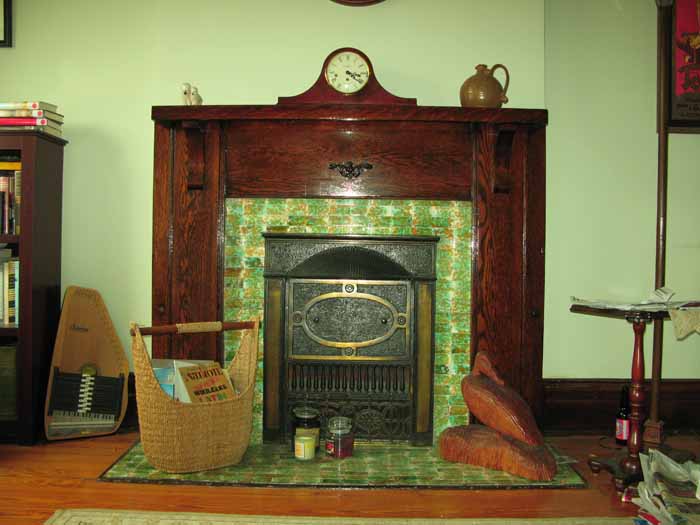
Our house was piped for natural gas from the beginning and seems to have had at least one gas light, although it was originally wired for electric lighting as well. An old gas outlet has been capped at the top of the front stairwell, the original entrance to the second-story flat. My beloved hangs a wreath on it. We have the original gas units in the upstairs and downstairs fireplaces, though we’ve never tried to use them. I keep thinking I’d like to have modern gas units, but the old ones are beautiful. Here’s the downstairs fireplace as it looks today.

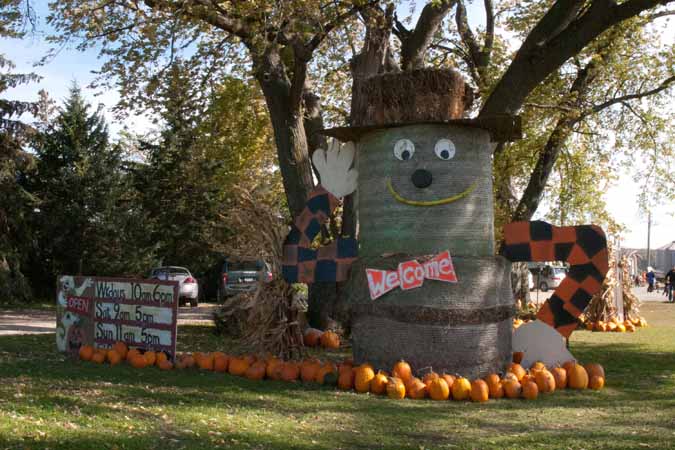
So it’s good to be breathing in and out and able to savor these good things. We may even go to the pumpkin patch outside Iowa City next month after we get back from our other adventures.