
ramblin’ boy

Here’s my two cents about Pete Seeger.


You needed to hear him live, to see him and witness the display of energy, artistry, and sheer chutzpah that was a Pete Seeger concert. After that you felt you knew him a little, didn’t need to ask him for an autograph or speak to him in the press of fans that had surrounded him even on stage. I heard him at Duke, one evening in spring 1968 I think it was. Page auditorium was sold out. People were sitting in the aisles and on the stage so that he had only a small circle to walk around in. He sang flat out two hours and then did some encores, just him. No band, no light show, no overproduction, nothing except what came out of his skinny body, that long-necked banjo, his big twelve-string guitar, and the sweet wooden flute he sometimes played. He was huge.

He was an American original, perhaps the best of a generation of American specialty pop singers who gravitated towards a multiplicity of ethnic genres they weren’t born to, made them their own, made them new, added to them, turned them to the purposes of social and political protest. He started no movements, not even the folk-music revival, but he emerged as a folk hero, a leader, and a moral force at the time when roots music was beginning to be big business. Following Paul Robeson and Woody Guthrie, He remained a proud leftist throughout his life. Though he left the Communist party after the excesses of Stalin, as many did, he remained a communist with a small c, as he once said. And unlike many ex-Communists of his period, he did not turn to cold-war advocacy, to neo-conservatism, or to any of the other forms of easy super-patriotism available in the second half of the twentieth century.

Nor did he shy away from controversy. Along with Guthrie and Lee Hays, his wife Toshi, and his small children, Seeger was assaulted by a mob after his appearance along side Paul Robeson at Peekskill, New York in 1949. In 1951 e was convicted of contempt of congress and sentenced to a year in jail after refusing to answer questions put to him by the House Un-American Activities Committee, though the conviction was quashed. Later, he and the rest of the Weavers were blacklisted and placed under FBI surveillance throughout the McCarthy era. The John Birch society sometimes picketed his concerts. During the civil-rights movement and the Viet Nam War protest, he was always in the front lines. The story is apocryphal that he attempted to cut off Bob Dylan’s electrical supply with an axe when Dylan appeared with a rock band at the Newport Folk Festival in 1965. But why not, after all? Dylan had abandoned not only acoustic music, but social protest as well. From his Viet Nam era protest to his attempts to clean up the Hudson river to his recent leadership in the Occupy movement, Seeger has always been true to his roots in the radicalism of the thirties’ labor movement.
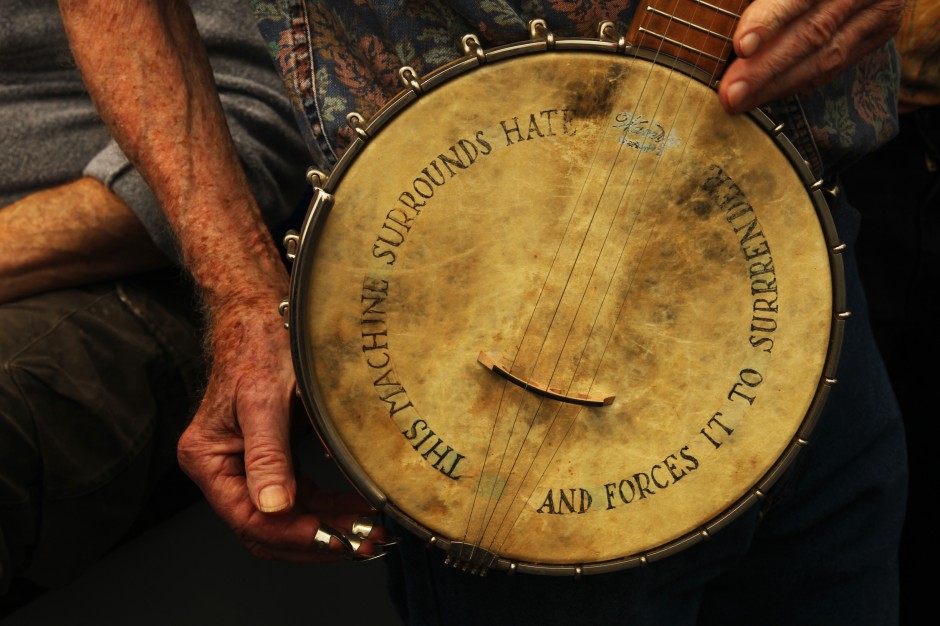

He also “put together” a good many songs, as he sometimes said. And some of his best known songs are associated with other singers who covered them and whose recordings became more famous than his: The Byrds for “Turn, Turn,” Peter, Paul, and Mary for “If I Had a Hammer,” which Seeger wrote with Lee Hays; though not “Waist Deep in the Big Muddy.” Many obituaries cite it, partly to point up the adversarial side of Seeger’s career and partly, I think, because Seeger never ceased to own that song. My personal favorite Seeger song is mentioned, or quoted, in none of the obituaries I have read. It is this one, the words by Idris Davies. Seeger found them in an essay entitled “Welsh Poets” by Dylan Thomas, that appears in the volume Quite Early One Morning. It features not the famous hate surrounding banjo but the dark sound of Seeger’s twelve-string guitar. The back story involves a Welsh coal mining disaster and the failure of the British general strike of 1926. The Birds’ version is more famous, but I like Seeger’s own.

Seeger first recorded “The Bells of Rhymney” on a live album made at a 1957 Carnegie Hall concert he and Sonny Terry presented together. In the notes to that album, he documents the guitar tuning and fingerings he used for the song and says some charming things about it, one of which is that the tune is pretty much the same as “Twinkle, Twinkle, Little Star.” My vote for the best Seeger obituary goes to this one. And it doesn’t change my love for “The Bells of Rhymney” to admit that I can still hear him singing “You can’t scare me, I’m stickin’ to the union!” I could wish him rest, but I can’t think of him resting any more than I can think of him dead. He was no twinkling star—he burned bright and hot, and if he’s now burned out there’s no black hole. He’s off rambling somewhere With Guthrie and Hays and his other pals, like it says in the Tom Paxton song he loved to sing.

Those lovesick blues, I just lost ’em . . .

I’ll be leaving this on the front page for a while. It’s not a review—you can’t review your friends’ work. Rather, it’s more in the nature of an appreciation. Appreciations are OK, and we once thought them legitimate criticism in the hands of say William Hazlitt, not to compare myself with that adorable genius.

A couple of years back I wrote about my friends, Pattie and Jack Le Sueur from Durham North Carolina. Jack had recently retired from the North Carolina Arts Council, and when I asked him if he and Pattie intended to continue performing around the Research Triangle area as they had since the nineteen-seventies, Jack told me that he was entering “legacy mode”—no more live performing, but that he had in mind to produce some recordings he and Pattie had made over the years.

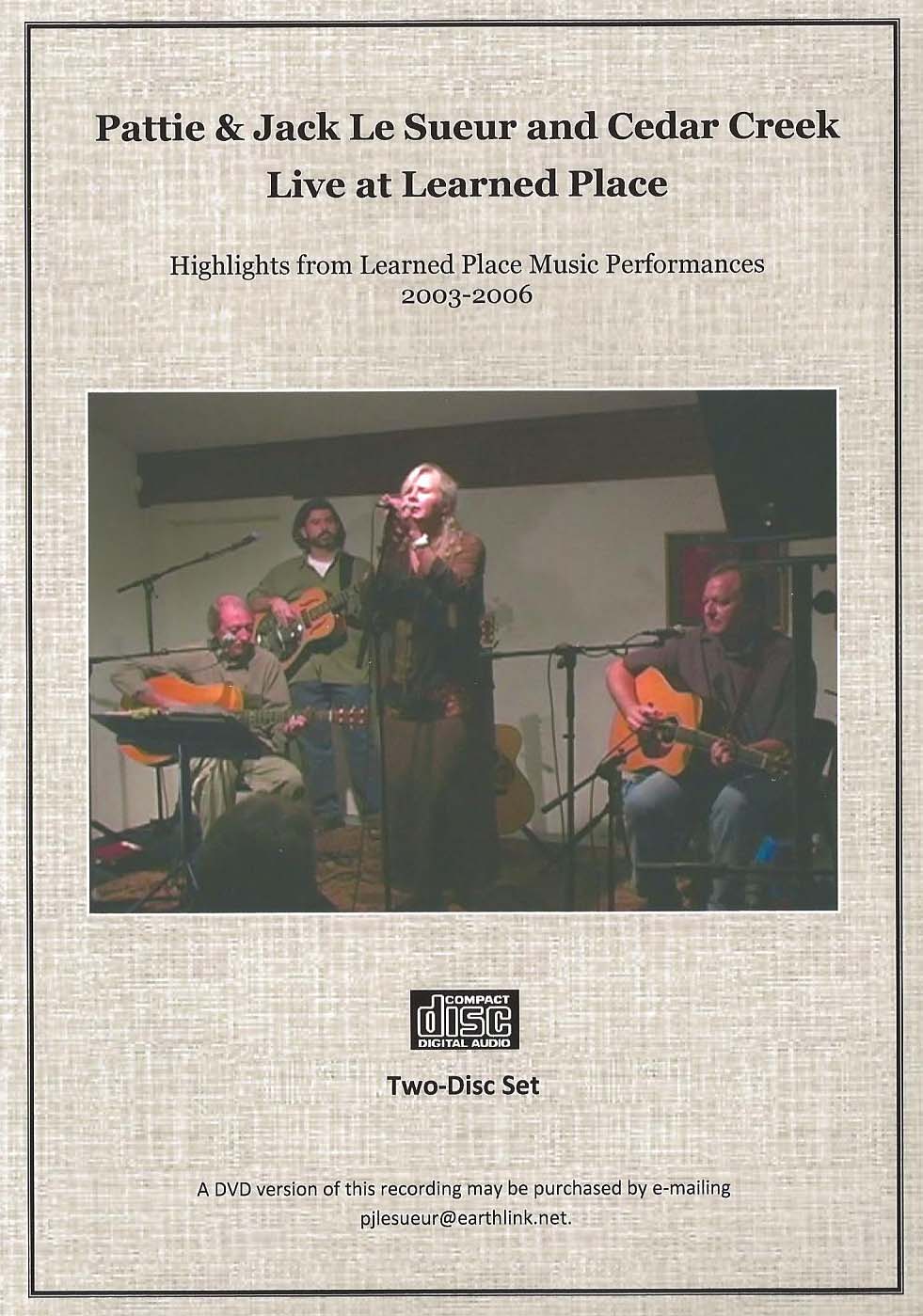
The first of these (I say first hoping there will be more) is now available, a double CD/DVD set entitled Pattie and Jack Le Sueur and Cedar Creek Live at Learned Place. I hadn’t known about Learned Place, but here’s a history written by proprietors, Deborah Jakubs & Jim Roberts, that’s included with the discs. As you can see it’s as much about Pattie and Jack and the album as it is about the venue. I’ll quote it all in hopes it will interest readers as it interests me.

Learned Place Music was inspired by chance encounters and our growing friendship with Pattie and Jack Le Sueur, first admiring their performances at the wonderful Cedar Creek Gallery in Creedmoor, then conversations at kids’ soccer games. Having expressed admiration for their music, we were invited to hear them play an opening set at Peter Kramer’s farm in Orange County featuring a trio then barely known in the US – the Krüger Brothers. Not only did we hear the amazing Krüger Brothers for the first time, but we also met the full Cedar Creek band, with the multi-instrumentalist and fine singer Rick LaReno on banjo and lead guitar and Mike Foster on bass. Our sons were soon taking private lessons with Rick, and we became groupies of Pattie & Jack Le Sueur and Cedar Creek. And the Krüger Brothers, who have several times collaborated musically with Pattie and Jack and Cedar Creek. [You can read about the Krüger Brothers here. JL].

These friendships inspired us to begin sharing our home for acoustic music performances, what we dubbed Southern Roots music. We are now in our tenth year of the Learned Place Music series and have hosted over 50 concerts. Pattie & Jack Le Sueur and Cedar Creek took part in many of these performances until they ended their collaboration in 2009. This album, with songs recorded between 2003 and 2006, shows both the evolution of the band and the concert series. Through it all is the astonishingly beautiful singing of Pattie Le Sueur, punctuated by some great lead singing by Jack and Rick. In all our experience, it is hard to imagine a finer singer than Pattie. Were it not for day jobs and family commitments, these folks could have been making a mark on the musical world anywhere. But they chose Durham, and we are grateful. Their music is timeless and beautiful and rendered extraordinarily well in this collection.

This is a great collector’s item for fans of Pattie & Jack Le Sueur and Cedar Creek, for the faithful supporters of Learned Place Music, and for anyone devoted to fine acoustic music.

The album contains 34 songs. My favorites at the moment are the second two songs on the first disc: “The One Who knows,” a Dar Williams song about breaking away and letting go that Pattie calls contemplative. It displays some of the best things Pattie does as a singer, quiet and thoughtful things that require mastery both of her voice and of the microphone, as well as maturity and interpretive insight. My other favorite is “Lark in the Morning,” a wistful Kate McLeod song about loss and the memory of love–how’s that for country?–that Pattie and the boys in the band almost turn into a dance hall stomp. I say almost because the song their way still retains its seriousness. It just doesn’t protest too much. For a sentimental listener like me this song is the true gold, in the vein of A. P. Carter, et al.

Rick LaReno does some fine guitar picking in “Lark in the Morning” and many other songs on the album. For the second disc opener LaReno turns a performance of folk chestnut, “The Fox,” into an occasion for some splendid guitar riffs. He also sings well, especially in John Gorka’s “Gypsy Life,” and plays fine Scruggs style banjo. Mike Foster, the bass player, doesn’t get the spotlight much, but provides the solid bottom of the music that never rings false, sings harmony vocals, and sometimes contributes a bit of percussion by thumping his big resonator guitar.

Pattie and Jack’s son, Jon Le Sueur, a professional musician and filmmaker in his own right, plays guitar and accompanies his mother on “A Stor Mo Chroi,” a traditional Celtic lament; and daughter Sarah Le Sueur joins in the choruses of country favorites “New Night Dawning” by John Poythress and Tammy Kidd and Delbert McClinton’s “Two More Bottles of Wine.” Michael Borstleman and Jens Krüger fill out the ensemble with mandolin and banjo as needed.

All in all this new album is a great romp that spans genres from traditional folk to contemporary country and rockabilly. There’s even a good yodeling song, Jimmy Rogers’ “When the Cactus is in Bloom,” that shows off Pattie’s skill as a vocal acrobat. Jack’s “Administrator’s Blues” is included and his lovely wedding song, “Two Paths,” but not his “Waisting My Time,” which I miss; though I already have that song on Pattie and Jack’s earlier CD, Two Paths.

The back and forth banter as Pattie introduces the songs provides more good fun. At one point she quips that Jack is in administration, and Jack fires back that she (of course) is not, eliciting a big laugh all around. One has the sense that the jokes are as familiar to these friends as the songs are. There seems an easy camaraderie between them all, performers and audience alike. Jack plays mostly second guitar, filling in the rhythms and the harmonies, sitting back and letting others take stage. He was always good at that, though I’m sure that much of the thinking that shapes these performances is his.

On the whole this album seems exceptionally well-produced. The sound quality and the mixing are excellent, and the video quality is high. There are some flaws here and there, places where feedback intrudes, an intonation problem or two. But I think such things are to be expected in recordings made at live performances. What one gains from such recordings is a special kind of presence, something more than passion, a kind of focused immediacy, what Hazlitt called gusto. These are fine musicians at the height of their powers performing music that has become part of their being—for an audience of friends and neighbors to whom they are physically present.

Buy this album. It’s available from jack.lesueur@earthlink.net. Prices are $20 for the DVD, $15 for the CD, or $30 for both—plus shipping, of course. I’ve got both, so that I can watch indoors and listen in my car; and I plan to buy more copies for gifts to friends and family.

From Mahler to Jolie Blonde . . .

Last evening my beloved and I attended the funeral of a friend, Joe Kleeman, who had played bass in the Saint Louis Symphony Orchestra for many years. Pretty much the whole celebration was music. The Choir of Bethel Lutheran Church, where Steven Mager is music director, was supplemented by a group of SLSO musicians, including Concertmaster, David Halen.

Perhaps because of the music, and perhaps because I am still reacting to the death of Doc Watson, I came home in a mood to listen to something; but instead of classical music I decided to watch a DVD I have had for a while of the first series of Transatlantic Sessions, organized by fiddler Aly Bain for the BBC back in 1995.

I had got the DVD because one of the songs on it had disappeared from YouTube. I had posted “Maiden’s Prayer” here long ago, from the sixth program in the BBC series and told a story about the supposed origin of that fiddle tune. Some time after I posted it, the tune disappeared into the void of closed accounts. But last night I watched and heard it again. In fact, I watched two thirds of the Transatlantic Sessions DVD before giving in to sleep.

Among wonderful things in this music are several performances by Iris DeMent, including “Our Town,” the music from the last episode of Northern Exposure, Jay Ungar’s “Ashokan Farewell,” in whicn Ungar and Bain lead what amounts to an entire fiddle section, and many performances by DoBro player, Jerry Douglas, who plays throughout. You’ll hear him on this Performance of Jolie Blonde, together with Michael Doucet, Ricky Skaggs and others.

One YouTube comment declares this song to be the author’s “favorite waltz in all the world.” “[D]on’t you Cajuns call this the Cajun National Anthem?” he asks. I don’t know that it’s my favorite waltz, but I love it a lot, enough that I just ordered the second season of Transatlantic Sessions from Music Scotland. One of Joe Kleeman’s daughters wrote of her dad that he would listen to Mahler, take a sip of his drink and exclaim, “God, this is beautiful!” It’s a long way from Mahler to “Jolie Blonde,” but as I watched Transatlantic Sessions and sipped some reasonable bourbon, I felt like toasting Joe.

p

The Poet of Deep Gap

Doc Watson (1923—2012)

Arthel “Doc” Watson was as true a poet as I know. And now he is no longer resident in the mountains of his beloved Carolina but “scattered among a hundred cities,” as Auden put it when he remembered the death of his friend, W. B. Yeats. It’s a good thing, too, that the poet’s death be kept from his poems. Doc Watson now resides in the many tunes and songs and licks and riffs he left behind in various media, in the many good and generous gifts of himself that form the recollections of fans and friends who wrote about him in yesterday’s newspapers.

Blind almost from birth, a touring musician for whom touring carried the constant apprehension of being marooned, and a bereaved father; Watson, hugely talented, transported himself and his music nevertheless, into the lives and hearts of countless listeners like me who will recall him with fondness as we collect his recordings with renewed focus and energy, perhaps remembering when we first heard him in person (for me it was Durham, North Carolina, in 1967). For all of us, as for the world at large, Doc Watson is now timeless in memory—sad, to be sure (unexpectedly sad as a friend put it), but the sadness is the common sadness of human life. In Doc Watson’s case, as Daniel Gewertz put it in the comment section of yesterday’s New York Times obituary: “It wasn’t an easy life, but it was touched by amazing grace.”

It’s hard to pick a favorite recording, but here’s one I love that features Doc in his prime. It’s the ensemble recording of “Blue Railroad Train,” off the old Southbound album from 1966 that he made with Merle and others.