
at home in Denton

I have several home towns, and I expect I’m not different from many Americans. Lots of us have lived in a good many places long enough that we acquired a sense of belonging there that never quite leaves, so that we’re surprised and sometimes saddened to return and see changes, feeling that we’ve lost something when some landmark disappears, or thrilled and excited to note that some wonderful new thing has arrived in our absence.

Ten days ago I went home to Denton, Texas, in many ways my favorite home town; though I was not born there and didn’t attend high school there, and therefore can’t exhibit two important markers of a normal hometown claim. Still, I love Denton; it remains a funky little college town in spite of growth that places it inside what is now called the metroplex by many residents of the Dallas/Forth Worth area. And it continues unique in my mind and memory, partly because of its funkiness and partly because of its excellence.
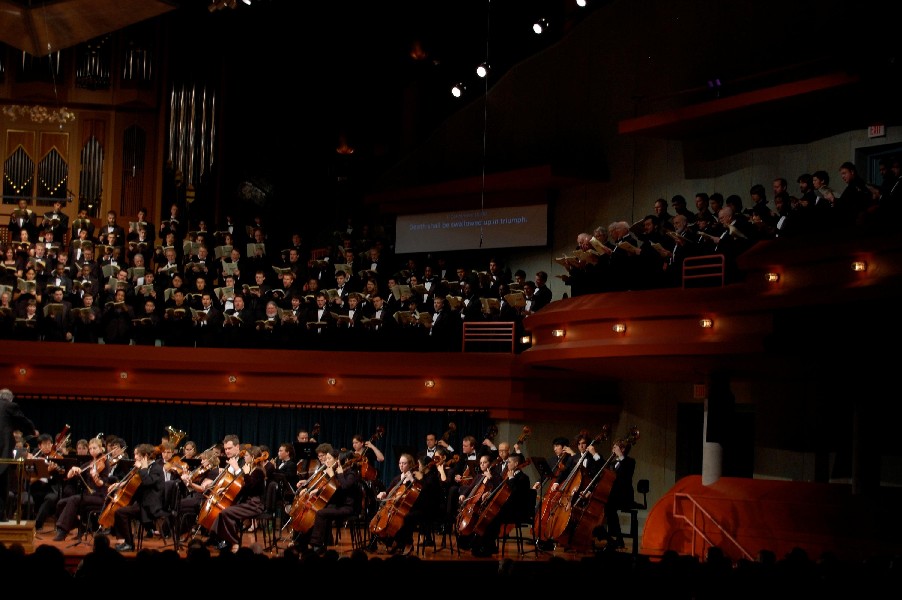
The excellent, first. I attended a performance of Brahms’ Ein Deutsches Requiem at Winspear Hall on the campus of the University of North Texas, long known for its fine College of Music. The conductor was my friend, Henry Gibbons, who is retiring from that college after after a career that has spanned thirty-plus years. The Brahms concert was his retirement celebration. The hall was packed, his colleagues were there, the stage and parts of the balcony were filled with an ensemble made up of UNT massed choirs, the Denton Bach Society (of which I was once a singing member), and the UNT orchestra.

It was a performance about which I cannot be objective. I will not attempt to review it. But I thought the choral singing superb, possessed of a clarity both of purpose and execution that startled me in the opening measures of the first movement and thrilled me to the point of tears many times. I sang with Hal Gibbons for seventeen years. Perhaps he will not mind if I characterize him as a musical humanist and suggest that his reading of the Brahms seemed to me to flow from a profound understanding of the Germanic character of the work and of Brahms’ music as a realization and fulfillment of its text.

Recordings are now available in CD and DVD format. The Denton Bach Society website offers information about ordering them — I have ordered both. If you click the thumbnail above (thumbnails in this blog are always live links) you’ll be able to see somewhat less than half the ensemble. I didn’t take this picture, but I think the photographer chose this angle to avoid including a central sound reflector, which was rather brightly lit, in the photo. On the left you can see part of Winspear Hall’s magnificent new organ, completed last year.

Now, the funky. Readers of this blog may remember that I’ve written before about a Denton neighborhood known as Fry Street. For a while I attempted to further the goals of a Denton organization that called itself Save Fry Street. Well, that organization disbanded and closed down its quite good website after a fire destroyed a number of Fry Street institutions, or what remained of them after the human beings moved out, having been evicted by a predatory developer. I took a look at the absence that is now the corner of Fry and Hickory, climbed the staircase to the roof at what is left of Cool Beans and had a beer in the middle of it. The sight was so depressing that I couldn’t stay long.
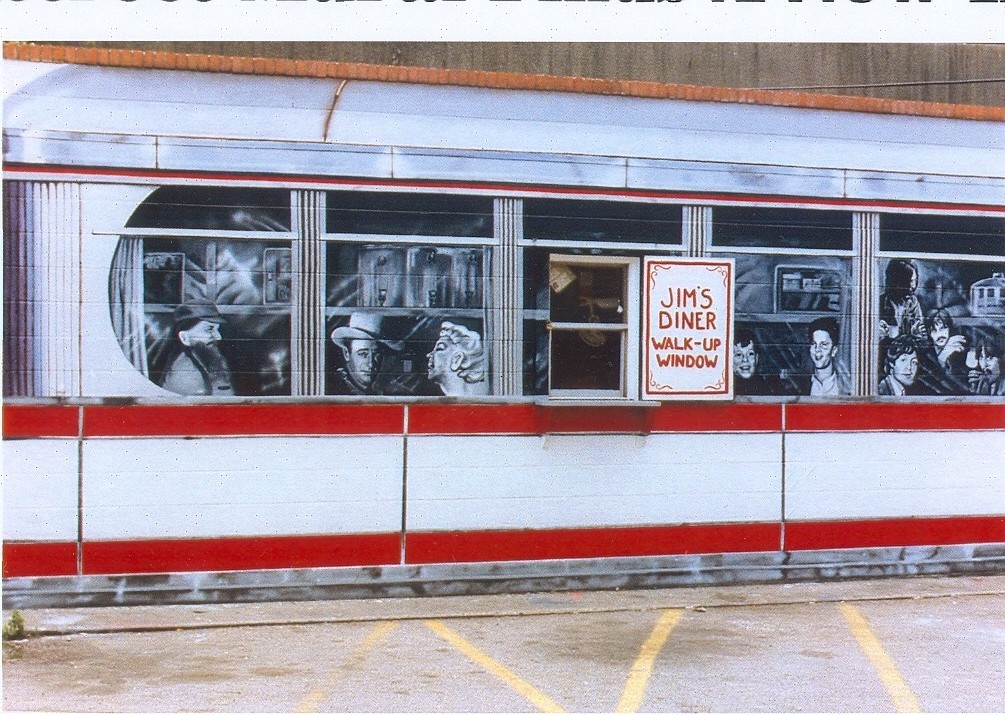
But later that evening I visited the Greater Denton Arts Council and watched as several panels were unveiled from the mural that once had appeared on the outside north wall of Jim’s diner. Here’s a photo that shows how the mural looked early on before Jim’s built a porch that adjoined it, which Bagheri’s (an Italian restaurant that replaced Jim’s) kept, along with the mural. Pieces of the mural were saved from the June, 2008 fire and ultimately donated to the Arts Council. Three panels, created from those pieces of wall, are now permanently and prominently mounted at the northwest corner of the Visual Arts Center at Hickory and Bell, as you can see in the second photo. A fourth panel, made from the door whose inside you see in the photo of the mural that was, will be displayed inside the Center. I wondered why at first and then realized that the door was made of wood — a minor miracle that it was preserved.


I spoke with the president of GDAC, and with old friends who live in the historic district that adjoins Fry Street, during the reception that followed the unveiling. What I could glean of the news from Fry Street in those brief conversations suggests to me that there’s not much remaining of the developer’s plans that precipitated the destruction and that new plans for the area are waiting for people to think them up as well as for the arrival of bettter economic times. I also heard of changed minds and hearts on the city council and at UNT (Fry Street sits at the northeast corner of the UNT campus. Both UNT and Denton city government at one time supported the depredations of United Equities). I think if I were one of the proprietors of the Save Fry Street website I’d be thinking of putting it up again. That voice may be both necessary and relevant in the coming months. I’ve just learned of a recent documentary about this history that looks promising as well.

yet once more . . .

Yesterday the Supreme Court began yet another debate about race, this time about whether a test for promotion that favors white candidates may legitimately be used by the Hartford, Connecticut, fire department. White candidates who were denied promotion on the basis of the test had sued, claiming discrimination (i. e. that they were refused promotion because of their race). No black fire fighters passed the Hartford promotion test–it’s not an unfamiliar situation. St. Louis Fire Chief, Sherman George, was fired by Mayor Francis Slay in a similar case.

In the case before the Supreme Court, the arguments quickly took shape around the clichés of the affirmative action debate. Here’s what Robert Barnes reports in The Washington Post as plaintiff’s attorney Gregory S. Coleman’s presentation of the heart of the plaintiff’s case:

Racial classifications are inherently pernicious and, if not checked, lead as they did in New Haven to regrettable and socially destructive racial politics, [Coleman] told the court. He said New Haven officials scuttled the promotions not because they found fault with the test, which they had commissioned from a private company, but because the results caused a political uproar.

The court is sensitive to the perception among some whites that affirmative action programs are unfair to them and seems set to endorse the proposition that racially discriminatory outcomes do not establish a basis for municipalities to reject test results such as the ones at issue in Hartford.

Barnes reports that at one point in the questioning yesterday, Justice Roberts “asked Deputy Solicitor General Edwin S. Kneedler whether he could ‘assure me that the government’s position would be the same’ if the results had been reversed — if black applicants had scored well and no whites were eligible for advancement.” Apparently Justice Roberts did not find Kneedler’s affirmative answer satisfactory, and he is right; though his initial question is wrong and wrong headed.

White racism remains entrenched in American life from top to bottom, the institutional racism of white privilege. It may be that affirmative action programs have done all they can do to change this situation and that what remains must be left to hope and good will as our society evolves. But if the court rules as it seems set to rule and endorses institutional racism, that will be a serious setback to the almost century-old effort to redress racial injustice through the courts, to the legacy of James Weldon Johnson, W. E. B. DuBois, and Thurgood Marshall.

As Barnes puts it:

[These] arguments come as the court has grown more skeptical of [race based] policies, and in the wake of the election of the nation’s first black president, who has urged a new conversation about the effects of past discrimination and the future of race relations.

It will be a truly mournful thing if one consequence of the election of Barack Obama turns out to be an endorsement of white privilege by the United States Supreme Court.

puerile supremes guffaw about strip search

I am amazed and very seriously troubled by the language and tenor of arguments at the United States Supreme Court in the case of Safford Unified School District v. Redding. I am also outraged at the tone of the reporting of this language by New York Times writer Adam Liptak.

This is the case of Savana Redding, who was strip searched by school officials in Safford, Arizona, looking for an ibuprofen pill and acting on a “tip” from another student. Redding was 13 and in the eighth grade at the time. Both male and female school officials participated in the search, which found no ibuprofen or any other “controlled substance.”

Here is Liptak’s lead:

The United States Supreme Court spent an hour on Tuesday debating what middle school students are apt to put in their underwear and what should be done about it.

After that it’s all downhill. Liptak reports with apparent relish comments from the justices which are vulgar, voyeuristic, and offensive. Apparently, even Redding’s attorney participated in the verbal undressing of his client, commenting at one point that “there’s a certain ick factor to this.”

At another point, compounding the “ick factor,” Justice Breyer offered the following profundity:

In my experience when I was 8 or 10 or 12 years old, you know, we did take our clothes off once a day, . . . We changed for gym, O.K.? And in my experience, too, people did sometimes stick things in my underwear.

After which, according to Liptak, “The courtroom rocked with laughter, and the justice grew a little flustered at having apparently misspoken.”

According to Liptak, “While Supreme Court arguments can often be bone-dry exercises in statutory exegesis and doctrinal refinement, Tuesday’s session was grounded in vivid facts: school snitches, drugs, underwear and body cavities.” At one point, Justice Roberts exclaimed, “The issue here covers the brassiere as well, which doesn’t seem as outlandish as the underpants.” Later, Justice Scalia, with his usual profound confidence, asserted:

You search in the student’s pack, you search the student’s outer garments, and you have a reasonable suspicion that the student has drugs. . . . Don’t you have, after conducting all these other searches, a reasonable suspicion that she has drugs in her underpants . . . ? You’ve searched everywhere else. . . . By God, the drugs must be in her underpants.

This might be funny, if it weren’t so awful. And nowhere in this discourse, not from the attorney for the plaintiff, nor from the federal attorneys arguing as friends of the court, nor from the justices (except for Justice Ginsburg), nor from the reporter, is there any recognition of the obscenity of the violation of this young woman’s privacy, her body, and her person by mindless school officials mindlessly enforcing a mindless zero-tolerance policy.

I’m surprised that Liptak didn’t report Justice Ginsburg’s remarks critical of the strip search, as several bloggers have done. Indeed, Liptak seems eager to join in the boys’ club atmosphere he describes. One blogger notes that

After [Justice] Breyer wondered aloud just “how bad” the search really was, Justice Ruth Bader Ginsburg interrupted energetically to underscore how bad it was. She said Redding and another student in the case weren’t just told to strip to their underwear. “They were asked to shake their bras out, to stretch the top of their pants and shake that out.”

The same blogger remarks ruefully that “Ginsburg has said more than once that she feels lonely on the Court as the only woman;” and adds that “this must have been one moment when that loneliness was acute.”

According to Liptak, the court’s mood was summed up when Justice Souter remarked as follows, “My thought process, . . . is I would rather have the kid embarrassed by a strip search, if we can’t find anything short of that, than to have some other kids dead because the stuff is distributed at lunchtime and things go awry.” Begging the court and the reporter’s pardon, the insensitivity of this remark is worse than appalling, it is a dishonest appeal to a false choice, and worse still: it is an off-the-rack cliché. It reflects nobody’s actual thinking. It is intellectual junk.

And apparently no thought on anybody’s part, either, that the events at issue occurred in a school, or any concern about what such scenarios teach. Here’s what they teach — that the people who have the power in life can do anything they want to you, and you have no recourse. They teach that to young vulnerable teenagers. I’m glad Savana Redding is fighting back. I hope she wins. I would have no objection to a little jail time for the school officials who molested her.

But if the language of the majority of the justices here noted is an indication of the seriousness with which this case will be adjudicated, I don’t have much hope.

completing the figure

It’s good to think that one can learn something even in one’s seventh decade when the brain has begun to stiffen with the rest of one’s body. Today I think I have learned something, or at least thought about something familiar in a new way. Easter isn’t about welcoming the happy morning, at least not at first.

I had been thinking about the Easter Vigil, how we light new fire in darkness at the begining of the service and begin the Mass with bells and organ sounding for the first time in three days. A friend had written me to say that his pastor had quoted James Weldon Johnson’s lines about Gabriel’s silver trumpet in her Easter sermon. Somehow it occurred to me that the passage from death to life must be a sudden occurrence, the body snapped into being like a spoken thing. That’s why resurrection, if there be such, is different from birth.

And that’s why scripture tells us that God comes suddenly — when one is unprepared — like a thief in the night. The watchmen cries out from his high tower; but God comes with the watchman’s utterance still unheard, and nothing is the same afterwards. It’s the twinkling of an eye of which Paul speaks. It’s the bugler in Krakow cut off in mid voluntary by an arrow in the throat. And it’s because of the traditional painful imagery that surrounds the whole idea in scripture that I missed it. It isn’t at first about judgment at all. It’s about hierophany.

I think Mozart understood what I’m talking about, and maybe that’s why the Glorias in one of his most famous mass settings sting the ear and run up the scale like birds flushed from underbrush, startling the bonae voluntatis, “the living and the dead in the twinkling of an eye . . . caught up in the middle of the air,” as the poet says.