
more on the ABC

The Lead this morning at the Episcopal Cafe directs me to Theo Hobson in The Tablet. In a piece entitled “Quiet voice of modernity’s enemy,” Hobson characterizes the Archbishop of Canterbury as an old fashioned Anglo-Catholic whose championing of gay rights in the 1990s “made him seem the liberal he never really was.” Hobson’s commentary on the ABC’s now famous remarks about sharia law incorporate a reading of Dr. Williams that is substantially like my own. What I have interpreted as a kind of theological toryism, Hobson reads as “anti-liberal ecclesiology”:

The liberal state, in this view, offers itself as an alternative community of salvation; it tempts us into supposing that we can dispense with the Church, or at least water it down, and develop a more progressive form of Christianity. This leads to weak forms of Christianity that are unable to resist dangerous ideologies: most obviously, the liberal Protestants of Germany embraced Nazism.

I think it’s at least worth pointing out that it was a coalition of liberal states that ultimately defeated Nazism and that notable Catholics, including Pius XII and Martin Heidegger made highly problematic alliances with the fascists. It’s also true that European Christianity whether Catholic or Protestant has deep and abiding anti-Semitic roots. It was the public idealism associated with liberal politics that ultimately stood against Hitler. Perhaps the Quakers can lay claim to a record without shame with respect to the murder of European Jewry, but no other Christian group can.

Hobson pictures the Archbishop as an anti-modern thinker who regards secularism as the enemy of the human spirit. According to Hobson, the Archbishop has argued that secularism “shuns comprehensive visions of human good,” whereas “[r]eligion addresses the whole human being.”

He sees his role, then, as defender of the various subcultural spaces that resist the logic of secularism, the enclaves within our culture where fully human meaning is made. And of course these are not only Christian. In a curious way his vision echoes Prince Charles’ declaration that he would like to be the defender of faith rather than the faith. He wants to be the defender of the endangered cultural space that insists on the priority of God. If the Muslim form of such space is tied up with sharia law, we must try to accommodate this.

I wonder what the Archbishop would say about a story such as that which Nafisi tells in Reading Lolita in Tehran, or about the novels of Chaim Potok. For better or worse, freedom has meant more often than not in modern, pragmatic terms: breaking out of a constricting, dehumanizing, religious tradition. Outside the ancient world, and that only briefly until Christians came into their own politically, the historical instances in which established Christian communities have advocated for justice and human liberty are few and far between, almost nonexistent until modern times with the rise of modern secular tyranny. We have reread Luther and made him an enlightenment hero, but that image will not withstand a careful perusal of Christian Liberty, not to mention Against the Jews and Their Lies.

To argue that religious communities have a unique ability to entertain “comprehensive visions of human good” flies in the face of too much history to be taken seriously. And even in those cases where Christian critiques have influenced social change, as in the modern abolition of slavery and the civil rights movement, they have done so in the face of serious and determined opposition from religious groups defending the established tyranny. The history of sectarian groups demanding freedom is long, but with few exceptions and some of those problematic, these same sectarian groups have shown themselves quite capable of instituting tyrannies of their own once they attained political power. Americans need look no further than the history of Massachusetts for an instance.

And one more thing. The Archbishop acknowledges a certain difficulty with sharia law in a modern political system suggesting that it “could have the effect of reinforcing in minority communities some of the most repressive or retrograde elements in them, with particularly serious consequences for the role and liberties of women.” If these minority communities were to be restrained from honor killings, etc., what would be the basis of such restraint? Indeed what is the basis for the ABC’s own critique in the sentence I have just quoted? I suggest the basis will be found in the very principles of secular, positive, law that the Archbishop seems to find problematic. And if we’re talking about teasing out “some of the broader issues around the rights of religious groups within a secular state,” we’re talking about a secular negotiation that can only be conceived of inside the framework of the very liberal politics the ABC opposes, or seems to oppose.

Hence, the Archbishop of Canterbury’s remarks about sharia law, though seriously bothersome to me as an anglican, seem quite logical coming from a thinker whose public statements (as I have argued elsewhere in these pages) seem to indicate a political preference for established social practice over the interest of the oppressed. It’s nice to discover an analysis, such as Hobson’s in The Tablet, that seems to agree. But it’s also interesting to see the Archbishop broadening his approach to established practice to include a defense of freedom for marginalized groups, even if he is pretty selective of the marginalized he chooses to defend. And I don’t think this is necessarily bad. As background for my argument and Hobson’s, I might recommend reading the Archbishop’s speeches entitled “Faith Communities in a Civil Society – Christian Perspectives,” delivered last September and “Civil and Religious Law in England: a Religious Perspective,” delivered to the Royal Courts of Justice last week.
last week’s news

Things are happening fast in the presidential primaries. And for us Democrats it isn’t just that Obama is piling up bigger majorities. A week ago, David Sirota wrote an insightful column arguing that Obama was staying away from issues of economic injustice because, for him, to speak about class equals speaking about race.

Remember, this is always how power-challenging African-Americans are marginalized. The establishment cites a black leader’s race- and class-unifying populism as supposed proof of his or her radical, race-centric views.

But this week, Sirota writes on his blog that Obama has decided to “put our lobbyist-written trade policy on trial in states like Wisconsin, Ohio, Texas and Pennsylvania.” He quotes Obama’s Virginia victory speech:

It’s a game where trade deals, like NAFTA, ship jobs overseas and force parents to compete with their teenagers to work for minimum wages at the local fast-food joint or at Wal-Mart. It’s what happens when the American worker doesn’t have a voice at the negotiating table, when leaders change their positions on trade with the politics of the moment, and that is why we need a president who will listen not just to Wall Street, but to Main Street, a president who will stand with workers not just when it’s easy, but when it’s hard, and that’s the kind of president I intend to be when I’m president of the United States of America.

Like Sirota, I think this turn may be good for Obama and for the country, though the risk is double. On the one hand, Obama is vulnerable to characterization as “An African American of a certain age and ideology, easily stereotyped [and] one of the ancient band of left-liberals who grew up in the angry hothouse of inner-city, racial-preference politics,” as Joe Klein characterized Rep. John Conyers (Sirota) in a 2006 column in Time. That’s one serious risk. The other is that Obama’s Edwards-like attack on shipping jobs overseas, etc., will feed into the current wave of xenophobic nativism that is sweeping parts of the country. And it’s also true that Obama’s record on NAFTA and other matters of trade policy isn’t unmixed, as some respondents on Sirota’s blog point out.

In other news the ABC took heat on the front pages over some relatively innocuous comments about the relevance of sharia law to British practice in regard to family disputes. Fr. Mark Harris remarks that “The Archbishop of Canterbury is flying mighty close to the flame” and suggests that the controversy over Dr. Williams’ remarks may be based in anti-Semitism. On the other hand, one reaction to Fr. Harris’ analysis cogently argues that women are not on an equal footing with men in British Muslim communities and makes the following complaint about the ABC’s remarks:

Women’s lives are not academic. I fault the ABC for giving the potential for abuse under an extremely patriarchal system just a passing reference rather than the attention it deserves.

The full text of Dr. Williams’ remarks may be found here. Ruth Gledhill gloats this morning that the controversy isn’t over and speculates that it may undermine the ABC’s career.

. . . the Queen is anxious now about the Archbishop of Canterbury. She is worried about the “fall-out” from the row. I imagine she fears the authority of his office has been undermined. Which of course it has.

I generally dislike Gledhill’s column, but I think she may be right about this one. Issues of life and death for women need the benefit of Enlightenment principles, the ABCs multiculturalism notwithstanding. In the end Gledhill quotes Anne Applebaum, writing yesterday in the Washington Post.

Every time police shrug their shoulders when a Muslim woman complains that she has been forced to marry against her will, every time a Western doctor tries not to notice the female circumcisions being carried out in his hospital, they are acting in the spirit of the archbishop of Canterbury. So is the social worker who dismisses the plight of an illiterate, house-bound woman, removed from her village and sent across the world to marry a man she has never met, on the grounds that her religion prohibits interference. That’s why — if there is to be war between the British tabloids and the archbishop — I’m on the side of the Sun.

Here in St. Louis, news reports have focused on the public tragedy of the Kirkwood City Council and a man called Cookie Thornton, who ambushed the Council meeting last Thursday night and killed six people. Today, Kirkwood Mayor, Mike Swoboda, remains in critical condition, and the mourning continues. This story has a racial component, but public expressions of grief have avoided race for the most part. If the history of Meacham Park, the small, perhaps oppressed, community in which Mr. Thornton lived has some bearing on the story of Thornton’s murderous rage, so do the comments of Post-Dispatch columnist, Deb Peterson, who tells the story of how her Kirkwood neighbors helped her heal after her husband’s death some years ago. Complete Post-Dispatch coverage of the Kirkwood shootings and their aftermath is available here.

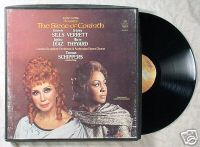
On Saturday, I listened to the Metropolitan Opera broadcast. It was a reprise of Beverly Sills’ 1975 Met debut in Rossini’s The Siege of Corinth, and it was spectacular: not just Sills, but Shirley Verrett and Justino Diaz as well. Even the chorus and orchestra, not always wonderful in those bygone times, were sharp for the most part. It’s a deservedly famous performance. I just bought on ebay a copy of the 1975 studio recording made with the same cast and conductor.

And speaking of old Met broadcasts, not long ago I acquired a copy of the famous 1950 broadcast of Faust with Jussi Björling, Cesare Siepi, Dorothy Kirsten, and Frank Guarrera. It too is a wonderful performance. The orchestra and chorus leave much to be desired, expecially the chorus, but this recording is a Björling lover’s dream–not only Faust but a lagniappe of songs and arias as encores by the great Swedish tenor. Dorothy Kirsten is wonderful as Marguerite. Not only does her skill as an actress show through even on this old recording, but her coloratura is sure as well, if not quite so spectacular as that of some others who have sung this role. Siepi and Guarrera are sometimes too lyric for me. Guarrera shines in the dramatic scene in which his character meets his death at Faust’s hands, not so much in the famous “Avant de quitter,” which he sings too sweetly for me. Siepi, a basso cantante, sings Mephisto for the most part without the comic edge I want to hear but is fine in the two big arias, especially the serenade. It’s a great recording. I had to get it from Amazon.uk, though. At the moment it isn’t available in this country.

getting the white male vote

Laura McKenna sent me to this New York Times piece this morning. It’s interesting to find out that both my beloved and I are atypical Obama supporters, she being a middle-aged person of the female persuasion and I being a geezerly type of seventy. We are atypical for different reasons, of course–and that’s fun too. Here’s the Times writer’s description of “The Obama Democratic Party.”

The Obama Democratic Party is made up of younger voters (under 44), blacks, white men (to a more limited extent) and independents whose show of support accounted for his victories in states like Missouri. Their level of enthusiasm for Mr. Obama — their excitement about the possibility of an Obama White House — is palpable in their response to him, or in any conversation.

It may be that statewide it was independents whose support accounted for Obama’s narrow victory in Missouri (less than 10,000 votes out of 823,503 votes cast–you can see the raw figures here). But the Post-Dispatch is saying today that as election day played out it was a heavy turnout of African-American voters in St. Louis and St. Louis county that carried the vote for Obama. I am thinking that Obama is doing pretty well at picking up votes outside his base with the exception of one core group that may have been part of John Edwards’ base. Here’s the Times again:

Mr. Obama split the white male vote nationally with Mrs. Clinton, but there was an important geographical disparity there: White men in California voted for Mr. Obama but white men in Southern states like Alabama did not.

And according to the Times writer, “The question is what white men in Ohio will do next month, . . .” This observation, together with the fact that Clinton is generally thought to have a stronger appeal among working class voters, suggests to me that Obama needs to tune his message to appeal to the economic interests of workers in the midwest and south who may perceive themselves to be competing in the labor market with African American and Spanish speaking workers.

The way to do that will not to be with a coded appeal to nativism, something John Edwards steered close to, but with proposals for action to relieve economic distress. Clinton got out front on this one with her program to relieve the current economic crisis. But Obama might reclaim some lost territory if he’s smart and fast.

and it’s tempting too

to comment on the dust-up going on in St. Louis about SLU’s new multi-million-dollar basketball coach, Rick Majerus, and Catholic Archbishop Raymond Burke. The Post-Dispatch has reviewed (and commented on) the story today. And the Post’s quotations from the SLU Faculty Handbook are telling, as are comments by President Biondi, Provost Weixlmann, and various board members who have been interviewed.

Burke is widely regarded as a fascist and a bully here in the gateway to the west, and not just by protestants. His boast that he would deny communion to John Kerry during the 2004 election got him brief national exposure, and he seems to have been looking for more ever since: publicly forcing a Missouri Catholic school to rescind its invitation to Senator Claire McCaskill to speak at her daughter’s commencement because of her views about women’s reproductive rights, attempting on similar grounds to shut down a popular local fundraiser because it featured Cheryl Crow and Billy Crystal, turning the screws on the dissenting Polish congregation at St. Stanislaus church for exercising its legal right to hold on to its property and assets, excommunicating two local Catholic women, who allowed themselves to be ordained priests, and threatening the Jewish congregation that gave them “sanctuary” when local Christian spaces were closed to them.

Burke is a piece of work, but he is much praised around the Catholic blogosphere. The full extent to which Burke and his boss, the former Cardinal Ratzinger, espouse a reactionary social (and geopolitical) agenda ad majorem dei gloriam may perhaps be seen here. If the notion of human family seems innocuous, one might remind oneself that the devil is in the details. Here, not only does the Vatican wrench the discourse of world peace into a reactionary defense of hierarchical family values, but it also yokes the conception of world peace to a retrograde ideological position on the science of global warming.

In this regard I’m also thinking of the Vatican’s recent defense of its suppression of Galileo. There was an interesting discussion of this history at Entangled States a while back. My view pretty much jibes with that of the commentator who remarked that, “the problem wasn’t what Galileo said or thought. The problem was that the Church had the power to punish him for what he said and thought – and that it did. Nobody would care about this incident otherwise.”

And nobody would care about the present dust-up in St. Louis if Majerus weren’t a high profile sports figure. That’s why SLU is defending him, as Bill McClellan implied in a recent column. And sports columnist Brian Burwell carries that general view even further. After recalling Arthur Ashe and other morally heroic sports figures, Burwell defends Majerus thus hopefully: “Imagine the power and influence that many of today’s athletes could carry if they chose to spend as much energy in social and political movements as they invest in shilling sneakers and energy drinks.”