. . . snakes

Cheap at the price: So, today, The Washington Post tells me the EPA has devalued my life. I used to be worth $8.04 million, but now I’m less expensive, only about $7.22 million. Of course, this is my statistical worth. It has nothing to do with me personally, the elderly gent with high blood pressure, arthritis, and relatively few of his own teeth. It’s a worth that goes into cost benefit analysis designed to enable decisions about policy. Is some environmental plan worth its cost of 275 million, if it will save 37.5 lives? Assuming those lives are worth $8.04 million apiece or $301.5 million total, the answer is yes. But if those lives are worth only $7.22 million each the total drops to $270.75 million, and the cost of the program exceeds its benefit.

I like the Post’s title, “Cosmic Markdown: EPA Says Life Is Worth Less.” And I like the lead:

Someplace else, people might tell you that human life is priceless. In Washington, the federal government has appraised it like a ’96 Camaro with bad brakes.

Specifically, it looks as though the Bush EPA is up to more deviousness about environmental matters.

“By reducing the value of human life, which is really a devious way of cooking the books, the perceived benefits of cleaning up the air seem less,” said Frank O’Donnell of the District-based group Clean Air Watch. “That has the effect of weakening the case for pollution cleanup.”

I couldn’t agree more. And I also think the various federal agencies who put dollar values on life should at least agree with one another. Apparently the department of Transportation values life even less than the EPA does, only about $5.8 million. Transpo needs a lower value, no doubt, to make its case for continued neglect of the nation’s roadways and bridges.

According to Jack Wells, chief Transpo economist, “We could eliminate a lot of the [highway] fatalities by imposing a 10-mile-per-hour speed limit,” but we tolerate increased risk of death at higher speeds “in return for the economic benefits of faster travel.” It’s the old false analogy trick, and it doesn’t explain (not even to an economist) how or why society (another statistical abstraction) should tolerate everything from unimproved and decaying interstate highways to dangerous construction zones and collapsing bridges.
On the road: My guy has gone to the Middle East, I see, with a great big media entourage. The Washington Post editors and Wake Up America are keeping their powder dry in the expectation that Obama will lack the judgment to admit he was “wrong about the surge” which reversed earlier Bush policy “and is finally winning the war”: an amazing claim, it seems to me. Lives continue to be lost, some of them to the Bush/Cheney legacy of malfeasance in contracting; other valuable resources continue to be wasted.

Present developments in Afghanistan are proving Obama’s judgment to have been correct there though, like McCain, he has had some trouble with the small stuff. Gail Collins wonders in today’s New York Times if Obama needed to make the trip at all, if a series of phone calls wouldn’t have done just as well, especially since John Mccain can’t seem to decide whether he thinks Obama is remiss for having stayed away from Iraq or for going there now, or apparently going there.

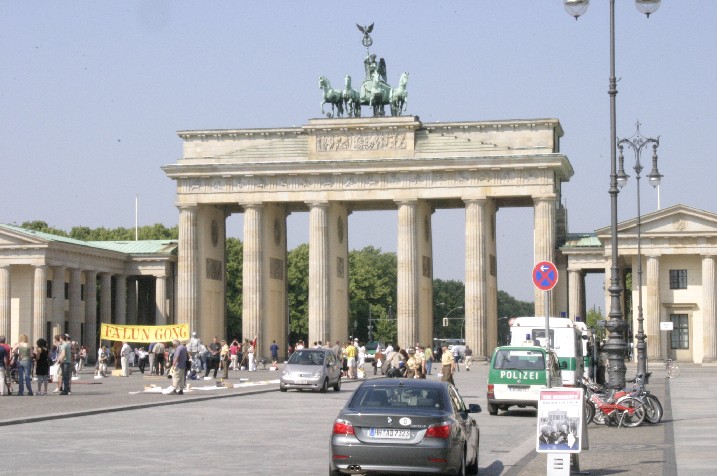
He’s not there yet (not in Iraq, that is), and I’m now reading that he he will not speak at the Brandenburg Gate on his way home. It’s too bad. The gate is regularly available for show business (which there’s no business like) in spite of Angela Merkel. Last year about this time our German guide explained to me that the military looking folks in the jeeps with the guns that seemed to be keeping a watchful eye on a group of Falun Gongers, were actually actors.

I’m sorry I missed the opportunity to kvetch about the now infamous New Yorker cover. But if showbiz wins elections these days (and it’s always played a big part in them), there’s no way McCain can win. Unless, of course, the stuff the New Yorker cover spoofs has more influence than I think it does. Obama may need this trip abroad for the favorable media he may generate, and not just for now. It really is too bad about the Brandenburg Gate. Future sound bites could have presented Obama as JFK (though the famous Ich bin ein Berliner speech was delivered at Schöneberg Town Hall), and that may be important when the swift boat ads have given us shots of Obama’s Indonesian school, interspersed with images of dark fists in the air all tied together by an announcer with a Walter Cronkite voice and backed up by ominous music.

It’s now being reported that Obama will speak in Berlin at the Victory Comumn. Here’s a long telephoto of it shot from the top of the Reichstag. What you see all around is the Tiergarten, and even though it looks as if there’s no space around the tower, there’s plenty. What looks like smog is actually something else, the result of a hand-held camera shooting with a 300mm lens through a glass window. It was a beautiful clear day when I took this picture. I’d stay away from the column if I were Barack–too much association with German imperialism. What about the Reichstag? Though I think I’d go here. This courtyard lies between the old Royal Library (now the Humboldt faculty of Law) along Unter den Linden, and the historic Staatsoper. Here’s a shot of the stage house. I don’t know why I didn’t take a picture of the front door. This was once the principle courtyard of the University of Berlin, which was renamed for its founder in 1949. It was here that books were burned by the Nazis in 1933. There’s a monument to lost learning in the courtyard’s center. I think Barack could do something good by speaking in such a place instead of the Kaiser’s monument to militarism.

. . .

If we count the lives lost in Iraq — just the American soldiers, 4,122 acording to one recent count — that’s an expenditure of almost $30 billion if we use the EPA’s valuation. I wonder if that cost is factored into present cost estimates for the war that are being bandied about. I wonder what the Department of Defense would claim to be the value of a life.


political novels

“You don’t get any fingerprints from Laura Bush.” It’s hard to know how to talk about writers when you know them. A new novel, American Wife, which may or may not evoke Laura Bush, has made Curtis Sittenfeld the subject of a column by Maureen Dowd. Good, Right? It has also caused Curtis to be held up to hysterical ridicule on a right wing blog. Not so good. The Blog is called euphemistically, Town Hall, but it’s a long way from any kind of civil discourse. One commentator alleges that all us democrats “really like trash.” Another hopes for divine vengeance on “people like . . . this loser.” Still another expresses embarrassment at being a “married relative.”

I’ve not read American Wife. It won’t be out until September. Maybe I can get a review copy. But whatever may eventuate about that, I’d like to report that Curtis is a fine writer, who deserves to be read by people who aren’t idiots. Dowd seems seems to be more fortunate than I and actually to have read the book. She writes sensitively and sympathetically of it without giving much away, like the Laura Bush she describes as guarded in interviews. “[T]he main vibe she gives off is an emphatic: ‘I am not going to show you anything.'” Dowd also suggests that “there is the air of a ‘Primary Colors’ stunt about this political roman à clef, which is timed to come out during the Republican convention.” I certainly hope so, for a host of reasons, and I hope it sells a billion copies. I’ve already ordered mine from Amazon.

Inspector Chen. Here’s more from the groupie department. Last Christmas I learned about the novels of Qiu Xiaolong, a Chinese expatriate writer who lives in St. Louis, has translated T. S. Eliot’s poetry into Chinese, has published a book of his own English poems as well as a dual language anthology of classical Chinese poetry, and writes elegant and complex mystery novels that feature a poet/detective. I read the five Inspector Chen novels currently out in English–a sixth novel is already out in French, or will be soon–and convinced the members of a book club, to which my beloved and I belong, to read the first of them for our June meeting. A member of our group who knew how to contact Dr. Qiu invited him and his wife, Lily, to our book club meeting. And they came.

Our meeting with Xiaolong and Lily was an absolute delight. Among the many things we learned is that there is now a tour of Inspector Chen’s Shanghai, conducted by a German travel agency. After our meeting we all had dinner together at a good Chinese Restaurant in University City. It was a fine time. I teased Xiaolong about having become an overseas Chinese, a category of human almost as complex as whatever category Inspector Chen belongs to. He laughed kindly, which led me to believe that I hadn’t committed a terrible faux pas. It was a wonderful afternoon. The books are wonderful books. Read them all.

Our book club is devoted mostly to political books, many of which have been novels but not all. Our next selection is “Wilentz’s” The Age of Reagan. It’s not unreasonable to speak of Qiu’s novels as political. Melanie Kilpatrick, writing in The Wall Street Journal in 2006, listed Death of a Red Heroine as one of five best political novels of all time in a list that includes Darkness at Noon and All the King’s Men.

I’m thinking of doing some reviewing here, maybe of dredging up some old reviews as well. Perhaps because of that I’m reminded of a piece by Harold Jaffe I read not long ago in Armageddon Buffet. It’s called “The Writer in Wartime,” and it raises the question whether writers who seek aesthetic autonomy, usually understood as an a-political character, engage in what Hannah Arendt termed inner emigration or escape from responsible citizenship into fantasy or art or thought. My beloved has written a book about James Farrell’s desire to separate his literary work from his political work. For Farrell, ideology was the enemy of artistic integrity, of truth telling. But Farrell’s novels are political in the same deep way that the novels on Kilpatrick’s list are political, in the way that War and Peace and the Fixer and Reading Lolita in Tehran are political.

Qiu Xiaolong’s novels are as much about the political life of contemporary China as they are about food, psychology, family, crime and punishment, or any of the other themes that inhabit Inspector Chen’s universe. I’m looking forward to thinking about “what lies behind that placid facade of the first lady” as I read Curtis Sittenfeld’s American Wife, which I expect to be a good deal more of a read than the “women’s book-club novel” Maureen Dowd describes. As Curtis wrote in a Salon piece in 2004, “I believe that George Bush’s policies are at best misguided and at worst evil. And yet I love Laura Bush. In fact, there is no public figure I admire more.” That’s got to be a pretty complicated character to put on. And the fact that American Wife and Death of a Red Heroine have been, or seek to be, popular successes, makes them no different from the plays of Shakespeare. It’s a curious modernist elitism that ascribes excellence to books with few readers.

. . . snakes

Not writing. It’s a year to the day since we returned from Eastern Europe. I’ve just realized that I’ve now been blogging for more than a year, but I’ve been away for more than a month. I need to write here again, before whatever readers I may have begin to think I’m dead. Here are some things I’ve been thinking about while I’ve been not writing, not writing being an actual activity. It might be fun to undertake a defense of not writing. Maybe I’ll do that one of these days.

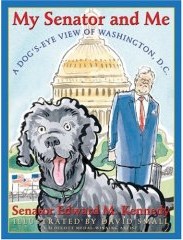
Ted Kennedy. My coffee table sometimes holds a copy of Splash Kennedy’s book about his senator. As I looked around this morning, thinking about the book, which is charming and witty and altogether a hoot, especially if you love dogs, I was struck by the meanness of some of the commentary about it when it came out. All tne more struck now that Edward Kennedy’s life has entered a new stage. I expect Kennedy would be among the first to acknowledge that politics is a rough and crude business. In fact, Splash announces on the second or third page of his book that he owes his relationship to the senator to a familiar saying: “If you want a friend in Washington, get a dog.” I, on the other hand could take the photo of Kennedy and his dog that appears on the back of My Senator’s dust jacket as the way I want to remember this man, who is my senator too. God bless him.

Tim Russert. And while I’m thinking of folks I hope will be blessed, God bless Tim Russert. I think it’s possible to agree in principle with Alexander Cockburn in The Nation that Russert wasn’t a progressive, that he often spoke for the political establishment–and at the same time to wish that Cockburn had held his peace for a while. What Cockburn calls “The Canonization of St. Tim” has revealed what many knew about Russert, that he was a devout Catholic who took his faith’s exhortation to serve very seriously, and a serious family man and father. Friends at Boston College say that he could often be seen wandering the hallways waiting for his son to finish class so that he could take him to lunch. I believe Russert was a good and decent person, who died far too young, and not a bad reporter. I miss him.

Plenty to drink. Both the Post Dispatch and The New York Times today carry stories to the effect that Anheuser-Busch is preparing to fight the takeover by InBev. Here in St. Louis we’re hoping that can be done — the city and region stand to lose a good corporate citizen whose relations with workers and other local businessses have on the whole been good over many decades and whose philanthropy has shaped other local institutions so numerous that one can’t even attempt to list them. If the takeover goes through, A-B will be replaced by a corporation whose relations with workers recall those of Wal-Mart and whose willingness to continue A-B’s philanthropic relationships seems questionable. All this to benefit a group of stockholders who for the most part don’t live here. InBev has now filed suit in Delaware Chancery Court to establish its ability to approach A-B stockholders individually, “to ensure that Anheuser-Busch shareholders preserve their voices.” No doubt we’ll be invoking sainted grandmothers with a few shares of A-B stock protecting them from the wolves as beneficiaries of the InBev raid. But the real wolf is InBev, itself.

High water. While the flood waters have yet to recede entirely upriver, we’re pretty dry in St. Louis. The city is built on bluffs. It’s outlying towns, particularly in areas of the flood plain where levees have broken that have suffered. And of course Iowa City, where the Iowa River rose many feet above the level of 1993, and the university remains closed with many buildings permanently damaged. The media are full of praise for FEMA’s response to midwest floods this year, but we’ve heard otherwise here. More about that later — it’s summer now. The Gettysburg Address will be on display at the new Lincoln Museum in Springfield, Illinois until sometime in August. We’re thinking of making a trip to see it.

public intellectuals

Tim Burke sent me this morning to a good piece in The Chronicle of Higher Education. In “Tales of Western Adventure” Particia Nelson Limerick describes a public sphere project of her own and at the same time makes an argument about the role of the humanities in public life that I wish I heard more often. Instead of pursuing “individualistic research, directed at arcane topics detached from real-world needs and written in inaccessible and insular jargon,” humanists should embrace the new world of applied research as Limerick has done at The Center of the American West that she chairs at The University of Colorado.

Limerick’s program reminds me very much of an ambitious program I once had a small part in called The Center for Texas Studies. It should have succeeded, for all the reasons Limerick marshals in describing her program at Colorado. But it didn’t. I think perhaps Texas Studies focused too much on heritage — a new center with the same name at TCU seems to do the same. But the former center also attempted to form alliances with business and non-profit communities, sponsoring programs on water, ecology, and other issue complexes with economic dimensions and attempting to “dissolve the barriers that block the full engagement of professors with the public.” Texas Studies probably failed, though, because of weak institutional support, a particular dean that didn’t see the virtue of it and the constant necessity of translating its work into FTEs. Which are ways of saying that UNT was still too dependent in those days on the traditional funding formulas of a former teachers’ college to accomplish much with generalized public sphere projects.

Today we see more and more academics emerging into the public sphere. I think especially of Kathleen Hall Jamieson, who regularly appears on Bill Moyers Journal. Jamieson and other humanists, such as Stanley Fish, who are making an impact on public discourse, suggest that the growing matrix of partnerships between the academy, government and business is entirely positive. But Moyers Journal recently carried a story that points up a serious problem area — quoting Melody Peterson, a journalist:

A very powerful technique that the drug companies spend millions and millions of dollars on is hiring physicians to give lectures to other physicians on their drugs. It looks like the physician is up there giving his independent position on this drug, but often he’s been trained by an advertising agency. His slide presentation has been created by an ad agency. It looks like independent science, but it’s not… They want to get as many articles published in our medical journals as they can that show their products in favorable lights and will get physicians to prescribe them, so they often hire a Madison Avenue ad agency to write up an article for them or a study. The name of the ad agency rarely appears in the published version; instead, they hire doctors to put their names on as author… It’s gone so far that some independent scientists are starting to view our medical literature as propaganda.

This state of affairs was the subject of a recent New York Times article, but reports like this have been in the news for a good many years now; here’s a 2003 article from the Guardian. Pharma is neither benign nor heroic, in spite of a slick image campaign linking it with white-coat clichés.

And the military–industrial complex isn’t benign either. Recent complicity of medical and psychological practicioners in the torture of so-called enemy combatants and others has caused both the American Medical and American Psychological Associations to reiterate ethical standards that prohibit such complicity. But the complicity goes on, or apparently it does.

The extent to which public discourse and practice have been poisoned not just by politicians but by intellectuals as well during the past quarter century sometimes leads me to wonder if there’s a remedy. Limerick optimistically compares today’s public humanists with Dante’s Virgil, “guiding [scientists and engineers] through the inferno of cultural anxieties, laypeople’s misunderstandings, and political landmines.” One may certainly hope.

But it isn’t Virgil who causes Dante to undertake the journey through hell and purgatory. Virgil is without hope; only his words are salvific. Dante’s true source of hope and the desire to emerge into the realm of the blessed is Beatrice (Inferno ii, 133-142), who is both eros and Christ’s vicar. Maybe I better not pursue that thought too far.