And I said that was good

This needs poetry, but prose is all I have to give it, at least today. An old friend and colleague at St. Barnabas Church in Denton, Texas, has died—Bob Lockwood. The obituaries will tell you he was Robert Minturn Lockwood, III, M. D., whose profession as a radiologist hardly defined him. They will tell you of his devotion to Ann’s Haven Hospice in Denton, a pioneering effort in the hospice movement and one of the large works of his life. I didn’t know Bob at the time Ann’s Haven began and can’t speak of that, but his friends and acquaintances who are quoted in the newspapers speak eloquently of his service to the community and how it grew out of his grief over the death of his beloved first wife.

Bob was almost a renaissance man when I knew him, as close to that ideal as any son of the twentieth century could come: physician, scholar, poet, playwright, churchman, birder, naturalist, gentleman farmer—a longer list could be made. He was also an idealist with an almost Emersonian edge of Yankee shrewdness (though he wasn’t literally a Yankee) in spite of all the years he spent in Texas. He was a brilliant man who chose to find his destiny in the community of scholars assembled around two universities in the little town of Denton, Texas, a long way from Harvard and Penn Med. Circumstance was part of the reason why, but also a certain venturesomeness, I thought, coupled with a tendency to discount his accomplishments. Bob sometimes spoke of his career at Harvard as though he had been a failure and treated his medical credential as slight achievement. He was not a proud man, at least not when I knew him. When he retired he sold his radiology practice and went to work for the people who bought him out. But he also translated Brecht’s Theepenny Opera once, because he thought the popular adaptation (Blitzstein’s, I guess) was too tame. Bob’s father had been a professor of Latin and the Librarian of Haverford College, also the college’s informal historian and a devoted teacher. Students dedicated their yearbook to him in 1924. Maybe some of Bob’s interests, as well as the shaping of his character, began at home.

For the better part of ten years I knew Bob at St. Barnabas—many knew him better than I. But we served together for a year in a discernment process that brought us close, and we shared a heart-wrenching experience of the death of a beloved priest and friend that surprised us like a thief in the night. When I learned of Bob’s own death, I first turned to a poem he wrote in 1993 as a memorial to Charles Williams, the rector of our church at that time. Charles had been diagnosed with lung cancer just shy of his fiftieth birthday and was taken from us swiftly, in less than six months. Bob’s poem is a powerful reflection, not just upon Charles’s time with us and his death, but also upon how Charles talked with us about his death as he was dying—in a series of wonderful pastoral letters. Just before he died, Charles asked me to put together a small book of his sermons; I asked Bob if I could include his poem in the volume. I’ll not quote it entirely, just the conclusion.

And then you died—and were no longer there
       I saw your chest x-ray myself.
       It said DEATH—soon, no matter what.

So then, we cared for you (with a little help from the hospice).
And as you died
       you learned
       you grew
       you bloomed.
It was beautiful, it was terrible.
We wept.

Now please live on in us your friends
We are now more connected, more a Church, more the Body
Because you cared about us.

In the willow-meads of Tasarinan—may we meet again in the spring.

In his second life, the only life in which I knew him, Bob devoted himself to land and to practicing what we are now coming to call sustainability, raising chickens and bees, the farm where he lived with his second family a favorite resort of at least a couple of generations of children at St. Barnabas—a chosen place, a Vergilian place if you will—it’s useful at my age to learn what one thinks. I didn’t know Bob’s family, never went to his farm. He always came to church alone, as I do mostly now, myself, church being something my beloved and I do not share. I knew about Bob’s second life, the private part of it, only from conversations with him; but I believe the farm had been his renewal, or perhaps his last reinvention, of himself.

Now as I reread Bob’s poem I particularly think about its last line, an allusion to a place invented by Professor Tolkien in The Lord of the Rings. Treebeard sings of it in a wonderful song that recalls one of the Genesis creation stories:

In the willow-meads of Tasarinan I walked in the Spring.
Ah! the sight and the smell of the Spring in Nan-tasarion!
And I said that was good.

Tasarinan, in the legendarium of Tolkien’s Elves, is part of the lost flat world, now “under the waves,” that preceded middle earth in the same way that the legendary world of gods and heroes preceded classical antiquity, where the stories of that former world were regarded as history. As the members of the ring fellowship bid farewell to Treebeard midway in their journey, Treebeard speaks these poignant words: “I too must bid you now farewell. I do not think that we shall meet again. For the world is changing: I feel it in the water, I feel it in the earth, and I—I smell it in the air.” To which Elrond replies, “Maybe not in Middle-earth, Fangorn. But when the lands that lie under the wave are lifted up again, then in the willow meads of Tasarinan we may meet in the Spring.”

Did Charles and Bob read Tolkien together? I don’t know—I’m not sure I even want to know. But I think I understand that in wishing his dear friend and priest a pagan immortality, Bob meant to wish Charles a place in a time out of time wherein the difference between Pagan and Christian has been erased—and the world in which humans dwell with fire and water, beasts and great trees, no longer innocent, has found a new beginning.

—I can think of no better wish for Bob himself, or for us all.
memorials, days after

On Memorial Day my morning ritual was accompanied by occasional bursts of patriotic music from the bedroom next door where my beloved was watching the morning news. She likes to watch TV in bed as she reads the morning paper. I drink coffee in the adjoining study in front of my computer and read the news on line, but at one point I went into the bedroom to watch as Vice President Biden presided over the familiar wreath-laying at Arlington Cemetery. I thought how, as a summer exercise, Americans of many political persuasions still allow one another the benefit of the doubt on the two three-day weekends that frame the month of June.

And about allowing one another the benefit of the doubt, I hoped it remains true–that in our increasingly tribal society we have ways of practicing our citizenship that transcend our differences. I used to think the 1976 bicentennial celebration allowed us to do that in the aftermath of the terrible divisions over the war in Viet Nam. Now I’m not so sure—about that and a good many other things. In the past couple of days I have attended two events celebrating Memorial Day. Both events demanded my participation in the rhetoric of American exceptionalism. Both events shoved Lee Greenwood’s “God Bless the USA” in my face.

In the evening on Memorial Day, we watched Milk at my house. As that fine film reminds, the historical context of Harvey Milk’s death also includes the depredations of Anita Bryant. Bryant is still politically active, more’s the pity; though she seems to have fallen on bad times. A former website advertising her Oklahoma ministry is empty, and her MySpace page seems a rearguard action. It’s easy to see that Harvey Milk’s America and Anita Bryant’s are incommensurable. To my mind that same dissonance pretty much limns the difference between the Obama movement’s America and the Tea Party America of today.

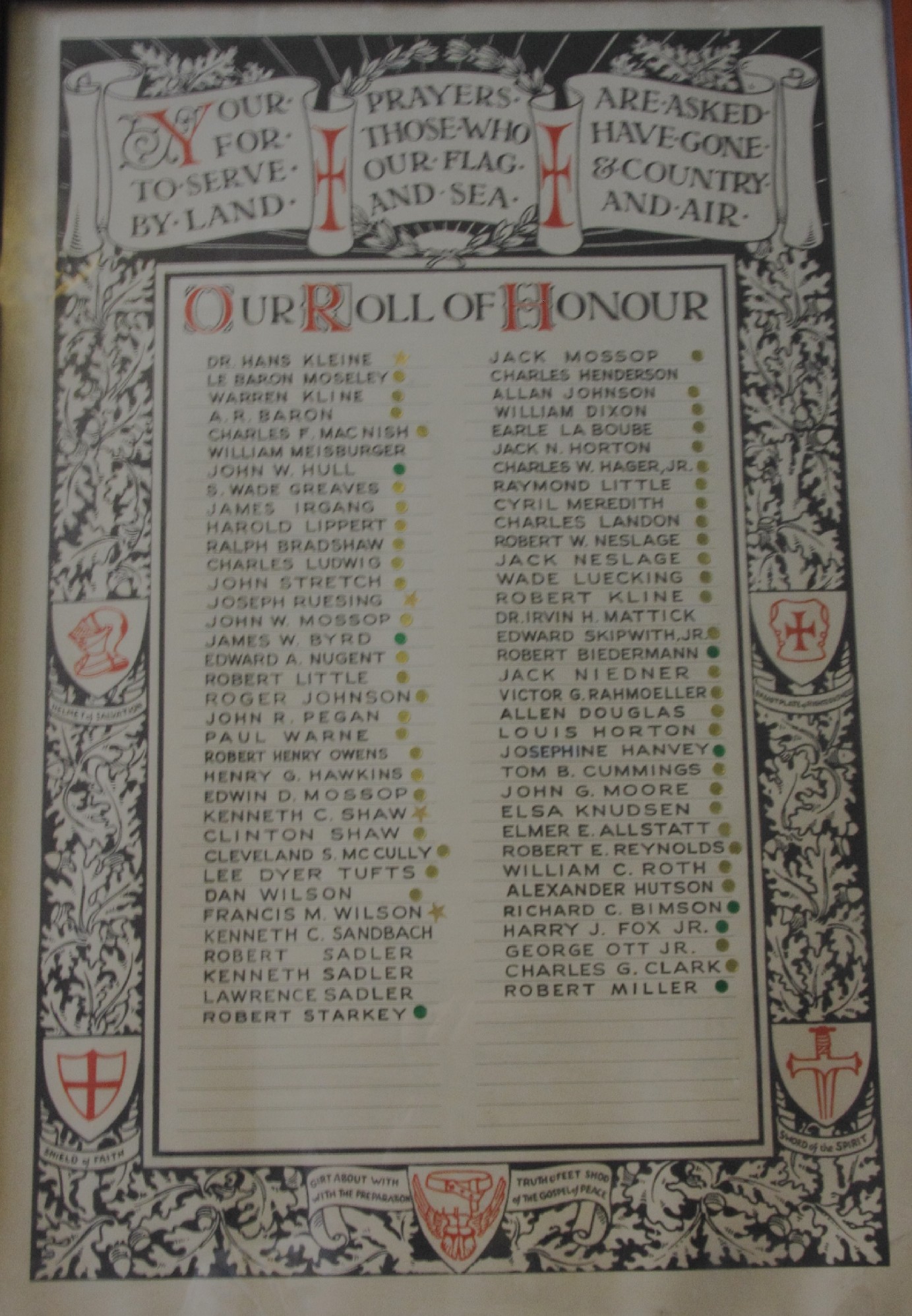
And speaking of rearguard actions, Sunday after church some of us gathered around a memorial to parishioners who had served in World War II. One of our fellow parishioners had found it in the church archives. A simple glass picture frame containing a handsome, hand-lettered sheet of paper listing sixty-nine names, most marked with stickers—mostly gold, though some are are stars and some not (we couldn’t figure out the color code). This memorial no longer hangs in my church, though I think it should, even though there is now no one among us who remembers any of the people listed. I note, too, that not all those listed are men. We will likely find a place to hang it again, and the antiquarians among us can perhaps discover who the people were. Maybe somebody will also discover why honour is given the British spelling. But why was this memorial plaque removed from whatever place it had in the church and placed in the archives? What was the thinking that led to its removal? As time obliterates memory, do memorials become curios?


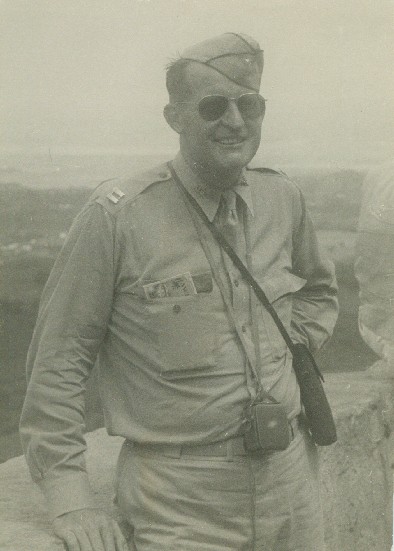
When I first started this blog, I wrote something about my father, who died in World War II. I’ve always liked this picture of him, taken at Ft. Bliss during training exercises before he and his comrades in the New Mexico Militia were sent to the Philippines as the United States 200th Coast Artillery in August 1941. He was a physician and a volunteer—at the time his unit was federalized physicians couldn’t be drafted—though he didn’t want to go overseas and hoped for a long time that the unit would be reprieved. I’ve always thought service in the National Guard was part of a payback for help with medical school—my father graduated from medical school in 1932—though I’ve never confirmed my suspicion. We saw him off with his unit on the train at El Paso a couple of days after my birthday that summer of 1941. He told me to take care of my mother. Here’s a bit more of what I wrote back then, paraphrased a little.

“More recently, I’ve read many of his letters to my mother. They describe his westward journey, first by train and then by ship, to the east, his arrival, much experience in the first heady weeks of his encounter with the MacArthur establishment. He didn’t like MacArthur, but I think he loved the old brown shoe army and relished being even a very lowly Captain, as he puts it in one letter, in that foreign outpost which must have had a certain old fashioned clubbiness and esprit. Then, of course, things turned sour. The letters are fewer from mid October on, and stop altogether in late November. One letter arrived after Pearl Harbor, written from a tent on Bataan in February, 1942. He died in 1944, somewhere in the South Pacific on an unmarked prisoner ship that was torpedoed by the U. S. Navy. The story of the sinking made the papers back home, with tales of escaping prisoners being beaten to death by Japanese marines. Of course that wasn’t anywhere near the whole horror of it.

“I learned more about the Japanese death ships when I read Dorothy Cave’s Beyond Courage a few years back. Apparently the Japanese used prisoner ships, marked with a red cross, to ship munitions, but there seems also to have been an intention to exterminate prisoners by transporting them on unmarked ships. Cave’s book also confirmed my impression from family and other history that my father and his comrades had been abandoned by their government when it was decided that the war in Europe took precedence over the far east. I learned too that my mother had been a member of an advocacy group during the war, that attempted to pressure congress and the president to rescue the folk in the Philippines. I found a collection of newsletters among her effects after her death. I also found a check for $100 that my father wrote to someone with a Filipino name. It was presented to my mother for payment after the war. The letter that accompanied it explained that my father had written it for black market medical supplies that he managed to smuggle into the prison at Camp O’Donnell.

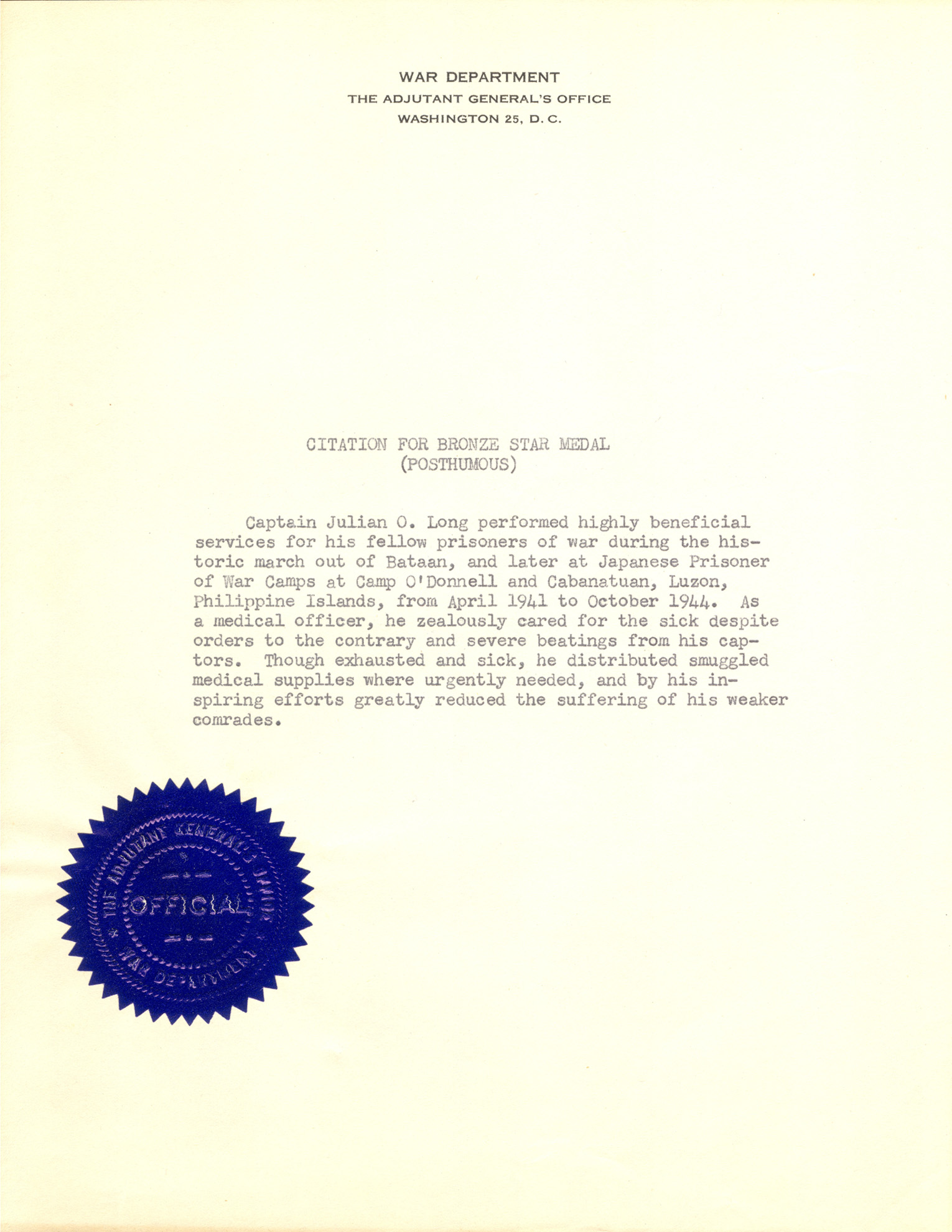
“After his death was confirmed, they promoted him to Major and gave him some medals. One was a Bronze Star, the highest military decoration awarded to noncombatants. He also received a Presidential Citation, signed by Franklin Roosevelt, which my mother always cherished. I didn’t know much of this as a child. I thought my father’s Purple Heart more important than the Bronze Star, bigger and more imposing. And for a long time I refused to believe he was dead. I fantasized that he would come around the corner of my school one day and grab me up in his arms.” There’s an error in the Bronze Star citation. It dates my father’s internment from April 1941 and should read April 1942.

My father’s regiment was sent to the Philippines because its personnel spoke Spanish. It was a multicultural unit that included native Americans as well as hispanics and anglos like my father. It had been a horse cavalry unit only recently. I remember a closet full of my father’s cavalry uniforms and riding boots. It’s a nice irony that less than fifty years after the close of the Indian and range wars, and in a place where both had been pretty fierce, there was a military regiment that included soldiers whose recent ancestors had likely fought each other over territorial and other claims, some of them genocidal, now a unit engaged in a common struggle far from home and united in part by a common language that wasn’t English.

and look away . . .

I’ve just recently learned that my old friend, Jack Le Sueur, retired from the North Carolina Arts Council last December after thirty-five years’ service. Thinking about Jack brings back a flood of memories of a life I no longer have—of friends and places, sights and sounds: shaking hands with Jimmy Carter in the town park in Southern Pines, a copy of T. S. Eliot’s poems I bought in the Intimate Bookshop on Franklin Street in Chapel Hill when there was still such a place, the smell of woodsmoke at the Malcolm Blue Farm in Aberdeen, and the fireplace poker Jerry Darnell made me at his forge there one day. So many details, flakes of being floating on a river that never stops running.

Many of those memories include Jack. We met in 1974, some time in the fall, I think—though it’s been too many years to be sure. I got a call one day from a young man who had just taken a job with the arts council in Raleigh, and he wanted to come and see me. In a few days he showed up at the Campbell House in Southern Pines where I was housed as Executive Director of The Sandhills Arts Council (now the Arts Council of Moore County). We drove around the county all day together, getting to know one another and looking the place over. I had been on the job only about a year at that time. But I knew enough to take Jack to Jugtown, then operating as a nonprofit under the tutelage of the late Nancy Sweezy. I think I remember that we watched as interns unloaded one of the pottery’s big groundhog kilns.

And I’m sure I must have remembered to introduce Jack to board members and any community leaders I could find. I must have taken him to see Sam Ragan in his office at The Pilot, where he hid out behind a three-foot-tall pile of manuscripts that took up the front of his desk and banged away on the old Underwood he used to do his writing. But my memory of that day with Jack is mostly a recollection of country roads—Moore County is a beautiful place—and of pleasant conversation with a soft-spoken young man who was ten years younger than I but already an ex navy officer and a graduate of Duke, where I had studied for a PhD I never managed to get.

In his years at the North Carolina Arts Council Jack had many jobs. In those early days his job title was Community Coordinator. Jack, and later Fred Schultz, traveled the state as liaisons with local arts groups of all sorts. It was a natural step for Jack to become the administrator of the Arts Council’s signature Grassroots Arts Program, a program that’s been much copied around the country and a source of public funds for arts efforts large and small that continues to this day. But to me Jack was the North Carolina Arts Council, its face and its true soul, the embodiment of bureaucracy with a heart, something I guess I still believe is possible. Jack had a wonderful way of striking a balance between being my friend and advocate, which he mostly was, and sometimes being my boss. There was no pretense in him, no self-importance. He was always just Jack.

Hardly a month went by that we didn’t talk on the phone, sometimes just because he’d call to check in and see how I was. We’d meet at least four or five times a year at meetings and workshops, my favorite of which was a meeting of us professionals at the Quail Roost Conference Center, usually around Christmas time every year. We’d sit around a big seminar table and hear reports and instruction from peers during the day, and we’d party in the evenings. I remember one good poker game when I think I won ten dollars. I’m sure there were other communities of culture around the country like the one I was part of in North Carolina in the 1970s, but I was privileged to be part of that one. Thinking of Jack still takes me back to a time before the culture wars ruined so much of life for us, albeit I’ve not seen him these last twelve years. It was like Kristofferson’s great song; we were advocates for everything good we knew.

And so I’m moved to learn of Jack’s retirement and wish him godspeed in whatever future he travels. Jack is a fine musician. We used to spell one another at meetings singing and leading singing. He and his wife, Pattie, began performing together before they got married and have continued to do so over the years. They have a lovely CD that includes a wedding song, “Two Paths.” I hope Jack’s future holds lots of opportunities to perform and that I get to hear him and Pattie again before I go somewhere else. Here they are in a little video medley from a few years back that I found posted on the net. Jack’s “Administrator Blues” reminds me of a meeting in Denver when a couple hundred of us listened to Jack sing one evening and there were lots of lighters in the air at the close. I also especially like the Kate Campbell song that’s last in the video, and Pattie’s take on it, speaking of things the culture wars have ruined for us.

more godspeak . . .

Religion editor Lisa Miller’s essay in this week’s Newsweek, combatively entitled “Harvard’s Crisis of Faith” troubles me. One can easily grant her point (not actually hers but Louis Menand’s) that Harvard ought to provide undergraduates with a serious opportunity to study present-day religious discourse, especially now when “conflicts between the Israelis and the Palestinians; between Christians, Muslims, and animists in Africa; between religious conservatives and progressives at home over abortion and gay marriage—all . . . relate, if indirectly, to what rival groups believe about God and scripture.” One can even grant her subsidiary argument that it’s a pity “for Harvard, its students, and the rest of us who need leaders better informed about faith and the motivations of the faithful” if the university fails to do these things.

However, it’s by no means clear to me (and certainly not clear from Miller’s essay) that Harvard indeed doesn’t do these things. Sociology, history, anthropology, literature, philosophy, and other disciplines, each and all, might contribute to understanding of the cited concerns. But that seems not to be the issue. Whilst reporting on Harvard’s debates about a proposed undergraduate requirement entitled Reason and Faith, Miller notes with disapproval that Harvard has neither an undergraduate religion department which can hire and fire and grant tenure, nor a specific religion requirement, but rather relegates religious study to an interdisciplinary program some faculty seem to regard as an academic poor relation or to the divinity school where students “can take graduate-level courses about belief from people who are, by tradition, believers.” She then notes, simplistically, that “This separation of ‘faith’ from ‘reason’ occurred in the early part of the 19th century, when the American university evolved into a secular place,” and concludes:

Even now, in an era when a presidential candidate cannot get elected without a convincing “faith narrative,” the scholars who study belief continue to reside in the Divinity School [at Harvard], and when the subject of religion comes up, the scholars on the Faculty of Arts and Sciences sniff at its seriousness.


It’s a curious position for a Jewish writer, given Judaism’s historic emphasis on practice, but the target of Miller’s critique is unbelief. Not only that, she makes the frightening claim that today’s global conflicts legitimate religious faith. She seems, as in another Newsweek piece, “Faith in love” to occupy a positon somewhat like that of an Israeli friend who advised her, “This is the new world . . . . Deal with it,” in which rhetorical zingers acquire truth in proportion to their effectiveness as weapons. And again and again, she seems to stick a rhetorical thumb in the eye of skeptical readers like me, gloating “Deal with it” when we squirm.

“Harvard may or may not be the pinnacle of higher learning in the world,” Miller solemnly intones,

but because it is Harvard, it reflects—for better or worse—the priorities of the nation’s intellectual set. To decline to grapple head-on with the role of religion in a liberal-arts education, even as debates over faith and reason rage on blogs, and as publishers churn out books defending and attacking religious belief, is at best timid and at worst self-defeating.

The priorities of the nation’s intellectual set? To study religious discourse in any respectable department of religion (as opposed to, say, talking about religion at a cocktail party) is not, as Miller supposes, to toss rival truth claims about in a Proufrockian fog. Moreover, it’s one thing to argue, as Menand does in The Marketplace of Ideas: Reform and Resistance in the American University, the book Miller takes as her starting point, that “college is a time to ‘unsettle presumptions, to defamiliarize the familiar, to reveal what’s going on beneath and behind appearances'” and quite another to claim in the next sentence, as Miller does, that “[f]orcing kids to grapple head-on with the world view of a Christian or Muslim fundamentalist, . . . would be a part of this unsettling.”

“Harvard faculty cannot cope with religion,” Miller announces in her second paragraph. Regardless of what Menand may have meant in championing the proposed Reason and Faith requirement, it’s clearly not religious assumptions that Miller believes should be unsettled at Harvard but rather what she characterizes as secular fundamentalism, something she seems to identify with the Harvard establishment and particularly with Professor Steven Pinker, who opposed the Faith and Reason course. “In Pinker’s view,” says Miller, “human progress is an evolution away from superstition, witchcraft, and idol worship—that is, religion—and toward something like a Scandinavian austerity and secularism. (Pinker is one of those intellectuals who speak frequently about how sensible things are in Europe; one suppresses the urge to remind him of the Muslim riots in the Paris and London suburbs).”


Ad hominem arguments are odious, but Miller has made her own religious practice into something of a cause, portraying her adult reaffirmation of Judaism and raising her daughter as an observant Jew (who also conveniently celebrates her father’s diverse background) as part of an approach to life that celebrates everything.

Our Jewish daughter knows about her Jewish heritage and can say the Shema. She also knows that she comes from generations of French and Irish Catholics, and WASPs, and Native Americans on her father’s side. She’s obsessed with the statue of the Virgin Mary in the garden of the church down the street. She believes in Santa and we celebrate Christmas — with a tree, and lights, and bright green cookies made of Rice Krispies.

In another sentence Miller admits that the exclusivity of Judaism troubles her but seems to dismiss that concern as she affirms the value of a serious cultural grounding.

Only in marrying a non-Jew did I become aware of how much of the Jewish story one learns by osmosis. Without two Jewish parents, my child would not absorb these stories automatically. We would have to teach them to her.

And so we joined the Temple. My daughter and I go, every Saturday morning. Together, we’re learning the prayers. My husband supports us, though he rarely joins — partially because he’s ambivalent about God, and partially because this is not his tradition and he feels like a foreigner there.

Why, one might ask, does Miller’s faith take precedence over her husband’s unfaith. I think perhaps because whatever she believes about God she passionately believes in a kind of religious entitlement. As she puts it more or less directly, “If my husband and I were of different races rather than different religious backgrounds, our daughter would no more be able to ‘choose’ her identity than she would the color of our skin.”

Of course a child with parents of “two different races” must perforce “choose” an identity—we now can cite the life and experience of the President of the United States as a case in point. And, one might argue, Miller’s daughter will in her turn have to choose, in spite of her mother’s protectiveness. No less, the Harvard student Miller quotes as part of her final anecdote in “Harvard’s Crisis of Faith.”

On one of my visits to the Yard, I met a sophomore named Ryan Mahoney in a basement pub. Raised in Queens, N.Y., and educated, as generations of Irish Catholics have been, by Jesuits who saw in him some promise, Mahoney was forthright about a despondent feeling he had, in class and among his friends: neither the Catholic theology that framed his thinking nor the religious community that gave him comfort were appropriate subjects for discussion. He once overheard students in the dorm making fun of his rosary. “I do not think there would be any openness to discussing God in any of the classes I took last year,” he said. “But acknowledging the fact that religion exists and that it’s not lunacy to believe in God would be helpful.”

So much for unsettling presumptions and defamiliarizing the familiar. Miller tags this story with the observation (her last word) that “[t]o dismiss the importance of the study of faith—especially now—out of academic narrow-mindedness is less than unhelpful. It’s unreasonable.” By “the study of faith” Miller seems to envision some sort of sensitivity training in a safe zone where religious beliefs and practices constitute protected areas of individual identity and are therefore not legitimate objects of criticism. This might be a good thing, but it isn’t the critical study of religion Miller affects to admire—“Fluency in religious history and texts, in fact, is the sharpest weapon against fundamentalism, as Sam Harris demonstrates in his polemic The End of Faith.”—and it belongs in the Hillel Yeshiva or the Canterbury House or the Baptist Student Union or the Islamic Center, not in the classroom. Miller’s readers get the point. As one of them puts it,

It is outrageous that a Catholic student should be ridiculed by other students for his Rosary. I bet those same students would not make fun of a Muslim student in a hijab. That would not be politically correct now, would it? The Catholic student should transfer to a Catholic college/university. Harvard is so overrated.


I greatly admire the work of Louis Menand, and I support the now familiar trend that seeks to infuse present day undergraduate education with a new emphasis upon citizenship. To that extent I am in sympathy with Miller. And to be fair I should admit that the movement of my own mind over many years has been away from faith. Both my commitment to secular humanism and my commitment to Christianity are cultural, but the humanist commitment is deeper because it is a product of my adult experience. I think a systematic interrogation of religious faith and practice (indeed of all ideology) ought to be part of undergraduate education, as it was part of my own. I don’t think simplistic claims that universities insult the pious serve any useful purpose.

And I think Miller’s primary point is that Harvard disrespects religion; albeit that’s an argument worthy of somebody like Brit Hume or Sarah Palin. Miller has defended Hume in another column, in which she also defends Christian proselytizing—”I’m not at all sure why the liberal left is always so shocked that evangelical Christians want other people to become Christians.” There is secular bigotry just as there is religious bigotry. Miller’s own critical perspective reflects neither; it is sharply political at best. But it is sloppy and impressionistic at worst. Harvard students don’t need to study religion as an exercise in identity politics. Still less do they need to study religion because supposedly religious controversies are all the rage in popular culture.

In the final analysis we all choose and do not choose our identities. And in the final analysis the old-fashioned positivist tradition, which seems to have won the day at Harvard for the present, “isn’t the only—or even always the best—tool for understanding human experience,” as Miller puts it. I agree with Miller (and Menand) that undergraduates should “engage fully with the messiness and contradiction of clashing ideas.” The Harvard argument over Reason and Faith exhibits just such a messiness, and it isn’t a bad messiness. Actually, it’s normal. Miller might have pointed that out, instead of trying to score cheap points in a tired culture war whose only remaining antagonists are people like Hume, Palin, and maybe David Horowitz.