
My old friend, Shelby Stephenson, is the new Poet Laureate of North Carolina. The N&O story covering his installation last Monday offers a clip of the poet reading from his long poem Fiddledeedee, first published in 2001 and reissued just last month by Press 53 in Winston Salem. It was a good choice for that Audience, describing in moving cadences the springs of his imagination.
Shelby’s accomplishments are many: a dozen or so published books and countless magazine publications; thirty-one years as editor of Pembroke Magazine at UNC Pembroke, where he rose to the rank of full professor over a long and illustrious academic career; winning the Bellday Prize and the North Carolina Award for Literature; induction into the North Carolina Literary Hall of Fame, to name just a few.
We met, I think, in 1978, when the Stephensons moved to Southern Pines, NC, where they remained for many years before moving back to Johnston County and the farm where Shelby grew up. I have eaten oysters and barbecue, sung songs, argued about poetry and philosophy, jogged, commiserated, and more with Shelby Stephenson over the years. We’ve lived a long way from one another for a long time now. But if you are fortunate enough to have such a friend as Shelby, you don’t let time or distance deprive you of the friendship. I’m happy for him now, and I very much hope our paths cross again before long.
And I may have been the first person to write about Shelby’s poetry. He has always said that I was. Maybe the best way for me to recognize his present achievement is to reprint what I wrote. The piece pretty much explains its own circumstances: Shelby and Sam Ragan reading together at the Southern Pines Library. Sam Ragan would be named Poet Laureate of North Carolina in 1982 and hold the laureateship until his death in 1996, the last of the NC Laureates to receive a lifetime appointment. Here is what I wrote about them both almost thirty-seven years ago, as published in the Southern Pines Pilot on April 26, 1978.
* * *
It is a mournful truth that poetry, perhaps the eldest of the arts, has never made its fortune in the modern world. Our time, which has seen the elevation in prestige and economic value of professions which would have seemed unlikely of success in the last century, has seen the decline of poets in influence and social regard.
But poetry has by no means died. Sturdy souls that they are, poets have simply gone underground. Their works are to be seen, of course, in the few major-house publications which print serious verse and in a small group of surviving prestige literary magazines. But in the main poets are writing for the thousands of independent publishers and literary magazines which have grown up in the last ten years, publishers like Moore of Durham, magazines with names like Vantage Point, Aspect, The Stone. These for the most part have limited circulation, a decided regional or individualistic feel and an anti-slick, anti-establishment voice.
COSMEP, the Committee of Small Magazine Editors and Publishers, maintains a traveling bookstore representing little magazines from all across the country. This store, called the COSMEP Van Project, has been in our area this week.
To celebrate the project’s arrival, the Sandhills Arts Council sponsored a poetry reading last Sunday in the Southern Pines Library combined with a tour of the book van. Poets Sam Ragan and Shelby Stephenson read from their own works, many of which have appeared in works printed by small presses.
Sam Ragan explained that the difference between a major and a minor poet was that the major poet would never use the word “rue,” as minor poets do, and that major poets always read from their own works as he and Shelby Stephenson did.
Sam Ragan is well known as a writer and publisher, perhaps less well known as a poet. This is unfortunate, for his verse possesses great beauty and economy of expression. It is a reticent poetry, depending upon unadorned images, things in themselves, which sometimes gather into landscapes.
I can see through the tree’s limbs.
Beyond the girl
In the green bathing suit,
Beyond the sea oats and sand,
Where the sea rolls,
Breaking white, as far out
As where fishing boat
Sits motionless in the sun.
Mr. Ragan quotes William Faulkner about the literary art, saying that he wishes to arrest time in his verses, which he thinks of as frozen moments. This is the lyric impulse, and it suggests iconic poetry dominated by visual imagery. A survey of the poet’s recent book, To the Water’s Edge, will reveal much that is visual, but the first interest in these poems is in the play of the poet’s mind over the objects and events of memory and perception.
Driving down No. 1 at night
The headlights catch the gleam Of beer cans,
They look like cat’s eyes.
When lilacs last in the junkyard bloomed.
This passage opens “Notes On the Margins of Our Times,” a poem made of vignettes from the social history of the sixties, each moralized with a fragment of familiar verse, song, or speech, sometimes quoted, sometimes paraphrased. The landscape of this poem is an inward one, finally, through which things pass sometimes unaltered from themselves, sometimes changed by ironies sensitive or sensible:
Do not go bojangles into that good night.
Sam Ragan’s poetry is invested with a love of common things and common order, against which the horrific, the startling, the grotesque, assume proportions assigned by common sense:
It was a bad trip,
And when he couldn’t fly
They picked up his body
Where it had splintered on the sidewalk.
Flights of fancy, always understated, stand out in relief, too, from the general steadiness as when in “Sandhill Summer” the poet imagines the surging of an ancient sea in the sound of wind in tall pines. “I sleep,” he says, “in the shadow of ghost winds.”
Shelby Stephenson’s verse is heavier and sweeter than Sam Ragan’s. Mr. Stephenson likes long sentences and heavy rhythms rich with words and sometimes thick with music. Here are some lines from “Winter Ritual,” a poem about hog killing.
Hog tails hang down after the maul.
Men swill homemade scuppernong brandy,
Rake thick sleeves across mouths
Cutting the sun’s slash on the tin barn-roof—
Someone has speculated that musical English poetry tends to fall into the’ patterns of Anglo-Saxon. True or not, the first line of this passage is an almost Anglo-Saxon line, with its alliterative linkages and dual syntactic units breaking it into half-lines. The rest of the passage is heavily consonantal and assonant, and the whole demands to be intoned rather than merely read. Here, a complex boyhood experience of violence and death is also creative, and the adult poet examining the childhood memories from hog-killing days seems most of all to find it all intoxicating, the blood and meat, the sausage and entrails, the swilling and the boiling-strong stuff for a small boy.
The primary emotion animating Mr. Stephenson’s verse is nostalgia, but there is in it such a tempering of humor and good sense that the poems generally avoid sentimentality. One poem, “Goat Pills,” talks about castrating a goat named Billy—without any Freudian confusion. It is always clear that the goat is a goat, and as such he is the main actor in a comedy of violent high-spirits which ends as he runs up the hood of Uncle’s Buick spraying goat pills all over the place:
striking handles and knobs, discovering places Uncle says
we cannot find
when he messes up the seat
of his Palm Beach pants on one, just one!
In this poem, too, the children save the goat pills in bottles and dispense them as hangover medicine to unsuspecting uncles and cousins. Never a dull moment down on the farm.
Together with a strong feeling for the land and its influences in the lives of men and women who live daily with it, there is in Shelby Stephenson’s verse a recognizable strain of frontier humor of the kind one associates with Twain and Faulkner. For these poems too, are boyhood poems, whose lessons are enhanced for us readers by the poet’s pose of innocence, accepting all experience almost without judgment. Nonetheless the boy is not forever; nor is the farm. In a poem entitled “Clematis Post” Stephenson talks of how a basketball post serves in succeeding decades of his life as a post for cleaning game and as a makeshift trellis. In the midst of dying there is life.
Hidden in my growing a growing is.
Every spring the turning leaves
scrape from brown-dry stems the hanging scraps of winter.
Sam Ragan reads as he speaks, with generous literacy, but also with the gentle cadences of eastern North Carolina. Shelby Stephenson closes his eyes and sings. One may read them for himself in the literary magazines, but there is a wealth of other poetry in the listening, which reference to text fails to disclose—a fact which strengthens this writer’s conviction that poetry is language for the ear.
We were glad to entertain the COSMEP Van Project and to celebrate its presence with a reading by two fine North Carolina poets.
* * *
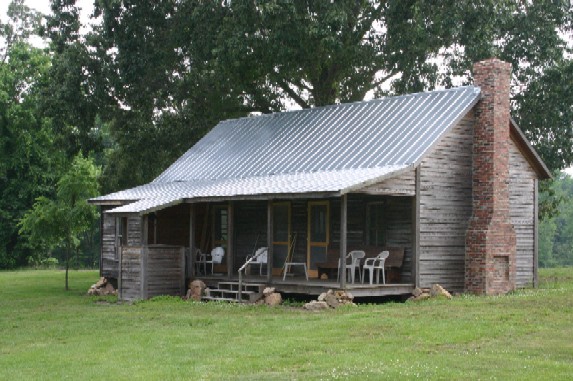
In 2005 Shelby inscribed a copy of Fiddledeedee to Kathleen and me when we visited him and Linda on their farm near Benson, NC, south of Raleigh. I own most of Shelby’s books by now, but I’m still partial to his first, Middle Creek Poems. And my favorite lines of Shelby’s are those I’ve quoted from the poem “Clematis Post,” which he included in that 1979 collection. Maybe Shelby likes those lines as well. He published that poem again in abbreviated form in his 2013 chapbook, Play My Music Anyhow, with the title, “All That’s Left.” His newest book is called The Hunger of Freedom. My copy should arrive from Amazon tomorrow. I look forward to finding out what else is left.