
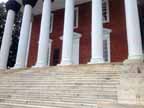
 This photo heads a piece that’s been in the news for a few days. It shows the columns of the historic Rotunda at the University of Virginia, designed by Thomas Jefferson, with the word greed spray-painted on them. University officials have painted over the letters and hired an expensive PR firm to help Rector Helen Dragas and the board members who supported her star-chamber ouster of UVA’s President, Teresa Sullivan, weather the storm of criticism that has engulfed them. A Google search just now unearthed over 1500 news articles and opinion pieces about the matter.
Today’s Washington Post carries a fine piece by Valerie Strauss about UVA’s present horror. Strauss quite rightly points out that the removal of President Sullivan “reflect[s] the way school reform at all levels has been carried out in recent years in some important ways.” Strauss’s painstaking comparison of events reported to have taken place at UVA and the now familiar scenario of “reform” that continues to be imposed on educational institutions of all sorts by venal legislative bodies and corporate boards and abusive, tyrannical administrators is telling, as is her point that the UVA board’s appointment of “Carl P. Zeithaml, dean of U-Va.’s highly regarded McIntire School of Commerce” should be taken very seriously as an indication of the direction Rector Dragas wishes to chart at Charlottesville.
At the center of the modern school reform movement is the philosophy that public schools should be treated not as civic institutions but rather as corporate entities. That the interim leader is Zeithaml, whose speciality is in the field of “strategic management†speaks volumes about the direction the board wants the school to go.
I take Strauss’s analysis a step further, for it seems to me that the emerging philosophy of higher education on display at many of our nation’s flagship universities regards these institutions as mere brands to be bought and sold like companies ripe for takeover. It’s a sad affair when a corporate vandal is able to leverage the purchase of an American institution like Anheuser Busch here in St. Louis, deplete its workforce, destroy its corporate culture, destabilize its philanthropy, and generally turn what was a sustainable enterprise and something of a model of corporate good citizenship into a mere profit center, only because, as he declared when he came to town, corporate vandal Carlos Brito wanted the Anheuser Busch brand. That’s a sad affair. But when the same logic is applied to a great public treasure such as the University of Virginia, that’s criminal. And of course school reform is being pursued according to a similar logic, taking us back to the discredited idea of the factory school.
Strauss points out as well that “education reform” has been a goal of “the American Legislative Exchange Council, or ALEC, an organization of nearly 2,000 conservative state legislators,” who have “worked in secret for years to promote privatization and corporate interests in education and other areas of American society.” The corruption of university research by corporate money is an open scandal. It’s now common practice for the giants of corporate chemistry to produce “studies” favorable to their own marketing strategies and seek vulnerable faculty to sign their names as researchers. And undergraduate education is going the way of the public school. Faculties are being scapegoated just as public school teachers are. Mindless sets of “assessment” instruments are being imposed on them and upon their students by entities outside education who now find themselves able to demand “accountability” from them. Academic tenure is being undermined in all venues, but of course tenure has never protected faculty from the most egregious actions of administrators and boards of directors.
Thomas Jefferson regarded the founding of The University of Virginia as one of his highest achievements, second only to the composition of The Declaration of Independence. It is hard to imagine that Jefferson would approve what is presently happening in the shadow of his Rotunda.
 The death of a friend and colleague surprised us on Thanksgiving day. He was