no Anglican covenant for this Episcopalian

Simon Sarmiento is reporting that the bishops of the CofE have not only commended the Anglican Covenant for adoption by the Church of England, but have also taken steps to ease its adoption. Still, passage is by no means certain, judging from the comments at Thinking Anglicans.

Katie Sherrod and Fr. Mark Harris have written useful commentary on the covenant’s reception by The (American) Episcopal Church, especially in relation to the recent visit of Canon Kenneth Kearon to the TEC Executive Council. You can read Katie’s thoughts and observations here and here. Canon Kearon is Secretary General of the Anglican Communion. Fr. Harris’s relevant posts are here, here, here, and here. The background of Fr. Harris’s reference to “mitregate” is a recent appearance of American Presiding Bishop Katharine Jefferts Schori as preacher and celebrant at Southwark Cathedral, London, where she was granted permission to preach and celebrate by The Archbishop of Canterbury but told she must not wear her mitre or carry her crozier.

Bishop Schori received a veiled apology from the Dean of Southwark Cathedral, though not from the ABC, and has reacted to this latest attempt to shame her with the aplomb of a canny American feminist who understands that there is no such thing as bad publicity. The more her enemies and the enemies of the ecclesial openness she represents attempt to denigrate her (and the attempts are serious, misogynistic, and hateful), the more sympathy she garners for her cause and the stronger she becomes.

I am opposed to the The Anglican Covenant, to the whole of it and not merely to section four which permits the church to discipline and punish. Were my church to constitute itself as the confessional body envisioned in the covenant, I would have to part company with my church. I have enough trouble with the Nicene Creed as it is, and believe that orthodoxies generally are pernicious things that require coercion for their establishment. But I also think the ABC’s refusal to allow Bishop Schori to preside at Southwark wearing the symbols of her office was not merely the coercive act of a petty authoritarian, not only a slight and an offense to Bishop Schori, to Americans and to the American church, but something more as well. Fr. Jake is featuring a challenging post the last few days entitled, “The Dark Side of Canterbury…Perhaps,” whose thesis is that the ABC is projecting power towards TEC because he has realized that we may need him more than he needs us since some of our present property disputes may hang on our membership in the Communion. I am thinking Fr. Jake is right and that there may be an even darker dimension to the ABC’s political maneuvering.

It seems clear that Dr. Williams not only wants to hold the Anglican Communion together, but that he also wants to preserve the primacy of the established English church. He is, after all, a peer of the realm by virtue of his office, and he has as recently as last February argued in the House of Lords in opposition to the prohibitions against discrimination contained in Britain’s new equality legislation. It seems unlikely that such a peer would wish to be reduced in stature or to be the cause of his national church’s diminution in stature in relation to the various colonial primates and churches who are presently subjecting him to great pressure. By promulgating the covenant, and now by getting out in front of it politically and fostering (by whatever means) its quick adoption by the general synod, perhaps Dr. Williams preserves advantage over the colonials as well as gaining leverage with TEC.

In light of these thoughts it’s interesting to note the recent appearance of three new Facebook pages, here, here, and here.

One more thing. The Episcopal Church’s prophetic positions with regard to gender roles and sexual orientration inevitably proclaim the bigotry of patriarchy and homophobia. The contentions generated by these proclamations cannot merely be held in tension. As Terry Eagleton has put it, “there are a good many important contentions which someone is going to have to win and someone else to lose.” Reactionary Anglicans (who may now count Dr. Williams as one of their number) understand that they cannot win social justice arguments about gender and sexual orientation and have chosen to cast these contentions rather as arguments over tradition and the authority of scripture. For a good many years now, Dr Williams has been developing and expanding a theological understanding of Christian identity that puts him on the side of traditionalists. I’m presently reading his recent book on Dostoyevsky, which seems to be a major statement of that theological understanding, and intend to post an essay about it in the fairly near future.
And I said that was good

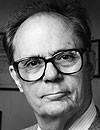
This needs poetry, but prose is all I have to give it, at least today. An old friend and colleague at St. Barnabas Church in Denton, Texas, has died—Bob Lockwood. The obituaries will tell you he was Robert Minturn Lockwood, III, M. D., whose profession as a radiologist hardly defined him. They will tell you of his devotion to Ann’s Haven Hospice in Denton, a pioneering effort in the hospice movement and one of the large works of his life. I didn’t know Bob at the time Ann’s Haven began and can’t speak of that, but his friends and acquaintances who are quoted in the newspapers speak eloquently of his service to the community and how it grew out of his grief over the death of his beloved first wife.

Bob was almost a renaissance man when I knew him, as close to that ideal as any son of the twentieth century could come: physician, scholar, poet, playwright, churchman, birder, naturalist, gentleman farmer—a longer list could be made. He was also an idealist with an almost Emersonian edge of Yankee shrewdness (though he wasn’t literally a Yankee) in spite of all the years he spent in Texas. He was a brilliant man who chose to find his destiny in the community of scholars assembled around two universities in the little town of Denton, Texas, a long way from Harvard and Penn Med. Circumstance was part of the reason why, but also a certain venturesomeness, I thought, coupled with a tendency to discount his accomplishments. Bob sometimes spoke of his career at Harvard as though he had been a failure and treated his medical credential as slight achievement. He was not a proud man, at least not when I knew him. When he retired he sold his radiology practice and went to work for the people who bought him out. But he also translated Brecht’s Theepenny Opera once, because he thought the popular adaptation (Blitzstein’s, I guess) was too tame. Bob’s father had been a professor of Latin and the Librarian of Haverford College, also the college’s informal historian and a devoted teacher. Students dedicated their yearbook to him in 1924. Maybe some of Bob’s interests, as well as the shaping of his character, began at home.

For the better part of ten years I knew Bob at St. Barnabas—many knew him better than I. But we served together for a year in a discernment process that brought us close, and we shared a heart-wrenching experience of the death of a beloved priest and friend that surprised us like a thief in the night. When I learned of Bob’s own death, I first turned to a poem he wrote in 1993 as a memorial to Charles Williams, the rector of our church at that time. Charles had been diagnosed with lung cancer just shy of his fiftieth birthday and was taken from us swiftly, in less than six months. Bob’s poem is a powerful reflection, not just upon Charles’s time with us and his death, but also upon how Charles talked with us about his death as he was dying—in a series of wonderful pastoral letters. Just before he died, Charles asked me to put together a small book of his sermons; I asked Bob if I could include his poem in the volume. I’ll not quote it entirely, just the conclusion.

And then you died—and were no longer there
       I saw your chest x-ray myself.
       It said DEATH—soon, no matter what.

So then, we cared for you (with a little help from the hospice).
And as you died
       you learned
       you grew
       you bloomed.
It was beautiful, it was terrible.
We wept.

Now please live on in us your friends
We are now more connected, more a Church, more the Body
Because you cared about us.

In the willow-meads of Tasarinan—may we meet again in the spring.

In his second life, the only life in which I knew him, Bob devoted himself to land and to practicing what we are now coming to call sustainability, raising chickens and bees, the farm where he lived with his second family a favorite resort of at least a couple of generations of children at St. Barnabas—a chosen place, a Vergilian place if you will—it’s useful at my age to learn what one thinks. I didn’t know Bob’s family, never went to his farm. He always came to church alone, as I do mostly now, myself, church being something my beloved and I do not share. I knew about Bob’s second life, the private part of it, only from conversations with him; but I believe the farm had been his renewal, or perhaps his last reinvention, of himself.

Now as I reread Bob’s poem I particularly think about its last line, an allusion to a place invented by Professor Tolkien in The Lord of the Rings. Treebeard sings of it in a wonderful song that recalls one of the Genesis creation stories:

In the willow-meads of Tasarinan I walked in the Spring.
Ah! the sight and the smell of the Spring in Nan-tasarion!
And I said that was good.

Tasarinan, in the legendarium of Tolkien’s Elves, is part of the lost flat world, now “under the waves,” that preceded middle earth in the same way that the legendary world of gods and heroes preceded classical antiquity, where the stories of that former world were regarded as history. As the members of the ring fellowship bid farewell to Treebeard midway in their journey, Treebeard speaks these poignant words: “I too must bid you now farewell. I do not think that we shall meet again. For the world is changing: I feel it in the water, I feel it in the earth, and I—I smell it in the air.” To which Elrond replies, “Maybe not in Middle-earth, Fangorn. But when the lands that lie under the wave are lifted up again, then in the willow meads of Tasarinan we may meet in the Spring.”

Did Charles and Bob read Tolkien together? I don’t know—I’m not sure I even want to know. But I think I understand that in wishing his dear friend and priest a pagan immortality, Bob meant to wish Charles a place in a time out of time wherein the difference between Pagan and Christian has been erased—and the world in which humans dwell with fire and water, beasts and great trees, no longer innocent, has found a new beginning.

—I can think of no better wish for Bob himself, or for us all.

and their works follow after them . . .

Morning news reports were saying that more than 20,000 mourners had passed by Edward Kennedy’s coffin at the Kennedy Library. Thousands more had lined the route of the motorcade that took the late senator’s body from Hyannis Port through Boston.

Last night I remembered how Edward Kennedy’s brother lay in state in the nation’s capitol as this music was played—I don’t know who played it, CBS, NBC? and how the long reach of history has touched the Kennedys, and through them touched us all.

Edward Kennedy, 1932 — 2009.

bogoroditse devo

Not having posted for a while, again, I think of music as a way to reenter. Tonight I began thinking of Rachmaninoff, and the beautiful all night vigil, better known as the Vespers. Here’s a fine performance of the Hail Mary from that piece, perhaps everyone’s favorite. It’s short, and it doesn’t reveal all the many virtues of the long choral liturgy of which it is a part. But it’s tonally and melodically spectacular. I can’t identify the performance. You can find it at YouTube.

One of the nice things about YouTube these days is that at the end of a given selection one finds links to other listening. You can likely find some other performances of this piece by following links at the end of this one, if you’re interested.