
To see the earth as it truly is, small and blue and beautiful in that eternal silence where it floats, is to see ourselves as riders on the earth together, brothers on that bright loveliness in the eternal cold — brothers who know now they are truly brothers.
–Archibald MacLeish
MacLeish’s evocation of liberal hope, as moon missions of the 1960s began to exert their influence on popular culture, was first published in The New York Times on December 25, 1968 and is now iconic. I don’t think its hope is tarnished by the fact that realization remains “halfway to the moon” or further out of reach in the post 9/11 world.
Thinking about today’s anniversary of the Apollo 11 Moon landing sent me in search of memorabilia. For years I used the famous whole earth image as a screen saver. But here are a couple of images I like better now, downloaded from the NASA website. The first images of earth from space (including these two) were created in 1968, before the first moon landing, by the astronauts of Apollo 8, the first manned space mission to orbit the moon. I like the first I show for its composition and for what looks like a tiny, far-off planet just beneath the blue earth as it hangs in the black sky.

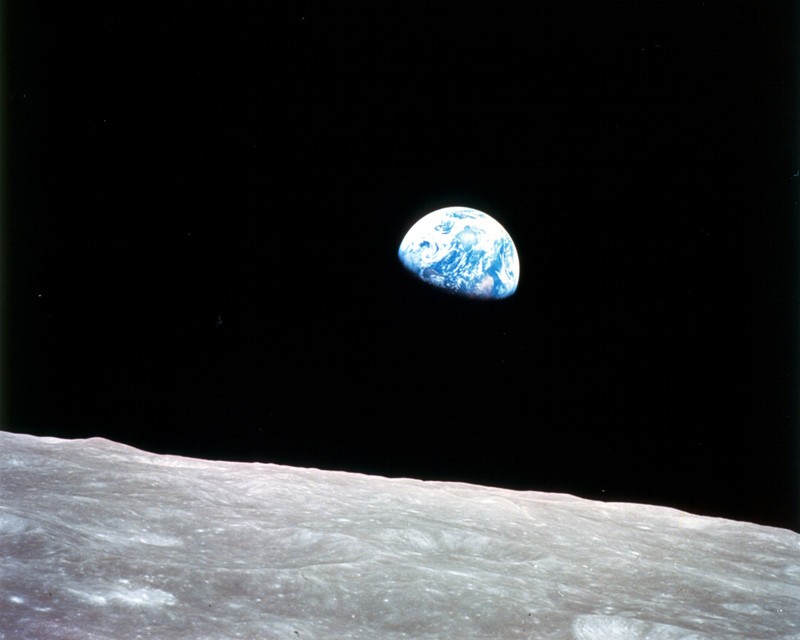
The second image is one of many to have been given the somewhat problematic title, Earthrise. But I think it must have been a photograph like this one that inspired MacLeish’s famous New York Times poem, published to coincide with the landing of Apollo 11 but written earlier.
VOYAGE TO THE MOON
Archibald MacLeish
(1892-1982)
Presence among us,
wanderer in the skies,
dazzle of silver in our leaves and on our
waters silver,
O silver evasion in our farthest thought–
“the visiting moon” . . . “the glimpses of the moon” . . .
and we have touched you!
From the first of time,
before the first of time, before the
first men tasted time, we thought of you.
You were a wonder to us, unattainable,
a longing past the reach of longing,
a light beyond our light, our lives–perhaps
a meaning to us.
Now our hands have touched you in your depth of night.
Three days and three nights we journeyed,
steered by farthest stars, climbed outward,
crossed the invisible tide-rip where the floating dust
falls one way or the other in the void between,
followed that other dawn, encountered
cold, faced death–unfathomable emptiness . . .
Then, the fourth day evening, we descended,
made fast, set foot at dawn upon your beaches,
sifted between our fingers your cold sand,
We stand here in the dusk, the cold, the silence . . .
and here, as at the first of time, we lift our heads.
Over us, more beautiful than the moon, a
moon, a wonder to us, unattainable,
a longing past the reach of longing,
a light beyond our light, our lives–perhaps
a meaning to us . . .
O, a meaning!
Over us on these silent beaches the bright earth,
presence among us.

And speaking of presences among us, My beloved and I went to hear Joan Baez sing last evening at The Pageant on the Delmar loop. For me, she was as magical as ever. Though her voice lacks some of its former power, particularly the strong upper register, it’s sweeter now, and the fast vibrato that used to bother me sometimes has smoothed out. She has a terrific band, but she did about a third of the show by herself, including her last encore, when she sang “Diamonds and Rust.” Lots of memorable lines and licks in the show: “When first I came to Louisville,” “Come back Woodie Guthrie,” “I believe in God, and God ain’t us.” Here’s the chorus of an Elvis Costello song I liked a lot.
We’ll rise above the scarlet tide
That trickles down through the mountain
And separates the widow from the bride . . .
For the truly nostalgic she sang “Silver Dagger,” “Forever Young,” “Old Dixie Down,” “Farewell, Angelina,” and “Don’t Think Twice, It’s All Right.” For the community organizers in the audience she delivered a rousing rendition of “Joe Hill,” as well as John Lennon’s “Imagine,” and Steve Earle’s “Jerusalem.” She threw in a spot-on impression of Dylan for the last verse of “Don’t think Twice” that brought the audience to its feet. But my favorite thing was an unaccompanied performance of “Angel Band” (which the Riverfront Times reviewer apparently didn’t know). With the other musicians singing along, that lovely old gospel song sounded for all the world like it might in a country church somewhere in eastern North Carolina . . . “O bear me away on your snow white wings to my immortal home.”