 No posting from Door County, but here’s a picture of The Alpine, the funky old-fashioned resort where we stay there. It sits right on what I take to be the harbor in Egg Harbor that opens out into Green Bay (not the town, the body of water). I love the place, love especially to sit on the porch and read — though I have to say that listening to Johnny Belmont and the Fabulous Cheeseheads runs a close second. I try never to miss the Cheesehead dances. They’re always crowded and feature various musics. I tend to like dancing to rock chestnuts like “Taking Care of Business” and “YMCA” rather than to the tunes that belong to my generation. That’s partly because almost everybody in the room dances to the rock tunes, grandmothers and geezers like me, young moms and kids, and even some teenagers and their youngish parents. I also love the chicken dance and the polkas.
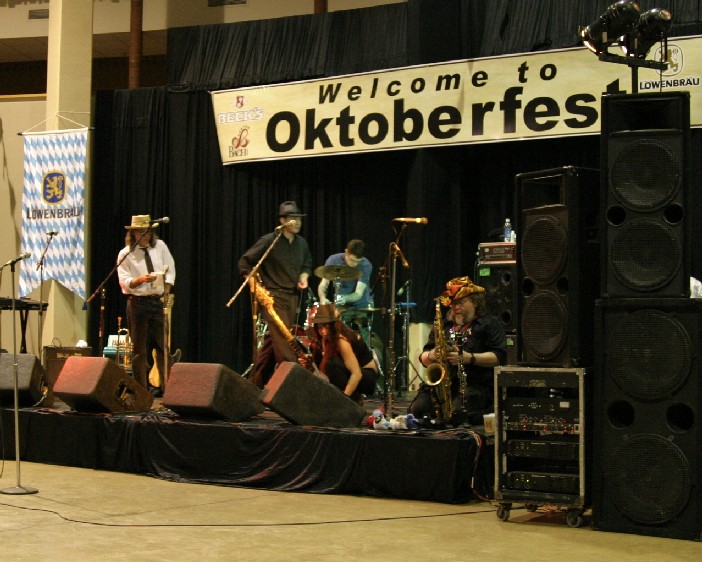
 Which reminds me to say that polka is Czech. I never knew that before last summer when my beloved and I spent some time in the Czech Republic. I recall dancing with a fine, strapping Czech person of the feminine persuasion who startled me by exclaiming “heeyaah” a good many times rather loudly in my ear during the experience. Apparently Czech women do this to indicate pleasure, though I can’t imagine having been the cause of such a thing. At any rate, polka is Czech, and the famous song which in the US begins with the words “Roll out the Cheese Whiz” (as the Cheeseheads’ have it), is really a sad song in which a woman dumps her lover . . . no heeyahs there. My good polka memories also extend to an Oktoberfest back in Denton a couple of years back when we danced to music from Brave Combo, who play a mean chicken dance.
I had resolved to hate the Olympics, but I failed to do so. Mostly because I became a fan of Michael Phelps as he swam his way to contention with whoever breaks all his records thirty years from now. It was a little sad to see past winners Mark Spitz and Mary Lou Retton as youth surpassed them, though they are hardly irrelevant and many of their exploits will remain in media libraries to be parsed by whatever future comes. The crowd of them makes me think of Houseman:
So set, before its echoes fade,
The fleet foot on the sill of shade,
And hold to the low lintel up
The still-defended challenge-cup.
And round that early-laurelled head
Will flock to gaze the strengthless dead,
And find unwithered on its curls
The garland briefer than a girl’s.
A commentator for an online pony thinks that “Housman’s cynical view of life may have a certain perverse appeal for young people” but scolds that the poet “neglects to mention that people . . . remember important men and women who lived well beyond middle age.” Houseman was a better classicist than this commentator, who, though he knows the ages of Sophocles, Queen Victoria, and a long list of other luminaries who died old, like Houseman’s Mithridates, doesn’t seem to remember that the classical tradition recognized two sorts of fame: one earned over a long life, such as that of Odysseus, and the other earned by brilliance in youth followed by early death, such as that of Achilles. And the fleeting nature of all fame is also a classical trope. But let that go. It’s clearly time for me to go back to school.
Speaking of racers, my guy Obama has seemed a bit underwhelming for a while. His FISA vote really disturbed me, because I need to be able to hope for the restoration of the rule of law by an Obama presidency. His campaigning since the trip to Europe has seemed pretty lackluster. And now he has participated in a widely publicized conversation with Rev. Rick Warren and John McCain that has given Warren license to claim that he has helped the rest of us understand Obama’s world view. If this claim were true, I doubt that Wm. Kristol would be crowing in The New York Times that McCain “won” the conversation and calling for Warren to replace one of the media types scheduled to moderate the three TV debates scheduled this fall. Apparently McCain “won” because he interpreted a question about evil not in a theoretical way, as Obama did, but as a question about, what else, 9/11. I am so sick of this horse shit and of the way it is hyped as profound, and I’m almost angry at Obama for lending himself to it. If he wished to put his piety on display, he’s certainly not chasing any snakes out of the country with it.
Then I remember Jeremiah Wright, and I realize that the hallmark of my guy’s campaign has been to accept a host of arbitrary and unfair “tests” of himself and his abilities as he continues to allow white voters the luxury of thinking that they live in a post-racial society. Shelby Steele, whom I’ve mentioned before, is good on the racial dilemma that Obama faces, and now Adam Serwer has written another good piece at The American Prospect arguing that Obama only loses if he acknowledges the racism to which campaigns against him have appealed, first the Clintons and now McCain, the Paris Hilton ad being only the most recent in an ongoing series of coded racist messages about the Illinois senator.
According to Serwer, we have now reached a point at which “saying the race card has been played is actually the ultimate race card.”
The McCain campaign’s apparently race-neutral approach, and its subsequent accusation that the Obama campaign is playing the race card, is a well-thought-out strategy — it is pure Nixon. In his recent chronicle of conservative political history in The New Yorker, George Packer describes Pat Buchanan’s plan for exploiting political divisions, particularly ones of a racial nature. Buchanan’s assessment was that they could “cut the Democratic Party and country in half; my view is that we would have far the larger half.”
Is there a counter strategy? None, as Serwer sees it. “The brother needs to keep it together. There’s simply no way he can win this one.” Obama needs to stick to policy. So I hope for the future he’ll not venture into any other megachurches where his successes can be turned against him.
It’s very much like the racially charged sentiments of some white basketball fans that black basketball players are overpaid. No one resents franchise owners for being fantastically rich, the same way no one resents McCain for being fantastically rich, because presumably, their riches are “deserved.” But fans do resent the players for million-dollar salaries the same way the Obamas are resented as elitists for owning one nice home.
Back to Michael Phelps and fame. I have to think, too, of Kobe Bryant, LeBron James, and the other African American basketball players who are presently carrying the day for the U. S. in Beijing. If they win it all, they’ll be touted as having reversed a condition brought about by past teams of overpaid professionals who had a poor work ethic. If they lose, they’ll be painted as overpaid professionals (read black professionals) with a poor work ethic.