Advent II: Looking for America

If I have left the impression that I think all evangelical Christians supported the election of Donald Trump, I should correct it. Here are two statements, one by a Baptist layman and another by the president and past president of Fuller Seminary expressing dismay over Trump’s election that is kin to my own. Nor do I want to convey the impression that I think the mix of racism, misogyny, and xenophobia that permeated the Trump rallies is necessarily characteristic of evangelical Christianity or of Catholicism. What follows is a meditation on what I take to be the spirit of these two statements. I have no idea how to translate it into anything else.

On the other hand, I am convinced that a vote for Trump was not an innocent act. We will discern that lack of innocence in the coming months as the Trump presidency unfolds. It will have two primary goals, I think: to enlarge the cult of Trump, and to act out what Katherine Kramer has termed The Politics of Resentment. We won’t see the wholesale return of “American jobs,” but we will see plenty of scapegoating of the politically and socially vulnerable, who will be blamed for the country’s alleged ills, and an attempt to dismantle the liberal establishment. Look at Wisconsin, Kansas, Louisiana, Michigan, and other states that have experienced large-scale destruction and/or stagnation of the public sector for models of what could happen nationwide. Trump’s scapegoating of Boeing is also deeply disturbing. Coupled with the corporate welfare Trump and Pence have promised United Technologies in relation to Trump’s inflated claim of “saving Jobs” at Carrier, it bespeaks the capriciousness of a would-be dictator.

One of my students a couple of years back remarked that we are living in a time of great change. I didn’t disagree because I never did that with students, but I thought then and am thinking today (as I noted in a previous Advent piece) that a time of great change may already be past, a trajectory such as that Richard Rorty describes in an essay entitled “Trotsky and the Wild Orchids”–one defined by the Bill of Rights, the Reconstruction Amendments, the building of the land-grant colleges, female suffrage, the New Deal, Brown v. Board of Education, the building of the community colleges, Lyndon Johnson’s civil rights legislation, the feminist movement, and the gay rights movement. Following Dr. King. It may be that the arc of history bent towards justice for a stretch of time in the last century, but if so it has now snapped back with a vengeance in the rise of Donald Trump. Those of us who opposed him now have to figure out how win elections in a poisoned political environment.

And it may also be important in the short term for those of us who have been part of the liberal establishment and still celebrate its accomplishments to figure out how to prevent, or at least to slow, its destruction: to preserve public education, the national parks, the continent’s infrastructure, the professions, civil rights, the elements of democracy we have taken for granted since the great depression, the social safety net, the press, the middle class, to say nothing of civility and common decency in our national leadership. Trump and the Republican leadership promise us liberals not only destruction, but also authoritarianism, cruelty, crudity, and inauthenticity on a scale we have not seen in American public life for a long time, perhaps since the time of Lincoln. Last June as I wandered about the mall in our nation’s capital I couldn’t help thinking that I can’t imagine how or why anyone would seek public office with a goal of destroying the institutions that surrounded me. Yet here we are. An apparent majority of our nation’s governing faction currently rejoices in its intention to do just that.

We were in Washington over the Father’s Day weekend, and it was on Father’s day that we visited the Vietnam Veterans Memorial. Here is how it looked, with garlands of flowers and personal memorials along every inch of the long memorial wall that is its centerpiece.
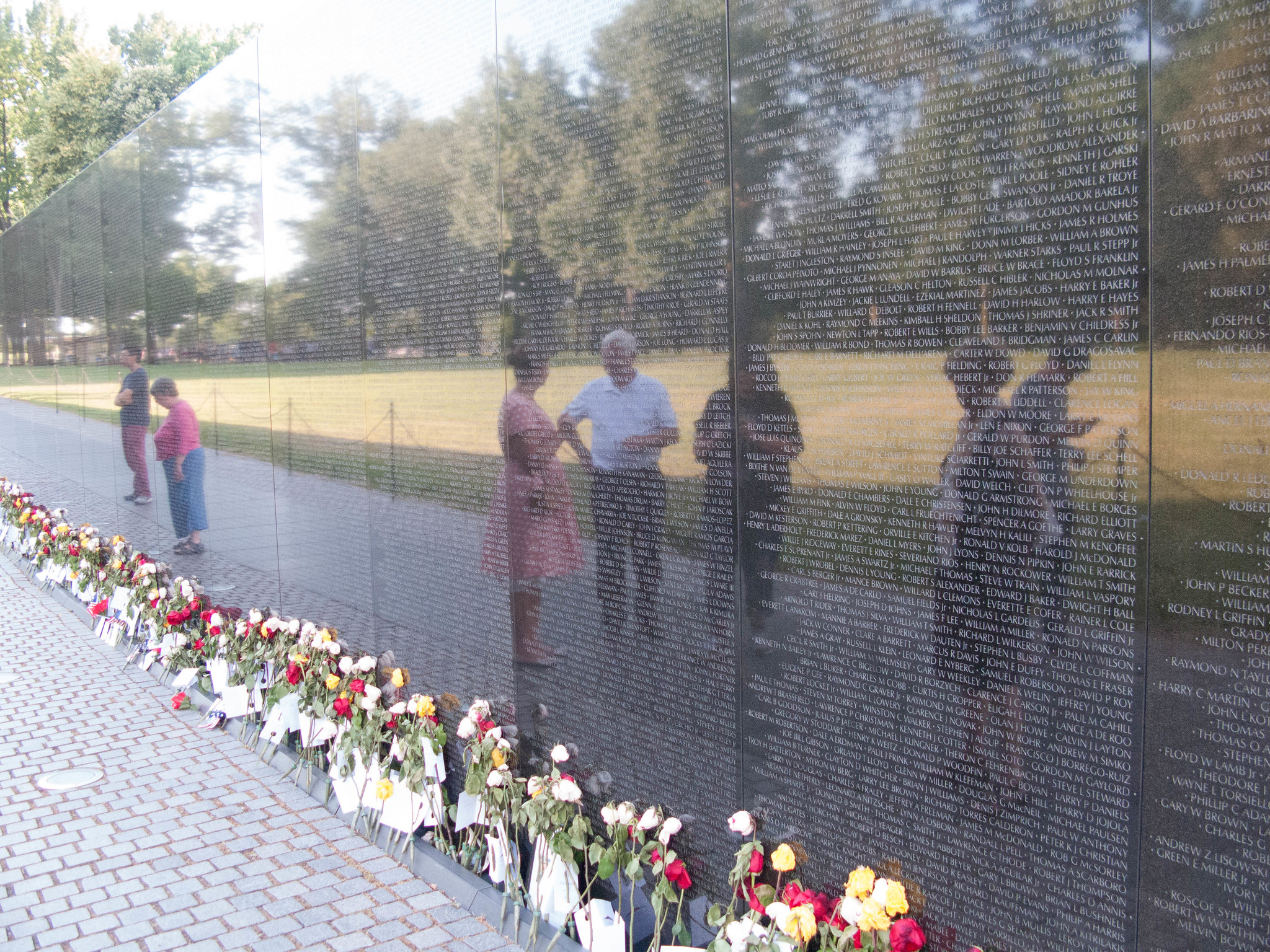

IMG_2220.jpg

IMG_2224.jpg

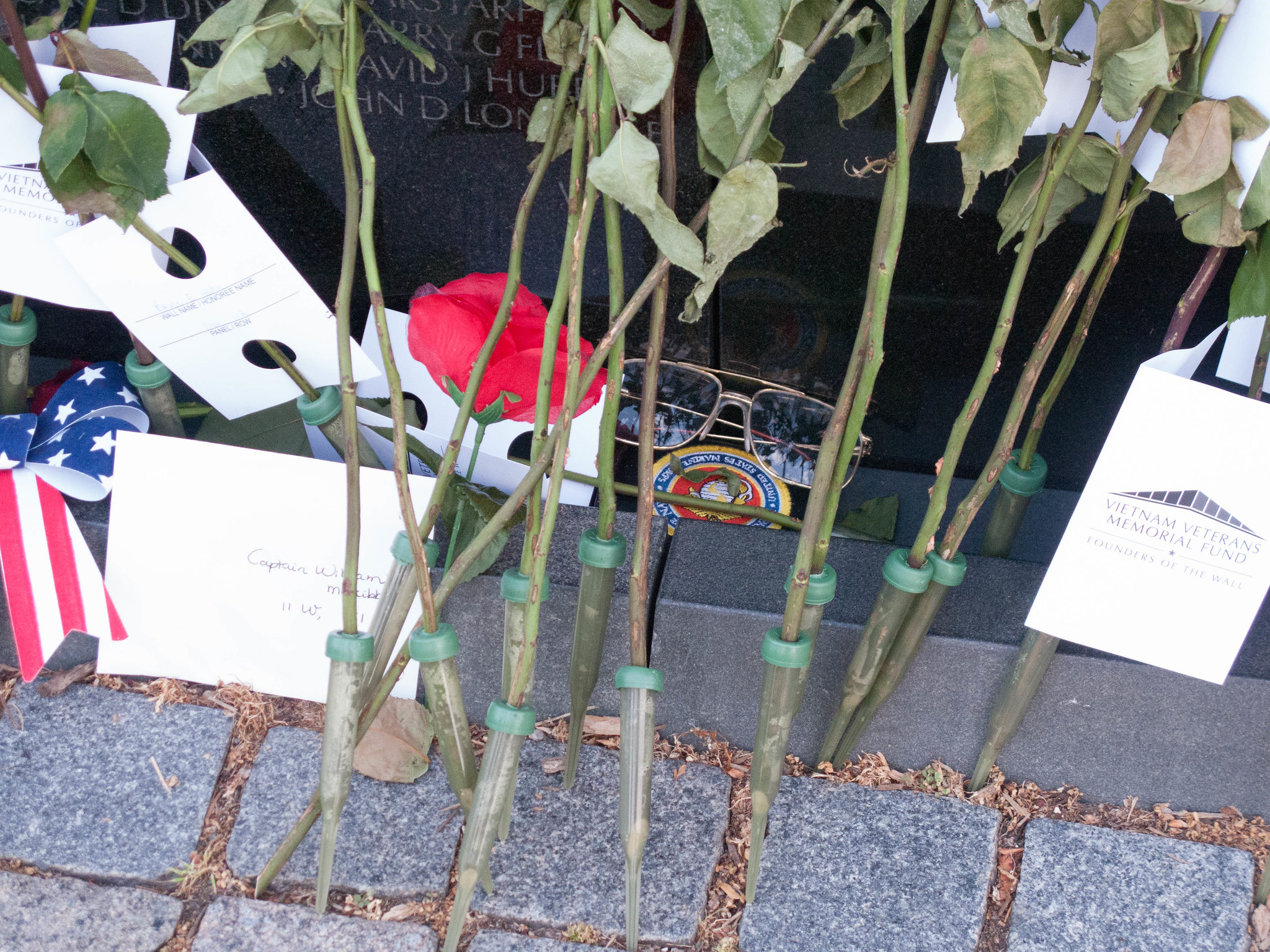
It continues to draw huge crowds, and this Father’s Day I estimated thousands of friends and families of the dead of that war had left remembrances there. Some were little shrines that included effects of the persons remembered, family pictures, glasses, driver’s licenses, wallets, medals and insignia. It was heart wrenching to see them there in a way no photograph can convey.
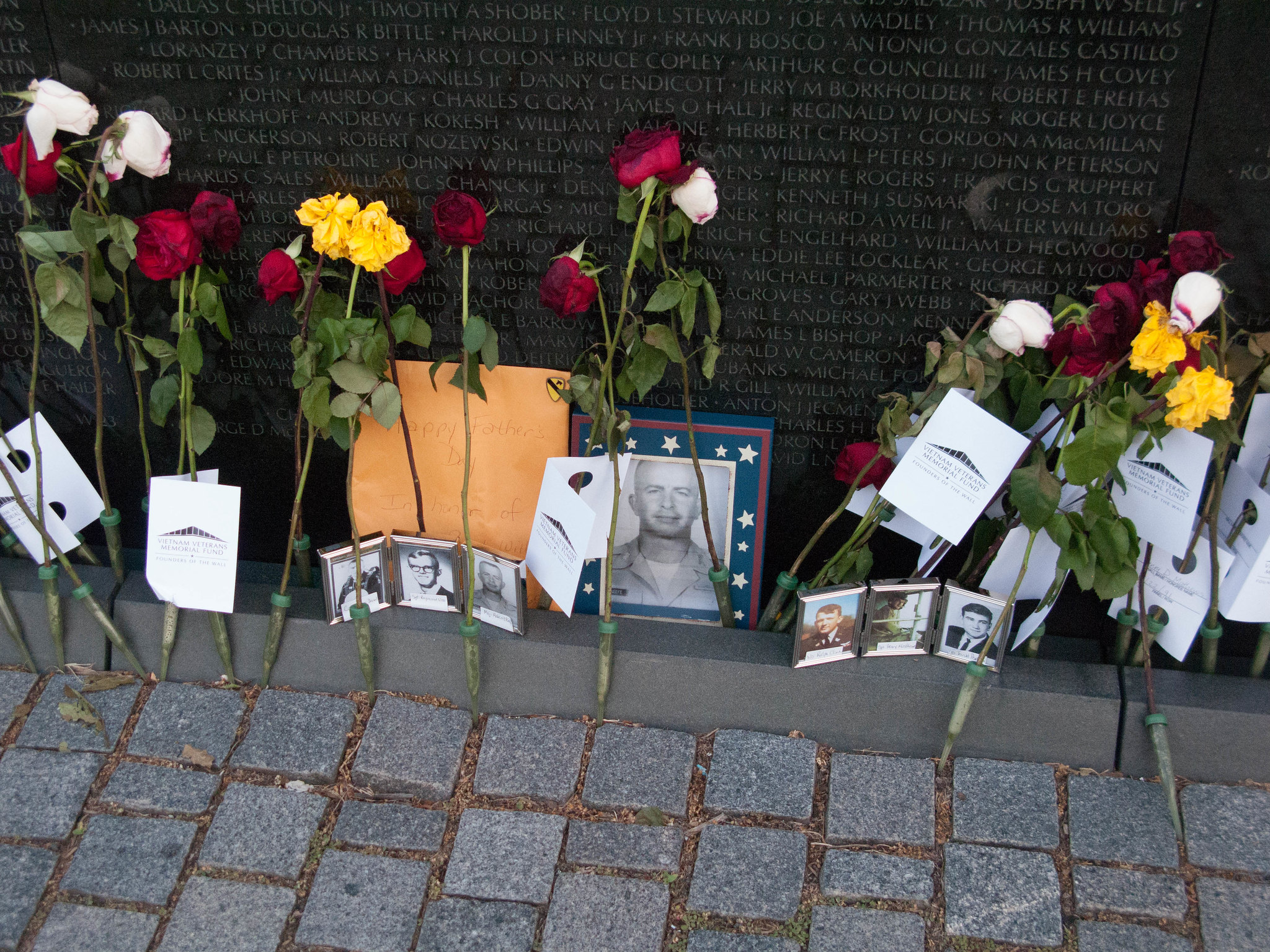
IMG_2222.jpg

IMG_2219.jpg

I opposed the war in Vietnam, made no secret of my opposition, participated in protests; but I also spent three years at the height of the conflict teaching school at Fort Bragg, North Carolina where I knew, befriended, and was befriended by many Vietnam veterans, some of whom were in between tours. One of my students (younger than I was—I was young then too) had done three tours in Viet Nam and wanted to go back. He had some things on his conscience from his first tour for which he had continued to try to atone. I have often wondered what became of him. Then there were the days I arrived on post to an atmosphere supercharged with dread and grief because there had been a parachute malfunction that caused a training death. And it wasn’t just that someone had died; the atmosphere was quite different during the days when the post was absorbing news of the MacDonald murders. Airborne soldiers folded and packed one another’s parachutes for each jump. I learned something about solidarity on those death days, something I think I saw again last Father’s Day.

In 1987 I reviewed My Father, My Son for The Dallas Morning News, a book by Elmo Zumwalt, Jr. and his son, Elmo Zumwalt, III. It tells of the their terrible struggle and grief as Elmo, III slowly died of lymphoma caused by exposure to Agent Orange, whose use as a defoliant his father had ordered in Vietnam. (Elmo III’s son Elmo IV, was born with a severe nervous disorder linked as well to his father’s exposure to dioxin.) At book’s end in 1986, Elmo III was recovering from a successful bone marrow transplant that extended his life another two years. At the end of my review I quoted a short statement from a letter he wrote his father at that time that I thought illustrated how Vietnam had given them a particular bond.

Both in Vietnam and with my cancers, we fought battles and lost. Yet, we always knew even when the battle was clearly desperate, that our love could not be compromised.

Young Zumwalt never blamed his father for his illness, always thought his father was right to order the use of Agent Orange. But by the time of his death in 1988 the Supreme Court had removed the last obstacle to implementing a multi-million-dollar settlement between veterans and the Agent Orange manufacturers. My Father, My Son is still worth reading. The Zumwalt story is almost an epitome of the entire war and its complex chain of consequences that continue to play themselves out in our country’s moral history. The Vietnam Veterans Memorial reminded me not only of that complexity but also of the way Vietnam veterans were treated upon their return home, one of the most shameful episodes in that moral history.

Our country’s present rightist elite have ruthlessly and, I think, cynically exploited a moral divide between Americans in relation to which there is good will on both sides. What many of us on the left know is that we don’t deserve the resentment that right wing elites have channeled towards us. But we also need to realize that some of our attitudes towards conservatives are stereotypical and that the divide between “us and them” will not be understood or ameliorated by wonkery because it’s more than political. Indeed it goes to the heart of who we are as Americans. As I walked along the veterans memorial wall I thought of Simon and Garfunkel’s “America.”

“Kathy, I’m lost”, I said,
Though I knew she was sleeping.
“I’m empty and aching and
I don’t know why.”

Counting the cars
On the New Jersey Turnpike
They’ve all come
To look for America. . . .

I love this song for its catalogue of ordinary ironies and its evocation of a time when I thought I had America right. I’m thinking now of a friend who I think voted for Trump but still offered to hug my neck as we realized we had things we could talk about in the aftermath of the election. We Americans are, we were then, who we are—all of us, as Mrs. Antrobus says of women in Wilder’s The Skin Of Our Teeth. “We’re not what politicians or poll takers say we are, and we’re especially not the ideological idiots pundits and social media say we are. We’re ourselves.’ Perhaps we could find America again together if we met spiritually somewhere near the Vietnam Veterans Memorial and began to talk about how we got there.

Advent I: Who is an American?

Some years back I attended a funeral in one of my city’s conservative Catholic churches. On this particular day, the celebrant in inviting the faithful to communion went out of his way to explain to us non-Catholics that we were not welcome at the Lord’s table. We were told to remain in our pews and pray for the unity of God’s Church. I was a bit taken aback at the blatancy aand harshness of this priest’s inhospitality, but the rubric was not unfamiliar. I grew up in a town dominated by two Protestant sects that each believed only its members were destined for heaven.

I’ve never understood such exclusivity. If we are to believe John Dominic Crossan, the unique things about Jesus were that he healed freely without enquiring whether his patients were deserving and that he ate with anybody. The remarkable thing about Jesus’ feeding the five thousand may not be the miraculous multiplication of the five loaves and two fishes but rather Jesus’ specific prohibition of gatekeeping on the part of his disciples. No one seems to have been excluded from Jesus’ healing ministry on that day, or from the meal that followed. On the other hand scripture is replete with examples of Jesus’ eating with ‘publicans and sinners;’ and If we are to believe the gospel accounts, Jesus shared his last meal in the flesh with the disciple he knew would betray him to the Romans and also with a disciple he correctly predicted would deny knowing him before morning.

I have found myself returning to Jesus, A Revolutionary Biography again and again over the years since I first read it, and I find myself returning to it again this year as a discipline for the four weeks of Advent. I have never believed that the question ‘Who is a Christian’ is answered by The Baltimore Catechism or the thickets of proof texts some evangelical Christians use as weapons to protect the territory of faith from incursion by the ritually unclean or by persons whose beliefs particular sects judge to be incorrect. I think with Crossan that scripture does not provide a unitary picture of Jesus; there is no view of him that one can adopt with scriptural certainty, no view that is supported by the entire body, even, of canonical scripture without leaving a scriptural remainder that might support another conflicting view. Indeed, the Bibles as Christians and Jews have fashioned them over the centuries do not support a unitary conception of God, and on that one fact hang all our diverging communities of doxa and praxis. If one adds the Quranic tradition to the mix as we do, for instance, when we speak of the Abrahamic religions, further complications arise.

But I am presently thinking of something I’m describing to myself as the sociology of religious certainty, from which I stand aside as a dissenter and sometime critic. Advent is good for me because it forces me to examine again for the near eightieth time (since I will be eighty soon), my reasons for standing aside and the images of Jesus and of God to which my experience and affection have inclined me. I like the Christian Science appellation for God, father/mother. It could just as well be turned around, mother/father. The metaphor calls attention to itself and moves my mind to the thought of a god without gender, whose attributes I like to think are creativity, empathy, nurturing, and a disinclination to self-glorification. One difficulty I have with some contemporary feminist images of God is that they retain the triumphalism of traditional imaging, having removed gender references only. I’m still back there with Micah, who set it down that God requires justice, mercy, and humility of us humans.

I am a cultural Christian, a Christian humanist, and I have reasonably specific reasons for claiming these things. Christianity provides me with much of my fundamental vocabulary, with the linguistic tools I need to cope with the world as it seems to me to be. I could be a complete pragmatist, like Richard Rorty whom I admire, but for a profound awareness of sin, in myself and in the world I inhabit. I am a humanist in the sense of understanding that the world I experience is a text, composed of many subtexts, some of which I know and some of which remain opaque to me. In this I am not alone. Not even Kant or Einstein could read the world entire. It should be obvious by now that I am describing a position that posits uncertainty as a fundamental. I might have certainty if I had reached the end of the unknown, but to know everything is not a human possibility. I can hear a voice telling me to have faith, but that instruction merely requires me to accept someone else’s partial and interested description of the world and its history. I prefer uncertainty. I particularly prefer uncertainty to the dogmatism and exclusivity of much contemporary Christianity.

And now I am confronted with a new messiah, Donald Trump, who has drawn upon the savior language of past centuries in advancing his rise to prominence, who is recommended to me by an apparent majority of evangelical Christians in my country. “I alone can protect you,” he has told his ardent supporters as he encouraged them to brutalize dissenters at his rallies. Trump’s position as president elect is in part the product of mass dramas recalling medieval Good Friday sermons that whipped up the faithful to brutalize Jews and their communities in pogroms that were a standard feature of European history well down into the twentieth century; that resembled the whipping up of lynch mobs in this country, most of which targeted African Americans but not all. In the East St. Louis riots of 1917 some ten whites were killed along with upwards of one hundred blacks, though the true death tolls will never be known precisely.

My point is that Trump populism was and is of a piece with these past excesses. We saw them at the Trump rallies. If you voted for Trump, this is what you voted for, regardless of how you may try to sugar-coat it. You voted to enable violence against those aliens, those illegals, and you voted to “Lock her up” (or perhaps to kill her) on the basis of a pack of lies invented by unscrupulous people with no purpose beyond their own aggrandizement. The Trump rallies were spectacles designed to force an answer to another question: ‘Who is an American?’ And the answer is rhetorical: ‘Not those others, not those brown people, not those aliens with strange names who don’t worship Jesus.’ The Islamic conception of Jesus is very like that of Judaism, but most Americans are utterly ignorant of Islam, or worse, are informed by anti-Islamic bigotry masquerading as history or news.

Advent invites me to ponder the last things: heaven, hell, death, and judgment. In my eightieth rethinking I am struck by the realization that the last things are not last. The holy is last. But the problem with the holy is that we have located it in the person of a cosmic despot who demands worship and abject obedience. As Christians we have assimilated Jesus to this despot, and before Jesus there was Moses. In the tale of Moses’ conversion the holy had already been imaged as a despotic ruler; as in the tale of St. Paul’s conversion the assimilation of Jesus to cosmic despotism had already taken place. There is a deep truth in the stories of Moses and the burning bush, and of of St. Paul’s blinding. The holy sometimes breaks into common experience when least expected, like a thief in the night, as St. Paul said of the coming of the day of the Lord. But the small among us might have done without the murders, torturings, enslavements, deportations, and other excesses that have come in the wake of our hanging holy robes on bishops, kings, and dictators through the Christian centuries.

Donald Trump has behaved from the beginning of his candidacy for the Presidency, and is behaving now, like the leader of a cult, and his following has many of the trappings of cultic discipleship. Either sense of cult will do here. Trump demands worship and abject obedience. He punishes subordinates who fall short. He has in a few short months gathered a cult following, still a minority of Americans but a very effective one. Will he be able to turn at least the Republican party into the Church of Donald Trump? I don’t know. I decline to join. But the faux holy has been a force to reckon with throughout the history we know. It has broken out into the common life of nations many more times than once in Germany since the Great War. And I fear it is upon us again.

Nosce Teipsum

I came across an email the other day from an old friend who sent me his address at the time by way of saying that I might need it in case there were some imponderable about which I needed to speak with him. Usually I get to the imponderables during Advent, but this year I’m late. It’s taken until mid January for the winter of my discontent to set in with its perennial itch.

But here goes—of all silly questions (silly in our sense of benignly foolish and also in Chaucer’s sense of blessed) perhaps the most sophomoric is what is the meaning of life. I spent the summer of my nineteenth year with it nonetheless, not mooning over it in the abstract but attempting to decide whether I would continue on the career trajectory to which I had at that time committed myself. I had grown up in church, by no means a bad thing; and I had announced to my family and my peers at the end of high school that I thought I had been called to the ministry.

In due course I had been appointed a local preacher in the Methodist Church, which meant that I was permitted to preach under the supervision of an ordained pastor and that I might serve as an an assistant, or apprentice, minister in a church. In the summer of my nineteenth year after my sophomore year at college I had a job as youth minister of Central Methodist Church in Dalhart Texas, It was not a job that involved onerous responsibility; I had a lot of time on my hands. There were no young people my age around that summer in Dalhart. I thought of the church youth group I helped to supervise as my clients, not as friends, and socialized with them only in very limited ways.

There was one movie theatre in Dalhart—films changed once a week or so. The primary entertainment of an evening was to drive your car up and down the town’s main street and honk and wave at your friends. I joined in that activity to some extent, but lacking friends and feeling some discomfort honking and waving at my youth group clients, though they were perfectly civilized young people, I didn’t do too much dragging, as the driving and waving was called. I spent some midweek time, twice I think, visiting a girlfriend who was working as a camp counselor five hundred miles away in Kerrville, but that was exhausting. Mostly I read.

I’m sure I must have read plenty of trash, but what I most remember is that I read War and Peace, pored over the agonies of Pierre Bezukhov in particular, and speculated about comparisons between Napoleon’s marches and Hitler’s (drawn by Clifton Fadiman for the Inner Sanctum Edition I found in the Dalhart Public Library). I read War and Peace twice through and continued to reread parts of the novel until I had exhausted the experience. When a voice spoke to me out of nowhere and announced that the meaning of life had to be lived, I thought for the first time that I might find meaning in my own life by throwing myself into the flux and complexity of lived experience, though I remained uncritically sure that questioning the meaning of life ought to remain the constant occupation of a serious person.

My idyllic time came to an end in late July or early August when I preached a sermon at the Sunday morning service. I naïvely and irresponsibly explained to the good folk who came to hear me that day that I was in some doubt about heaven and hell and was becoming what I would have called a universalist had I known the term. I presented what I thought were fine arguments for my emerging views and invited any of my co-parishioners who were so inclined to come and talk with me about them. Afterwards, the kindly minister who was my supervisor suggested to me that perhaps I didn’t really want to be a preacher and advised that I might want to think about doing something else.

Fast forward to the present year: I’ve been reading Marilynne Robinson’s new book, The Givenness of Things, which I like a lot with some reservations. I suspect Robinson of a similar universalism to my own, though she claims to be a Calvinist. Still, after owning that Robinson has read Calvin more deeply than I have, I’m skeptical, primarily because the reformed tradition with which Robinson identifies places more faith in logic and theological correctness than I do. Having worried ontological questions most of my life, I have much sympathy with Robinson’s rehabilitation of ontology. But my own ontological meditations don’t inevitably lead me to affirmation of the Trinity or to a literal belief in a created universe.

I have no trouble claiming solidarity with the ages in the Nicene Creed, which we Episcopalians recite in the plural: we believe (I suspect Robinson would demur); but my submission to the creed is a concession to formulations I am bound to regard as metaphors. After I recite the creed, the fundamental ontological questions remain for me. What is reality? What is being? What is my place in the cosmos? What indeed do I mean by the locution, I believe in one God, the Father, the Almighty? If this means that I am promoting the questions of Greek philosophy as the philosophers confronted the death of their ancient Gods over those that must have guided the Hebrew prophets as they confronted the death of their ancient Gods, so be it. Actually, I dont think there is such a conflict, as Robinson seems to do. I think in both traditions wonderful minds were at work on inherited pieties, transforming them into the poetry of new historical epochs.

The Creed, after all, is a political document, as I think all creeds are: ideology in Mannheim’s original sense of formalization designed to forclose discourse. It takes some stretching to assert that it is scriptural. Its primary purpose at the time of its adoption was the defeat of Arianism, which was the Christian religion of a substantial minority in Christendom of mostly Germanic origin. Its adoption represented the triumph of Constantine and the return of Rome to Romans; though Constantine was obliged to wage wars most of his life in that cause, and Arianism survived well down into the eighth century. Arius, himself, declared a heretic in 325, was exonerated in 335 only to be declared a heretic again in 381 after he had been dead almost half a century. Robinson’s loyalty is to the earlier Apostle’s Creed, though she mostly speaks of a Trinity that involves two persons only, hardly mentioning the Holy Spirit (or Ghost, as we used to say).

Robinson spends a good deal of time arguing for a historical Jesus, something I’ve never seriously doubted; though like Dostoyevsky’s inquisitor I think the magisterium of the Faith, Gospels, Churches, Dogma, the rich inheritance of liturgy, the terrible and cruel inheritance of sectarianism, all of it could exist on its own even if there had never been such a person as Jesus. Years ago I encountered in a book of sayings of Albert Schweitzer the statement that the quest of the historical Jesus fails because that Jesus inevitably returns to his own time; whereas the faithful who encounter Jesus in their own worlds and lives possess a wisdom that transcends mere history. Robinson is content to leave issues such as predestination and the problem of evil out of consideration and to treat them as mysteries. Though I do not doubt the historical Jesus, I will confess here that I regard the existence of a God apart from the world of worlds (saecula saeculorum) who numbers the hairs of my head—as a deep mystery, though I revere (and hope I keep) the first commandment. As to the second, I have broken it so often, committed so many offenses against my fellow creatures and myself that I am acquainted with grief.

I still worry the question with which I began from time to time, but from a different perspective. Closer to my eightieth year than to my teens I wonder occasionally what it might mean, beyond oneself and one’s selfish pursuits, to ask if one’s life has meaning? One answer, a moral one perhaps, might be to wonder if, at life’s end the world in which one lived and acted were at all changed by one’s passage through it. The question is still naïve, one’s life being subsumed in historical processes over which one has had no individual control and which remain hidden by one’s immersion in them. It is like asking whether a lake (or an ocean) is changed because one swam in it, or whether the air is changed by the flight of a bird. And the matter becomes more obscure if one asks the question in ontological terms. Is the void to which one’s being returns at the end of life the same void out of which one’s being emerged. Is the void of not life changed, indeed, by the emergence and eventual dissolution of any single life, or even by the emergence of life in the aggregate. Is life in the aggregate an accidental, a momentary disturbance in the great peaceful eternity of not life. Or does the emergence of life argue for something like emergent evolution, a process in which a new creation struggles to be born.

Robinson likens the universe to a storm, seeking to appropriate insights from physics and contemporary cosmology. I have no quarrel with that image, though I am more attracted to T. S. Eliot’s image of a turning about a still point, with its Aristotelian and Thomist resonances. And I am attracted as well to the ancient conception of peace as the primary characteristic of the world of worlds, the universe of universes which we have in idea, a little handful, to paraphrase a poem I love. I also think it does not diminish humanity to take the psalmist’s view, “what is man that thou art mindful of him.” I have always mostly thought that art, science, religion, and philosophy all lead our understanding towards wonder. Robinson takes a similar view. The Givenness of Things is a meditation on such wonders as quantum physics, Shakespeare’s poetry, and human forgiveness. The presence in our limited world of such wonders argues for a kind of cosmic optimism, in Robinson’s view, with which I can only concur.

And that brings me to the parts of Robinson’s argument I like the most. Wonder first, which Robinson evokes most poignantly with respect to human forgiveness and the largeness and generosity of spirit that can often accompany it. Robinson finds these displayed preeminently in the plays of Shakespeare. She argues that Hamlet’s famed hesitation should be understood as a humane shrinking from revenge, to be expected, to be thought normal, in a king’s son, especially perhaps in a king’s son who has been to the university and longs to return. It is the genius of Shakespeare’s language to model such things for us without sentimentality. The prince’s dispatching of Rosencrantz and Guildenstern is a necessary act of self-preservation. His killing of Polonius and his complicity in the death of Ophelia must be seen as more than problematic. But he refuses to the end to play the hero of a conventional revenge tragedy, refrains from exulting in Claudius’ death, and is at pains to beg Horatio to tell his story truly, not as one done in by the sour necessity of revenge, but as one who was “likely, had he been put on, / To have proved most royally,” as Fortinbras describes him at the close. I am thinking of something Sidney says in the Apologie for Poetrie as part of his argument that poetry limns a world that might be, a world that ought to be. He describes a scene that men of his time often carried on their persons inscribed upon medallions. “Who readeth Aeneas carrying olde Anchises on his back, that wisheth not it were his fortune to perfourme so excellent an acte?” And sometimes, as we can also see in Shakespeare, excellence is more than its own reward. What more unlikely than the restoration of Pericles’ daughter, whom Pericles had thought dead. It is “like a resurrection”. It “makes men glorious” as promised by the Prologue to Pericles, Prince of Tyre, “by allowing plausibility to drop away in deference to human particularity, human love and loyalty and worth.”

For Robinson the givenness of things is most displayed in the arbitrariness of our experience, which she links to what Jonathan Edwards called “the arbitrary constitution of the creator.” For Robinson as for Edwards, the fact that “We know only what we know only in the ways we know it or can know it” argues persuasively for “the creation’s arbitrary character, that is for its being composed to reflect the intentions of a creator, not as the elaboration of an order intrinsic to itself.” I think this is the weakest place in Robinson’s argument in that it requires the same unjustified leap from epistemology to ontology that positivists make in claiming that the limits of our experience require us to conclude that what we take for nature is of our own making. For me the givenness of things is palpable. I think of Wendell Berry’s reverence for topsoil. We cannot make it. It is my belief that we awake as humans (slowly, to be sure) to nature and culture as equal parts of our environment. I believe it is our gift as humans to stand apart from nature simultaneously as we are contained within it. That is what the story of the loss of Eden means to me. It is the measure of the problematic place of humans in the scale of being. “Who told you you were naked?” the Lord asks Adam in the cool of evening.

Yet it is that very problematic place that is our freedom, such as it is. Like Robinson I am unwilling to argue that the extremes of human sin are the price of that freedom. Such a conclusion is as vicious a reduction of experience as it is to claim that any chimpanzee with a typewriter would eventually write the works of Shakespeare. I am a brother to that chimpanzee. It is because I began my conscious life as a disciple of Jesus that I refuse the sort of arrogance that proclaims a human superiority that I cannot justify, since all I really know about my sibling chimp is that her thoughts, if she has them, are not mine. And I am as unwilling as Robinson is to reduce human nature to ‘hominid nature,’ as a friend of mind suggested in conversation a while back. The developed being is not reducible to her remote ancestor, however much we may agree about the genealogy. I think it was Annie Dillard who described the universe somewhere as feathered and free. I worry more silly questions: what accounts for difference, lissomness, the persistence of trees, turtles, cockroaches, and the thousand iterations of human excellence, pride, and meanness. I incline to the view that it is grace that accounts for these things at a level unknown to science or to theology; but I also believe that as regards culture it is we humans who must keep the balance. We seem now to live in a time characterized by meanness and the determination to reduce all of life to money. But I expect my little yard to bloom again this spring after I clear away my neighbor’s leaves. I expect science will deal with the virus that is presently decimating Missouri’s white tail deer herd. And because I began my life as a disciple of Jesus I hope for a resurgence of humanism in the world after I am gone. We need to learn again to love one another, to honor and to love the second commandment, however poorly we may keep it.

town again

I awoke this morning to reports of the terrorist atacks in Mali, which I’m sure will rachet up xenophobic paranoia in this country. For some days now I’ve been thinking of an essay I posted back in 2012. Part of it was another essay I had initially posted five years before that. It’s a memory that haunts me. Unlike some who seek solace in being alone during times of stress, perhaps in favorite secluded outdoor places, I tend to look for company when the world turns mean.

I’ve been going to church a bit more than usual here lately; and while there are some purely local reasons why, I also have to acknowledge a need in me to locate myself (or relocate myself) among folk with whom I share much of my final vocabulary. Notice I did not say my faith community or my religious family. I have stopped using such terms because I think they have been debased beyond present repair by identity politics and are now ciichés of various discourses in which I have no wish to participate.

In response to my 2012 speculation that perhaps we need a bigger tent, religiously speaking, a friend commmented that parhaps we’d build a bigger tent if we had bigger hearts. I think I seek a large heartedness that can leave to the cosmos its undoubted unfathomability, at the same time claiming solidarity with a sense of human community that embraces enmity, even enmity unto death, without irritably reaching after fact and reason, as the poet says, and still proclaim what Reynolds Price has called “the unaccountable worth of the world.” This is very hard.

* * *

August 26, 2012

I attended church today, and while I enjoyed seeing my friends and loved the eucharist as always, I found the lessons a bit edgy. We’re at the end of the sixth chapter of John’s gospel in the lectionary, and in today’s lesson Jesus protests that his way is the only way a bit heavy handedly with the result that many of his followers leave him and only the few most faithful remain. The epistle lesson was Paul’s injunction to the Ephesians that they put on the whole armor of God, language that I as a boy in the fourth grade was required to memorize in my public school class.

Perhaps it was that memory, or perhaps it was that we sang “I am the Bread of Life,” with its strong assertion of the exclusivity of the Christian way, as a communion hymn—whatever the specific trigger, I found myself thinking (as I often do these days) that we need a bigger tent. In a recent post I used Churches as a generic term for religious houses of all sorts. When I realized the error of my usage I decided not to edit myself and to talk about it. Having attained the age of 75 I often find myself thinking and sometimes speaking the language of my youth before I learned from my old friend Martha Webb that there are some women who really don’t like being lumped in with men as the linguistic default and further came to realize by reading Abraham Heschel, James Carroll, and others, that Judaism gets a bad rap in the gospels. Some Christian apologists draw a distinction between anti-Semitism and the anti-Judaism of the New Testament, but that seems to me to be interested pleading claiming a distinction that doesn’t count for much.

For these reasons, and for some others, I thought I’d repost a piece I wrote just after I began this blog. I’ve edited a bit, and I’m going to leave it up for a while because I constantly find myself reaching out for some spiritual balance as my country slides deeper into a slough of hateful sectarian partisanship. I can’t be any smarter than I was in this piece from five years ago.

* * *

Here’s a story. It begins in the parking lot of the Denton (TX) Islamic Society, a tiny congregation named so as to claim standing in the world outside the traditional Islamic realm. It was Sunday, the Christian Sabbath. Three hundred or so local citizens, Muslims, Christians, Jews, and others gathered in the back parking lot of the society’s tiny mosque in order to express our solidarity after someone had fire bombed the place. I didn’t visit the interior of the building because I didn’t know whether I should take off my shoes, and I don’t know today whether the Sabbath has any standing in Islam.

Tuesday the week before—I won’t put the date down—a thing occurred that I never dreamed I would live to see when terrorists crashed two hijacked airliners into the main towers of the World Trade Center in New York and destroyed them, together with other buildings nearby and the lives of several thousand souls. I should set it down that other terrorists also hijacked airplanes that were crashed into the Pentagon and the Pennsylvania countryside. These terrorists were almost immediately identified with Islamic fundamentalism by government and press–hence the bombing of our little mosque in Denton.

I’d been stunned since the destruction of the World Trade Center. Our very young President (he seemed so at the time) had told us we were at war. I had resisted that conclusion in my own heart since I watched the first news reports and believed them to be true. I couldn’t find any anger in myself, though perhaps it was there and I didn’t recognize it. What I remember now is that as the Imam began to chant the prayer with which we began the little service that afternoon, I wept.

Bishop James Stanton was with us, having come to town for a confirmation service at my church. His preaching had urged the proposition that we all needed to touch one another in the aftermath of our communal loss. Those of us who remained alive needed to touch, I think he meant. I thanked him for his sermon and his presence at the mosque, felt close to him for a moment and was surprised because I disagree with him more often than not. I was struck too by a dear old friend’s comment as we walked around the parking lot together, exchanging greetings after the service, when he said to me that he didn’t want to go to war without God (without something he could pose to himself in his own mind as God—those were his words). I can go along with Bishop Stanton that we seek to touch what grounds us in times of great crisis. I’m not sure I understand my friend’s anxiety about going to war without God.

The Imam chanted and then translated. His prayer expressed gratitude to God for his beautiful creation. ‘This is my Father’s world,’ as we sang in the Methodist Sunday School of my childhood, I thought—I will take the memory of that prayer, which I didn’t initially understand, as a symbol of our struggle to find community with inadequate language and inadequate minds as we stood there in the hot sun on that concrete parking lot, greeting one another with words expressing our knowledge that we are not one people. I believe we stood in grace there, however much God may have turned his attention from his beautiful creation as the World Trade Center exploded. The next evening I opened my class at the university with the statement that I’d be glad to hear thoughts and expressions in regard to our country—we’d been asked to do this by the president—and I let my students talk for an hour and a half. There was a variety of expression, including that of one student who left the room because the discussion disturbed him. Later I put my arm around him, and the other students welcomed him back for the remainder of the evening.

I can now report that my eldest child, who is 45 years old, is as likely to have another birthday as I am. He worked in the World Trade Center–when there was a World Trade Center. Fortunately for him and his coworkers and their families and friends including yours truly, his office didn’t open until 10:00. St. Paul says ‘here we have no continuing city, but we seek one to come.’ I’ve always loved that sentiment; somehow, it suggests to me the kindness of strangers. Maybe that’s why I felt at church the next week that our processions and triumphal evocations of God were not just pretentious but wrong headed. I thought of a Quaker meeting house I know and wondered if real piety waits upon grace without asking any questions.

I tend to think the moral universe is a human creation, more like a town than like the vast reaches of interstellar space. What I believe in outside that is grace and the human struggle for community, a version perhaps of what we used to call in my church ‘the summary of the law.’ I remembered my son’s words as he looked from his apartment in midtown Manhattan and described the smoke and the smell of the great explosions at the World Trade Center. That awful thing caused many New Yorkers to remember their town and to become citizens behaving like citizens in countless ways that filled the news reports in the aftermath. Perhaps something similar happened to us in Denton; perhaps we remembered our town, and remembering, perhaps we transcended our differences for a while.

And I’m remembering now a notion of Karl Jaspers’s, in a little book entitled Die Schuldfrage, that in the aftermath of the Nazi terror perhaps all who remained alive felt a sense of what he termed metaphysical guilt, a sense of estrangement from the body of humanity. I have felt and talked with others who have also felt, in the aftermath of the terror of what we now call nine-eleven, a sense of alienation from the body of humanity and the world, not guilt but something that makes us reach out for one another. Was God in those terrible explosions that destroyed so many innocent? Was God absent? I don’t know. I can’t believe God caused them in the sense that some religious zealots have claimed. To my mind the question is something like asking if God was in the Tsunami of 2004. All fear and trembling is not hierophany. Some of it, even the unthinkable, is the ordinary terror of the world. This makes us feel uneasy in our skins sometimes, to experience ourselves as painfully other. Some say that Jesus undid our alienation just as he healed the eyes of the man born blind; and perhaps it is significant that the mud Jesus placed on the blind man’s eyes is mixed with spittle, earth and human stuff.

The blind man’s answer when he is asked what occurred is enigmatic: ‘I only know that before I was blind and now I can see.’ The wind of God blows where it will. But in the interstices of the world, where we are who mostly lead ordinary lives, it often seems good that we touch each other, that we love as much as we can and do what we can to make the world better than it often manifestly is. We’d like to think that the world as God made it is as fresh as we’d like to find it on Easter morning. We’d like to think that the prophets and poets who have taught us to love our father’s world were right and that it is indeed a good and joyful thing to give thanks for it, even on a hot Texas parking lot in the aftermath of a fire bombing.