I’d have written “pease.”

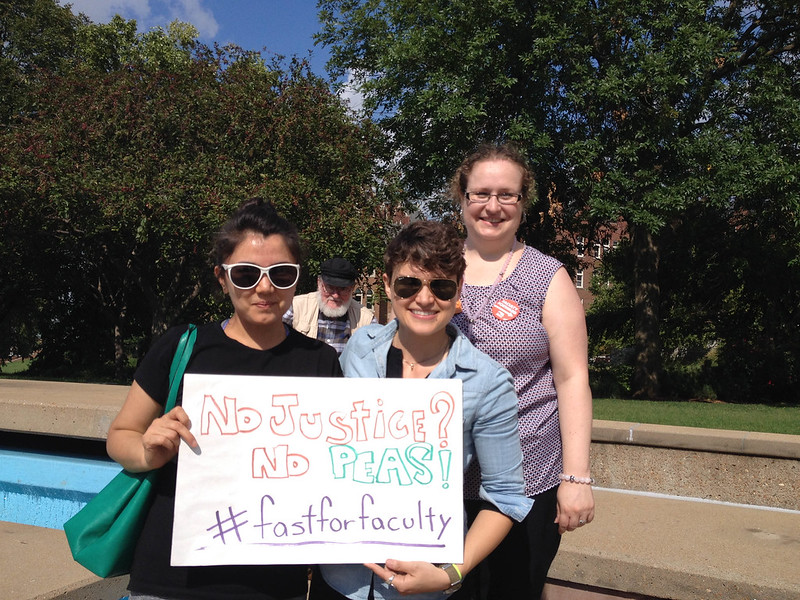
Yesterday I participated in the Adjunct Action Fast for Faculty on my campus at Saint Louis University. Here I am photo bombing some of my young friends at that event late in the afternoon.

IMG_0451.jpg

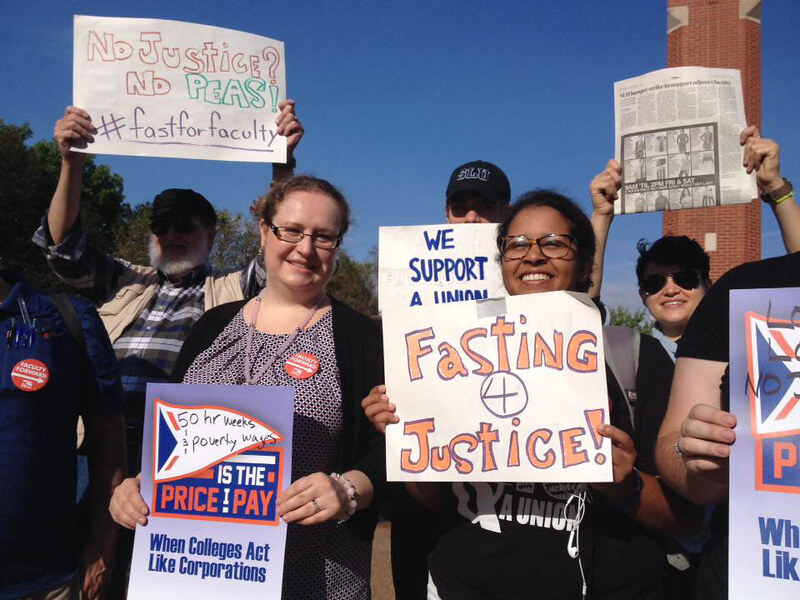
And here’s a shot of a number of us in the early morning hours. I’m in the background holding up a silly poster—good silliness, to be sure. Of course, if I had made the poster I’d have written “pease” (q. v.).

11181865_528496013983309_7428248693347719987_n.jpg

We talked to members of the university community at the clock tower and collected a respectable number of signatures from folks who were willing to support our efforts to negotiate for better wages and working conditions for adjunct faculty at the Jesuit colleges and universities. A Just Employment Policy has been in effect at Georgetown University for ten years now. We’re hoping that similar policies can be adopted throughout the Jesuit system.

We’re also hoping that Pope Francis’ visit to this country will help to energize our effort, perhaps even endorse it; and in the spirit of that hope we joined the Nuns on the Bus at the opening rally of their current bus tour, which began in St. Louis today in the shadow of the Dred Scott courthouse framed by the Gateway Arch, that iconic and problematic image the American dream. Sister Simone Campbell referenced the image in her opening remarks to the crowd in Kiener Plaza and linked it to the theme of the bus tour: “Bridging divides: transforming our politics.”

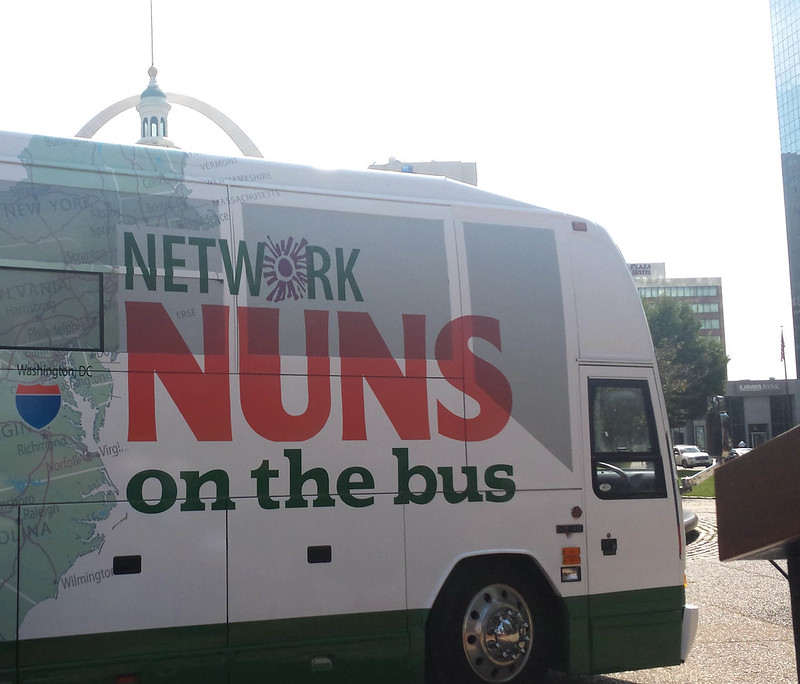
I didn’t have a camera with me at the Nuns’ event, but I did manage an inadequate cell phone photo that shows the bus parked behind the speakers’ platform and the Courthouse dome and Arch in the background.

2015-09-10 10.50.47.jpg

Fortunately, however, there are lots of good pictures of the event at the Nuns’ Network site at Flickr. There is also a good piece on NPR that summarizes the event, including my remarks, as well as providing more photos. And here’s the Nuns’ own summary on tumblr. I get quoted in it, though you have to look around to find the quotes.

I made a short speech about our effort in the Jesuit universities and afterwards recorded more remarks for the Nuns on the Bus Network archive. Then I signed the bus, along with a good many others, before returning to campus for the rest of the day. In the evening I attended another event with the Nuns at the college church. Quite a large crowd had assembled, and for an hour and a half we participated in small and large discussions about the various divides we know and what efforts we know of that are attempting to breach them. It was a heady experience, the room full of good energy, people clamoring to speak.

As I thought about it afterwards, I remembered the Truth and Reconciliation commission from the early days of the new South Africa. Like that effort, this bus tour doesn’t aim at ideological victory but rather at accommodation and community. I’m thinking that the Nuns intend to lay the takings from this long conversation of theirs, that will take them to a score of American cities, on Pope Francis’ heart in some way as he arrives in this country later this month.

the right hand of darkness

This ‘Heavy” time, which is ours, is nothing more than the long while in which nothing speaks to us . . .
—Martin Heidegger

Advent IV: One of Donne’s Holy Sonnets begins, “What if this present were the world’s last night?” It’s a thought that can be entertained without the heavy overlay of Donne’s piety. I have great respect for that piety, though there is much piety I have to admit to myself I have no grounds to respect. And this year, especially this year, I need to think past Donne’s images of the crucified Christ to ask this question: as the late year empties itself into darkness, what if the darkness proves all-encompassing?

I have no real doubt that I shall write again about the political issues that have moved me since last August, but when that time comes I think I shall face a moral emptiness that will shape my thinking in uncomfortable and strange ways, strange to me at least. That a majority of my fellow citizens apparently approve agents of their government torturing alleged enemies so darkens my moral horizon that I fear the light may never return. And adding to that concern is the growing pushback from police all over the country against the possibility of any constraint upon their behavior.

And what if there is no dimension to my question that reaches beyond this historical moment? This is not to ask what if there is nothing beyond history. That question remains unmeaningful to me. The fact that I don’t understand what I sometimes think of as the world, sometimes the cosmos, sometimes the system of the heavens, sometimes a great economy like Wendell Berry’s doesn’t mean that these metaphors signify an absence. They are rather ways of imaging something that is constantly present.

Or maybe not.

Recently, I found myself in a discussion of hiraeth, a Welsh word for a kind of ontological homesickness, at Facebook. The discussion devolved into thoughts about homeland landscapes. I didn’t contribute much because I was almost immediately cast into my own nostalgic mood, a mood whose objectifications vary, have varied, in my life; and with which I have been familiar since I was pretty young. This year, a year in which I have surprised and been surprised by the antique character of many of my habitual resorts, I not only ponder the growing darkness around me, but also search the emerging future for some source of light whose vitality I haven’t used up.

Donne will not serve. Perhaps no antique eloquence will serve. “Work for the night is coming,” says an old hymn—a night in which no one can work—thoughts attributed to Jesus in John’s gospel. But if the coming night is a moral nothingness in which work and other human actions lose all meaning, then what? What if the darkness is total? That’s the awful possibility that my country’s present flirtation with totalitarianism opens up for me. Or to put it another way around, what if the darkness of our present American history so obscures the cosmic that contains me that I become blind to it and desensitized to its mystery. Then too, at my time of life there is another concern.

I know that one day, rather sooner than later, the world will wink out and be gone from me. Advent has always asked me to look into that darkness. This year my response to facing it is a certain apprehension, partly because I am aware of being closer to it than ever before. I have no confidence in my religion’s myths of eternity. They remain metaphorical for me, ways of imaging an ontological awareness in an epistemological void. For many years, however, I have been confident of the essential goodness of life, what Reynolds Price has called the unaccountable worth of the world—but that confidence is historical. The thought of losing it is what troubles me this year.

Last night my beloved and I trimmed our Christmas tree as we have for all the years we have been together. Afterwards we sat in our living room, whose front window is always open to the street outside, with all the lights out except those on the tree. I thought that even if my confidence in the unaccountable worth of the world were to shrink to the size of this room and the small warmth of my own hearth, that would still be something. But I am more blessed than that. When I was senior warden of my church we built a new set of rooms for our growing multitude of children. It was the windows of those rooms that were broken the night my church served as a protest sanctuary not long ago.

Now those windows are being repaired, and on Christmas Eve we shall celebrate the return of light as an extended family large enough to include even my atheist beloved, who will endure joking admonitions from friends that it really wouldn’t hurt her to take communion. We are all blessed, singly and severally, and though I approach the altar alone, as I will one day approach that final darkness, a hand will be in mine that I trust will one day close my eyes.

It’s just business

When I hear somebody use the expression I’ve taken for a title, I think one of two things. Either some monstrous evil is about to be justified by appeal to the sacredness of profit, or it’s time to hold on to your wallet. I should likely leave this topic alone, since I’ve been trying not to write about political firecrackers. But there are so many things wrong with the SCOTUS Hobby Lobby decision that one hesitates to try to list them. Still, among the concatenation of fact, falsehood, and argument swirling around the decision’s aftermath a few things seem to me to be of particular importance.

It’s been known for some time that Hobby Lobby’s owners are connected with right-wing organizations whose goal is to push “a Christian agenda into American law,” as Eli Clifton has reported in Salon. Time has reported this week that the Green Family (Owners of Hobby Lobby) were recruited to act as poster children for this particular lawsuit against a portion of the Affordable Care Act. They had a family prayer meeting about the matter before they decided to act, but in the final analysis they signed their company up to front for a political action that originated with The Becket Fund for Religious Liberty.

The Becket Fund is a right-wing Washington law firm that specializes in “religious freedom” cases. To be fair, Becket has defended persons and organizations of a variety of faiths. On the other hand, the Fund has made significant recent contributions to the current trend that interprets religious freedom as a Christian license to discriminate against individuals and has been allied with others, including Hosanna-Tabor Evangelical Lutheran Church and School v. EEOC, about which I’ve written earlier, the recently enacted Arizona SB 1062 that would have provided religious exceptions to protections in federal public accommodations law and specifically permitted discrimination on the basis of sexual orientation, vetoed by Governor Jan Brewer, and now in Burwell v. Hobby Lobby.

It appears as well that the Green family’s participation in this present case was not the sincere religious matter it has been portrayed to be by media and by the Supreme Court. The Greens are heavily invested through their pension fund in pharmaceutical companies that manufacture IUDs and the specific birth control medications to which the Greens affected to object as well as drugs used to induce abortions. The story was first reported by Molly Redden in Mother Jones and has been confirmed by Rick Ungar in a piece published today in Forbes, and elsewhere.

The Greens have a perfect right to invest pension funds in whatever way they choose, as long as their investments meet their fiduciary obligations. But they do not have a right, it seems to me, to support the manufacture of the very devices and medications to which they claim a religious objection that qualifies them for an exemption from the Affordable Care Act’s employer mandate. Conservatives have rushed to defend the Greens, claiming among other things that they were not responsible for these investments, didn’t know about them, and didn’t profit from them. Ungar pretty much demolishes those arguments and sums up as follows:

You simply can’t say that you will give your all in defense of your closely held beliefs when it suits you while seeking to make money in violation of those beliefs. You also cannot pretend you were simply negligent in learning what investments you hold if you are going to hold yourself out as an example of righteousness.

These observations underscore the extent to which this lawsuit is a move in the political chess game that is being played out over the Affordable Care Act. Justice Alito admitted in his majority opinion that the SCOTUS doctrine that corporatiions are people is a fiction, but claimed it is a useful fiction designed to protect the people who own corporations from harm.

[T]he purpose of extending rights to corporations is to protect the rights of people associated with the corporation, including shareholders, officers, and employees. Protecting the free-exercise rights of closely held corporations thus protects the religious liberty of the humans who own and control them.

Whether Justice Alito was aware that he had contradicted himself here in including employees in one sentence among those protected by the “familiar legal fiction” of corporation=person and excluding them in the next I cannot judge. But the contradiction makes clear the perversity of the fiction.

There is a second perverse fiction involved in Burwell v. Hobby Lobby, and that is the fiction of sincerely held religious beliefs. The Greens’ beliefs as described in Burwell v. Hobby Lobby are at the very least problematic scientifically, but now it turns out that their sincerity is open to question as well. Women, it is claimed, may not use certain contraceptives with the Greens’ support, but it is perfectly all right for the Greens to profit from the manufacture of these same contraceptives.

To be sure, the court more or less invited the President and Congress to extend the arrangement devised for non-profits who claim a religious exception to for-profit corporations such as Hobby Lobby. I suspect that this will be done, and that the cost of covering Hobby Lobby employees for the contraceptives to which Hobby Lobby objects will ultimately be passed on to you and me. And perhaps this means can be extended to the many other corporations now in queue for the religious exception. I will be glad to pay it, but this eventuality merely invites the religious right to espouse another putatively righteous cause.

It’s tempting to dismiss this entire matter as just another example of the contemporary practice of religion as identity politics, though I have no dog in that hunt. But now that this deplorable Supreme Court decision has entered the realm of precedent it is being interpreted with some justice, as in Justice Ginsburg’s dissent but also on the right, as opening the door to all sorts of new exceptions to established law on the basis of religious scruple, which need not have a grounding in fact and may, perhaps, even be feigned. As Justice Ginsburg has wisely pointed out, the court has “ventured into a minefield,” exposing itself to the necessity of deciding perhaps thousands of supposed “religious freedom” cases ad hoc.

last Advent

So, what horizon do I look towards as Advent closes?

Perhaps not a new miraculous birth, but a couple of posts ago I wrote about some signs of the times that give me pause. Here’s one that gives me hope. Just hours ago my long-time Internet friend, Hadar Aviram, swam the length of the Sea of Galilee. I can’t even imagine swimming nine and a half hours, and Hadar is quick to point out that she did not do it all by herself, having been assisted by members of her family and friends. You can read various narratives and see some photos here.

Hadar’s swim raised funds for Beit Dror, an Israeli shelter for homeless LGBT teens. According to the shelter’s website, it is “the first and only center designed to meet the needs of out-of-home GLBT youth in Israel, and one of the few similar institutions in the world operated by governmental organizations.” Opened in 2002, Beit Dror has a modest program at present, but its goals call for expanding programs and services. Hadar’s fundraising goal was a modest $2000, which she has substantially exceeded. I want to tell another story now, but I’ll come back to this.

My calendar shows that December 29, 1957 was a Sunday. I’m thinking it must have been that evening I found myself driving back to Dallas from Waxahachie, where I had a church job. I’m sure it was late, after an evening service. I was driving my four-year-old Oldsmobile 88, a lemon for sure; I had to shift the Hydramatic manually. I had traded a beautiful De Soto coupe for it, but it had a twelve-volt electrical system, whereas the De Soto had an old-fashioned six volts, which made for dim lights at night and bad radio reception.

The Oldsmobile had bright lights and a great radio. That evening, December 29, 1957 (if that’s when it was), I was listening to Monitor, the NBC weekend radio service, as host Dave Garroway mused ironically about quirky things in between news episodes with Chet Huntley, and skits by Bob and Ray and Mike Nichols and Elaine May and other Monitor regulars. At one point, Garroway chuckled about how Americans had been down recently because the Soviets had launched Sputniks one and two and made us feel inferior, or at least a little insecure. Indeed the Soviets’ capture of the lead in the space race, a race we Americans didn’t even know we were running until we found ourselves losing it, had become a major political issue at the end of 1957. Sputnik two had carried a dog and weighed a thousand pounds. We Americans didn’t even have a Rocket capable of launching such a behemoth.

But we had launched a Santa Claus, as Garroway pointed out with a gentleness that gave the cliché some cover, who had been sighted many times orbiting the earth (or at least our part of it) just days before, as he had since time immemorial. I was twenty that year, old enough to have been stung in a bad car deal, and it still embarrasses me a little to acknowledge that for a moment I took some consolation and perhaps a bit of hope from Garroway’s sentimental ramble. We had launched Santa Claus, that particularly American myth figure, whom my Grandmother had taught me to think was the spirit of Christmas: brash, jolly, generous, full of good will, and fearless—all that and a lover of children, somehow the guarantor of the good middle-class world many of our parents in my generation had died, we thought, to preserve in the preceding decade.

The Soviets might have the better of us for a little with their beeps in the night and thousand-pound flying dog houses; they may have stolen Eastern Europe and China from the good world. But Americans knew we were not totalitarians in the depths of our hearts. We were still a long way from achieving racial and economic justice, but we had repudiated McCarthyism. Our understanding of life and the world and the social contract we had based upon it offered more of the goods of life, more liberty and prosperity than any other. It disturbed us a little that some outside our country thought of us as ugly Americans, but we wished them well as we did our best to spread the same liberty and prosperity we enjoyed around the planet. Or so we thought, some of us at least.

Why think of this now? Perhaps because I hope my fellow citizens have not lost the naïve impulse towards human good will I took from Dave Garroway on my evening road home that fifth day of Christmas so many years ago. It’s problematic, to be sure. We err in its service, as I have often erred. But it’s the best thing about us as a people. Still, if the last century taught us anything it taught us the limits of our mythology. If we are to remain major stakeholders in the evolving world we shall need a better vision of ourselves than that offered by present versions of American ambition. We ultimately won the space race, only to abandon it. Neil Armstrong’s first step on the moon proved to be somewhat less than a giant leap for all humans.

So who or what else might escape the surly bonds of earth and point the way for us towards a usable future? What present brightest and best might dawn on our darkness and lend us aid? I take present hope from young people like Hadar Aviram. You can read about her at the websites I’ve linked. I don’t know why Hadar chose the day of the winter solstice for her swim, but it seems fitting. It draws together both the adventurous and philanthropic aspects of the winter festival as it is celebrated in many traditions; for it isn’t just Christmas, or even the ancient Yule—it’s ecumenical whether we like it or not and always has been. It crosses seas and deserts. I will never ponder another Advent without thinking of this one and of Hadar’s Swim. Then too, there are profound ethical and human issues involved in the very existence of Beit Dror. You can read about some of those at the shelter’s website as well.

Finally, I’m thinking of the orchestra that Daniel Barenboim and Edward Said founded. To proclaim such things, to support such enterprises as Beit Dror and the Divan Orchestra, is to preach the gospel of peace, however one does it; though how fine a gesture to swim the Sea of Galilee! And I’m thinking of the words of Isaiah as James Jenyns fit them up for Handel’s music: How Beautiful are the feet of them . . . who cross such seas. Deer walk upon our mountains now, as the poet says. Great white bears still swim amongst the polar ice floes. And the universe rolls on into what heavens, what still unspeaking and unspoken Word to one who has seventy six winters and fewer tomorrows than he used to have? There is more in heaven and earth than is dreamt of in anyone’s philosophy.