
the doe and the angel: thoughts on the empty tomb post Easter

In the beginning I find I want to remember Paul Robeson, whose birthday occurred on April 9. Even though I’m late, I thought I’d post this little video again in honor of the occasion. It stirs up something I want to say after a relatively dry period.

Politics aside, Robeson was a great singer and a phenomenal talent in many other ways, a consensus All-American football player and eventual hall of fame inductee who played in the old NFL, a graduate of Rutgers University where he was class Valedictorian, and of Columbia law school, an international star. If you’re not familiar with his life or know of him only as a name associated with communism, you might like to read a short biography. A couple of not bad ones are here, and here.

Robeson ended his life in sad obscurity, but his reputation revived in the aftermath of the civil rights movement. Given our country’s present neofascist turn against civil rights, Robeson’s life and example, not to mention his voice, can serve as at least a small reminder of the civilized people we might have been in the united States of America and of a part of what we have now willfully thrown away.

I told the story of making this video here. It has not been unpopular, and it presently has more hits than any other performance of “Joe Hill” listed at You Tube. I think that may have as much to do with the way the song fits Robeson’s voice as with anything else. When I think of “Joe Hill” and the singers I admire who have been associated with it recently: Luke Kelly, Joan Baez, Pete Seeger, Bruce Springsteen—none has quite the eloquence or the authenticity of the Robeson performance. I think of it as I sometimes remember this, a guitar pick and a Wobbly membership card left on the step at Mother Jones’s grave some years ago when I was there.

It’s important to me that such people be remembered, now that most of our founding narratives have failed us in this country. I believe they are reminders, not of who we are, or were, but of who we might have been. This month’s issue of Orion, a magazine I can’t recommend too much, carries a lead article by Paul Kingsworth that evokes the historical trough I’ve thought about in a good many posts on this blog. Kingsworth takes up Karl Jaspers’s old idea of an axial age and suggests that we may be living in another one now, a time when all the old ways of thinking and doing are open to new and urgent questioning and the future of the experiment with life on this planet seems to hang in the balance.

But in the final analysis Kingsworth is both too optimistic and too nostalgic for me. I don’t think the old stories will save us from ourselves. For many of us the old stories only reinforce popular bigotry and the violence of extractive capitalistic practice. That is why I am coming to believe we should think of Robeson and Jones and Dr. King and perhaps even the prophets of Jasper’s axial age, Jesus and Buddha and Socrates and Mohammad, as witnesses to who and what we might have been, and reminders that we can no longer be those things in the ways we thought we could when I was young.

We shall now have an entire new overcoming ahead of us as our modern liberal societies rebarbarize. And as the planet that nourishes us becomes less and less hospitable because of our willfulness, we shall need new stories and new prophets to teach us how to live upon a ruined earth. We’re like some mythic witness of the sacrifice of Isaac. Everything in the world hangs on the moment as the knife begins to move and the the angel cries out, No! Or as Apollo rebukes Achilles in the Olympian assembly after the hero has brutalized Hector’s dead body:

Let him take care,
or, brave as he is, we gods will turn agaist him,
seeing him outrage the insensate earth!

For dust we are, Hector made of the same dirt as Adam. Martin Heidegger famously predicted that only a god could save us in this present crisis, which he more or less foresaw. But what if God doesn’t hear or comes too late or thinks we’re not worth saving? What if the angels stay home? What if Abraham had killed his son in a godless world and burned the boy’s bleeding body when nothing aside remained but his own conscience and self-loathing? The old stories push the narrative of human destiny to a limit the other side of which is nothing recognizably human and then provide an escape, the angel and the ram, the political machinations through which Achilles returns Hector’s body to his father and saves his own pride, the empty tomb.

Kingsworth argues that we are at a religious turn in history. I think I agree but don’t find much consolation in the fact, if fact it is, today. Kierkegaard argues that God injects a radical new command into an ordinary act of conventional piety in order both to suspend and to reground Abraham’s sense of the ethical. Gone is Abraham’s naive normative ethics in which his love of his son is grounded in his sense of family and community. But in exchange he gets to love his son again as the gift of God who, we are told, in another epoch sacrificed his only son, completing the figure.

It seems a cruel bargain on all sides, but it has the virtue of recognizing the cruelty that seems to run through our experience of the world from beginning to end. I’ve said elsewhere that I sometimes think the rift in nature is aboriginal. In the story of Isaac’s sacrifice, Abraham has a choice, and that too may be aboriginal. Indeed, had Abraham withheld his son, as Genesis presents the nature of his dilemma, he would have chosen as the Olympian gods finally demand of Achilles, having themselves abetted the hero’s excesses and marooned him morally.

But on Good Friday there’s no Olympian colloquy and especially no empty tomb, only this:

My God, my God, why have you forsaken me?
and are so far from my cry
and from the words of my distress?
. . . . . . . . . . . . . . . . . . . . . .
My mouth is dried out like a pot-sherd;
my tongue sticks to the roof of my mouth;
and you have laid me in the dust of the grave.

Another Orion piece this issue is called The Doe’s Song. It begins with the story of a car hitting a doe on a night road. Her leg is broken, and she will die. She frantically resists the ineffectual efforts of distraught humans to help her and runs away into the woods by the side of the road, the broken limb dangling uselessly. Human choice, especially the modern choice to inject inhuman agency into the cosmic balance of life and death and perhaps to have altered it permanently, has at at the very least introduced a radical post-Edenic cruelty into our experience of the world. The doe’s death is an accident, like a crucifixion.

Perhaps Abraham made the wrong choice. Perhaps Kierkegaard’s affirmation of it is wrong headed. Had Abraham made the choice Achilles made, perhaps a better angel would have appeared to explain to him that God desires mercy rather than sacrifice, as in Hosea where the ground of piety seems to shift. Or perhaps Abraham’s obedience is correct and the Angel a poor translator. On Good Friday the nails of crucifixion may be yet many iterations of Abraham’s knife, turned mad as the sword of Achilles and rending flesh like the giant engines that presently torture Canadian tar sands. This past Good Friday, though we may not realize it yet, we Americans have made Abraham’s choice, the knife, the nails, over the possible better angel.

That is why this story won’t save us—and one more thing. The empty tomb is not a talisman of the coming of spring. That is what Lent is, lent being the Old English word for spring. ‘Lent is come with love to town’ wrote an anonymous monk of the fourteenth century. So, the earth experiences the yearly round of renewal. I understand the poet’s need to call it love. But the empty tomb is a tallisman of another love altogether. “Only a god can save us,” Heidegger exclaimed. Human wullfulness and its devastation have so altered the normality of that first love that only a radical intervention, something like a resurrection, can put things right. This is what John Updike must have meant in a well-known Easter poem that has always given me trouble.

Make no mistake: if He rose at all
it was as His body;
if the cells’ dissolution did not reverse, the molecules
reknit, the amino acids rekindle,
the Church will fall.

Such may be taken for hope by the pious, but the conventional appropriations of the old stories by churches and the hopeful humanism of modernity represent a refusal of the judgment leveled against us by knife and nail and their modern analogues, and by the poor dangling limb of a dying doe. Some deaths in which we are implicated as modern humans did not, do not, have to be. Some cruelty, and let me hear no suggestion of collateral damage as we willfully continue to channel the horror of the twentieth century into its successor—some cruelty is but the will of humans who will be neither controlled nor reproved. Here is Updike’s conclusion.

Let us not seek to make it less monstrous,
for our own convenience, our own sense of beauty,
lest, awakened in one unthinkable hour, we are
embarrassed by the miracle,
and crushed by remonstrance.

If there is hope. If the possibility of our salvation remains in the midst of the ruin of our stories and now of our planet, that hope, that possibility will require a miracle to be achieved. The renewal of our planet and the turning of our hearts required for its enabling will not occur in the natural course of things. Hope may be real, but judgment is radical and now.

Big pig, little pig

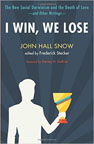
I Win, We Lose:
The New Social Darwinism and the Death of Love, and Other Writings

by John Hall Snow
edited by Frederick Stecker
229 pp., Wipf and Stock, $34

White Trash:
The 400-Year Untold History of Class in America

by Nancy Isenberg
476 pp., Viking, $28


During the years I worked at Fort Bragg I had various old cars as companions along the country roads of North Carolina. I’ve already written about my 1959 Porsche in another context. But I drove and fiddled with a Karman Ghia coupe for a while as well. The Karman Ghia had a tendency to throw fan belts, and I always carried a couple of spares with me.

One night when I was on my way home to Durham the little VW engine began to overheat. I pulled over, turned the car off, and opened the rear boot to let the engine cool a little. Then I got out some tools and sat down on the shoulder with my legs underneath the back of the car.

My head was fairly close to the edge of the boot cover, too, as I bent into the engine compartment; and that turned out to be important in a few minutes when I was startled by some strange noises coming my way from an open field just off the road. I straightened up suddenly, banged my head on the boot cover and knocked myself out.

When I awoke after what I took to be just a few minutes, I didn’t worry about what had startled me, and I was too shaken up to finish the work on my car. I locked things up, hitchhiked back to the base, took some aspirin for my headache, called home, and spent the night on a cot in my office that I kept there for just such emergencies.

The next morning early I hitchhiked back to my car. When I got there I saw that there was a small herd of medium sized hogs in what I had taken for an empty field the night before. They had been turned out to forage in the stubble of whatever crop had been harvested in that field and were still snorting around quite contentedly.

That was my introduction to the practice of turning hogs loose to forage in fields and woods. I didn’t know then but do now that the practice has a long and complex history that has been productive of culture of various kinds. It has given us songs about the Revolutionary and Civil Wars and the War of 1812, songs about cowboying, prospecting, going to Texas, being seduced by fancy men, and other profundities, in addition to providing us with lots of feral hogs. It has also given us the expression, “Root, hog, or die”—self reliance or nothing, you’re on your own old buddy—which might have meant something to me on the road back then if I had thought of it. Here’s a verse from an old song, for which I am indebted to Wikipedia.

I’m right from old Virginny wid my pocket full ob news,
I’m worth twenty shillings right square in my shoes.
It doesn’t make a bit of difference to neither you nor I
Big pig or little pig, Root, hog, or die.

The speaker would appear to be a slave, “worth twenty shillings right square in [his] shoes.” Though it dates the song 1856, the year of its first copyright, Wikipedia traces the expression “Root, hog, or die” to a time “well before 1834,” that date being the date of the publication of Davy Crocket’s Autobiography, which quotes the expression as “an old saying.”

Before he became enshrined in Texas history as one of the heroes of the Alamo, Crocket had a considerable career as a politician in Tennessee and served in the United States House of Representatives. He was a tireless defender of squatter’s rights and of the landless poor. Nancy Isenberg attributes the saying to Crocket that “It’s grit of a fellow that makes a man.”

In her new book, White Trash: The 400-year Untold History of Class In America, Isenberg also writes of the complex and racially charged history of social Darwinism among us, whose cultural roots are probably older than any songs about them. Indeed, the cluster of ideas we subsume under the social Darwinist rubric has been around in America since before we had a term for it, before Darwin’s Origin of Species (1859), and before the career of Herbert Spencer, who gave the phrase “survival of the fittest” its characteristically modern spin.

On the other hand, the Rev. John Hall Snow’s analysis of social Darwinism, as revealed in a new book edited by the Rev. Frederick Stecker, doesn’t explore its folkloric or other cultural antecedents, perhaps because Snow seems less interested in social Darwinism’s American history and more interested in the corporate consequences of the faith (after it had become a faith), particularly in its having resulted in a culture of winners and losers. Indeed the most telling and interesting sections of I Win, We Lose concern how winning came to be the American conception of “survival of the fittest.”

Fr. Stecker found the manuscript of this little book among Fr. Snow’s literary remains together with a number of unpublished sermons. Indeed, some of the most valuable parts of this book are to be found in the sermon excerpts that Fr. Stecker includes as commentary on the main text. I’ve read Fr. Snow’s other books since reading I Win, We Lose. Two of them, The Gospel in a Broken World and A Vocation to Risk specifically address issues of preaching to times of great change: the first in relation to the massive social changes wrought by the 1960s and the second in relation to late twentieth century culture, which Fr. Snow perceived to be in spiritual decline. The effects of social Darwinism and the American culture of winning are themes to which Fr. Snow returned again and again in his writing and preaching.

The importance of winning grows out of competitiveness through the introduction of an adversarial component into all human relationships, according to Snow. The chapters of Snow’s book detail the effects on education, racial justice, marriage, institutional life, and environmental ethics of a cultural paradigm that views social life in all its forms as a series of sites for competition. Winning is promoted and winners are rewarded with major or minor celebrity, money, etc. This is the meaning of success in America. Losing, normally identified with performance that falls short of accepted standards of achievement, but also with wage earning and poverty, is rewarded with shame. The social consequences have been devastating, as Snow details them. His understanding of the losses to public education brought about by the competition paradigm, which Snow alleges have “removed the last vestiges of true learning from the educational process” prefigure present day concerns about high stakes testing and the unfortunate social consequences of our so-called meritocracy, for instance.

For the culture of winning requires that most will be losers. “Winners are defined by the symbolic power of what they own as well as what and how much they consume.” And as the win/lose ethos expands into the creed of American exceptionalism it comes to require “the aggressive accumulation of natural resources, wealth, and technical-scientific information for the single purpose of denying them to the rest of the world as the guarantee of the survival of those currently self-defined as the most fit, namely the richest and most powerful.” Acceptance of this view and the corollary views it requires in contemporary American life puts Christians in a particularly difficult position, because “No vision of reality could be more in conflict with what Christians believe,” according to Fr. Snow. Yet American Christians have defended slavery, Indian removal, the destruction of Appalachia and other environmental devastation by extractive industry, as well as the pervasive growth of destructive technologies the world over, as beneficial and necessary to the survival of “the most comfortable, elegant, liberated life-style in the history of the world . . . .”

Professor Isenberg has other fish to fry. She traces the history of American scapegoating of the poor and the persistence of destructive class-consciousness in America to English colonial policy and practice. Our former British rulers viewed their North American colonies not merely as a source of wealth but also as a dumping ground for human trash, for the hordes of landless paupers, “vagrants, idlers, highwaymen, Irish rebels, known whores and convicts” that filled England (particularly English cities) with what the better classes termed human rubbish. It was settled British colonial policy to transport these persons to the new world for centuries, a fact amply illustrated by the history of Jamestown as Isenberg tells the story. After 1776 the newly constituted United States adopted and extended this policy through the various stages of continental expansion. But far from being valued as pioneers and settlers, the landless poor remained objects of scorn, in some cases more scorned than people of color, described as sallow, diseased, and malformed, an inferior breed of human beings.

It is a widespread conviction that Jefferson’s ringing affirmation of human equality at the opening of the Declaration of Independence entitles Americans to believe that we have created a society without invidious class distinctions. But that belief is everywhere deconstructed by the actions of Americans past and present. We tend to perceive and address the cognitive dissonances entailed by the belief by reference to the category of race in our present-day life and to erase other manifestations both from our perception of and discourse about inequality; yet we have never successfully discriminated between the natural inequalities that abound in our experience of one another and forced or artificial inequalities that are social constructions. This blurring has contributed to our history of demagogic exploitation of inequality for political purposes. Professor Isenberg provides a wealth of examples of the political exploitation of inequality from colonial times to the present in a thick social history that lends substance to Fr. Snow’s argument. Just as race has marked many as socially inferior in our history, so extreme poverty has marked others as deserving of exclusion from the goods obtained through our social contract. Historically, those identified as white trash have been regarded as naturally inferior to their more affluent betters, along with people of color, especially in the South, and their putative natural inferiority has a long history of association with partisan attempts to exclude them permanently from society’s benefits. In its most extreme form, the belief in the natural inferiority of some humans has resembled fascism in all but name.

I owe recognition of the relevance of one of his sermons to our own historical moment to Fr. Snow’s daughter, Lydia Field Snow, who called attention to it in a recent Facebook post. I quote only part of the passage to which she refers.

The precise situation that creates fascism is where society is demoralized, where the conscientious are paralyzed with guilt and leadership believes that it is no longer accountable to anyone, where social disorder is everywhere and that this disorder is everywhere met with more police using more force. It occurs when the law is set aside in the name of order and humans find that the fear, the tension, the chaos, and the guilt become unbearable. It is at that moment when the human spirit is tempted to say suddenly, No! Wrong is right, evil is good, ugliness is beauty, repression is true freedom, and the important thing is to be on the side of the strong. This is nature’s law—the weak, the stupid, the ugly, all those people who are not like me are destined to be destroyed, they are a drag on us, the truly strong. We’ve wasted enough time on them—let’s get it over with—why put up with their nonsense?”

There was a time when I didn’t believe the Republican Party really wanted to destroy the social contract. That was then, before they paraded a collection of proto fascists through a series of elections that ended up requiring all those who survived to pledge ever more stringent scenarios of social harm and that produced a final round of so-called rallies that fostered a lynch-mob ethos. Faced with the recent consequences of that ethos, we shall hardly need the renewed rallies to sustain the country’s angry mood. Our President ran for office in the familiar role of outsider, attacking government as ‘the problem’ in the tradition of Ronald Reagan. But his authoritarian approach to governing promises a police state, and as it develops it isn’t hard to predict a time when his régime will declare itself free of all obligation to ordinary human decency and give itself carte blanche to complete destruction of the social contract. And one further thing is clear. His appeal is deeply rooted in the American culture of winning. Here’s the President speaking to that point.

You’re going to be so proud of your president if I get in—and I don’t care about that—we’re going to start winning again, we’re going to win so much, we’re going to win at every level, we’re going to win economically, we’re going to win with the economy, we’re going to win with military . . . we’re going to win with every single facet, we’re going to win so much you may even get tired of winning, and you’ll say, “Please! Please! It’s too much winning! We can’t take it anymore! Mr. President! It’s too much!” And I’ll say, ˜No it isn’t! We have to keep winning! We have to win more! We’re going to win more! We’re going to win so much!

There’s some cognitive dissonance between the spectacle of Americans winning on such a scale and the destruction of the social contract that the Republican hard core desires, but winning in the presidential rallies was and is imaged as Fr. Snow described it: We need not concern ourselves with “the weak, the stupid, the ugly, all those people who are not like [us].” As the Republican program unfolds, particularly as the Affordable Care Act is repealed and great numbers of citizens lose access to health care while the middle class and the wealthy are given substantial tax breaks, it will become clear that Republican scapegoating doesn’t stop with Muslims and other immigrants but targets the poor as a social class as well. As Representative Roger Marshall (R—Kansas) put it in a recent interview: “Just like Jesus said, ‘The poor will always be with us,’ . . . There is a group of people that just don’t want health care and aren’t going to take care of themselves . . . .”

Advent IV: How Unto Bethlehem

Seek we a king, and honor
bear him from afar . . .

Another last Advent, and I stayed home again. The night before the streets iced up, and a frigid south wind swept down them like wrath with darkness in its wake, chasing the cold moonlight towards another winter solstice. I thought of the famous passage from Lancelot Andrewes’ 1622 Christmas sermon:

. . . just the worst time of the year to take a journey, and specially a long journey. The ways deep, the weather sharp, the days short, the sun farthest off, in solsitio brumali, the very dead of winter . . .

Andrewes spoke here of the Magi, those legendary kings from the east whose powerful appearance in the Christmas story we celebrate during Epiphany; he might have spoken as well of the holy family and their lonely journey to Bethlehem as the story has come down to us. But yesterday’s gospel lesson comes from Matthew “Now the birth of Jesus Christ was on this wise . . .” (I like to quote the KJV because its periods are lodged in my memory.)

And you may remember that Matthew’s gospel opens with a series of “begats” proclaiming the lineage of Jesus the Messiah, an interesting passage to say the least in that it gives Jesus a political lineage stemming from King David and Father Abraham, but an ontological lineage stemming from the Holy Ghost. Then into the middle of his account, Matthew inserts a further claim:

Now all this was done, that it might be fulfilled which was spoken of the Lord by the prophet, saying, “Behold, a virgin shall be with child, and shall bring forth a son, and they shall call his name Emmanuel, which being interpreted is, God with us.”

Jennens and Handel quote the prophecy’s source in Isaiah, “Behold, a virgin shall conceive,” which I always hear in the background; and that mental hearing reminds me that Messiah is both liturgical and biblical, both a rehearsal of the liturgical year and an epitome of Christian salvation history. Behind the two is one tradition whose typology was perhaps first articulated by St. Augustine: “The New Testament lies hidden in the Old, and the Old Testament is unveiled in the New.” And perhaps the best known general explanation of the working out of the typologies of scripture is Eric Auerbach’s:

Under the term figura—defined in the essay of that title (1938) and developed in the opening chapters of Mimesis Auerbach defined a view of reality, at work in Christian thought and biblical narrative, whereby one historical personage or event prefigures or signifies a second, later one. The latter will, effectively, fulfill the former such that while the two remain distinct historical realities, their full significance is to be sought in the figural relationship between them. Developing this concept from the hermeneutics of St. Augustine and the exegetics of the fathers, Auerbach deploys it most effectively, and with the greatest subsequent critical impact, in his reading of Dante. (Seth Lerer, article on Auerbach in The Johns Hopkins Guide to Literary Theory and Criticism [2005]).

Auerbach terms this relationship a process of ‘completing the figure,’ and if Augustine stands somewhere near its beginning (though one can find traces of the same logic in the writings of St. Paul—“for as in Adam all die, even so in Christ shall all be made alive”), St. Thomas stands at one terminus—“Types and shadows have their ending, for the newer rite is here,” that is the Eucharist, not a memorial as Thomas understood it but the true body of Christ. (Aquinas’ great hymns to the Eucharist may be found in many hymnals.)

I must have been very young, third grade at most, when I was taken to a Christmas concert at Albuquerque High School. It featured the high school choir, whose performance of “Unto Us A Child Is Born” from Messiah was my first introduction to Handel’s masterpiece via live performance. I think I had been introduced to some recordings at school and knew the story of the King’s standing for the Hallelujah chorus. But “Unto Us a Child” in the same room with me, with live human voices, was an amazement (though the voices must have been young, and the performance surely must have lacked the panoply of Handel’s orchestration). I have never forgotten the experience. I left that concert with those great choral phrases filling my mind—“And the government, the government, shall be upon his shoulder!” Even at that age I recognized a high serious metaphor for what it was, though I couldn’t have articulated what was a felt thought that was mostly feeling. It is recorded now in my memory along with a performance of “Comfort Ye, My People” by a young tenor about whom I have written before, though I can’t locate the place right now. From there my Messiah experience joins with a veritable river of rehearsals and performances of parts and the whole. In the summer of 1956 I sang the Hallelujah chorus so many times (almost every day all summer) as one of the first group of Lake Junaluska singers (whose future seems to be in jeopardy), that I was burnt out for a while on that great work. To this day I resist certain ceremonial Messiah gestures but love the whole. Some years back I learned Handel’s refiguring of the refiner’s fire aria for bass, the original (which I had sung forever) having been rewritten by Handel for the celebrated castrato, Gaetano Guadagni. These experiences, and many like them, so many, give me a stake in the mythology of the Christmas story. I’m there to reenact it on Christmas eve, during the twelve days and Epiphany, all through the pensive time of Advent. I’m there, but there’s more.

For me this Advent IV, these multiple empressions, memories, intertextualities, have about them what Professor Tolkien has termed “the ‘inner consistency of reality.'”

There is no tale ever told that men would rather find was true, and none which so many sceptical men have accepted as true on its own merits. For the Art of it has the supremely convincing tone of Primary Art, that is, of Creation. To reject it leads either to sadness or to wrath

It is not difficult to imagine the peculiar excitement and joy that one would feel, if any specially beautiful fairy-story were found to be primarily true, its narrative to be history, without thereby necessarily losing the mythical or allegorical significance that it had possessed. . . . But this story is supreme; and it is true. Art has been verified. God is the Lord, of angels, and of men—and of elves. Legend and History have met and fused (On Fairy Stories).

For me, as (I think) for Professor Tolkien, the issue of the naive truth of the Christmas story, so important for some, simply doesn’t exist, allowances being made for the fact that Professor Tolkien is dead and can’t defend himself. We moderns have invented a standard of truth of which the ages before the Enlightenment knew nothing. For Matthew, the truth of the Christmas story is referred to biblical prophecy. For Augustine and Aquinas, the same truth is referred to the beauty and coherence of the body of the faith.

It is the mythical and allegorical significances of the story of the birth of Christ that give the tale its character of primary truth, as Tolkien reads it, and it is these mythical and allegorical significances that resonate down through the centuries in the encyclopedia of tropes that surround us here as Advent draws to a close, the shepherds, the babe in the manger, the angels’ song:

Such musick as ’tis said
Before was never made
  But when of old the sons of morning sung, . . .

“Unto us a Child is born,” will always be true.

Advent III: rocked by the Infinite

Gaudete in Domino semper: iterum dico, gaudete.

Rejoice in the Lord alway, and again I say, rejoice

The wilderness and the solitary place shall be glad . . . ; and the desert shall rejoice and blossom as the rose.

Advent customs vary. In my parish church we have honored the third Sunday in Advent as Gaudete Sunday for many years, though this year we gave the theme of rejoicing no special emphasis, and we kept to violet colors except for a rose candle in our advent wreath. Just as well—I’m having a solemn advent too this year. As St. Paul instructs, I rejoice alway, liking the locution from the KJV—and I like it that Gaudete Sunday connects me with centuries of of catholic practice.

Do you love the world? I do. To be a Christian humanist, as I am, is to love the world and one’s fellow creatures as the gift of God. As the old hymn says, “All the world is God’s own field.” I’ve just been rereading a poem I love by Stanley Kunitz. It’s called “The Long Boat.” You can find it here. I first found “The Long Boat” on the wall by the elevator at Prairie Lights in Iowa City. It was first published as a broadside, a little larger than ‘double folio’ size. Framed, it is larger still. I initially thought it was a Prairie Lights broadside, but it was published by Norton in 1995. Reading it for the first time was a religious experience. I have passed it many times since, reread it, rather like touching a mezuzah. We don’t see God, but sometimes we know that we’ve been seen, known perhaps—the knowledge and its memory remain fearful and joyous at the same time.

And maybe one has to be almost eighty, as I am, to understand how one can rejoice in being reminded so of one’s love of the world as one anticipates leaving it. It has not been meny years since a student asked, ‘If we’re not rational actors who are supposed to maximize our utility, what are we?’ I gave him an answer he may not have expected, ‘How about creatures made in the image of God?’ I asked him later in the conversation if he thought economics provided a total explanatiion of the world and our human place in it. His reply was, ‘No, but I wish it did.’ I think his point may have been that our human choices might be simpler for us if economics taught us all we need to know.

A small digression: I have to say that I loved this student and thought highly of him as well. I’d never have asked him such a question otherwise. But we were in a Jesuit classroom after all, and besides, there are times when one is given a large teaching moment. I seized that one, and of course I didn’t press for a defense of, I wish I did. He already knew what he meant, and his classmates knew as well. It was a thing for them to ponder in their hearts. What occasioned the conversation was Wendell Berry’s essay, “The Two Economies,” which opens with Wes Jackson’s claim that only the Kingdom of God is a truly comprehensive economy.

The last lines of Stanley Kunitz’s poem land me square in the middle of the Kingdom of God for the same reason that Wes Jackson evoked it in the conversation that Berry reports. When I think that I love the world so much that I don’t want to leave it I’m not expressing a triviality. When Socrates gets to a point like this in Plato’s dialogues, he too resorts to myth making, as does Jesus. I love the the anglo-saxon word for parable; It is bigspell, a distant cognate I like to think, to German Beispiel, meaning “example.” I love the homeliness of it, the use of the soft power of storytelling when argument reaches the end of its tether.

As the writer of Hebrews says, we may not see the world brought into subjection to us—indeed it will never answer to our wishes—but we see Jesus. Orthodox Christians make a gesture of respect at the mention of the incarnation in the creeds and in the eucharistic prayer. This is the part to which the writer of Hebrews alludes when he describes Jesus as having been made “a Little lower than the angels.” Whatever may be true about worlds beyond this one, it has always seemed to me that a substantial part of Jesus’ mission was to reprove a particular sort of worldliness in the here and now, the very sort to which the writer of Hebrews alludes when he admits we do not see the world at our feet. Indeed, the world addressed by the writer of Hebrews was a terrible place, full of violence and grevious injustice, ruled by petty tyrants and an emperor who aspired to be a god. But in the midst of that terrible politics, Jesus advised those who listened to him that they feed the hungry, clothe the naked, heal the sick—following his example, another use of soft power.

As I’m finishing this, Gaudete Sunday has passed. I’ve had an opportunity to rejoice in the Lord, albeit to do it slant, as Emily Dickinson said we poets should tell the truth. I am resolved again to cease striving to subdue the world, but rather to live within it as a brother to the sun and moon, as St. Francis put it. I am disheartened by the election of Donald Trump, but I do not share the hope of fellow Democrats that Trump can be denied the presidency by the electoral college—nor should he be. The Trump presidency is what our political system has given us in this historical moment. Our response as Christians who disagree should be to continue our work for social and economic justice using all means of soft power at our disposal and to undertake a work of persuasion that will seek to restore good will in a society that has for the present, at least, by intention or default: embraced neo-fascism.