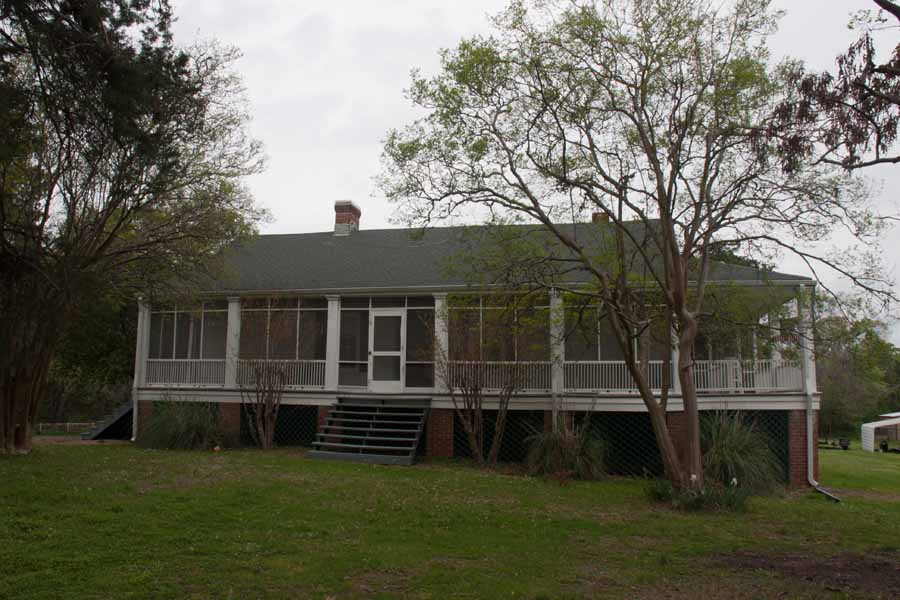
 Recently I was sent a collection of family photographs. Among them is this snapshot taken outside the farmhouse in Las Cruces, New Mexico, where my father and his brothers and sister did much of their growing up. My father is the tall one in the middle with his hands on my grandmother’s shoulders. Her youthful appearance startles me. The elderly woman on the far left is my great grandmother, Melissa Peterson. The farm in Las Cruces was a homestead. Only my uncle Bill (standing just behind Mrs. Peterson and my aunt Frances) was born there. My father, his brother Randolph (the one with the silk handkerchief in his pocket), and his sister were born at an earlier homestead near Sayre, Oklahoma. There’s no date on this photo, but I think it was taken in 1930 or ’31. The subjects seem to be dressed in their best, on their way somewhere.
Except for my father they would all live long lives. Mrs. Peterson lived to be 82; my grandmother and two of her children would live almost a century, reaching the age of 99. Uncle Randolph, the eldest of my grandmother’s children, would live to be 94. And except for Mrs. Peterson they would all find themselves far away from Las Cruces at the end of their lives, most of their experience shaped largely by their country’s mid-century adventures in the far east. All of my grandmother’s children went to college. As I look at these images of them, see the hardscrabble under their feet and the house with its look of temporariness, I am thinking how remarkable that is.
I’ll not tell all I know of their stories now. My father and my uncle Bill were already in medical school, I think; uncle Randolph on his way up the corporate ladder in what would become AT&T. My aunt Frances would marry a man who became a Brigadier and travel widely. My grandmother, once her children were launched, would travel widely as well, living in Honolulu for a while and finally settling in Seattle. But the various fulfillments of these separate destinies were long ahead of them all in 1930—what strikes me in this photo is the seeming anticipation in their demeanor, and a certain innocence.
My title is borrowed from a poem of Robert Frost’s that anticipates the end of a long life as a time of certainty. The poem’s speaker imagines that friends he left behind, should they catch him up at the end of life’s journey, would discover him to be not “changed from him they knew— / Only more sure of all [he] thought was true.” These are the thoughts of a young man, part of Frost’s first book, A Boy’s Will, published when the poet was thirty-eight years old. At this distance they seem a recipe for closed mindedness.
• • •
I recalled the lines from Frost as I was thinking about some lines from a much longer ago dead poet, Henry Howard, Earl of Surrey:
Martial, the things that do attain
The happy life, be these, I finde.
The richessse left, not got with pain:
The frutefull ground, the quiet minde:
After I factor out the mindset of the landed aristocrat, there remains in this translation of Surrey’s the still attractive classical ideal of the quiet mind; though Surrey’s own mind was less than likely to be quiet. Like Martial he lived in turbulent times. He led a dangerous life as a Catholic in the twilight of Henry VIII’s reign and was ultimately executed as a traitor. He was perhaps 30 years old when he died.
But the ideal of the quiet mind need not be thought youthful, nor need it presuppose certainty. It is a stoic ideal, conceived as a response to uncertainty and frustration, a consciousness that seeks its own in the midst of political and other stresses; and it’s sometimes held up as a goal of liberal education, a mind both copious and quiet, “liberally furnished with objects of contemplation,” to paraphrase Dr. Johnson, another latter day stoic, who between herculean labor and coping with Tourette’s syndrome and other afflictions, had plenty of mental noise in his life.
I’ve just finished a week’s reading that included, in addition to various consumables (by which I mean newspapers, blogs, media, etc.), John Gardner’s Grendel, which my class discussed last week, S. C. Gwynne’s Empire of the Summer Moon, a popular meditation on the the winding down of the Indian wars in the southwest (yet another retelling of the story of Cynthia Ann Parker, the exploits of her son, Quannah, and the capitulation of the People), and Wendell Berry’s Home Economics.
I turned to Gwynne on the recommendation of friends I encountered in my home town of Abilene, Texas where I recently attended the 57th reunion of my high-school graduating class and was struck by the realization that my grandparents had arrived in western Oklahoma around 1901 in the aftermath of the turbulent events Gwynne’s narrative brings to mind. From Gardner I took away (again—I’ve read Grendel many times now) what seems the quite reasonable claim that Whitehead was right to assign the name of God to that which limits action and energy and therefore calls forth “the entire multiplicity of eternal objects.”
And I turned again to Berry because I am trying to formulate for myself a rationale for the liberal arts in contemporary university education. I’ve previously written about Berry’s essay, “The Loss of the University.” But now I’m more interested in his thoughts on sustainability and his claim that community has economic value, because it seems to me that whatever case we make for the liberal arts in our day has got to take into account the material conditions required for their study and the material benefits of the same. If we can’t make the case that the liberal arts have practical, economic value, it is hard to argue that they have cultural or spiritual value. As Berry puts it with respect to community, “Can there be a harvest festival where there is no harvest?”
• • •
Two years ago I asked my class to read Alasdair MacIntyre’s After Virtue. It’s a beautiful book, though I don’t agree with much of it, including its core argument. MacIntyre says, in a preface to the third edition, that he was not yet a Thomist at the time he wrote the book (1981); but what I think I loved about After Virtue when I first read it in the mid-eighties was its insistance on the importance of a conception of human nature. Without such a conception (and I like Aristotle and Thomas about this too) the Enlightenment notions of liberty and equality are pretty empty. Something more is required, it seems to me, as a ground for these notions than the naked assertion of self-interest—some notion of human good, potential or real, immediate or lost. Adam Smith, often cited as the godfather of neoliberal economics, believed in a moral sentiment, physically present in human being.
The enlightenment tradition has tended to emphasize private judgment, private enterprise, etc., as opposed to centralized coordination. This was liberating in the eighteenth century, when people could still be put to death for witchcraft. Now, when “The notion that every action is is both a private experience and a a public utility,” as Whitehead says, has all but died out, individual beliefs and practices tend to be asserted as near absolute private entitlements. We see this on both sides of the political spectrum, but it has particularly emerged recently in the argument against government mandated health care. Obamacare, so called, infringes on my right of self-determination. Government, so we are told, has no right to tell me, as a sovereign individual, that I have to purchase health insurance. It’s the old seat-belt argument.
Here is Aquinas’s fifth proof of God, the one I like the best:
The fifth way is taken from the governance of the world. We see that things which lack intelligence, such as natural bodies, act for an end, and this is evident from their acting always, or nearly always, in the same way, so as to obtain the best result. Hence it is plain that not fortuitously, but designedly, do they achieve their end. Now whatever lacks intelligence cannot move towards an end, unless it be directed by some being endowed with knowledge and intelligence; as the arrow is shot to its mark by the archer. Therefore some intelligent being exists by whom all natural things are directed to their end; and this being we call God.
I don’t like this because I think it succeeds as a proof. Its conclusion in no way follows from its premises. As an argument, it’s an exercise in question begging. But it’s beautiful, and beauty is truth in a way; though Keats claimed too much for the idea.
Still, my point here is that without such a conception of intelligence grounded in the material stuff of the world, the enlightenment conceptions of liberty and equality degenerate into empty assertions of individual autonomy that are easily transformed into the right to bear arms, the right not to purchase health insurance, the right not to wear a seat belt, etc. And politics aside, without such a conception the fundamental issues of ethics and aesthetics degenerate into cost benefit analysis that deserves comparison with the excesses of medieval scholasticism, or into empty claims about the timeless worth of things that we know only as inferences and extrapolations.
• • •
At this point in my life I am more uncertain than I have ever been about the things I hold dear, though I am pretty comfortable in my skin. I tend to think that certainty, not uncertainty, is the enemy of life. None of us knows when he will die–that’s the fundamental uncertainty–and I don’t need to be certain about the ideas that I use, because my practice constantly confirms their usefulness. Unlike MacIntyre I embrace and celebrate democratic pluralism. To be sure, it gives us Sarah Palin and the gun toting folks in Arizona and elsewhere. But it also gives us what I identify, following Richard Rorty, as liberal hope.
Uncertainty seems basic to the hope for a better world. An uncertain person, such as I am, tends to embrace bounded ambition in regard to the potential for historical accomplishment, or social progress. But the person who seeks certainty seeks an establishment, a city on a hill, the end of history. I think history and the end of history both abide in the moment, and I am content with that. I embrace the long tradition of uncertainty in Christian mysticism. (See, for instance, “The Cloud of Unknowing.”) Rather than doctrine, I embrace prayer. I find common prayer particularly efficacious, though I have no belief in, or knowledge of, a personal god.
I am not uncomfortable with any of this, perhaps because I am a poet and grounded in poetry. I read, for instance, the ending of “Little Gidding,” as it draws together the poet’s personal quest with Dante and Julian of Norwich, as a method of being. Here are the lines:
We shall not cease from exploration
And the end of all our exploring
Will be to arrive where we started
And know the place for the first time.
Through the unknown, unremembered gate
When the last of earth left to discover
Is that which was the beginning;
At the source of the longest river
The voice of the hidden waterfall
And the children in the apple-tree
Not known, because not looked for
But heard, half-heard, in the stillness
Between two waves of the sea.
Quick now, here, now, always?
A condition of complete simplicity
(Costing not less than everything)
And all shall be well and
All manner of thing shall be well . . .
And I think of truth as but one of the conditions of thoughts that one loves. The difficulty of Truth and Truth establishments is that they drive truth (small t) out of the room. In this regard I am remembering something from Hannah Arendt, in one of her letters to Mary McCarthy, “The chief fallacy is to believe that Truth is a result which comes at the end of a thought-process. Truth, on the contrary, is always the beginning of thought; thinking is always result-less. That is the difference between ‘philosophy’ and science. Science has results, philosophy never. Thinking starts after an experience of truth has struck home, so to speak. . . .”
I’ve learned a lot from MacIntyre, even though I don’t agree with him about much. I particularly don’t agree that Aristotle needs vindication. Aristotle remains with us, as Plato does, perfectly available to the next thinker who might wish to use him as Aquinas used him, just as the Homeric poems remain available to poets. I’m not entirely sure of this, but I think MacIntyre’s use of Aristotle may be perverse. It’s not an adventurous use in any case, as Whitehead’s use of Plato is adventurous, for instance.
“In my end is my beginning.” All my grandmother’s children went to college. I loved college so much that I’ve never wanted to leave. Though I’ve knocked around a bit and seen a bit of the world, I remain primarily a mental traveler, like Joyce Cary’s “randipole Billy Blake,” perhaps not unlike my grandmother’s children, too—on my way somewhere unknown, unknowing.