
and it’s tempting too

to comment on the dust-up going on in St. Louis about SLU’s new multi-million-dollar basketball coach, Rick Majerus, and Catholic Archbishop Raymond Burke. The Post-Dispatch has reviewed (and commented on) the story today. And the Post’s quotations from the SLU Faculty Handbook are telling, as are comments by President Biondi, Provost Weixlmann, and various board members who have been interviewed.

Burke is widely regarded as a fascist and a bully here in the gateway to the west, and not just by protestants. His boast that he would deny communion to John Kerry during the 2004 election got him brief national exposure, and he seems to have been looking for more ever since: publicly forcing a Missouri Catholic school to rescind its invitation to Senator Claire McCaskill to speak at her daughter’s commencement because of her views about women’s reproductive rights, attempting on similar grounds to shut down a popular local fundraiser because it featured Cheryl Crow and Billy Crystal, turning the screws on the dissenting Polish congregation at St. Stanislaus church for exercising its legal right to hold on to its property and assets, excommunicating two local Catholic women, who allowed themselves to be ordained priests, and threatening the Jewish congregation that gave them “sanctuary” when local Christian spaces were closed to them.

Burke is a piece of work, but he is much praised around the Catholic blogosphere. The full extent to which Burke and his boss, the former Cardinal Ratzinger, espouse a reactionary social (and geopolitical) agenda ad majorem dei gloriam may perhaps be seen here. If the notion of human family seems innocuous, one might remind oneself that the devil is in the details. Here, not only does the Vatican wrench the discourse of world peace into a reactionary defense of hierarchical family values, but it also yokes the conception of world peace to a retrograde ideological position on the science of global warming.

In this regard I’m also thinking of the Vatican’s recent defense of its suppression of Galileo. There was an interesting discussion of this history at Entangled States a while back. My view pretty much jibes with that of the commentator who remarked that, “the problem wasn’t what Galileo said or thought. The problem was that the Church had the power to punish him for what he said and thought – and that it did. Nobody would care about this incident otherwise.”

And nobody would care about the present dust-up in St. Louis if Majerus weren’t a high profile sports figure. That’s why SLU is defending him, as Bill McClellan implied in a recent column. And sports columnist Brian Burwell carries that general view even further. After recalling Arthur Ashe and other morally heroic sports figures, Burwell defends Majerus thus hopefully: “Imagine the power and influence that many of today’s athletes could carry if they chose to spend as much energy in social and political movements as they invest in shilling sneakers and energy drinks.”
a perfect little play for the start of a new century

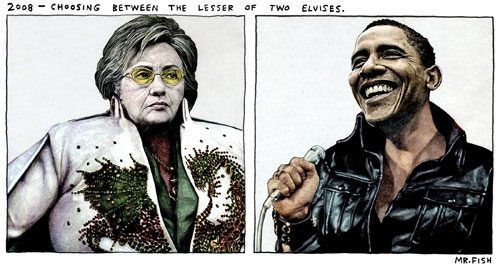
Since I always need to have my own seriousness deconstructed, I was delighted to find this cartoon at truthdig this morning, celebrity being what it is. Mr. Fish has in effect sent up both my reaction to the viral spread of yesterday’s Obama celebrity video and the video itself.

Here’s another celebrity, deconstructed in the act of studying us humans. One of the things that make writing this blog fun (aside from the fact that people do occasionally read it) is the opportunity it gives me to discover new blogs as I read the ones I know and branch out.

Apropos of deconstructing celebrity, I stole the title of this piece from a review by Kathryn Osenlund of a recent play by Steve Martin. Here’s a sample deconstruction in the speech of one of Martin’s characters.

I was walking down the street one afternoon and I turned up the stairs into my flat and I looked back and he was there, framed in the doorway, looking up at me. I couldn’t see his face, because the light came in from behind him and he was in shadow, and he said, “I am Picasso.” And I said, “Well, so what?” And then he said he wasn’t sure yet, but he thinks that it means something in the future to be Picasso. He said that occasionally there is a Picasso, and he happens to be him.

Elvis turns out in the course of Martin’s play to be a third transformative figure of the twentieth century along with Picasso and Einstein, neither of whom understands the other (or himself) very well. So . . . the great Elvis moves through space/time like god reading the dictionary, trying on various incarnations without necessarily understanding any of them. It makes sense. I’ll be sure to remember later today when I cast my vote for Barack, for whom I cheered myself hoarse as Ted Kennedy downtown two nights ago.

PubDef, etc.

I just discovered PubDef today, Antonio French’s St. Louis political blog. It’s a great read, especially if one were, as I was, looking for the latest presidential polling information summarized. It looks as if my man Obama is, as he says sometimes, doing pretty good.

Last Saturday my beloved and I braved the cold and lateness, important things to a geezer like me, and made a trip downtown to see him at 9:00 pm at the Edward Jones Dome, where the line to get in was wrapped around three sides of the stadium as we arrived. We got inside fairly fast, though. And we had the good fortune to pass the time standing in line with a young couple who had driven up from Oklahoma for the event with their two small daughters.

The crowd was large, 22,500 by some estimates, more than the Rams draw these days, a diverse mixture of ethnic, social, and age groups. Before the speeches we got to watch the Harris-Stowe University drumline perform. It was especially gratifying to me to see as many young and very young folks among the spectators as I did–and then on the way home on the train to see even more.

Obama didn’t make his best speech that evening; he was tired and talked too long, I thought. But it was fascinating to hear the talk about the speech amongst the younger folks around us on the train afterwards. They all thought the speech was fine and loved the rhetorical flourishes. The talk reminded me how he was interrupted from time to time during the speech spontaneously, not in a call and response sequence. Once another elderly gent near me hollered, “God bless you, Barack!” from the back of the crowd.

We thought it remarkable that Obama was able to draw such a large crowd with what seemed to us to have been very little advance publicity, and almost no advance coverage in the mainstream media. Apropos of that, Laura McKenna at IID put me on to this video, with which I’ll end this post. It’s long, but you don’t have to watch it all to get the sense. She has it from Crooked Timber, where Eszter’s comments are as interesting as the video itself. Take a look here, if you’re interested. And here’s the video, if you’d like to watch all, or part, of it.

tit for tat

Today’s Washington Post editorial, “Race in the Race: Stop the distortions and the innuendo” contains some distortions and innuendo of its own. I’m amazed. Here’s just one paragraph:

Supporters of Sen. Barack Obama (D-Ill.) have taken remarks of Sen. Hillary Rodham Clinton (D-N.Y.) and former president Bill Clinton out of context and then unfairly criticized them for what they did not say. Mr. Clinton was accused of belittling Mr. Obama’s career or campaign as a “fairy tale.” But the “fairy tale” Mr. Clinton was referring to had to do with the much narrower issue of Mr. Obama’s opposition to the Iraq war; the former president was bemoaning what he saw as a lack of attention to Mr. Obama’s — again, in Mr. Clinton’s view — inconsistent stances on the war.

To suggest that Mr. Clinton didn’t know that his “fairy tale” remark would be taken to refer to Mr. Obama’s career as a whole is naive. The Clinton campaign has embarked on three negative strategies, it seems to me. These are:

    1) To belittle Obama’s career and accomplishments, a pervasive Clinton campaign theme and a corollary of Clinton’s claim that she alone is qualified to be president. Bill Clinton’s “fairy tale” characterization has been fairly taken as an expression of this theme, though it was couched so as to give Mr. Clinton plausible deniability.
    2) To undermine the credibility of Obama’s criticism of the Iraq war. This is the text of Bill Clinton’s “fairy tale” characterization — belittling Obama’s career is the subtext.
    3) To belittle Obama’s skill as an orator. Here, apparently the Post agrees with the Clintons, suggesting that “Mr. Obama [likens] his oratory and vision to that of President John F. Kennedy and the Rev. Martin Luther King Jr., but (following the Clinton theme) that “presidents Kennedy and Lyndon B. Johnson, as well as King, all had to do much more than orate to accomplish their goals.”

Of course, Obama has never likened his oratory and vision to Dr. King’s or President Kennedy’s. He has cited Dr. King and President Kennedy, something quite different. For a political opponent to blur that difference is one thing; for the editorial writers at the Post to do so is another. Now, a Clinton surrogate has said of Obama that he is no Martin Luther King — and the Post editorial quotes without irony or criticism, what Clinton said on “Meet the Press” two days ago:

Dr. King didn’t just give speeches. He marched, he organized, he protested, he was gassed, he was beaten, he was jailed. He understood that he had to move the political process and bring in those who were in political power, and he campaigned for political leaders, including Lyndon Johnson, because he wanted somebody in the White House who would act on what he had devoted his life to achieving.

Not to belabor the issue, Obama is doing just what Clinton credits Dr. King with doing. He is running for president, acting, moving the political process. Of course Obama has had the temerity to run against Clinton, and he has done so in a way that threatens to define the campaign. If they are to defeat him, the Clintons have to prevent him from setting the campaign agenda in his own way. Hence, as Eugene Robinson puts it: “It could be that the idea is to engage Obama in so much tit-for-tat combat that his image as a new, post-partisan kind of politician is tarnished.” To be fair, the Post editorial probably suffers only from an attempt to provide a “balanced” view. If Clinton is to be criticized, then Obama must be equally so. But in this case I think balance is merely putative — more tit for tat combat.

I can almost go along with the Post editorial’s last paragraph, particularly with the last sentiment expressed:

A hallmark of Mr. Obama’s campaign is its transcendent, universal appeal. He refreshingly portrays himself as a candidate for the presidency who happens to be black, not the black candidate for president. As long as racial divisions remain in America, race is a legitimate, important subject for political debate. But the current finger-pointing is unproductive and even dangerous because it threatens to revive those divisions rather than bridge them. The candidates should use tonight’s debate to acknowledge that each of them has a demonstrated commitment to civil rights and move the discussion to a higher plane.

It’s hard to argue with that, except that it lets the Clintons off scot free. As a reader of several generations of student essays, I know that attacking someone’s language is equivalent to attacking that person’s identity. It seems to me that Obama’s replies to this attack have been particularly generous considering the nature of the attack, including Clinton’s attack via Dr. King. Whether the Clintons have intentionally injected race into the presidential campaign I can’t judge, but they have attacked Obama’s language in a particularly insidious way, by accusing him of being prolix, or full of words. It’s an ancient and dishonorable rhetorical ploy, an ad hominem designed to deprive one’s opponent of dignity. To yoke this attack to an evocation of Dr. King as equally a man of words, was unfortunate, as Obama has said — and in saying no more than that, Obama has put the kindest construction on it.