making sure it goes on

The title is stolen from the late Richard Hugo’s collected poems. I’ve loved it for many years. Maybe I should write something about Hugo, here—but whatever, it’s time for something new.

So I’ll remember that The Hon. Russ Carnahan was in town last week and walked into a restaurant where a number of us were having dinner to celebrate birthdays. We noticed him across the room, and he must have sensed our recognition because he came over to our table to talk. We told him that all of us were hoping that he would continue to support the public option part of proposed health care legislation. He allowed that he would and added that the public option will be in whatever bill the house advances.

Carnahan also volunteered that he thought the health care debate was a good thing, even though much of it had been rough, taking a view that I think can be defended: that our new president has re-energized public discourse. It was good to talk to the congressman.

As for the health care debate, so called: The Daily Beast offers this video with the headline: “NJ Town Hall Reaches New Low.” True enough, but the woman on camera is spunky, and she gets her message past the hecklers.

Just another example of what is fast becoming the norm in my country where swaggering thugs carrying assault rifles parade outside venues where the president is speaking. It’s good to think that moral suasion can sometimes cut through the lies and bravado.

I’ve taken it down

I’ve removed the “I stand with Obama” about health care link I had posted here. Apparently both the end of life provisions and the public option have been abandoned by the administration.

Mike Allen at Politico suggests that the public option was always a mere bargaining chip and quotes Marc Armbinder of The Atlantic about angry liberals, of whom I guess I am one.

If you equate health care reform with a public option, then, well, health care reform is dead to you. There are a lot of angry liberals tonight. They are within their rights to feel aggrieved.

Whatever may be the future of the health care debate, so called. the move to reform our health care system has now been so demagogued by the wingnuts (who can now include Charles Grassley among their numbers) and so mired in payoffs to the medical-industrial complex, that the entire mix has become toxic.

And the President, instead of leading, instead of providing clarity, caves.

It’s a great disappointment, but no less I suppose than my disappointment with the President’s validation of Bush policies on detention and the rule of law, with his willingness to force major auto manufacturers and their subsidiaries with their hundreds of thousands of workers and retirees into bankruptcy whilst propping up major banks with billions in undeserved federal dollars and rewarding venal bank executives with huge bonuses as recompense for their venality, with his adoption of the factory model of education, emphasizing test scores and rote learning at the expense of independent thinking.

I have a deal of thoughts about all this, but tonight I’m just angry. So I’ve removed the link.

“alive as you and me”

Thinking about Joan Baez, especially about her impassioned rendition of the old labor ballad of Joe Hill (and perhaps thinking of professor Gates as well) set me to thinking about other musicians whose singing has moved me and others, and who also have been passionate about politics. For me, “Joe Hill” will always be territory owned by Paul Robeson, that great and tragic American whose name was always mentioned with respect tinged with dismay and sadness in my childhood home, at least after the time I became aware of politics during World War II.

Whatever else he was, and he was many things, Paul Robeson was hugely talented, a great singer, perhaps the greatest American-born voice of his century. Still, as his biographer, Martin Duberman, points out in The New York Review of Books:

It is the familiar “liberal” anti-Communist judgment on Robeson [that] he was a Stalinist and a philanderer, personally agreeable, not very insightful and not very talented (though very, very lucky).

If I shared that view I wouldn’t be writing this, for surely Robeson’s eulogy of Stalin does not qualify him as a Stalinist in our present-day sense of that term. Duberman calls him “a great-hearted and sophisticated black radical.” In the politically complex time between the two world wars he found room in the world for his art and his radical, socialist politics. For the politically simplistic 1950s, he became a pariah, so much so that his career and his undoubted accomplishments were erased from the history of his time. Now, the erasure remains, a curious absence. Though we are able to speak of him again, we speak of him in the same breath with J. Edgar Hoover and Joseph McCarthy.

We cannot revive old factions
We cannot restore old policies
Or follow an antique drum.
These men, and those who opposed them
And those whom they opposed
Accept the constitution of silence
And are folded in a single party.

Paul Robeson died in obscurity in 1976, but the Robeson voice can still be heard, on a number of recordings of surprising quality. Here’s Robeson’s recording of “Joe Hill.” It’s my first experiment making a video, and I’m rather proud of it. You can crank up the sound, if you like.

presences among us

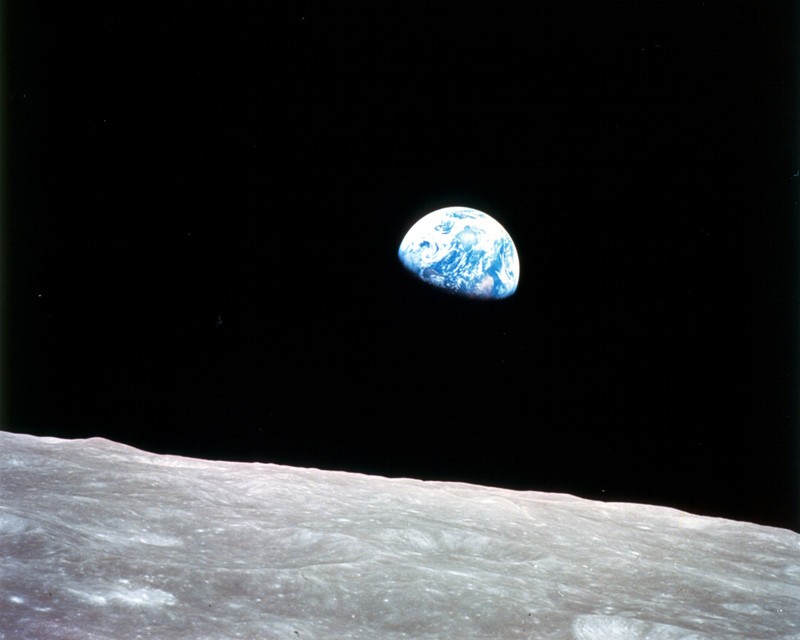
To see the earth as it truly is, small and blue and beautiful in that eternal silence where it floats, is to see ourselves as riders on the earth together, brothers on that bright loveliness in the eternal cold — brothers who know now they are truly brothers.

–Archibald MacLeish

MacLeish’s evocation of liberal hope, as moon missions of the 1960s began to exert their influence on popular culture, was first published in The New York Times on December 25, 1968 and is now iconic. I don’t think its hope is tarnished by the fact that realization remains “halfway to the moon” or further out of reach in the post 9/11 world.

Thinking about today’s anniversary of the Apollo 11 Moon landing sent me in search of memorabilia. For years I used the famous whole earth image as a screen saver. But here are a couple of images I like better now, downloaded from the NASA website. The first images of earth from space (including these two) were created in 1968, before the first moon landing, by the astronauts of Apollo 8, the first manned space mission to orbit the moon. I like the first I show for its composition and for what looks like a tiny, far-off planet just beneath the blue earth as it hangs in the black sky.


The second image is one of many to have been given the somewhat problematic title, Earthrise. But I think it must have been a photograph like this one that inspired MacLeish’s famous New York Times poem, published to coincide with the landing of Apollo 11 but written earlier.

VOYAGE TO THE MOON
Archibald MacLeish
(1892-1982)

Presence among us,

wanderer in the skies,
dazzle of silver in our leaves and on our
waters silver,
O silver evasion in our farthest thought–
“the visiting moon” . . . “the glimpses of the moon” . . .
and we have touched you!

From the first of time,
before the first of time, before the
first men tasted time, we thought of you.
You were a wonder to us, unattainable,
a longing past the reach of longing,
a light beyond our light, our lives–perhaps
a meaning to us.

Now our hands have touched you in your depth of night.

Three days and three nights we journeyed,
steered by farthest stars, climbed outward,
crossed the invisible tide-rip where the floating dust
falls one way or the other in the void between,
followed that other dawn, encountered
cold, faced death–unfathomable emptiness . . .
Then, the fourth day evening, we descended,
made fast, set foot at dawn upon your beaches,
sifted between our fingers your cold sand,

We stand here in the dusk, the cold, the silence . . .
and here, as at the first of time, we lift our heads.
Over us, more beautiful than the moon, a
moon, a wonder to us, unattainable,
a longing past the reach of longing,
a light beyond our light, our lives–perhaps
a meaning to us . . .

O, a meaning!

Over us on these silent beaches the bright earth,
presence among us.

And speaking of presences among us, My beloved and I went to hear Joan Baez sing last evening at The Pageant on the Delmar loop. For me, she was as magical as ever. Though her voice lacks some of its former power, particularly the strong upper register, it’s sweeter now, and the fast vibrato that used to bother me sometimes has smoothed out. She has a terrific band, but she did about a third of the show by herself, including her last encore, when she sang “Diamonds and Rust.” Lots of memorable lines and licks in the show: “When first I came to Louisville,” “Come back Woodie Guthrie,” “I believe in God, and God ain’t us.” Here’s the chorus of an Elvis Costello song I liked a lot.

We’ll rise above the scarlet tide
That trickles down through the mountain
And separates the widow from the bride . . .

For the truly nostalgic she sang “Silver Dagger,” “Forever Young,” “Old Dixie Down,” “Farewell, Angelina,” and “Don’t Think Twice, It’s All Right.” For the community organizers in the audience she delivered a rousing rendition of “Joe Hill,” as well as John Lennon’s “Imagine,” and Steve Earle’s “Jerusalem.” She threw in a spot-on impression of Dylan for the last verse of “Don’t think Twice” that brought the audience to its feet. But my favorite thing was an unaccompanied performance of “Angel Band” (which the Riverfront Times reviewer apparently didn’t know). With the other musicians singing along, that lovely old gospel song sounded for all the world like it might in a country church somewhere in eastern North Carolina . . . “O bear me away on your snow white wings to my immortal home.”