Arguments for prayer

It’s an appropriate exercise for Advent that a growing number of members of the SLU community are meeting at noon each day for common prayer. As we await tomorrow’s Trustee meeting, both the Post Dispatch and the Beacon have printed major analytical pieces about the crisis at SLU. News of serious concern among the trustees is leaking out, some of it not bad. Apparently at least some trustees are trying to address the issues and concerns that have been brought to light by the faculty and student revolt. I don’t know whether to hope or not; so I’ll hope, and pray that I’m not wrong.

On another front, today’s New York Times carries a story about the hate campaign orchestrated by the Institute on Religion and Democracy against All Saints Episcopal Church, Pasadena. The IRD is not a church or a religious organization. It is a right-wing political organization (Rev. Chuck Currie calls it a think tank). The attack began with an IRD sponsored piece by Ryan Mauro published at frontpagemag.com, but IRD has deep pockets and lots of connections that enable it to orchestrate potent email mob attacks.

The Muslim Public Affairs Council will be holding its annual conference at All Saints Church tomorrow. The event offers IRD three of its favorite targets for smear campaigns, LGBT friendly churches, ecumenism, and Islam. The Times quotes the Rev. J. Edwin Bacon Jr., Rector of All Saints, about the virulence of the attack:

I’ve been called names all my life from the ultraconservative reactionary position, but this is a level of demeaning that I’ve not seen before. Demeaning not just of me, but of the Muslim faith, of this organization, the Prophet Muhammad and the Koran.

While it might be tempting to write this off as Michelle Bachman (or Joseph McCarthy) all over again, All Saints and MPAC have been forced, as reported by the Times, to seek aid from local police and private security guards to protect those who will be attending the meeting.

Happily, All Saints is also receiving positive email. The Rev. Susan Russell, a Senior Associate at All Saints notes on her blog that “the positive and negative are trending just about equally” and characterizes the MPAC partnership as a “witness to interfaith peacemaking,” noting, as the Times does, that the Los Angeles Times called the effort a mitzvah in a recent editorial. Pastor Russell also urges her readers to “pray for the people who send us this kind of polemic—that they be healed of the fear that blinds them to the neighbor God loves just as much as God loves them.” I also wrote about this very thing recently. Here’s a link to that piece.

And now, as I write, my beloved is watching the appalling news reports about the school shootings in Connecticut. I’m going to close this piece as Pastor Russell closes one of hers.

—Kyrie eleison

Lincoln redux, redux

Perhaps it’s my early training as a New Critic, or perhaps it’s just old age; but I don’t think the present media stir over the accuracy of Spielberg’s Lincoln is very sophisticated. Part of the stir, the nitpicking about details, is critically naïve. A good index of the potential nitpicking and the naïveté as well may be found in Harold Holzer’s commentary in The Daily Beast. Holzer served as a consultant for the film and was briefly worried that he might be held accountable for some of the film’s “bloopers.”

Inaccurate portrayals of history are at least as old as Shakespeare. Of the bard’s transgressions of history one might mention two in particular that stand out for their hyperbolic misrepresentation: Richard III and Shylock, the one referable to Tudor politics and the other to the history of anti-Semitism. Shakespeare’s Richard III is not a mere distortion of the historical Richard; it is a straw person fabricated (perhaps) to please a Queen descended from the usurping Henry VII, whom Shakespeare represents as a stock hero. But Shakespeare’s Richard transcends the official villain of Tudor historiography. He is, as Harold Bloom puts it, “a great monster, but one that will be refined into Shakespeare’s invention of the human, of which Iago, to everyone’s delight and sorrow, will constitute so central a part.”1

Bloom is unable to give Shylock such a blessing. “[I]t would have been better for the last four centuries of the Jewish People had Shakespeare never written this play,”2 he admits ruefully and notes that there is likely no way that The Merchant of Venice can now be performed that is faithful to Shakespeare’s apparent intention. But Shylock, himself, so transcends the limits of the cultural and artistic history that surround his creation that we see the whole spectacle of anti-Semitic persecution in his humiliation, as Bloom does. We may have to relegate The Merchant of Venice to the same corner of cultural history to which we relegate Chaucer’s Prioress’s Tale, but to deny Shylock and his persecutors’ presence in and relevance to the human, to us as we are, may be to deny the existence of sin.

Spielberg’s Lincoln and the characters who surround him in Spielberg’s film are no less fictions than the characters of Shakespeare’s history plays. The comparison is useful because these plays stand near the beginning of modern thinking about historiography and suggest at least two standards of judgment with respect to historical fictions generally. 1) Do we refer questions of authenticity to the surface details of our knowledge of the past; indeed, is our knowledge something like the sum of such details? And, 2) do we refer questions of authenticity to what we think we know about historical causation? What place in our thinking should be occupied by modern demythologizing and deconstruction? As Tim Burke has put it, in a piece with which I more or less agree, part of the argument is “just one more front in the long struggle between social history and narrative”: that is, whether we can legitimately claim that heroic individuals have power to shape the large movements of history or even to be major participants in them.

But historical fictions are not history in any academic sense I understand. They are rather meditations on a past which perhaps never was but which becomes usable as it is reenacted. It is in the nature of such meditations to focus on heroic individuals: saviors (however flawed), princes (as in the long mirror tradition), great villains (some comic some not), etc. And, for the same reasons, such meditations are inevitably selective, partial, contingent. Focus on the collective. on the mass, gives us the less than interesting productions of Soviet realism or at best, the novels of Farrell and Dos Passos which engage us today, I think, primarily through their focus on individual characters. If the immediate object of poetry is pleasure, not truth, as Coleridge thought, the immediate object of historical fiction (after pleasure of course) is usability. And in such usability there is a kind of truth, to some present need to imagine a past of a certain kind.

Such fictions may inspire us, as Richard Rorty says they do and should,3 or they may stimulate critical thinking. But our critical thinking is misplaced if it stops at the perception that, for instance, William Slade is (perhaps) misrepresented in Spielberg’s Lincoln, along with other African American characters who are presented as passive and subservient. We should ask, in addition, why we are moved as citizens of twenty-first century America to make such a claim. Is this claim (made by Kate Masur in the review I cited in my last post) coherent on its face? Is it self-evident? Or does it too proceed from historical and intellectual antecedents that could be examined?4

As participants in a historical fiction (and for my purposes it is convenient to blur the distinction between attendings to narrative and to drama) we are more like communicants at a religious celebration than readers of history. We are not mere spectators but reenactors ourselves. We are scripted, but whether we immerse ourselves in the script or participate with critical detachment, we do not escape invention. Bloom calls such practice the invention of the human, and argues that Shakespeare is chief among practitioners of such an art—but we all practice it. As Ishmael says, “I feel that the Godhead is broken up like the bread at the Supper, and that we are the pieces.”

Notes

1Harold Bloom, Shakespeare: the Invention of the Human, New York: 1998, 73.
2Ibid., 190.
3Richard Rorty, Achieving our Country, Cambridge, MA: 1998.
4At the beginning of her review, Masur avers, “As a historian who watched the film on Saturday night in Chicago, I was not surprised to find that Mr. Spielberg took liberties with the historical record. As in ‘Schindler’s List’ and ‘Saving Private Ryan,’ his purpose is more to entertain and inspire than to educate.” I have trouble with this statement, particularly with its reference to “the historical record,” as though there were such a univocal thing. The statement also ties Masur to what Bloom calls the “School of Resentment,” which substitutes resentment of past failures (or present ones as in this case) for social hope. See Rorty, op. cit., 126.

Lincoln redux

I’ve had a fondness for Robert E. Sherwood’s Lincoln since I studied the part in high school and performed it many times as we Thespians from Abilene, Texas wound our way through the one-act play competition of the Texas Interscholastic League with a cutting from the first act of Abe Lincoln in Illinois. We took second place in the state competition in Austin in 1955, and I received a Samuel French Award as best actor. I still have the plaque somewhere.

I mention this not so much to take pride in an accomplishment so old that it means very little, as to note a certain vulnerability. I began to think about Lincoln and particularly about the Lincoln myth long ago. I immersed myself in Sherwood’s Lincoln as a kind of alter-ego and internalized, almost as though it were my own memory, Sherwood’s picture of Lincoln as a flawed frontiersman who rose to the occasion of his destiny. I think I still picture Lincoln so.

At Lincoln’s tomb in Springfield, Illinois, one encounters a series of small bronze statues placed in niches in the walls along the way to the burial chamber. My favorite is an equestrian statue entitled “Lincoln the Circuit Rider.” During the eighteen forties and early fifties, Lincoln traveled the eighth judicial circuit of the State of Illinois as an attorney, trying cases and making political friendships that would last, some of them, until the end of his life. Sherwood’s Lincoln is background to Lincoln the circuit lawyer and politician, a backwoods postmaster who owed money to everybody he knew and is forced to ask the political operatives who woo him to run for the state legislature to buy him a suit of clothes.

So that when I read Lerone Bennet’s Before the Mayflower in the late sixties I was not entirely unprepared for its portrait of Lincoln as a white racist. Bennett has since enlarged his campaign against the Lincoln myth, with Forced Into Glory: Abraham Lincoln’s White Dream, rearguing the case with a zeal like that of Amiri Baraka’s “Somebody Blew Up America.” This view of Lincoln has never been persuasive for me, though it remains a useful corrective to old-fashioned Lincoln hagiography. The view of many present-day social historians that African Americans “freed” themselves in the nineteenth century, has more robustness, however. That view informs Kate Masur’s op-ed review in The New York Times of Steven Spielberg’s new film, Lincoln.

Masur argues with considerable interpretive skill that Spielberg’s film seems dertermined “to see emancipation as a gift from white people to black people, not as a social transformation in which African-Americans themselves played a role.” I think the criticism is fair, as far as it goes. But I also think the history of emancipation is not the subject of Spielberg’s film. Masur seems to think that the history of emancipation ought to have been Spielberg’s subject, and this apparent conviction leads her to conclude that the film is “an opportunity squandered.”

But I think this misses the point. So far, the most balanced review of Lincoln I have read is that of another Masur (Louis P.) in The Chronicle of Higher Education, which sets Spielberg’s portrait of Lincoln in the context of other film portraits. You can read that review here. It is entitled “Lincoln at the Movies.” Like Louis Masur, I think of Spielberg’s Lincoln as an appropriation of the Lincoln myth, not as critique or as an opportunity for critique “squandered,” as Kate Masur observed. I see the Spielberg character as an older instantiation of Sherwood’s frontiersman, personally flawed but still possessed of a naive hope for a better world than the one he inhabits, and an iron determination to sieze the moment and achieve at least some small realization of a part of that hope.

It’s sometimes claimed that the Lincoln myth is a twentieth-century phenomenon, but the claim is wrong. Millions mourned Lincoln as his funeral train made the slow passage from the nation’s capital to Springfield:

Through day and night, with the great cloud darkening the land,
With the pomp of the inloop’d flags, with the cities draped in black,
With the show of the States themselves, as of crape-veil’d women, standing,
With processions long and winding, and the flambeaus of the night,
With the countless torches lit—with the silent sea of faces, and the unbared heads,
With the waiting depot, the arriving coffin, and the sombre faces,
With dirges through the night, with the thousand voices rising strong and solemn; . . .

Walt Whitman’s great elegy for Lincoln, “When Lilacs Last in the Dooryard Bloomed” from which I have quoted, was written in 1865, as were a handful of other poems lamenting the President’s death. And Whitman was not alone. William Cullen Bryant, Oliver Wendell Holmes, Herman Melville, Richard Henry Stoddard, and many others also wrote poetic tributes at the time of Lincoln’s death.

And it’s well known that the Lincoln myth has a good deal to do with Lincoln’s campaign biography and his own habit of referring to himself as a man who had overcome humble beginnings. This part of the Lincoln myth has been the subject of considerable critique by historians who have followed Richard Hofstadter. At one terminus of this critique one finds Lerone Bennett and a surprising crony, Tom DiLorenzo, whose book, The Real Lincoln: A New Look at Abraham Lincoln, His Agenda, and an Unnecessary War seems a polemic in support of the cynical oligarchy that now owns Lincoln’s political party.

Any living myth is an exercise in memory as reconstruction. We reinvent what Van Wyck Brooks called the usable past continually from the perspective of present needs and understandings. Spielberg’s Lincoln is as much about our present political crisis and the constant question, “What is to be done,” as it is about the political conflict over the thirteenth amendment. And as Louis Masur sees it, Spielberg’s “Lincoln fits with our own cynicism about the political process. But it redeems the enterprise by suggesting that hardfought battles can be won, that bipartisan agreement can be reached, even over the most intractable issues.”

But I think Spielberg’s Lincoln is about something else as well, maybe even more important. Abraham Lincoln has been an inspirational figure for utopians like me in the face of the political struggles of my lifetime, both in my country, and in what many of my colleagues still refer to as “the academy,” where I have spent most of my working life. Among other things Lincoln has stood for the transformative power of language, for the proposition that something like The Kingdom of God stands unrealized but realizable in human affairs, in the turmoil and bloody struggle of history—and that our dreams of human flourishing are not forlorn as long as we have poets and orators to speak them.

Kate Masur notes the absence of Frederick Douglass from Spielberg’s Lincoln, noting as well that Douglass was among the White House guests at Lincoln’s second inaugural. It may push the evidence too far to claim that Lincoln and Douglass were friends; though they met several times, and Douglass has recalled that Lincoln was surprisingly cordial to him. But Douglass delivered a memorable oration in praise of Lincoln in 1876 at the “Unveiling of The Freedmen’s Monument in Memory of Abraham Lincoln.”

Douglass’s praise of Lincoln is complex and not without an accounting of Lincoln’s prejudices. Lincoln, according to Douglass, was primarily the white man’s President. Douglass listed, indeed catalogued among others, Lincoln’s actions that from the perspective of the twenty-first century could seem those of a racist dictator. But the conclusion Douglass drew regarding Lincoln’s life and legacy is perhaps best summarized in this passage:

The honest and comprehensive statesman, clearly discerning the needs of his country, and earnestly endeavoring to do his whole duty, though covered and blistered with reproaches, may safely leave his course to the silent judgment of time. Few great public men have ever been the victims of fiercer denunciation than Abraham Lincoln was during his administration. He was often wounded in the house of his friends. Reproaches came thick and fast upon him from within and from without, and from opposite quarters. He was assailed by Abolitionists; he was assailed by slave-holders; he was assailed by the men who were for peace at any price; he was assailed by those who were for a more vigorous prosecution of the war; he was assailed for not making the war an abolition war; and he was bitterly assailed for making the war an abolition war.

But now behold the change: the judgment of the present hour is, that taking him for all in all, measuring the tremendous magnitude of the work before him, considering the necessary means to ends, and surveying the end from the beginning, infinite wisdom has seldom sent any man into the world better fitted for his mission than Abraham Lincoln.

Somewhere towards the middle of Spielberg’s film, Lincoln’s cabinet challenge him in regard to his assumption of war powers. These are well known, especially Lincoln’s suspension of habeas corpus. Some of his cabinet even claim that Lincoln has destroyed democracy. His reply is something to the effect that if the Union can be saved perhaps democracy will survive as well, as a condition to be achieved. Abraham Lincoln had considerable skill with words, though he had no great voice. But he spoke with a prophetic prescience in an age that valued both poetry and oratory. He has left us with a body of words that still teach us about social hope. We do well to treasure those iconic words.

Of course, as one critic has spelled out, there’s no historical warrant for the opening scene of Lincoln featuring two pairs of soldiers, black and white, reciting the Gettysburg address with Lincoln as audience. It’s a tableau, designed as a mythopoeic moment out of time, as is the flashback that concludes the film with Lincoln speaking the most famous passage from his second inaugural address. The point is that these words lead us on—that is why they bookend the film—that the Lincoln of myth leads us on because the Lincoln of history, like the historic Thomas Jefferson, left us a legacy of words and deeds that on the whole were perhaps better than he was. His career can be viewed as an attempt, not without a steep learning curve, to live up to the best poetic vision of his country he could fashion.

Into my own

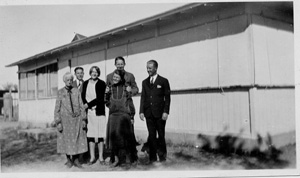
Recently I was sent a collection of family photographs. Among them is this snapshot taken outside the farmhouse in Las Cruces, New Mexico, where my father and his brothers and sister did much of their growing up. My father is the tall one in the middle with his hands on my grandmother’s shoulders. Her youthful appearance startles me. The elderly woman on the far left is my great grandmother, Melissa Peterson. The farm in Las Cruces was a homestead. Only my uncle Bill (standing just behind Mrs. Peterson and my aunt Frances) was born there. My father, his brother Randolph (the one with the silk handkerchief in his pocket), and his sister were born at an earlier homestead near Sayre, Oklahoma. There’s no date on this photo, but I think it was taken in 1930 or ’31. The subjects seem to be dressed in their best, on their way somewhere.

Except for my father they would all live long lives. Mrs. Peterson lived to be 82; my grandmother and two of her children would live almost a century, reaching the age of 99. Uncle Randolph, the eldest of my grandmother’s children, would live to be 94. And except for Mrs. Peterson they would all find themselves far away from Las Cruces at the end of their lives, most of their experience shaped largely by their country’s mid-century adventures in the far east. All of my grandmother’s children went to college. As I look at these images of them, see the hardscrabble under their feet and the house with its look of temporariness, I am thinking how remarkable that is.

I’ll not tell all I know of their stories now. My father and my uncle Bill were already in medical school, I think; uncle Randolph on his way up the corporate ladder in what would become AT&T. My aunt Frances would marry a man who became a Brigadier and travel widely. My grandmother, once her children were launched, would travel widely as well, living in Honolulu for a while and finally settling in Seattle. But the various fulfillments of these separate destinies were long ahead of them all in 1930—what strikes me in this photo is the seeming anticipation in their demeanor, and a certain innocence.

My title is borrowed from a poem of Robert Frost’s that anticipates the end of a long life as a time of certainty. The poem’s speaker imagines that friends he left behind, should they catch him up at the end of life’s journey, would discover him to be not “changed from him they knew— / Only more sure of all [he] thought was true.” These are the thoughts of a young man, part of Frost’s first book, A Boy’s Will, published when the poet was thirty-eight years old. At this distance they seem a recipe for closed mindedness.

• • •

I recalled the lines from Frost as I was thinking about some lines from a much longer ago dead poet, Henry Howard, Earl of Surrey:

Martial, the things that do attain
The happy life, be these, I finde.
The richessse left, not got with pain:
The frutefull ground, the quiet minde:

After I factor out the mindset of the landed aristocrat, there remains in this translation of Surrey’s the still attractive classical ideal of the quiet mind; though Surrey’s own mind was less than likely to be quiet. Like Martial he lived in turbulent times. He led a dangerous life as a Catholic in the twilight of Henry VIII’s reign and was ultimately executed as a traitor. He was perhaps 30 years old when he died.

But the ideal of the quiet mind need not be thought youthful, nor need it presuppose certainty. It is a stoic ideal, conceived as a response to uncertainty and frustration, a consciousness that seeks its own in the midst of political and other stresses; and it’s sometimes held up as a goal of liberal education, a mind both copious and quiet, “liberally furnished with objects of contemplation,” to paraphrase Dr. Johnson, another latter day stoic, who between herculean labor and coping with Tourette’s syndrome and other afflictions, had plenty of mental noise in his life.

I’ve just finished a week’s reading that included, in addition to various consumables (by which I mean newspapers, blogs, media, etc.), John Gardner’s Grendel, which my class discussed last week, S. C. Gwynne’s Empire of the Summer Moon, a popular meditation on the the winding down of the Indian wars in the southwest (yet another retelling of the story of Cynthia Ann Parker, the exploits of her son, Quannah, and the capitulation of the People), and Wendell Berry’s Home Economics.

I turned to Gwynne on the recommendation of friends I encountered in my home town of Abilene, Texas where I recently attended the 57th reunion of my high-school graduating class and was struck by the realization that my grandparents had arrived in western Oklahoma around 1901 in the aftermath of the turbulent events Gwynne’s narrative brings to mind. From Gardner I took away (again—I’ve read Grendel many times now) what seems the quite reasonable claim that Whitehead was right to assign the name of God to that which limits action and energy and therefore calls forth “the entire multiplicity of eternal objects.”

And I turned again to Berry because I am trying to formulate for myself a rationale for the liberal arts in contemporary university education. I’ve previously written about Berry’s essay, “The Loss of the University.” But now I’m more interested in his thoughts on sustainability and his claim that community has economic value, because it seems to me that whatever case we make for the liberal arts in our day has got to take into account the material conditions required for their study and the material benefits of the same. If we can’t make the case that the liberal arts have practical, economic value, it is hard to argue that they have cultural or spiritual value. As Berry puts it with respect to community, “Can there be a harvest festival where there is no harvest?”

• • •

Two years ago I asked my class to read Alasdair MacIntyre’s After Virtue. It’s a beautiful book, though I don’t agree with much of it, including its core argument. MacIntyre says, in a preface to the third edition, that he was not yet a Thomist at the time he wrote the book (1981); but what I think I loved about After Virtue when I first read it in the mid-eighties was its insistance on the importance of a conception of human nature. Without such a conception (and I like Aristotle and Thomas about this too) the Enlightenment notions of liberty and equality are pretty empty. Something more is required, it seems to me, as a ground for these notions than the naked assertion of self-interest—some notion of human good, potential or real, immediate or lost. Adam Smith, often cited as the godfather of neoliberal economics, believed in a moral sentiment, physically present in human being.

The enlightenment tradition has tended to emphasize private judgment, private enterprise, etc., as opposed to centralized coordination. This was liberating in the eighteenth century, when people could still be put to death for witchcraft. Now, when “The notion that every action is is both a private experience and a a public utility,” as Whitehead says, has all but died out, individual beliefs and practices tend to be asserted as near absolute private entitlements. We see this on both sides of the political spectrum, but it has particularly emerged recently in the argument against government mandated health care. Obamacare, so called, infringes on my right of self-determination. Government, so we are told, has no right to tell me, as a sovereign individual, that I have to purchase health insurance. It’s the old seat-belt argument.

Here is Aquinas’s fifth proof of God, the one I like the best:

The fifth way is taken from the governance of the world. We see that things which lack intelligence, such as natural bodies, act for an end, and this is evident from their acting always, or nearly always, in the same way, so as to obtain the best result. Hence it is plain that not fortuitously, but designedly, do they achieve their end. Now whatever lacks intelligence cannot move towards an end, unless it be directed by some being endowed with knowledge and intelligence; as the arrow is shot to its mark by the archer. Therefore some intelligent being exists by whom all natural things are directed to their end; and this being we call God.

I don’t like this because I think it succeeds as a proof. Its conclusion in no way follows from its premises. As an argument, it’s an exercise in question begging. But it’s beautiful, and beauty is truth in a way; though Keats claimed too much for the idea.

Still, my point here is that without such a conception of intelligence grounded in the material stuff of the world, the enlightenment conceptions of liberty and equality degenerate into empty assertions of individual autonomy that are easily transformed into the right to bear arms, the right not to purchase health insurance, the right not to wear a seat belt, etc. And politics aside, without such a conception the fundamental issues of ethics and aesthetics degenerate into cost benefit analysis that deserves comparison with the excesses of medieval scholasticism, or into empty claims about the timeless worth of things that we know only as inferences and extrapolations.

• • •

At this point in my life I am more uncertain than I have ever been about the things I hold dear, though I am pretty comfortable in my skin. I tend to think that certainty, not uncertainty, is the enemy of life. None of us knows when he will die–that’s the fundamental uncertainty–and I don’t need to be certain about the ideas that I use, because my practice constantly confirms their usefulness. Unlike MacIntyre I embrace and celebrate democratic pluralism. To be sure, it gives us Sarah Palin and the gun toting folks in Arizona and elsewhere. But it also gives us what I identify, following Richard Rorty, as liberal hope.

Uncertainty seems basic to the hope for a better world. An uncertain person, such as I am, tends to embrace bounded ambition in regard to the potential for historical accomplishment, or social progress. But the person who seeks certainty seeks an establishment, a city on a hill, the end of history. I think history and the end of history both abide in the moment, and I am content with that. I embrace the long tradition of uncertainty in Christian mysticism. (See, for instance, “The Cloud of Unknowing.”) Rather than doctrine, I embrace prayer. I find common prayer particularly efficacious, though I have no belief in, or knowledge of, a personal god.

I am not uncomfortable with any of this, perhaps because I am a poet and grounded in poetry. I read, for instance, the ending of “Little Gidding,” as it draws together the poet’s personal quest with Dante and Julian of Norwich, as a method of being. Here are the lines:

We shall not cease from exploration
And the end of all our exploring
Will be to arrive where we started
And know the place for the first time.
Through the unknown, unremembered gate
When the last of earth left to discover
Is that which was the beginning;
At the source of the longest river
The voice of the hidden waterfall
And the children in the apple-tree
Not known, because not looked for
But heard, half-heard, in the stillness
Between two waves of the sea.
Quick now, here, now, always?
A condition of complete simplicity
(Costing not less than everything)
And all shall be well and
All manner of thing shall be well . . .

And I think of truth as but one of the conditions of thoughts that one loves. The difficulty of Truth and Truth establishments is that they drive truth (small t) out of the room. In this regard I am remembering something from Hannah Arendt, in one of her letters to Mary McCarthy, “The chief fallacy is to believe that Truth is a result which comes at the end of a thought-process. Truth, on the contrary, is always the beginning of thought; thinking is always result-less. That is the difference between ‘philosophy’ and science. Science has results, philosophy never. Thinking starts after an experience of truth has struck home, so to speak. . . .”

I’ve learned a lot from MacIntyre, even though I don’t agree with him about much. I particularly don’t agree that Aristotle needs vindication. Aristotle remains with us, as Plato does, perfectly available to the next thinker who might wish to use him as Aquinas used him, just as the Homeric poems remain available to poets. I’m not entirely sure of this, but I think MacIntyre’s use of Aristotle may be perverse. It’s not an adventurous use in any case, as Whitehead’s use of Plato is adventurous, for instance.

“In my end is my beginning.” All my grandmother’s children went to college. I loved college so much that I’ve never wanted to leave. Though I’ve knocked around a bit and seen a bit of the world, I remain primarily a mental traveler, like Joyce Cary’s “randipole Billy Blake,” perhaps not unlike my grandmother’s children, too—on my way somewhere unknown, unknowing.