what I did last summer 3


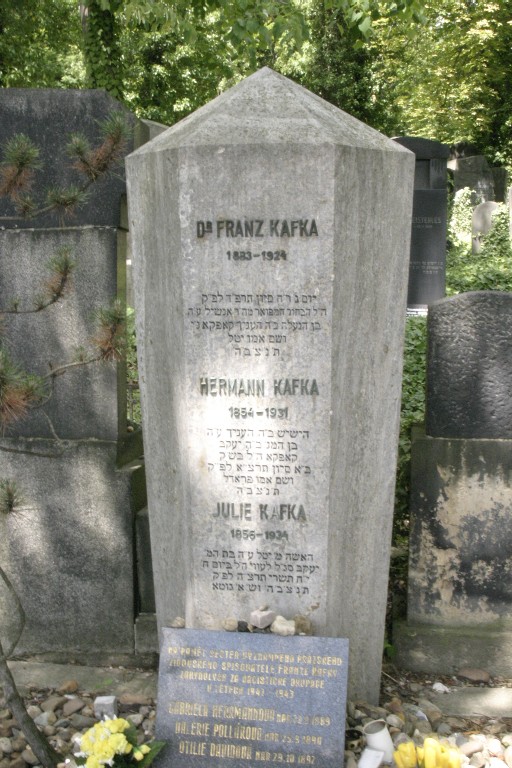
It’s early afternoon on Sunday, June twenty-fourth of this year. I am in Prague walking along a well-kept gravel path down a long wall from the entrance to The New Jewish Cemetery. I find Franz Kafka’s grave just opposite a memorial to his friend, Max Brod, snap a few forbidden pictures hoping that God will forgive me and thinking that some pilgrimage has now ended. Earlier in the day, my beloved and I visited the Old New Synagogue and walked down Maiselova Street where the day before we had struggled through a tour of the other old city synagogues and the Old Jewish Cemetary in a pouring rainstorm that made it difficult to orient oneself geographically.

We were at the end of our tour and had by this time seen a good many things that evoked the memory European Jewry, but neither of us was quite prepared to find that the synagogues of old Prague are mostly museums. The Old New Synagogue is still in use as a house of prayer, but when I asked a docent there how many were in attendance at the Saturday service, she told me apologetically that she didn’t know because she isn’t Jewish. Then she speculated that mostly visitors had attended because the congregation is very small. “There aren’t many Orthodox Jews left in Prague,” she sighed ruefully.
Brooding over these perceptions is the memory
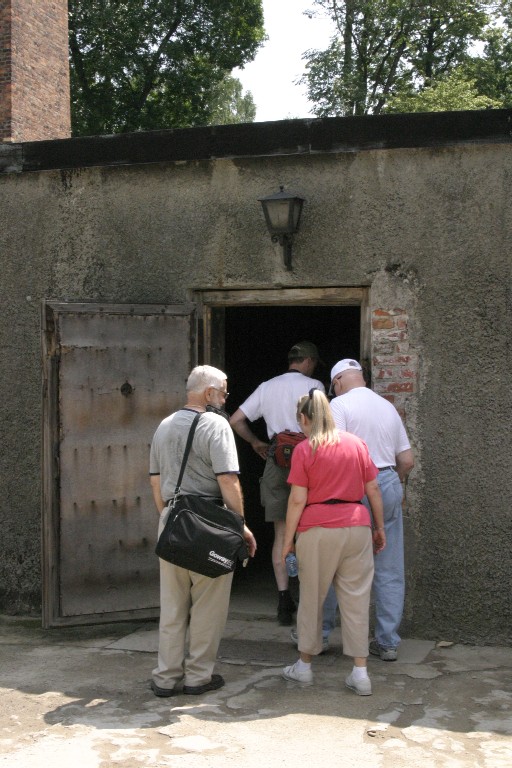
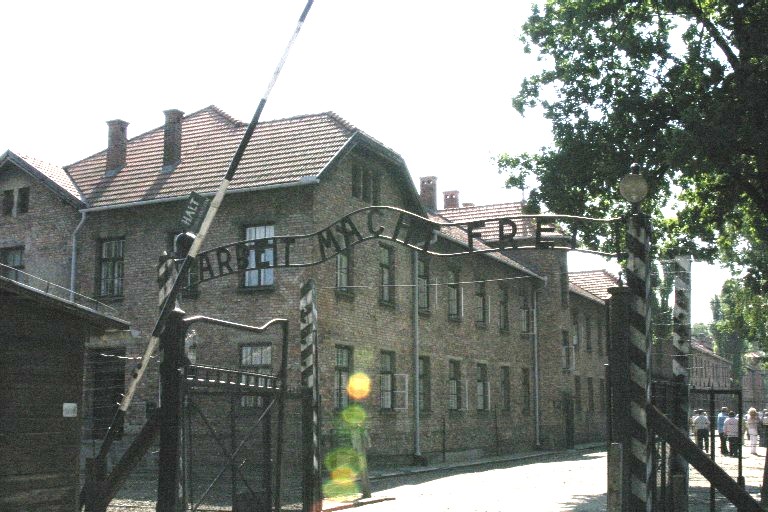
of our visit to Auschwitz, in Poland, almost two weeks before. Here’s the main gate at Auschwitz I, the first part of the camp (formerly an army barracks), with the infamous inscription Arbeit Macht Frei that was used throughout the Nazi system of concentration camps. And here’s a picture of some of our group entering the room where so many were murdered. Inside this bunker-like structure is a large room with openings in the ceiling, used to introduce Zyklon B gas, and a smaller room housing two ovens that were used to burn the bodies. This relatively small facility at Auschwitz I was used before (and after) the killing factory was built at Auschwitz-Birkenau, or Auschwitz II, a few miles away. The Nazis blew up the gas chambers and ovens at Auschsitz II when they abandoned the camp. It’s very hard to be at Auschwitz. Our program director, a lovely polish man named Marek Gajewski, told us that he has special respect for the people who work as guides at the death camps.

Marek’s father had spent time in the Soviet Gulag. He was a concert pianist, so his tormentors broke all his fingers. The most important thing I learned in Eastern Europe, I think, is that the memory of the Nazi terror and the Soviet terror that followed are vivid and contemporary. It is as though they happened only yesterday. I will never forget Marek’s account, as we drove along a now beautiful bridge across the Vistula from Warsaw to Praga, Poland (where much of the film, The Pianist was made), how the Soviet army had watched the almost total destruction of Warsaw by Hitler’s departing forces (when they could have prevented it) and walked into the city to take control afterwards.
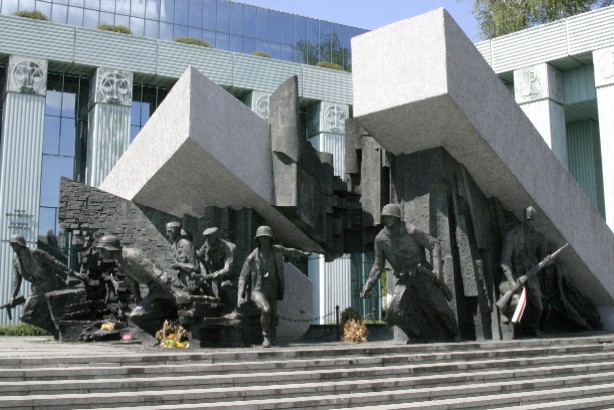

Here’s a picture of part of the memorial to the Warsaw Uprising at the end of World War II. It was this uprising that so angered Hitler that he ordered the total destruction of the city. Poles are understandably proud of this event in their history, when a small irregular army of fighters held off the Wehrmacht for some two months, especially since the Soviets would not allow them to celebrate it. It’s now honored not only by this large monument, but by a fine new museum in Warsaw.
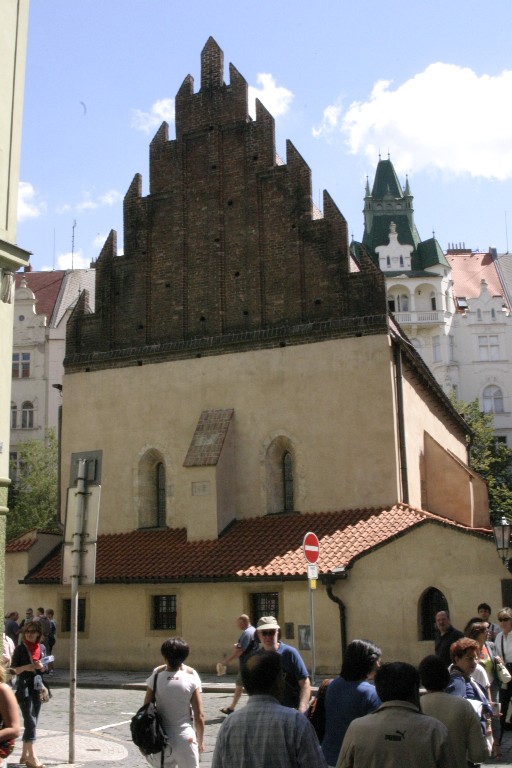

Back to Prague. Here’s the Old New Synagogue, completed in 1270 by most accounts. Small as it is, it has a feeling of loftiness and amplitude inside. The entrance now after centuries is well below street level. Its tiny reading desks suggest that it was built for humans much smaller than we moderns are on average. But it’s lovely, simple and clean and cozy, nothing ostentatious, nothing too much. I wasn’t allowed to photograph the interior, but you can see a couple of nice interior shots at Wikipedia and here. I’ve read with some dismay accounts of violent disputes at the Old New Synagogue recently. Though I don’t entirely understand what I read it appears that identity politics is everywhere, even in this venerable place.
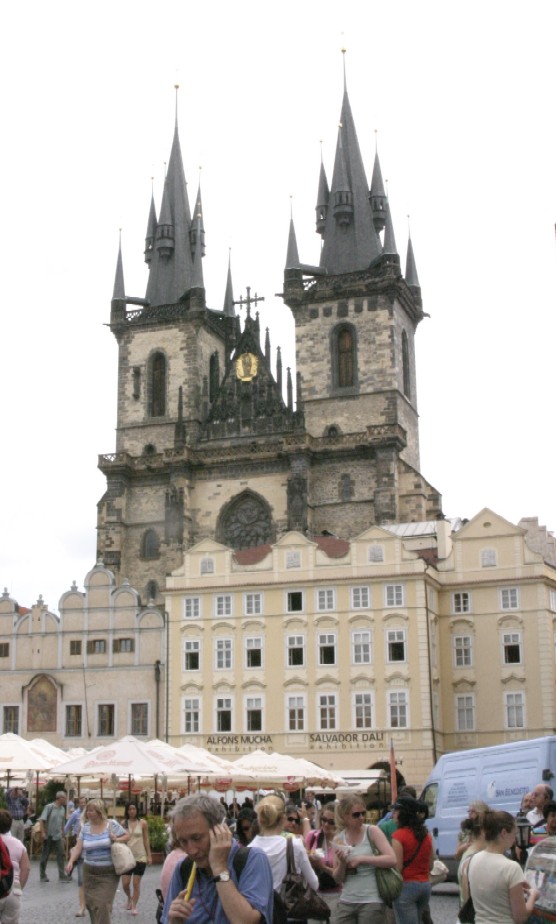

It was the law in most of Europe for centuries that synagogues could not be taller than churches. Here, The Church of Our Lady Before Tyn utterly dominates the old town square, its haughty towers a reminder of the fate of Jan Hus and his followers. Last summer the statue of Hus in the center of the square was being
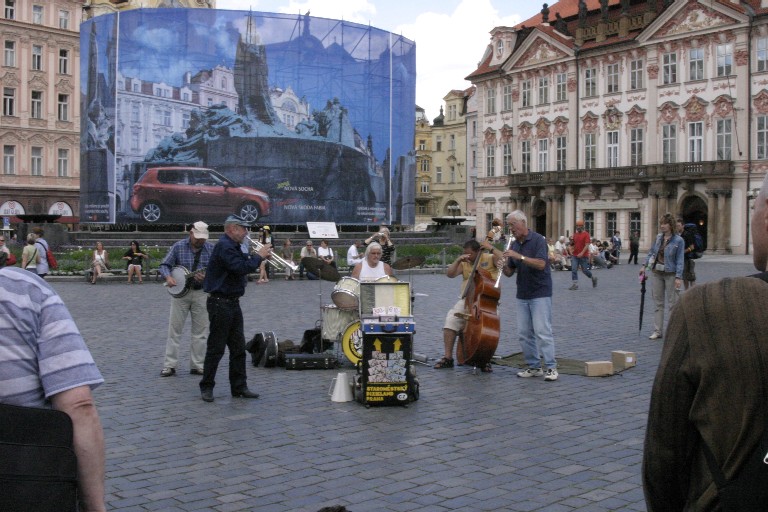
refurbished, so that one saw this wrap instead. The guys in the band here were playing dixieland, not badly either.

Prague is seriously crowded with tourists. This band in the middle of the square was surrounded by a pretty large crowd of folks listening or on their way, as we were, somewhere else.

more . . .

sexual politics

Tobias Haller has written an analysis, entitled Where We Are, that seems to this aging layman to be a fair and balanced account of the aspect of sexual politics in the Episcopal Church that is most in the news. Here are a few excerpts.

About the church as a whole:

It is very easy, in a liberal parish in a liberal diocese to come to think that The Episcopal Church as a whole is much more liberal than it really is. This applies to the Anglican Communion as well.

About the House of Bishops:

The House of Bishops as a whole — even with the “Network” bishops missing — is not as liberal as its most liberal members. When they gather, something between the Hive Mind and the Stockholm Effect takes place. The whole is often less than the sum of its parts.

About Bishop Robinson’s ordination:

The consent to the election of Gene Robinson was a “false dawn” — and was not the celebration of gay and lesbian equality it was perceived to be. The consent had more to do with Gene’s superb personal qualities and track-record as an excellent priest than with his sexuality and his partnership. The consent was given in spite of, not in affirmation of, his private life. The consent to his election thus made it appear both to us and to the world that we were moving faster than we actually were.

In the commentary that follows, Elizabeth Keaton says, “While I agree that this is a fair assessment of where we are, it’s decidedly not where we were last March,” and asks, “Why, do you suppose, that is the case?” Haller replies:

I think the main difference between March and September was that the March meeting dealt with something really gear (sic) and near to the Bishops hearts — polity and property — and you will note that in the present statement that is where their strongest language is placed.

Another issue of sexual politics, one about which I haven’t seen much discussion, is the HOB endorsement of the presiding bishop’s “plan to appoint episcopal visitors for dioceses that request alternative oversight.” I’m less disturbed by the presiding bishop’s endorsement–she seems a person of great faith and generosity of spirit–than I am by that of her colleagues. But both endorsements make me wonder how serious my church’s real commitment is to the ordination of women.

a consensus document?

There’s lots of advice around for those of us in the Episcopalian hoi polloi by now, telling us how we should read the HOB communiqué from New Orleans, some of it suggesting that we lack the ability to read for ourselves, either because we are not in the know or because we were not present in the room with the bishops as they consulted.

One writer puts the case pretty bluntly, saying that “hypercritical second-guessing of the bishops” is “unreasonable” and “unseemly.” Another describes the communiqué as “a consensus document” and advises that we thank the bishops for their leadership, suggesting that various statements from New Orleans are still being perfected. Another argues that the responses of those of us who don’t think the bishops wrote very well are “sophomoric and self-indulgent.” Still another commends the virtues of “wordsmithing” and argues for the necessity of such language in addressing the present dissensus in our church.

Part of this seems merely academic to me, but part of it seems an inevitable consequence of the publication of a document (a public document, by the way) that possesses all the worst features of documents written by committees. Worse yet, to my mind, the communiqué is a lawyerly document. The Anglican Scotist asks, “Why can’t compromise and discernment be messy? Why can’t an honest compromise leave everyone disappointed?” My answer is that an honest compromise would have addressed the demands of the “Anglican Primates in Dar es Salaam” directly and would have detailed the dissensus in the HOB, itself. I think the resulting document would have upheld the determination of the American Church to govern itself as the bishops affirmed in March instead of appearing to retreat from that determination, but I can’t know that.

As it is, the communiqué is being read as a retreat on every hand, and nowhere more clearly than in reflections of bishops from my home state of Texas. Retreat is the clear implication of reflections by Bishops Lillibridge and Reed of West Texas, who consider themselves marginalized within the HOB, but who nonetheless were able to persuade their colleagues to “go further than the Bishops were able to go in March.” Bishop James Stanton of Dallas has issued a statement in which he laments that the HOB didn’t retreat far enough but makes this rueful observation near the end:

It seems that, even with the best of intentions, we simply cannot get beyond the thought that we might learn from what the Archbishop of Canterbury called “common discernment;” in other words, that our decisions as a House might be wrong and at any rate ought to be subject to the advice and concerns of our Communion brothers and sisters. Many bishops argued for ambiguity as the most “honest” statement of “where we are.” Perhaps that is true. That is the effectual outcome of this meeting.

Though I should be leery of indulging in unseemly second guessing of my betters, I think the attempt to produce a consensus document when no consensus exists was a mistake. Bishops Lillibridge, Reed, and Stanton hold a minority position in the HOB, but it is a position that deserves to be heard. Other bishops, who represent the views of those of us on the left, deserve to be heard as well. Lawyerly language that obfuscates open dissensus serves nobody well. But perhaps the process was better than the document it produced. Many are saying of the HOB meeting as a whole that it was characterized by a lack of acrimony and a willingness to allow all members to make their own arguments. Here’s Bishop Stanton, again:

I am grateful for the tone of this meeting and for many aspects of the process and the contributions many bishops from very different perspectives made to it. I wish that such openness and frankness, and serious discussion, had characterized earlier meetings. (And here I refer to 15 years of such meetings!)

There will be more meetings, of course, and other position papers, and maybe some new legislation at the next General Convention. I pray for good news and hope I live to hear it. But as Dean Thomas Luck wrote yesterday, “in the scope of Christianity,” time is long.

–At seventy, I’m not getting any younger.

yet once more . . .

Well, the pastoral letter has come. Not from the entire House of Bishops, but from Bishop Kirk Smith of Arizona (thanks to Nick Knisley at Entangled States). I agree with Bishop Smith that a good headline for any story about the House of Bishops’ work in New Orleans might have been, “Bishops Bend Over Backwards to Hold Communion Together,” but I think what actually happened in New Orleans is that the bishops bent over backwards to accomodate the Archbishop of Canterbury.

In this regard I’m sad to read Giles Fraser’s piece in The Guardian today which argues that “The deal that the archbishop has brokered with the Episcopal church in New Orleans protects the unity of the church by persuading US bishops that the church is more important than justice.” I’m not sure the deal even protects the unity of the church, as witness this editorial in the Global South Anglican.

Bishop Smith says that the HOB statement from New Orleans is a compromise. That’s putting the best possible construction on it, in my view. He also says the communiqué “is a confirmation of the actions of the 2006 General Convention, and that “Our polity is such that the House of Bishops could not have changed that position, even had we wanted to.”

Only too true. However, the bishops could have spoken descriptively of the present condition of our church with regard to ordinations and blessings, but they chose rather to speak legalistically in the main in a way that is being widely read as a recantation, and I think justly so (I have quoted the full text of two crucial paragraphs of the communiqué in the previous post). I don’t think these paragraphs are exactly the endorsement of the status quo that some are saying they are (see Fr. Jake, for instance).

Nor do I think the bishops’ communiqué is ambiguous; though I do think the summary (to which I believe some early responders reacted before they digested the whole text) is not a fair précis of the document. A midday post at the Episcopal Cafe argues that disparate responses to the bishops’ language reflect distortions in the media and muses ruefully that “It’s small wonder that some laity have expressed bewilderment.” Isn’t that just a lovely thought? As one of the “laity” I note the various interpretations of the communiqué that are being published by the bishops, themselves (some of them cited by this same author).

I am senior warden of a growing metropolitan Episcopal church in the city of St. Louis. I will go about my work in that capacity in the next weeks and months with a heavy heart. And as a human being and a citizen of the United States of America, my heart is even heavier because I am largely in agreement with Fr. Fraser in The Guardian that “the struggle for the full inclusion of lesbian and gay people in the life of the church is a frontline battle in the war against global religious fascism.” And when I read Bishop Smith’s statement that the House of Bishops of my church sought to be sensitive “to the cultural and theological beliefs of our partners of the Global South,” I am reminded of something else Fr. Fraser says.

Robert Mugabe has called homosexuals “worse than dogs and pigs”. Mahmoud Ahmadinejad’s government denies that gay people exist in Iran, and hangs the ones it finds. The Anglican Archbishop of Nigeria thinks homosexuality “evil” and “cancerous”. There can be no compromise with any of this, irrespective of whether it is backed up by dodgy readings of holy texts or not.

I’m glad the bishops endorsed the “civil rights, safety, and dignity of gay and lesbian persons,” and I suppose they didn’t really mean to leave out bisexual and transgendered “persons.” But the bishops could have done, should have done, more. I think the New Orleans communiqué is an exercise in Episcopolitics (a wonderful word I have just learned from Tobias Haller). The bishops had a huge audience all over the world. If ever there was an opportunity for prophetic utterance, this was it. Instead, they labored like a mountain and brought forth a mouse. It’s a damn shame.