Richard Rorty begins a well known essay entitled “Love and Money” by recalling how E. M. Forster’s authorial voice early in Howard’s End observes that the poor are unthinkable, not because poor people are bad or inferior but because poverty reduces all of life to the issue of brute survival. It’s perhaps a mournful fact, but a fact nonetheless, that the pursuits of those whom Forster terms “gentlefolk” are possible only when survival is not the primary or foreground issue. I’m still teaching school at seventy-six. I still enjoy it, and it still seems to work for me. My students are senior honors students, but not by and large humanities majors. Still, they seem eager. They seem to enjoy the books and the conversations we have. I have had occasion to be proud of many of them over the years as they have gone on to do useful work in the world.
I, myself, have had three educations since I first sat in a college classroom, three turns towards new and unexpected framings of the issues of my life and work. I’m thinking now that I am embarked on a fourth, and that is the background of this essay, if not its subject. I have led a privileged life. My students are gentlefolk, in Forster’s sense, who are training themselves for the occupations and pursuits our society has until recently considered appropriate for gentlefolk, but I now worry that they may be entering a world of work in which leisure and the intellectual pursuits into which they have been socialized may be in short supply.
A recent New York Times carried yet another story about the plight of the humanities. It’s a constant theme of our present-day discourse of education reform, so called, a lot of talk in which there is precious little enlightenment and a growing load of clichés touting whatever is the latest digital fad. But education at all levels is being changed by market and sociological forces in combination with (and I think directed by) a set of political choices, some of which seem very unwise to me and some of which I think are beyond foolish and downright evil. But today I am thinking of this:
To take a Walk in the Gardens of the Palace of the Tuilleries, and describe the Statues there, all in marble, in which the ancient Divinities and Heroes are represented with exquisite Art, would be a very pleasant Amusement, and instructive Entertainment, improving in History, Mythology, Poetry, as well as in Statuary. Another Walk in the Gardens of Versailles, would be usefull and agreable. But to observe these Objects with Taste and describe them so as to be understood, would require more time and thought than I can possibly Spare. It is not indeed the fine Arts, which our Country requires. The Usefull, the mechanic Arts, are those which We have occasion for in a young Country, as yet simple and not far advanced in Luxury, altho perhaps much too far for her Age and Character.
I could fill Volumes with Descriptions of Temples and Palaces, Paintings, Sculptures, Tapestry, Porcelaine, &c. &c. &c. — if I could have time. But I could not do this without neglecting my duty. The Science of Government it is my Duty to study, more than all other Studies Sciences: the Art of Legislation and Administration and Negotiation, ought to take Place, indeed to exclude in a manner all other Arts. I must study Politicks and War that my sons may have liberty to study Painting and Poetry Mathematicks and Philosophy. My sons ought to study Mathematicks and Philosophy, Geography, natural History, Naval Architecture, navigation, Commerce and Agriculture, in order to give their Children a right to study Painting, Poetry, Musick, Architecture, Statuary, Tapestry and Porcelaine.
Written by then President John Adams in a letter to his wife dated 12 May 1780, this famous statement by one of the founders of our republic is an index both of where we stand as present-day Americans in relation to a past that we can claim, and of our distance from that past. I am thinking of it today less because of the thick matrix of cultural assumptions it entails, and more because, though he mentions commerce and agriculture as appropriate areas of study for his sons, Adams nowhere mentions economics. Of course the dismal science hardly existed in Adams’s time and would not be ridiculed as such for another fifty years (by Thomas Carlyle in a tract arguing for the reintroduction of slavery in the West Indies). It’s also interesting that Adams doesn’t mention the study of languages, whether ancient or modern, the former thought useful for young men in Adams’s time and the latter thought by some to be appropriate for young women. Of course, Adams doesn’t mention women’s education at all. Furthermore (and this is a big furthermore), Adams does not speak of education as a training ground for getting a job and making money, the only educational value present day culture seems to recognize. His conception of education is cultural rather than instrumental. The sciences of government and politics, the great structuring sciences of Adams’s time, he saw as appropriate to public men, as are the disciplines he assigned to his children. The next disciplines, those assigned to the third generation in his list, are appropriate to men of leisure, that is to humans primarily concerned with private pursuits.
There is a set of urgent questions we should be asking ourselves about education in our era, starting with these: On the most general level, what stake does one generation have in educating the next? And more specifically relevant to our time, what stake does a democratic society have in educating the young? Adams was no democrat and would likely have prefaced any answers he gave with an assertion that education is categorically superior to ignorance. Though his juxtaposition of practical arts and sciences with others he thought of as primarily decorative is familiar enough to us today, one should not forget in reading Adams’s letter that its catalogue is entirely humanistic. For Adams, education shaped humans in their public capacities, teaching them, as he said elsewhere, not only how to make a living but how to live—and how best to manage and govern the human world. In an earlier letter, dated 22 April 1776, Adams had written to James Warren:
We may please ourselves with the prospect of free and popular Governments, but there is great Danger that these Governments will not make Us happy. God grant they may. But I fear, that in every Assembly, Members will obtain an Influence, by Noise not Sense, by Meanness not Greatness, by Ignorance not Learning, by contracted Hearts not large Souls.
The relevance of these thoughts to the questions I’ve cited in relation to our own time seems clear enough. The distance between us and Adams cannot simply be measured by his world’s tolerance of genocide, slavery, and the subjugation of women (or his distaste for democracy). It must also be measured by our world’s tolerance of noise, meanness, ignorance, and contracted hearts.
I’m not arguing against democracy, but I fear one very plausible conclusion to the claims I am making: that our democracy in the United States of America may be nearing exhaustion. I’ve written before about Sarah Kendzior. Dr. Kendzior has recently published an essay in Al Jazeera that poignantly evokes the post-employment America being delivered to her generation by capital and our present-day governing elites. What do a lawyer, a computer scientist, a military analyst, and a teacher have in common? she asks:
They are trained professionals who cannot find full-time jobs. Since 2008, they have been tenuously employed – working one-year contracts, consulting on the side, hustling to survive. They spent thousands on undergraduate and graduate training to avoid that hustle. They eschewed dreams – journalism, art, entertainment – for safer bets, only to discover that the safest bet is that your job will be contingent and disposable.
Unemployed college graduates are told that their predicament is their own fault. They should have chosen a more “practical” major, like science or engineering, and stayed away from the fickle and loathsome humanities. The reality is that, in the “jobless recovery”, nearly every sector of the economy has been decimated. Companies have turned permanent jobs into contingency labour, and entry-level positions into unpaid internships.
This is the world we inheritors of the commonwealth of John Adams are bequeathing to our posterity; a posterity who have already arrived to face penury, blight, and the ruin of their hopes. And this doesn’t in any way account for our multitudes of working poor who lack education, or those imprisoned in our multibillion dollar incarceration industry or locked into cycles of poverty, violence, and oppression in the parts of our blighted cities we have decided to throw away.
I am a member of the American generation that is sometimes scapegoated as the cause of our present decline. Our society is aging, we are told, and too many resources have been pledged to the elderly. Unfortunately, scrapping federal programs that presently allow some elderly people some comfort and perhaps a dignified death—we have already all but destroyed our country’s pension system—unfortunately, destroying the safety net, so called, will do nothing to change the economic disaster that is faced by today’s rising generations. The problem is not that wealth redistribution to the elderly is depriving the young of opportunity. The problem is that today’s predatory capitalism, which seeks to hide its unparallelled greed in the forest of globalization, has destroyed the productive capitalism that for generations served as the primary wealth-redistribution instrument of our society through decent jobs, with decent salaries and benefits. We may presently be socializing the last American generation to be educated for the world we used to know, not in some golden age but back before 2008 when the credit bubble burst for the American middle classes and we were forced to comprehend the true extent of the economic inequality that had been growing in western societies since the 1970s. John Adams could be optimistic about the future he and his fellow citizens were building “in a young Country, as yet simple and not far advanced in Luxury.” The reality we must face is that we have created far too much luxury for a tiny few at the price of desolation for the many.
There are needed reforms in higher education. Though digital culture has already changed higher education radically, much of the promise of digital culture still needs to be explored and made good. But at present the glaring problem that nobody knows quite how to face is that we are educating an entire generation for a world of disappearing opportunity. In the present historical trough, all education faces redundancy as the scramble for survival becomes the primary datum for the great mass of humanity. Dr. Kendzior continues:
If you are 35 or younger – and quite often, older – the advice of the old economy does not apply to you. You live in the post-employment economy, where corporations have decided not to pay people. Profits are still high. The money is still there. But not for you. You will work without a raise, benefits, or job security. Survival is now a laudable aspiration.
And survival is complicated by the familiar scapegoating of millennials as self absorbed complainers who deserve their fate. But they don’t. The failure isn’t theirs. The failure is with a system of political economy that has allowed the commonwealth to be sucked dry. A few individuals and corporations are hoarding huge piles of cash while real productivity stagnates. Skilled labor is being relentlessly casualized. Infrastructures are being starved and allowed to deteriorate for want of maintenance. Manufacturing is being relocated in search of slave labor and the absence of regulation. We face a time when the American engine of consumption will sputter and die for want of demand. There may be hope for change long term. Gar Aplerovitz has outlined a number of hopeful programs that could redemocratize wealth, but these are just in the beginning stages. I don’t have any real hope that we can solve our present political/economic crisis by tax reform or even through the electoral process. Any new government we elect will be the creature of massed capital as matters stand—only a catastrophe on the order of the depression of the 1930s seems likely to change things.
Meanwhile, there are now at least two generations of Americans, not to mention those in older generations who have lost employment and/or benefits and may never be able to replace them, for whom the primary issue is not how to fix our rigged system but how to survive in it. Survival is also the agenda of many institutions, indeed of our entire public sector: that’s the reality today. And that creates a toxic social environment in which betrayal and victim blaming are normalized. The right would like us not to speak of class warfare. Fair enough. We’ve long ago outstripped mere class warfare and entered an era of wholesale class predation in which hoarded wealth is cannibalizing every resource it can use up: from land, water, and animals to what remains of people’s livelihoods and pensions. I’ve just read Cormac McCarthy’s post holocaust novel, The Road, in which a father and son are fleeing to nowhere, hiding from bands of cannibals, scrounging food and shelter, occasionally killing others in order to avoid being killed themselves. We’re not that bad off, but if things get much worse for us we could be as bad off as we were in 1932.
My title comes from a poem by the late Richard Hugo, the poem he chose as the title poem for his collected poems. It’s a dream of fishing, as so many of Hugo’s poems are, in clear mountain water for the deep source of the given world. A source that may be lost to the characters in Cormac McCarthy’s novel:
Once there were brook trout in the streams in the mountains. You could see them standing in the amber current where the white edges of their fins wimpled softly in the flow. They smelled of moss in your hand. Polished and muscular and torsional. On their backs were vermiculate patterns that were maps of the world in its becoming. Maps and mazes. Of a thing which could not be put back. Not be made right again. In the deep glens where they lived all things were older than man and they hummed of mystery.
I think it turns out that the humanities serve the same broad cultural and ethical purposes they have always served and that our stake in educating new generations is not merely that we hope our civilization may persist, but that we cherish the world in its becoming and hope that becoming may persist above all, even in and amongst the shadows cast by gigantic piles of dead and hoarded wealth.
Meanwhile, Dr. Kendzior urges her fellow graduates to work their hardest and do their best, to hustle and scrounge and play the odds, to organize and push for collective change, and to husband self-respect and compassion.
Small hope in these recommendations, but perhaps the only short-term hope there is.

 St. John’s Episcopal Church is the second oldest surviving Episcopal church in the city of St. Louis, founded in 1841. Only Christ Church Cathedral is older. I served two terms as Senior Warden of St. Johns, from 2006 until 2012. During that time we increased membership and budgets so that the parish now supports a strong pastoral size congregation that is on the verge of becoming program size. Here is a photo of our present building, where the congregation moved in 1908. And here’s a video (embedded below) that tells our story. It was made by the national church in 2012 and illustrates what I think is needed if our national church is to reverse its present decline.
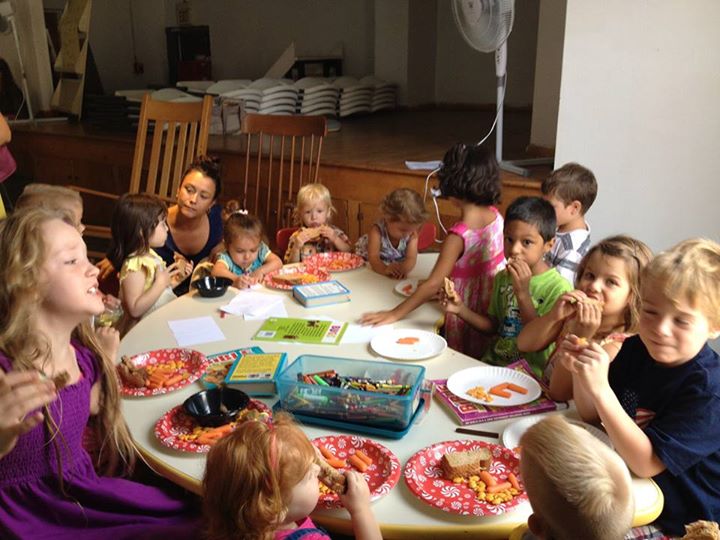 St. John’s had declined to a handful of members at the fime I first attended a service, partly because of changing demographics and partly for other reasons. One index of our growth is that we now have a thriving children’s program supported by a number of young families who have joined us over the past eight or ten years. We built some new nursery and sunday school spaces in 2010. Here is a picture that we recently featured on our Facebook page. It includes many of our youngest members. If you look at our Facebook page today, You’ll see a spread of photos from last Sunday’s Christmas Pageant in which you’ll see these same children and others. We’re blessed.