
eloquence and entitlement

I’ve realized something important today.

In Democratic Eloquence, Kenneth Cmiel points out how central the speech of experts has become in present day public discourse. Throughout her campaign Hillary Clinton has not only relied on a rhetoric of expertise but has also represented herself as entitled to nomination and election because of her expert status. Daniel Drezner makes such a case on the basis of two now familiar pieces of video. The first is from the New Hampshire Democratic debate.

And the second is the much cited “tearing up” sequence from the New Hampshire campaign.

I agree with Drezner that both these sequences display a powerful sense of entitlement, which Drezner characterizes as follows:

1) Hillary Clinton genuinely thinks the country needs change, and that she has the capacity, as president, to make the country a better place;

2) Hillary Clinton genuinely thinks that no one else but her possesses that capacity, and that it is insulting to suggest otherwise [italics original].

And I would add that both video sequences reflect the claim of expert status that has characterized the Clinton campaign from the beginning. As she says through her tears:

. . . Some of us are right and some of us are wrong, some of us are ready and some of us are not, some of us know what we will do on day one and some of us really haven’t thought that through enough; and so as tired as I am, and I am, . . . I just believe so strongly in who we are as a nation, so I’m going to do everything I can to make my case and then the voters get to decide.

Clinton has softened her claim of expert entitlement; and, as in her question and answer sessions and the staging and tone of her victory speech, she has endeavored to stand with rather than above those of whom she asks support. But the claim is still there: and I fully expect it to remain the centerpiece of her campaign, however she may repackage it in days to come. If Clinton receives the nomination of my party I will support her candidacy with enthusiasm, energy, and money, but in the real time of the present I am supporting Obama.

I was initially attracted to Obama because he is more liberal than Clinton; moreover, his liberalism is of the pragmatic sort, harder edged than the romantic populism of Edwards. I like Richardson a good deal as well, but the New Mexico governor seems not to be a real contender for the nomination, like Biden, Dodd, and Kucinich. Today I have realized that what I like most about Obama is that he speaks the language of my political heart, which is not the language of experts — it is rather the language of authentic new deal liberalism refitted for the twenty-first century. Obama’s language is the language of Franklin Roosevelt, Lyndon Johnson, Martin Luther King, and Jesse Jackson. Plain speech (another large theme of Cmiel’s book) albeit in Senecan periods, Obama’s rhetoric draws on a deep vein of significance in American public life that conservatives, so-called, have successfully ridiculed at least since the Reagan era (though the great communicator drew on it, himself).

Obama reminds me how it felt to make one with my sisters and brothers and students and colleagues in the marches of the sixties, how it felt to sing “We Shall Overcome” in those days when we lost a lot of fights, but won some too. Obama reminds me what it was like to win (even when we lost), what “Glory, Hallelujah!” meant to us then and how it almost became the national anthem. He reminds me what it was like to love my country when I loved my country with a passion that’s perhaps only possible when one is young. We’ve lost a lot of fights recently, but Obama gives me hope that we might still win a big one or two before what for me will be the end. He reminds me how Bobby Kennedy liked to quote Tennyson’s Ulysses:

                                  Come, my friends,
‘Tis not too late to seek a newer world.

Drezner says he isn’t supporting Obama, but Michael Gerson almost sounds as if he is. Gerson fairly rhapsodizes in today’s Washington Post, saying that Obama’s campaign is about “the return of idealism,” an idealism that has everything to do with Obama’s authenticity as an inheritor of the rhetoric of King and Jackson.

Obama spent the last days before the New Hampshire primary defending “hope” against Clinton’s contention that the Illinois senator was raising “false hopes.” In the final debate, Obama also defended the use of inspiring words and rhetoric against Clinton’s charge that words matter little in comparison to experience . . . .

And on Obama’s authenticity as an African American:

. . . Obama’s race matters greatly, because most of the American story — from our flawed founding to the civil rights movement — has been a struggle between the purity of our ideals and the corruption of our laws and souls. The day an African American stands on the steps of the U.S. Capitol — built with the labor of slaves — and takes the oath of office will be a moment of blinding, hopeful brightness.

Clinton has staked her campaign on her ability to sell herself; whereas Obama has framed his campaign as an attempt to sell a certain vision of America. Here’s another video clip:

So I’m joining up with Obama, and we’ll see; it’s a good fight to be in . . .
words matter

I like Barak Obama’s eloquence. I think it’s wonderful that his oratory works well in the notoriously cool medium of television. And this gives me a chance to recommend the late Kenneth Cmiel’s fine book Democratic Eloquence. In his last chapter, Cmiel observes that “It is a deep theme of literary modernism that language is exhausted.” One might expand the remark to include modernism generally. And maybe Obama excites me not just because he seems postpartisan, but because his language seems capable of reinvigorating public discourse as well. I realize that may be too much to expect, but it’s exciting to think about it.

Obama’s oratorical persona appropriates the romantic eloquence of Martin Luther King, with an edge that King lacked. I’m also very impressed with Obama’s skill as a debater, perhaps moreso than Kathleen Hall Jamieson on last Friday’s Bill Moyers Journal. In the New Hampshire Democrats’ debate on Saturday, I thought Obama answered questions definitely and sharply as they were put and at one point fended off an accusation of disingenuousness from Clinton really well by pointing out that Clinton had taken him to task over something about which they disagreed, explaining precisely and succinctly what the disagreement was, and pointing out that disagreement isn’t dishonesty. If I’m right Obama may be something like post ad hominem.

Elsewhere, James Fallows notes what he calls the essential exchange in the New Hampshire debate as follows.

Clinton, after pointing out that Obama voted for an energy bill that was full of the special-interest tax breaks he now criticizes in speeches:

So you know, words are not actions.

And as beautifully presented and passionately felt as they are, they are not action. You know, what we’ve got to do is translate talk into action and feeling into reality. I have a long record of doing that, of taking on the very interests that you have just rightly excoriated because of the overdue influence that they have in our government. And you know, probably nobody up here has been the subject of more incoming fire from the Republicans and the special interests, so I think I know exactly what I’m walking into and I am prepared to take them on.

Then, after an appeal by John Edwards to the Teddy Roosevelt tradition of head-on trust-busting, this response from Obama:

Look, I think it’s easier to be cynical and just say, “You know what, it can’t be done because Washington’s designed to resist change.” But in fact there have been periods of time in our history where a president inspired the American people to do better, and I think we’re in one of those moments right now. I think the American people are hungry for something different and can be mobilized around big changes — not incremental changes, not small changes….

[T]he truth is actually words do inspire. Words do help people get involved. Words do help members of Congress get into power so that they can be part of a coalition to deliver health care reform, to deliver a bold energy policy. Don’t discount that power, because when the American people are determined that something is going to happen, then it happens. And if they are disaffected and cynical and fearful and told that it can’t be done, then it doesn’t. I’m running for president because I want to tell them, yes, we can. And that’s why I think they’re responding in such large numbers.

I’m indebted to Laura Mckenna at 11D for the Fallows reference. After quoting Obama’s remarks noted above, McKenna observes that “Obama just won the election.” I don’t think I’m quite that sanguine (though I’d like to be). My own thoughts are more in line with Fallows’ analysis of the Clinton/Obama exchange:

Of course each of them was right. Each expressed part of the job of a president, or any leader. Words and deeds. Talk and action. Poetry and prose. Presidents obviously do best when they can do both.

But only Obama captured what is unique about a president’s role. A President’s actions matter — Lyndon Johnson with his legislation, Richard Nixon with his opening to China — but lots of other people can help shape policies. A President’s words often matter more, and only he — or she — can express them.

Kathleen Hall Jamieson had said pretty much the same thing on Bill Moyers Journal.

We forget sometimes that speech making is a very important role in the presidency. There are times in the nation in which the president is the only one who can speak to us and for us. And whether it’s the president we wanted elected or not, that person has to be able to play that role for all of us.

Apropos of saying the same thing somebody else has said, Dana Milbank has a piece in today’s Washington Post that makes a good deal of fun out of the candidates’ linguistic borrowing from one another (more nearly drawing on the same stock of clichés, I think, though I too have thought that the other candidates were echoing Obama). Milbank wryly points out at the end:

Of course, it isn’t all an echo of Obama. Clinton spoke of Mario Cuomo, the “wonderful former governor of New York [who] used to say that in politics, you campaign in poetry, but you govern in prose.”

Obama never used that line. Bill Clinton did — in 1993.

There’s a good deal for Democrats to be happy about right now, not the least item of which is a field of presidential candidates all of whom are good. Then there’s the fact that all the candidates, Democrats and Republicans too, seem to be trying to ride Obama’s coattails. And finally, there’s this:

Right on! as we used to say.

“Iowa . . . that’s so yesterday!”

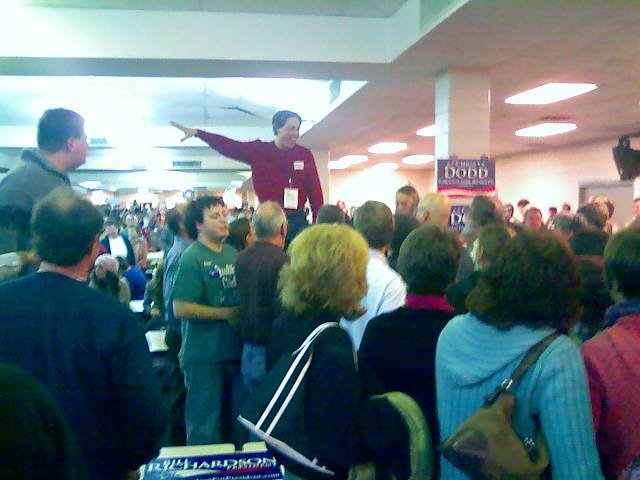
an NPR reporter observed tongue in cheek as we made our way home from Iowa City where we had attended a caucus as observers. With the campaign already moved to New Hampshire, all the analysis going on as we drove back to St. Louis on Friday seemed more retrospective than it actually was. Obama’s win pleased me from the moment I began to suspect it was coming, as we entered the Iowa City High School cafeteria at 6:00 p.m. for a 7 p.m. caucus and found that the Obama space was entirely full already when spaces allotted for the other candidates, including very large spaces blocked off for Clinton and Edwards, were mostly empty. Official voting attendance at our caucus was 719, with 50 or so observers in the room. You can get an idea how crowded it was from the picture on your left. That’s the precinct chair standing on a table trying to direct traffic during the realignment phase.

This morning I was still pleased with Obama’s win, because I’m a lifelong Democrat who thinks it’s extremely important to replace the bankrupt and terminally cynical administration in present day Washington, because I like everything I know about this young professor/senator, and because I responded to Obama’s victory speech much as the editorial writer for the Iowa City Press-Citizen did yesterday morning: “Got hope? Iowa does. More than enough to share.”

First-round voting at our caucus broke down as follows: 333 Obama, 130 Edwards, 105 Clinton, 53 Biden, 43 Richardson, 26 Kucinich, 19 Dodd. The threshold of viability in the first round of voting in the Iowa Democratic caucuses is 15%, which meant 108 votes at our caucus. Clinton was not viable in the first round but picked up 15 votes in the realignment phase to finish with 120. Voters for Richardson, Biden, Dodd, and Kucinich were unable to get together as a group, and some left without casting a second vote. Others realigned with the three winning candidates. Obama and Edwards finished with 384 and 169 votes respectively. I know personally that one final voter for Clinton was persuaded to switch from Obama by the argument that Obama wouldn’t miss one vote, but Clinton’s situation was desperate.

All in all, it was enough to raise my aging consciousness, punch my political junkie card, and make me proud of my country. I’m still proud, though the swift boating has already started. This afternoon I had a phone call from someone, purporting to represent the DNC, who asked me who I’m supporting for president. When I said Obama this person responded, “Aren’t you afraid he doesn’t have enough experience to be president?” I expect my caller represented some Clinton surrogate rather than the DNC. “What’s the national committee doing campaigning against a Democrat?” I asked as the phone went dead.

I know some Americans would like to have some better system of determining party nominees than the patchwork system we have. I like the present system because it leaves room for small places like Iowa and New Hampshire to contribute their brand of town meeting politics to the mix. I’ll be watching tonight’s TV debate with great interest, though, now that I have some skin in the game.

more on the Advent letter

I’m grateful to Fr. Jake for pointing out that the Archbishop of Canterbury’s Advent letter went out to the primates some time ago, so that its release to the public after the release of the ABCs Christmas message was accidental. But I still think, with Fr. Mark Harris, that the two messages are in conflict with one another, and that the conflict is unfortunate. I don’t see any Machiavellian purpose in the disconnect, but I’m thinking of something else Father Jake says: “[The Archbishop] does not consider it appropriate to state his personal convictions. He has set them aside, in an attempt to ‘articulate the mind of the Communion.'” And I’m thinking, OK, Maybe so. Fr. Jake also says that “Dr. Williams has polled the Communion, and has now come out in support of what he considers the majority view.”

I’m grateful as well to The Episcopal Majority for putting me in mind of Fr. William R. Coats’ reading of the Archbishop’s letter. Fr. Coats reads the letter far more positively than I do from a perspective much like my own, except that I think Fr. Coats may be better informed about the Communion than I am. My differences with Fr. Coats start with this passage:

What [The Archbishop] hopes for is what I call round two – the Covenant. This business to which we must all sign on to [sic] may in fact be the way we all do come together, so long as it doesn’t specifically turn on us. . . . Even Williams summation of Anglicanism at the beginning would be something I suspect we could sign on to – even the Biblical orthodoxy part (so long as no specifics are mentioned).

I’m not at all sanguine about the prospect of a covenant, any covenant; but that’s an argument for another day. Fr. Coats’ essay has garnered commentary to this effect:

The ABC is not taking sides. But he is defining the debate as much as anyone else. Extremists on both sides criticize him for not taking their side.

I thank him for staking out the middle. The place where unity trumps posturing.

I agree that the Archbishop has attempted to frame the debate. I do not agree that he has staked out the middle. If I understand Fr. Jake’s argument–and I acknowledge that I may have misunderstood–I agree in thinking that the Archbishop has attempted to identify himself with what he believes to be the stronger side politically. The politics of the Anglican communion have gone against TEC and against claims to social justice for gays and lesbians at least since 1998, with the adoption of the communion’s now infamous resolution on human sexuality. Now a reactionary trend has begun to affect internal TEC politics with the passage of resolution B033 at the 2006 General Convention and its “reconfirmation” by the House of Bishops in September 2007.

Actually, I don’t think there is a middle to stake out, though I realize that some within TEC are trying to find one. Nor is it a case of Fr. Jake’s way vs. the Archbishop’s way or the way of moderation. Not wishing to cast aspersions upon any person, clergy or lay, I merly point out that a political position that subordinates a legitimate claim to social justice to the exigencies of ecclesiastical polity is not moderate but pusillanimous. Those who argue against the legitimacy of the claim to social justice at least have a position for which, presumably, they are willing to take responsibility. But it’s also interesting, to say the least, that the blogger at Rather Not, prefers to remain anonymous.