I need to append a disclaimer to the beginning of this essay. It isn’t my intention in what follows to attempt a move out of politics or to pretend that I am making an analytical and apolitical rhetorical gesture. What I argue is political through and through, a point to which I return at the end of the essay.
It’s a cliché of political theater to claim that an argument is merely political, as though there were some form of the argument or some similar argument or some site of the same or a similar argument that is free of the taint of politics. There’s no such place, no such argument. It’s politics all the way down; and moreover, politics isn’t a taint. It’s the queen of sciences according to Aristotle. It’s the means by which we are able to act together in groups of all sorts, the index jointly of how we differ and of our solidarity. It’s the creator of the public space in which we reason together, as Lyndon Johnson was fond of saying, or do not.
And there’s the rub. Politics is by nature adversarial, the alternative to war and tyranny in civilized societies who take seriously the perception that persuasion is superior to force as a means of settling all but the crudest of disputes. And a corollary is that the cruder our everyday disputes become, the more the public space shrinks as a space for reasoned argument and the closer we come to war and tyranny. The public space has all but disappeared once in the history of the United States of America, and we fought a bloody war as a result. I’m thinking we’re very close to a similar near disappearance in our present public life.
That the present right-wing insurgency in this country is a rejection of politics ought to be very clear by now. Consider just a few phenomena. Since the beginning of President Obama’s term in office, the chief goal of the right has been to ensure the failure of his presidency. Just a year ago Republicans in congress held the entire country hostage and brought us to the brink of public insolvency in pursuit of this goal. Many Republicans now speak openly of overturning the voting rights act and of the partisan intention of current voter ID laws. Republican Mike Turzai”s claim that Virginia’s voter ID law would allow Romney to win in that state has been widely circulated, but other Republicans have made still broader claims for the rash of voter ID laws being passed by state legislatures.1 As conservative columnist Matthew Vadum put it:
Why are left-wing activist groups so keen on registering the poor to vote? Because they know the poor can be counted on to vote themselves more benefits by electing redistributionist politicians. Welfare recipients are particularly open to demagoguery and bribery. Registering them to vote is like handing out burglary tools to criminals.
And Minnesota Republican Kurt Zellers has been quoted as saying:
I think [voting is] a privilege, it’s not a right. Everybody doesn’t get it because if you go to jail or if you commit some heinous crime your [voting] rights are taken away. This is a privilege.
My point here isn’t to argue against these actions and claims (I think they are beneath contempt) but rather to present them as examples of the extent to which today’s right-wing insurgency rejects the most basic aspects of our republican tradition, and deeper still rejects politics itself. The ability of citizens to engage in political action depends in large measure on a shared sense of the common good. This is what present-day Republican strategies seem determined to destroy. Moreover, nobody should believe the right-wing insurgency’s claim to speak and act in defense of traditional American liberties. Quite the opposite is true—the right speaks and acts in an orchestrated effort to engineer the appearance of consent and thereby to restrict liberty.2
Republicans will shortly nominate Mitt Romney and Paul Ryan as their party’s candidates for the higest offices in the land. Both come from inherited wealth. Romney represents America’s most privileged class; Ryan is less wealthy but still much better off than most middle class Americans. The idea that Romney and Ryan are self-made individuals is equally ludicrous with respect to both men.3 Indeed, it is President Obama who has a reasonable claim to being a self-made person in the traditional sense (problematic for some voters who are sure he has been the recipient of some sort of afirmative action privilege).
Still, in the coming weeks the Republican ticket will attempt, indeed is already attempting, to draw upon a fund of populist support. They may have figured out something that progressives haven’t. In a recent New York Times piece, Binyamin Appelbaum and Robert Gebeloff describe the ressentiment that this Republican ticket attempts to enlist. Here’s one anecdote they present:
Ki Gulbranson owns a logo apparel shop, deals in jewelry on the side and referees youth soccer games. He makes about $39,000 a year and wants you to know that he does not need any help from the federal government.
He says that too many Americans lean on taxpayers rather than living within their means. He supports politicians who promise to cut government spending. In 2010, he printed T-shirts for the Tea Party campaign of a neighbor, Chip Cravaack, who ousted this region’s long-serving Democratic congressman.
Yet this year, as in each of the past three years, Mr. Gulbranson, 57, is counting on a payment of several thousand dollars from the federal government, a subsidy for working families called the earned-income tax credit. He has signed up his three school-age children to eat free breakfast and lunch at federal expense. And Medicare paid for his mother, 88, to have hip surgery twice.
“I don’t demand that the government does this for me. I don’t feel like I need the government,†says Gulbranson.
Appelbaum and Gebeloff focus on Chisago County, Minnesota, where “Mr. Gulbranson and many other residents who describe themselves as self-sufficient members of the American middle class and as opponents of government largess are drawing more deeply on that government with each passing year,” pointing out that Rick Santorum won 57 percent of the vote in the recent Republican caucuses there with his rhetoric about “the narcotic of government dependency.†Not all Chisago residents share Mr. Gulbranson’s views or his frustrations, as some of Appelbaum and Gebeloff’s other interviews illustrate. Still, the weight of Appelbaum and Gebeloff’s researches seems to justify this conclusion:
[A]s more middle-class families like the Gulbransons land in the safety net in Chisago and similar communities, anger at the government has increased alongside. Many people say they are angry because the government is wasting money and giving money to people who do not deserve it. But more than that, they say they want to reduce the role of government in their own lives. They are frustrated that they need help, feel guilty for taking it and resent the government for providing it.
………………………………….
But the reality of life here is that Mr. Gulbranson and many of his neighbors continue to take as much help from the government as they can get. When pressed to choose between paying more and taking less, many people interviewed here hemmed and hawed and said they could not decide. Some were reduced to tears.
Thirty years ago a team of social scientists led by Robert Bellah published a book entitled Habits of the Heart: Individualism and Commitment in American Life.5 The aporias that Appelbaum and Gebeloff detail remind me of some of the interviews recounted in first part of Habits of the Heart, narratives whose subjects encounter difficulty in resolving issues of commitment and relationship because they are trapped in a “culture of radical, privatized autonomy.”4
Bellah and his colleagues characterized the two large political discourses of modernism as welfare liberalism and neocapitalism. The problem with both as visions of our public life is that they share investment in an individualism that is empty of any conception of civic virtue and offers a vision of the good life based entirely upon accumulation and consumption. Ki Gulbranson wants to think of himself as a self-reliant individual, but his individualism cannot cope with the fact that he relies on elements of the welfare state in order to survive. As he puts it, “I don’t demand that the government does this for me. I don’t feel like I need the government.†But he does need the government, and his individualism gives him no ground for self-respect given that need. Nor does his individualism help him when he tries to think in terms of civic virtue. “You have to help and have compassion as a people, because otherwise you have no society, but financially you can’t destroy yourself. And that is what we’re doing,†he says mournfully.
Both modern political discourses reify individualism, the left primarily in terms of therapeutic self-actualization or traditional civil rights, the right primarily in terms of economics. We have come to see individualism as the only alternative to tryranny in contemporary social life. The left accuses the right of fostering a tyranny of wealth, and the right accuses the left of fostering state tyranny. Both are partly and sometimes right and partly and sometimes wrong, but the corrective is not to be sought in either, any more than it is to be sought in a retreat from politics.
Bellah and his colleagues claimed, I think rightly, that we Americans need to renew our civic life by reviving those habits of the heart which Alexis de Tocqueville long ago experienced as the foundations of our society. Tocqueville defined such habits loosely, as collections of notions and mental habits, but also as habitual practices involving religious, civic, and economic life. What is missing in our present social life is the understanding that such habits are public. For Tocqueville, indeed for his age, the notion of a private citizen would have been an absurdity. We are spouses, farmers, teachers, physicians—above all we are citizens. These roles and many others like them, together with the habits of mind and practice that shape them, are the forms of our public life, not items of reified private identity. Habits of the heart attach to our shared humanity, something we still experience (or at least some of us do) in “communities of memory and hope”6 such as churches, schools and universities, where vestiges of mutuality and shared obligation remain.
Churches, schools and universities are communities too small to effect a renewal of our social life. Tocqueville’s conception of American life was tied to a small-town, agrarian culture that hasn’t existed in this country since the late nineteenth century. Much of our American mythology nostalgically evokes images of that culture, but if we are to reconstitute a large-scale American community of memory and hope, it will surely possess outlines far different from the community Tocqueville experienced in the 1830s. One thing is certain, however. If we do seek to renew our social life, we will do so by a return to politics. It’s the only means we have. Part of any such return will inevitably involve the perception that present social and economic dislocation proceed (at least in part) from, and are exacerbated by, our present structures of inequality as well as by the level of incivility that characterizes our popular culture. As I write this my beloved is listening to President Obama’s press conference in the next room as she works on a syllabus for the coming school term. It is refreshing to hear the civil tone of the president’s conversation with reporters. Time will tell.
Notes
1The linkage beetween the broad Republican effort to restrict voting and the American Legislative Exchange council (which claims to be non-partisan), the Koch brothers, and other rightist foundations and corporations is now well known. See here, and here, and here.
2Noam Chomsky makes this point forcefully in a recent essay at the Huffington Post, “Destroying the Commons: How the Magna Carta Became a Minor Carta.”
3About Romney and Ryan’s relative wealth see this. On Ryan’s inherited benefits see this and this.
4For the quotation see “Individualism and Commitment in American Life,” a lecture delivered by Robert Bellah at the University of California, Santa Barbara, in 1986.
5Berkeley: University of California Press, 1983. A new third edition has been available since 2007.
6The term occurs pervasively in Habits of the Heart.

 Here’s the entrance to the Missouri Botanical Garden as we saw it over the fourth of July weekend this year during the Lantern Festival, a collaborative effort between the garden and a group of Chinese artists. There’s a video here, if you want to see more of what it was like at night, a magical experience. And here’s a picture I took of the Gateway Arch that same weekend. We went for a boat ride on the river with out-of-town guests one morning and in the afternoon attended a naturalization ceremony at the old court house (slideshow here).
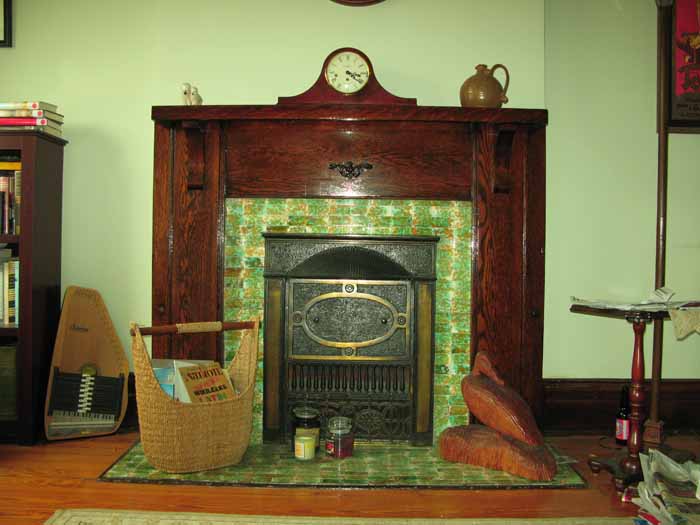 Our house was piped for natural gas from the beginning and seems to have had at least one gas light, although it was originally wired for electric lighting as well. An old gas outlet has been capped at the top of the front stairwell, the original entrance to the second-story flat. My beloved hangs a wreath on it. We have the original gas units in the upstairs and downstairs fireplaces, though we’ve never tried to use them. I keep thinking I’d like to have modern gas units, but the old ones are beautiful. Here’s the downstairs fireplace as it looks today.
 So it’s good to be breathing in and out and able to savor these good things. We may even go to the pumpkin patch outside Iowa City next month after we get back from our other adventures.