Advent: a time of great change?

One of my students two weeks ago remarked that we are living in a time of great change. I didn’t disagree because I never do that with students, but I am thinking today that a time of great change may already be past, a trajectory such as that Richard Rorty describes in “Trotsky and the Wild Orchids,” one “defined by the Bill of Rights, the Reconstruction Amendments, the building of the land-grant colleges, female suffrage, the New Deal, Brown v. Board of Education, the building of the community colleges, Lyndon Johnson’s civil rights legislation, the feminist movement, and the gay rights movement.” Rorty was more optimistic in 1992 than I am now. He didn’t live to see the neofascism of the anti-Obama movement, though he could have predicted it. “The future of American politics may be just a series of increasingly blatant and increasingly successful variations on the Willie Horton spots.”

Following Dr. King. It may be that the arc of history bent towards justice for a stretch of time in the last century, but if so it has now snapped back with a vengeance as far as I can see. That a seeming preponderance of good people, many of them liberal and some of them African American, can not merely countenance but embrace the official dehumanization of Michael Brown as recorded in the proceedings of the recently closed St. Louis County grand jury hearing, that these same good people can accept the outcome of that hearing as a triumph of the rule of law, that my country at large, including my young President, can not only accept but defend our contemporary surveillance state with its increasingly oppressive policing whose excesses fall primarily upon ethnic minorities, the disadvantaged and disabled, and the mentally ill—none of these circumstances gives me hope for my country’s future.

One of the big stories in St. Louis last weekend concerned the appearance of five St. Louis Rams players making the ‘Hands Up, Don’t Shoot’ gesture on the field at Sunday’s game with the Oakland Raiders. The St. Louis police union reacted quickly with a demand for an apology, though news reports alleging that the team had officially apologized were later denied by Rams executive, Kevin Demoff. But more interesting to me is the language of police union representative, Jeff Roorda:

[N]ow that the evidence is in and Officer Wilson’s account has been verified by physical and ballistic evidence as well as eye-witness testimony, which led the grand jury to conclude that no probable cause existed that Wilson engaged in any wrongdoing, it is unthinkable that hometown athletes would so publicly perpetuate a narrative that has been disproven over-and-over again. . . . Our officers have been working 12 hour shifts for over a week, they had days off including Thanksgiving cancelled so that they could defend this community from those on the streets that perpetuate this myth that Michael Brown was executed by a brother police officer and then, as the players and their fans sit safely in their dome under the watchful protection of hundreds of St. Louis’s finest, they take to the turf to call a now-exonerated officer a murderer, that is way out-of-bounds, to put it in football parlance, . . .

Not only does Roorda claim that Darren Wilson and by extension all Police were vindicated by the McCulloch grand jury, but he also promotes the grand jury’s findings to the level of absolute proof, delivered over and over again, while displaying a contempt for the community he alleges his brother officers defend that seems deep and abiding.

Along South Grand police still engage in racial profiling. St. Louis police tear gassed a crowd of innocent people inside Mokabes at the corner of Grand and Arsenal on the night the McCulloch announcement, sending a hundred or so injured to St. John’s Church down the block. My priest told me the next evening that she had called the chief of police on his private number—both Mokabes and my church had been designated sanctuaries—to ask what she should do with the wounded. That same evening I talked with two young men who had been among the injured. One of them was likely responsible for some of the video you can review here. I don’t know his name. It may be that police did not provoke the violence in Ferguson that night as they did last August. But Ferguson police apparently raided St. Mark’s Church, and someone allowed a large section of Ferguson to burn to the ground. Read my friend Kevin McGrane’s account of that evening at his blog, The View From Windy Hill.

Michael Brown has now entered the realm of urban legend as an incarnation of The Incredible Hulk, joining Trayvon Martin and a host of others of the publicly dehumanized. The dehumanization of 12-year-old Tamir Rice, of Cleveland, has already begun.

Meanwhile, the cosmic cycle wheels in the heavens and brings the beginning of another Advent season. I think I first understood Advent at about age fourteen when I sang in a Messiah rehearsal at First Baptist Church in my home town. I particularly remember a tenor whose name I have forgotten, a young man who served as a soloist at St. Paul Methodist Church, where I had grown up. His singing that day of the plaintive song of Isaiah forty, for a fourteen year old boy in love with singing, forever imprinted the words, “Comfort ye my people,” in my imaginary so that I cannot recall them without Handel’s music. I no longer remember the sound of the voice I heard that day—perhaps it has been supplanted by that of Richard Lewis. But the gestalt, the old half-round church that was later torn down, and the gray weather of an early 1950s December Sunday afternoon, lodges in my mind together with that musical gesture and other antique rhythms.

These seem particularly antique to me this year. I remember quoting the great Advent antiphon once long ago and moralizing it: ‘Desire of Nations is a handsome epithet; having intoned it, we are left desire.’ As this year winds down towards the solstice I find that I am much in need of such comfort as that of which Isaiah sang so movingly, but my own song sounds more and more to me like “That lucid souvenir of the past, / The divertimento; / That airy dream of the future, / The unclouded concerto . . .” of which Wallace Stevens speaks in a poem called “Mozart, 1935.”

If they throw stones upon the roof
While you practice arpeggios,
It is because they carry down the stairs
A body in rags.

A priest I loved once said in a sermon that we postmoderns are a people who have lost our story. I am feeling particularly marooned this Advent, having lost my story (or a substantial part of it) and perhaps its music as well.

We may return to Mozart.
He was young, and we, we are old.
The snow is falling
And the streets are full of cries.

—Come, Lord Jesus!

Happy Thanksgiving!

_MG_2122.jpg

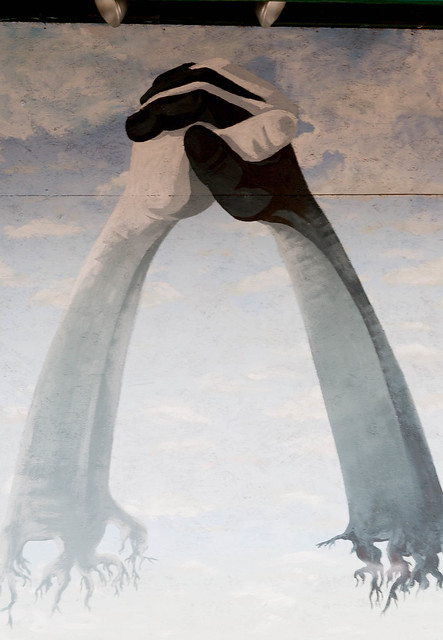
This photo from the Grand Boulevard Gallery in my city seems especially poignant to me today. I’m cooking, anticipating the arrival of friends and family for holiday visiting—doing the things I love to do on Thanksgiving day. If I could put my arms around all my friends and family and all those in the spectrum of my awareness and say nothing, only let the touch speak peace, perhaps that could call down a blessing as we will pray at my table this evening.

God keep you today and always, Facebook friends, blog friends, and all who may see this note.

along south grand the morning after

Back before I got sick last summer I had begun to explore my city with a camera. There’s a lot I want to write about St. Louis, and I’m thinking I’ll illustrate many of these posts with my own photographs as I write them and put them up.

I’m also getting more serious about photography. I’ve started a photo stream at Flickr and am trying now to build it up as I explore Adobe Lightroom. I think I’ll try to post photos every week from now on, in addition to the ones I’ll use in posts about the city and other things and places. I had thought to get my photostream built up a good deal more before posting the first photos here, but I have a reason for beginning now that will be immediately apparent.

This morning I braved chilly weather for a walk down South Grand, about a half mile from my house. It’s a strip filled with restaurants, boutiques, service businesses, a bank, and it serves as the comercial center of three more or less contiguous neighborhoods around historic Tower Grove Park: Tower Grove East (my neighborhood), Tower Grove Heights, and Shaw (where Vonderrit Myers was shot). Though protests about the Ferguson decision were mostly peaceful along South Grand there was some looting and a good many businesses had windows broken out. My church, St. John’s Episcopal Church just half a block west of Grand on Arsenal, had windows broken along the alley.

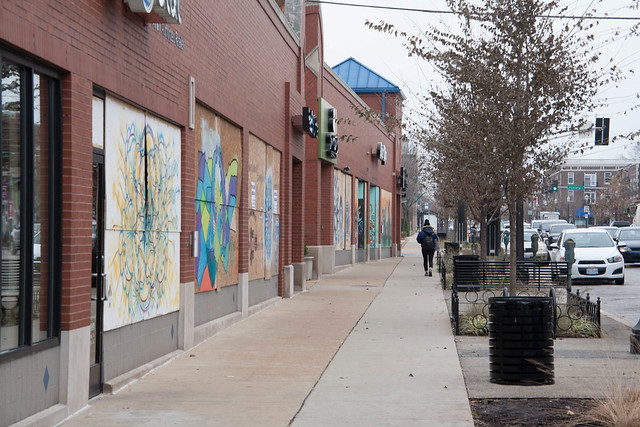
I’m going to write more about that evening and my church’s role in it later. Right now I’m still thinking about my morning’s walk. Here’s a photo taken at the southeast corner of Grand and Arsenal looking down past the storefronts on the east side of Grand. The same gestalt could be seen repeated in each block of Grand for the next six blocks.

_MG_2121.jpg

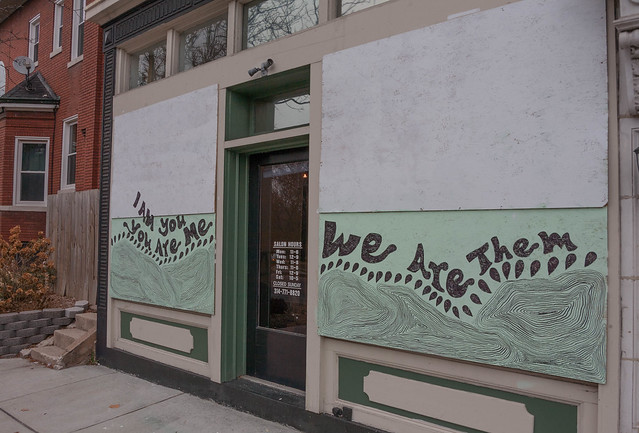
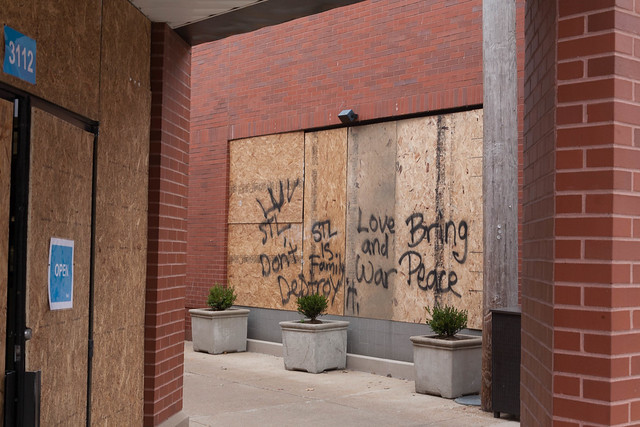
Something remarkable occurred in the hours after the plywood barriers went up. In late morning, early afternoon, people began to paint signs and murals on their storefronts. I don’t know how much of this was spontaneous and how much was orchestrated by neighborhood merchants, and I’m not sure I care. As the painting went on more and more artists joined in, painting whatever they were inspired to say in the spaces offered by the boarded-up storefronts. By late evening, when we walked to South Grand to have dinner, the street was alive with what in the sixties we might have called a happening, and what we now sometimes call a smart mob, made up of folks painting whatever vision they had on the walls left behind by calamity.

A good many of the South Grand Murals aspire to be prophetic, like this one on the front of Salon St. Louis where my beloved gets her hair cut.

_MG_2117.jpg

Or this one, in the window of the Wyoming St. Post Office.

_MG_2161.jpg

Others are more prosaic, like this one on a side wall of The St. Louis Bread Company.

_MG_2126.jpg

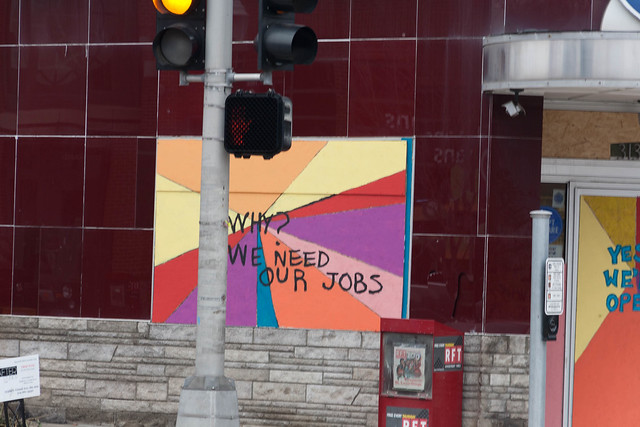
When I drove down Grand at mid morning yesterday, I noticed a good many boarded up windows spray painted with the slogan, “Why? We need our jobs.” Here’s one mural that stuck to that message, on the Medicine Shop window at Grand and Juniata.

_MG_2135.jpg

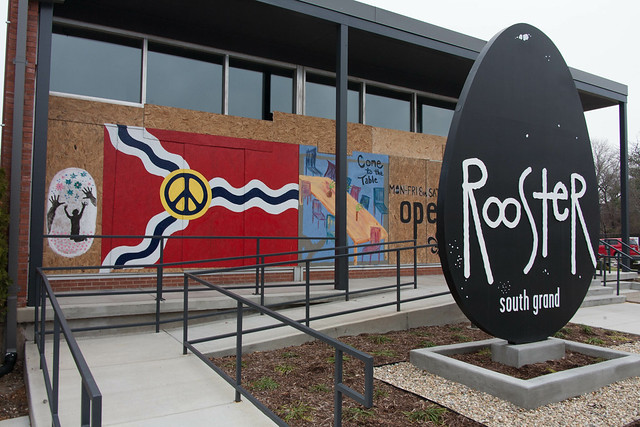
A brand new restaurant, Rooster, was particularly hard hit. Its large expanses of glass were too good a target, I suppose. Here’s what Rooster’s front looks like now.

_MG_2141.jpg

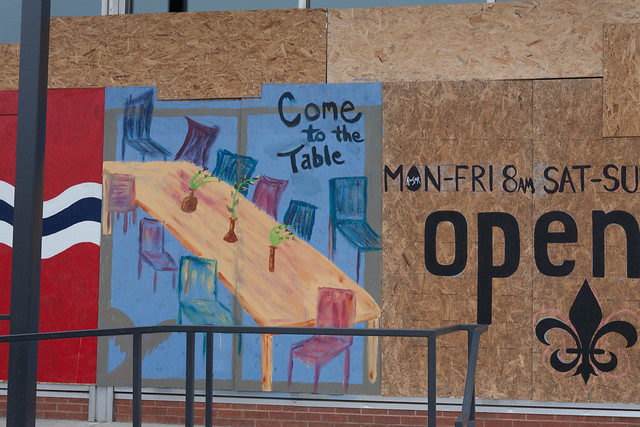
The flag is the city flag with a peace sign substituted for the central fleur-de-lis. Because we met friends from church inside last night when we had dinner there, and because we then stopped by the church on our way home, my initial reaction to the invitation to table was to think of church, but I’m sure Rooster was only advertising.

_MG_2142.jpg

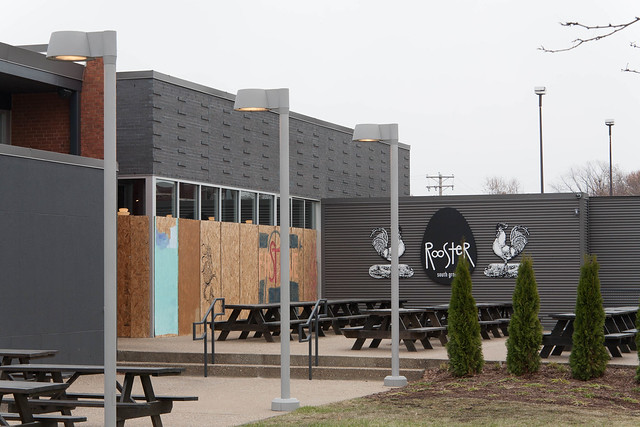
Here’s a photo that shows more of the damage at Rooster. It’s a former bank building and has been jammed with crowds since its opening in October. The owner is local entrepreneur, Dave Bailey. You’ll find a number of good reviews if you Google.

_MG_2170.jpg

As we were walking last evening after dinner we met lots of folks to talk with. There was a festive, almost holiday atmosphere along the street. One man we spoke with, not a young man, had a couple of cans of Krylon paint in his hands which he kept shaking as he spoke. We complimented the murals and asked which ones he had a hand in. He laughed enthusiastically, “I’ve not started yet, but I’m about to!”

I’ll post more mural photos at Flickr as I’m able. It will be interesting to see whether these murals grow as time goes by. Of course they aren’t permanent, but grafitti tends to grow while it lasts. Our server at Rooster commented about the murals that they made him proud and happy—he lives in the area. “Isn’t it interesting how sometimes the worst in people brings out the best,” he said.

Michael Brown verdict

The St. Louis County grand jury has now found no probable cause to indict Darren Wilson with a crime as a result of his killing of Michael Brown. County Prosecutor McCulloch has laid out the evidence in such a way as to exonerate Wilson and has suggested that anyone who disagrees must have made up her mind in advance of the facts, likely influenced by irresponsible media. Of sourse, what Prosecutor McCulloch presented was an argument based on a carefully selected account of the facts, despite McCulloch’s constant protest that the Grand Jury was presented with all pertinent evidence.

I have never believed that officer Wilson would be indicted for killing Michael Brown. I pointed this out first here. The law gives police the benefit of the doubt in cases such as this one. But it should be said that this is not justice. It is rather a legal shield for the power elite. Prosecutor McCulloch urged the expression of dissent ‘so that such a thing might never happen again,’ but I found his pleading unpersuasive. There are numerous possible interpretations other than the now official one of the “facts” that Prosecutor McCulloch presented. Unfortunately, we shall now never hear them aired in open court. This was what the St. Louis County Grand Jury process was about.

Aside from the fact that McCulloch had a huge conflict of interest in this case and should have recused himself in the beginning, his polemic defending the impartiality of the grand jury process and claiming that anyone who dissents is insulting or attacking the integrity of the good folk who served on the grand jury, who gave up their lives, etc., is a pretty naked appeal beyond the merits of the case. It seeks to set those good citizens who support the grand jury and do not support Michael Brown, a young black man with an attitude, and those who do support Brown, against one another. But these adversaries should have met in open court, and they will not.

For a grand jury proceeding does not allow cross examination of witnesses. When asked why he did not seek a jury trial in this case McCulloch responded that had he done so a pre-trial hearing would still have occurred and the case would still have gone to a grand jury to determine probable cause. The difference is, of course, that a prosecutorial trajectory would have been set in a normal pre-trial proceeding, and that would have strongly influenced the outcome. The best chance McCulloch had of influencing the outcome of this particular case (and of avoiding any potential negative consequences with the electorate) was to present it to the grand jury with no recommendation.

I think the Michael Brown murder trial, travesty though it was, was not about Michael Brown or even about Darren Wilson. I think it was about creating a local outcome that could not easily be appealed to fhe federal court system and create the possibility of overturning Graham v Connor. Of course there will be gunshots, never mind who shoots; and of course there will be looting and vandalism. Civil strife invites opportunistic exploitation, and the terrible irony of such things is that often the innocent are harmed. When a society sets out an intentional policy of harming the innocent, where will such a policy come to rest?

So in the final analysis the verdict was, and is, a whitewash, or worse: the fix was in. The grand jury was used, and the predictable outcome confirms the establishment narrative with all necessary violence and chicanery.