Cheap at the price: So, today, The Washington Post tells me the EPA has devalued my life. I used to be worth $8.04 million, but now I’m less expensive, only about $7.22 million. Of course, this is my statistical worth. It has nothing to do with me personally, the elderly gent with high blood pressure, arthritis, and relatively few of his own teeth. It’s a worth that goes into cost benefit analysis designed to enable decisions about policy. Is some environmental plan worth its cost of 275 million, if it will save 37.5 lives? Assuming those lives are worth $8.04 million apiece or $301.5 million total, the answer is yes. But if those lives are worth only $7.22 million each the total drops to $270.75 million, and the cost of the program exceeds its benefit.
I like the Post’s title, “Cosmic Markdown: EPA Says Life Is Worth Less.” And I like the lead:
Someplace else, people might tell you that human life is priceless. In Washington, the federal government has appraised it like a ’96 Camaro with bad brakes.
Specifically, it looks as though the Bush EPA is up to more deviousness about environmental matters.
“By reducing the value of human life, which is really a devious way of cooking the books, the perceived benefits of cleaning up the air seem less,” said Frank O’Donnell of the District-based group Clean Air Watch. “That has the effect of weakening the case for pollution cleanup.”
I couldn’t agree more. And I also think the various federal agencies who put dollar values on life should at least agree with one another. Apparently the department of Transportation values life even less than the EPA does, only about $5.8 million. Transpo needs a lower value, no doubt, to make its case for continued neglect of the nation’s roadways and bridges.
According to Jack Wells, chief Transpo economist, “We could eliminate a lot of the [highway] fatalities by imposing a 10-mile-per-hour speed limit,” but we tolerate increased risk of death at higher speeds “in return for the economic benefits of faster travel.” It’s the old false analogy trick, and it doesn’t explain (not even to an economist) how or why society (another statistical abstraction) should tolerate everything from unimproved and decaying interstate highways to dangerous construction zones and collapsing bridges.
 On the road: My guy has gone to the Middle East, I see, with a great big media entourage. The Washington Post editors and Wake Up America are keeping their powder dry in the expectation that Obama will lack the judgment to admit he was “wrong about the surge” which reversed earlier Bush policy “and is finally winning the war”: an amazing claim, it seems to me. Lives continue to be lost, some of them to the Bush/Cheney legacy of malfeasance in contracting; other valuable resources continue to be wasted.
Present developments in Afghanistan are proving Obama’s judgment to have been correct there though, like McCain, he has had some trouble with the small stuff. Gail Collins wonders in today’s New York Times if Obama needed to make the trip at all, if a series of phone calls wouldn’t have done just as well, especially since John Mccain can’t seem to decide whether he thinks Obama is remiss for having stayed away from Iraq or for going there now, or apparently going there.
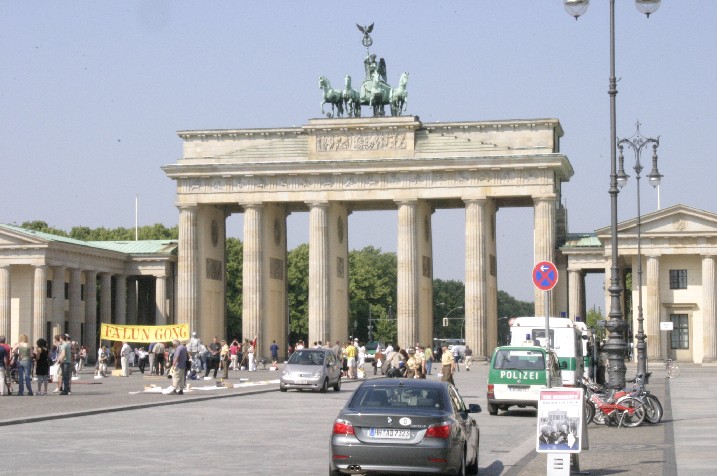
He’s not there yet (not in Iraq, that is), and I’m now reading that he he will not speak at the Brandenburg Gate on his way home. It’s too bad. The gate is regularly available for show business (which there’s no business like) in spite of Angela Merkel. Last year about this time our German guide explained to me that the military looking folks in the jeeps with the guns that seemed to be keeping a watchful eye on a group of Falun Gongers, were actually actors.
I’m sorry I missed the opportunity to kvetch about the now infamous New Yorker cover. But if showbiz wins elections these days (and it’s always played a big part in them), there’s no way McCain can win. Unless, of course, the stuff the New Yorker cover spoofs has more influence than I think it does. Obama may need this trip abroad for the favorable media he may generate, and not just for now. It really is too bad about the Brandenburg Gate. Future sound bites could have presented Obama as JFK (though the famous Ich bin ein Berliner speech was delivered at Schöneberg Town Hall), and that may be important when the swift boat ads have given us shots of Obama’s Indonesian school, interspersed with images of dark fists in the air all tied together by an announcer with a Walter Cronkite voice and backed up by ominous music.
It’s now being reported that Obama will speak in Berlin at the Victory Comumn. Here’s a long telephoto of it shot from the top of the Reichstag. What you see all around is the Tiergarten, and even though it looks as if there’s no space around the tower, there’s plenty. What looks like smog is actually something else, the result of a hand-held camera shooting with a 300mm lens through a glass window. It was a beautiful clear day when I took this picture. I’d stay away from the column if I were Barack–too much association with German imperialism. What about the Reichstag? Though I think I’d go here. This courtyard lies between the old Royal Library (now the Humboldt faculty of Law) along Unter den Linden, and the historic Staatsoper. Here’s a shot of the stage house. I don’t know why I didn’t take a picture of the front door. This was once the principle courtyard of the University of Berlin, which was renamed for its founder in 1949. It was here that books were burned by the Nazis in 1933. There’s a monument to lost learning in the courtyard’s center. I think Barack could do something good by speaking in such a place instead of the Kaiser’s monument to militarism.
. . .
If we count the lives lost in Iraq — just the American soldiers, 4,122 acording to one recent count — that’s an expenditure of almost $30 billion if we use the EPA’s valuation. I wonder if that cost is factored into present cost estimates for the war that are being bandied about. I wonder what the Department of Defense would claim to be the value of a life.