Advent II: Looking for America

If I have left the impression that I think all evangelical Christians supported the election of Donald Trump, I should correct it. Here are two statements, one by a Baptist layman and another by the president and past president of Fuller Seminary expressing dismay over Trump’s election that is kin to my own. Nor do I want to convey the impression that I think the mix of racism, misogyny, and xenophobia that permeated the Trump rallies is necessarily characteristic of evangelical Christianity or of Catholicism. What follows is a meditation on what I take to be the spirit of these two statements. I have no idea how to translate it into anything else.

On the other hand, I am convinced that a vote for Trump was not an innocent act. We will discern that lack of innocence in the coming months as the Trump presidency unfolds. It will have two primary goals, I think: to enlarge the cult of Trump, and to act out what Katherine Kramer has termed The Politics of Resentment. We won’t see the wholesale return of “American jobs,” but we will see plenty of scapegoating of the politically and socially vulnerable, who will be blamed for the country’s alleged ills, and an attempt to dismantle the liberal establishment. Look at Wisconsin, Kansas, Louisiana, Michigan, and other states that have experienced large-scale destruction and/or stagnation of the public sector for models of what could happen nationwide. Trump’s scapegoating of Boeing is also deeply disturbing. Coupled with the corporate welfare Trump and Pence have promised United Technologies in relation to Trump’s inflated claim of “saving Jobs” at Carrier, it bespeaks the capriciousness of a would-be dictator.

One of my students a couple of years back remarked that we are living in a time of great change. I didn’t disagree because I never did that with students, but I thought then and am thinking today (as I noted in a previous Advent piece) that a time of great change may already be past, a trajectory such as that Richard Rorty describes in an essay entitled “Trotsky and the Wild Orchids”–one defined by the Bill of Rights, the Reconstruction Amendments, the building of the land-grant colleges, female suffrage, the New Deal, Brown v. Board of Education, the building of the community colleges, Lyndon Johnson’s civil rights legislation, the feminist movement, and the gay rights movement. Following Dr. King. It may be that the arc of history bent towards justice for a stretch of time in the last century, but if so it has now snapped back with a vengeance in the rise of Donald Trump. Those of us who opposed him now have to figure out how win elections in a poisoned political environment.

And it may also be important in the short term for those of us who have been part of the liberal establishment and still celebrate its accomplishments to figure out how to prevent, or at least to slow, its destruction: to preserve public education, the national parks, the continent’s infrastructure, the professions, civil rights, the elements of democracy we have taken for granted since the great depression, the social safety net, the press, the middle class, to say nothing of civility and common decency in our national leadership. Trump and the Republican leadership promise us liberals not only destruction, but also authoritarianism, cruelty, crudity, and inauthenticity on a scale we have not seen in American public life for a long time, perhaps since the time of Lincoln. Last June as I wandered about the mall in our nation’s capital I couldn’t help thinking that I can’t imagine how or why anyone would seek public office with a goal of destroying the institutions that surrounded me. Yet here we are. An apparent majority of our nation’s governing faction currently rejoices in its intention to do just that.

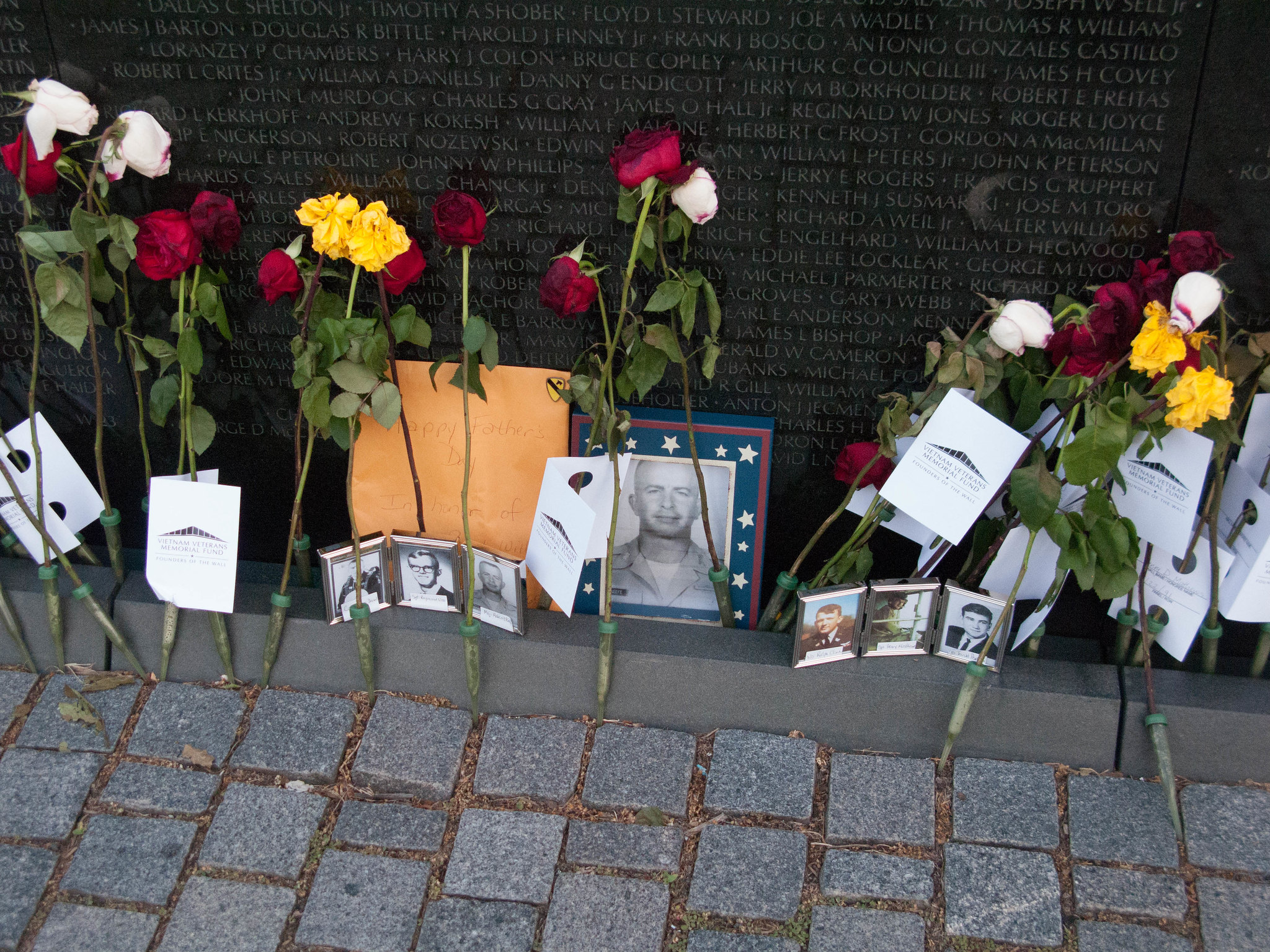
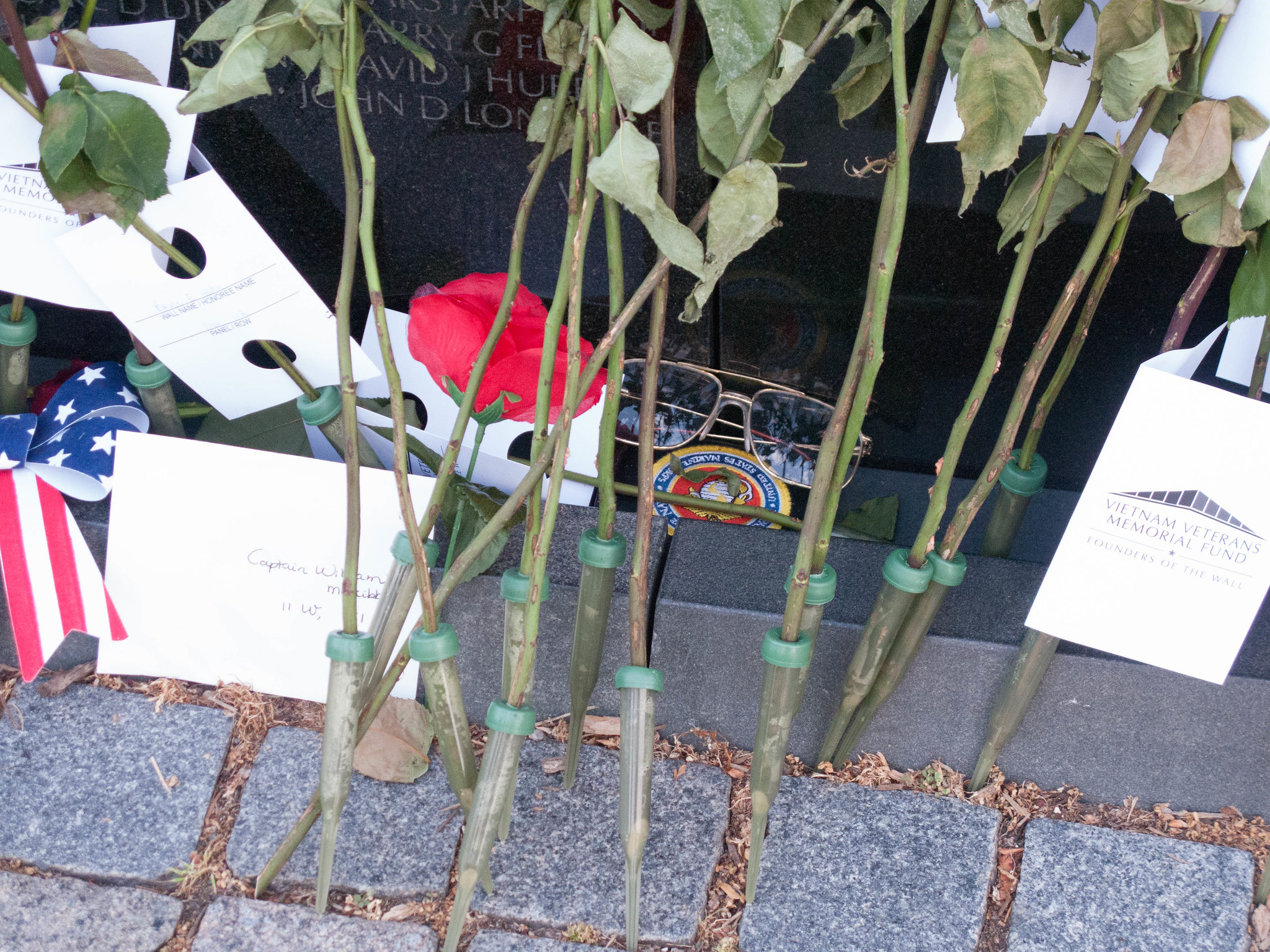
We were in Washington over the Father’s Day weekend, and it was on Father’s day that we visited the Vietnam Veterans Memorial. Here is how it looked, with garlands of flowers and personal memorials along every inch of the long memorial wall that is its centerpiece.


IMG_2220.jpg

IMG_2224.jpg

It continues to draw huge crowds, and this Father’s Day I estimated thousands of friends and families of the dead of that war had left remembrances there. Some were little shrines that included effects of the persons remembered, family pictures, glasses, driver’s licenses, wallets, medals and insignia. It was heart wrenching to see them there in a way no photograph can convey.
IMG_2222.jpg

IMG_2219.jpg

I opposed the war in Vietnam, made no secret of my opposition, participated in protests; but I also spent three years at the height of the conflict teaching school at Fort Bragg, North Carolina where I knew, befriended, and was befriended by many Vietnam veterans, some of whom were in between tours. One of my students (younger than I was—I was young then too) had done three tours in Viet Nam and wanted to go back. He had some things on his conscience from his first tour for which he had continued to try to atone. I have often wondered what became of him. Then there were the days I arrived on post to an atmosphere supercharged with dread and grief because there had been a parachute malfunction that caused a training death. And it wasn’t just that someone had died; the atmosphere was quite different during the days when the post was absorbing news of the MacDonald murders. Airborne soldiers folded and packed one another’s parachutes for each jump. I learned something about solidarity on those death days, something I think I saw again last Father’s Day.

In 1987 I reviewed My Father, My Son for The Dallas Morning News, a book by Elmo Zumwalt, Jr. and his son, Elmo Zumwalt, III. It tells of the their terrible struggle and grief as Elmo, III slowly died of lymphoma caused by exposure to Agent Orange, whose use as a defoliant his father had ordered in Vietnam. (Elmo III’s son Elmo IV, was born with a severe nervous disorder linked as well to his father’s exposure to dioxin.) At book’s end in 1986, Elmo III was recovering from a successful bone marrow transplant that extended his life another two years. At the end of my review I quoted a short statement from a letter he wrote his father at that time that I thought illustrated how Vietnam had given them a particular bond.

Both in Vietnam and with my cancers, we fought battles and lost. Yet, we always knew even when the battle was clearly desperate, that our love could not be compromised.

Young Zumwalt never blamed his father for his illness, always thought his father was right to order the use of Agent Orange. But by the time of his death in 1988 the Supreme Court had removed the last obstacle to implementing a multi-million-dollar settlement between veterans and the Agent Orange manufacturers. My Father, My Son is still worth reading. The Zumwalt story is almost an epitome of the entire war and its complex chain of consequences that continue to play themselves out in our country’s moral history. The Vietnam Veterans Memorial reminded me not only of that complexity but also of the way Vietnam veterans were treated upon their return home, one of the most shameful episodes in that moral history.

Our country’s present rightist elite have ruthlessly and, I think, cynically exploited a moral divide between Americans in relation to which there is good will on both sides. What many of us on the left know is that we don’t deserve the resentment that right wing elites have channeled towards us. But we also need to realize that some of our attitudes towards conservatives are stereotypical and that the divide between “us and them” will not be understood or ameliorated by wonkery because it’s more than political. Indeed it goes to the heart of who we are as Americans. As I walked along the veterans memorial wall I thought of Simon and Garfunkel’s “America.”

“Kathy, I’m lost”, I said,
Though I knew she was sleeping.
“I’m empty and aching and
I don’t know why.”

Counting the cars
On the New Jersey Turnpike
They’ve all come
To look for America. . . .

I love this song for its catalogue of ordinary ironies and its evocation of a time when I thought I had America right. I’m thinking now of a friend who I think voted for Trump but still offered to hug my neck as we realized we had things we could talk about in the aftermath of the election. We Americans are, we were then, who we are—all of us, as Mrs. Antrobus says of women in Wilder’s The Skin Of Our Teeth. “We’re not what politicians or poll takers say we are, and we’re especially not the ideological idiots pundits and social media say we are. We’re ourselves.’ Perhaps we could find America again together if we met spiritually somewhere near the Vietnam Veterans Memorial and began to talk about how we got there.

sentries of the heart

Before I go back to writing about my country, here’s a riff on the death of Leonard Cohen. It ultimately feeds back into my particular political angst and will, perhaps, make a nice segue.

To speak of Cohen’s death I need to do more than quote a few lines from my favorite Cohen song. indeed, I have some sympathy for the idea that Cohen would have been a better choice for the Nobel Prize than Bob Dylan. I think Dylan never escaped the historical moment to which his best songs were a response, though we can argue about what I think of as his retreat into religion. Cohen, on the other hand, spoke to the human condition at large; though a certain piety always tinged his vocabulary.

But I want to speak about Cohen from a moral perspective. I used to direct my students to a website devoted to Cohen’s “Alexandra Leaving,” one of his great songs, overlooked in the Facebook posts I have seen, as fans have flocked to songs like “Hallelujah” and “Anthem” that are easily susceptible to ideological translation. (Interestingly I have seen only one reference to “Suzanne, none to “Bird on a Wire.”) The Cohen songs of which I am most fond celebrate courage in the face of existential loss—and thereby hangs a tale.

“Alexandra Leaving” is a parody (in the musical sense of a copy or appropriation that does not necessarily imply or proceed from humorous or satirical intention) of a poem entitled “The God Abandons Antony” by Constantine Cavafy. If you look at the website I’ve referenced in the last graph you can read the texts of Cohen’s song and Cavafy’s poem in my favorite translation. My purpose in referring students to this website was that it exposes a complex case of appropriation. It also illustrates how an appropriation may not erase an appropriated text but rather comments on it in such a way that familiarity with the appropriated text can enhance and deepen one’s reading of the new. The website I reference cites Cavafy’s source in Plutarch but doesn’t mention Shakespeare’s use of it. Here’s another website that does.

It is both enough and not enough to say that “Alexandra Leaving” is about the end of a love affair, the loss of a lover and the speaker’s attempt to accept that loss without rancor or blame, even for himself, though acceptance of the loss necessitates acceptance of responsibility. For the loss is existential, like a death, a wound to the speaker’s identity and sense of his place in the world. That was Cohen’s gift in this song, to see how the loss of a lover to the death of love was akin to Antony’s loss of his adopted city, one of the greatest of Mediterranean cities, Alexandria.

There is a place in the Republic wherein Glaucon addresses Socrates as follows: “[Y]ou mean [to describe] this commonwealth we have been founding in the realm of discourse; for I think it nowhere exists on earth.” Socrates replies, “Yes, but perhaps there is a pattern set up in the heavens for one who desires to see it and, seeing it, to found one in himself.” (I’m quoting the Cornford translation.) For the Romans such a pattern was to be found in the earthly city, preeminently in Rome, itself. Even St. Paul paid homage to this conceptualization, claiming famously that he was a citizen of “no mean city,” taking some pride in his Roman citizenship. And it is this idea to which Cavafy alludes as he describes the defeated Antony:

As one long prepared, and graced with courage,
as is right for you who were given this kind of city, . . .

“[I]t is right and a good and joyful thing,” to quote the Book of Common Prayer, for the defeated Antony, having lost everything, to step to the window as an invisible procession passes, to listen with a heart filled with courage

to the exquisite music of that strange procession,
and say goodbye to her, to the Alexandria you are losing.

One may lose a lover. One may even lose a city. One may lose the center and focus of one’s life. But one is not permitted to lose heart, not one who had been given such a lover, such a city, in the first place and for a while, at least, been found worthy of the gift.

I thought of these things before I knew of Cohen’s death, as I tried to sort through my own sense of having been gobsmacked by the election of Trump. For a while I felt as though I had lost my country and a big chunk of my identity as well. But countries come and go. I have lived through many iterations of my country in my almost eighty years. Here is one of my favorites among the songs of Leonard Cohen.

May he go with God.

Living by Fiction

I’m at home this week with what I hope is almost the last of a case of pneumonia. I joked with a friend the other day that I have ‘the rockin’ pneumonia and the boogie woogie flu,’ though I’d not like to call up the lyrics of that Johnny Rivers hit too literally. Yesterday, in the midst of some solemn Sunday reflections, I received a nag from Facebook telling me I hadn’t posted on my blog for a week, tsk., etc. So I dutifully looked around under the bed for some unfinished thoughts I could work up into something to fulfill the Facebookian expectation.

And I found something. For years now, at least since I observed how Richard Nixon fulfilled the expectation of comic book ads I grew up with and made himself the life of parties by playing the piano, I’ve wanted to write something about the authority of the fake. We Americans can seem obsessed with authenticity sometimes. Consider such icons of popular culture as Antiques Roadshow, and now Finding Your Roots, wherein we are led to appreciate wonders by experts whose appeal is enhanced by their ability to startle us with surprises hidden in the obscurity of some past represented by an artifact or an old letter.

Yet we can also give credence and power to utterly trivial people, to patently false but convenient beliefs, and to confidence tricks masquerading as dark hidden truths. Today’s Internet rumor mills are rife with the apocalyptic predictions of charlatans of all stripes. Somehow the world goes on, but so do multitudinous predictions of its demise. I’m not speaking now of authentic concern about the survival of our planet in this post-scientific age or of legitimate concern over lost values. I can get as distressed as the next person about the potential alteration or disappearance of Social Security, for instance; but I doubt very seriously that God is punishing us with storm and drought because our culture is changing.

And who better to represent our present obsession with the grandiose than Donald Trump?— a man who is an utter fake but who has apparently convinced many of us that his candidacy for the presidency is substantial and serious. We’ve seen many iterations of this American type, a figure with no particular talent for anything else who manages to achieve prominence by standing in a media spotlight and convincing a large segment of the public he belongs there, that he is a winner in a culture that worships winning and regards losers, except for the Chicago Cubs, as beneath contempt. Not only does Trump seem to succeed by brashness alone (a fine American virtue), but he also tells lots of lies, many of them about himself. Indeed he projects an image as fake as his hair and so slight one suspects a lucky breeze might blow it away, which may be why he resorts to thuggery and surrounds himself with other thugs to keep his critics at bay. Yet we are told that Trump is popular among losers, chiefly white working class voters who find themselves economically disadvantaged and feel culturally disadvantaged as well. And about this factoid the pundits seem able to dance to various tunes, some arguing that Trump is a legitimate populist while others lament his apparent racism, sexism, authoritarianism, etc.

Of course the list of losers among us is getting fairly long now. Lots of us never learned to play the piano, it seems; but the genius of fakers like Trump and his predecessor, P. T. Barnum, is a gift for the same trick performed by the Wizard of Oz, who even after he is unmasked is able to retain preeminence by presenting his postulants with various consolation prizes. Everybody knows that losers love consolation prizes. The trick is to keep the prizes believable but relatively commonplace. The more portentous they seem to be the more likely the giver is to be accused of practicing an invidious affirmative action, leading to lost value for true winners in the race to the top. Trump’s speech to the NRA last week was a masterful consolation prize. The NRA and its zealous partisans are winners presently, but their program is despicable, destructive, and anarchic. It surely can’t last forever. Like most of the rest of his campaign Trump’s pandering to the NRA cost him absolutely nothing. Old Barnum, who is supposed to have claimed there’s a sucker born every minute, could hardly have done better.

This puts me in a difficult position, because with another hat on my head I’ll defend the importance and value of fiction and the fictive, even the fictitious, till the proverbial cows come home. Where do I get off sneering at Trump? A lot of people like him after all, and many in the Republican party are now vowing to support him as their candidate for president (I note that only recently many of those Republicans deplored Trump, but let that go). Trump is real, he is authentic, they claim. He says things openly that many believe but are shy of uttering, namely his now famous racist and misogynistic statements which seem to resonate with many conservatives. Part of my answer would have to be an admission that though I acknowledge the value of a popular culture figure such as Harry Potter to model courage and heroism for the rest of us (though that is not all such figures do), I don’t expect Daniel Radcliffe to run for president dressed in his Hogwarts scarf with a wand in his hand.

But another part of my answer would have to be that it is the courage and sacrifice of this fictional character that we most admire, not the mere winning. Had Potter gone down to defeat we should still have admired him as we do his mentor, Albus Dumbledore. Sometimes even romantic fictional heroes suffer final defeat, as with Lancelot and Arthur. Or perhaps some token signals for us that their defeat isn’t absolute, as with the sword that returns to its home in the lake. One cannot imagine Donald Trump as a figure of heroic romance. Dictators and potential dictators tend to try to dress the heroic part, as Augusto Pinochet did in his Chilean heyday, for instance, as Raymond Burke, the darling of the Catholic right wing, does today. Their pretensions historically have had poor survivability, but Trump goes on. He is problematic for me, and for others who deplore him, because like Ronald Reagan he seems to have a Teflon skin, impervious to fact or other deconstructive force.

Annie Dillard once wrote a book entitled Living by Fiction. It’s not her best book. She was trying to be a literary critic, something she isn’t. Nevertheless, some of her observations in Living by Fiction are memorable. Here’s one: “Fiction elicits an interpretation of the world by being itself a worldlike object for interpretation . . . In the fiction of Aestheticism [fiction in the tradition of Joyce and Chekhov] ideas dissolve into their materials without a trace.” Trump’s presentation of himself as a presidential candidate invites the same interpretive exercise in which critics engage with such literary fictions, a teasing out of meaning not apparent on the surface of the text. From such a perspective Trump is an antihero, an iteration of Trump the reality TV star, whose feral mind seems to relish the corporate sewer. I cannot imagine any morally acceptable American scenario unfolding in a country with Trump as its leader. He is a know nothing and a blowhard. He inherited money, but unlike Mitt Romney he has not racked up a string of financial successes—rather a string of bankruptcies and frauds like Trump University. His thinking is grandiose. His call to unity evokes white supremacy, stigmatizes Americans of color, and proclaims them enemies of the people.

As I say, I am reading Trump’s presentation of himself as a candidate for president, some critics would say his performance of himself. When I say he is a fake, I don’t mean he is an empty suit masquerading as a leader, but something more. Trump’s language and behavior proclaim him to be a man without moral character who is perfectly willing to proclaim the worst in himself to be the best and to represent the worst in his constituents; yet he is seeking an office that requires moral seriousness, vision, historical perspective, and strength of character at a bare minimum. I am also reading the performance of the movement Trump’s candidacy seems to gather around him. Trump’s rallies and campaign are part of the fiction too, with their violence and demagoguery. Trump is not Hitler, as pundits remind us (and we must believe them, else they wouldn’t be pundits). But the country his campaign proclaims to be the America Trump wishes to lead resembles Germany in 1932, and that all too closely for comfort. If Trump represents winning to his constituents—winning for them, their winning—and I think he does, the rest of us would do well to lock our doors and keep our powder dry.

And as Americans we would do well to ask ourselves why the fake has power to move us to wish (or to do) harm to others, to vote for destructive policies, to support hate campaigns, and the other like things the Trump organization seems ready to accomplish. Or perhaps Trump isn’t fake at all. Perhaps these things are what his campaign is about, harm to those who differ from us, hatred and destructive public policies that promulgate hatred of the most vulnerable among us, reversal of the access to public life achieved by women and minorities over the past fifty to sixty years, restoration of white supremacy and patriarchy. Perhaps these are the means to making America great again envisioned by Trump and his followers. If so, then the question becomes how did a substantial number of Americans come to think these things, to wish these things?

no continuing city

I retired officially fourteen years ago and moved to Saint Louis, but since that time I’ve continued to work part time at Saint Louis University. I taught basic English classes for a while; then for the past eleven years I have offered a senior honors seminar called Great Books. Somewhere in there I also served as an assistant dean in SLU’s now defunct graduate college. This spring I’ve decided to retire completely, partly because my beloved is retiring and partly because it’s time.

I’ve loved Rilke’s poem, “Herbsttag,” for many years, love the opening especially in English, “It is time, Lord . . . ,” not so much about what it is time for the speaker to do as a proleptic evocation of what God might do, the near casual feeling of those first few words juxtaposed as they are to a set of cosmic expectations couched in rhetorically extravagant flourishes. Clearly this speaker’s autumn reflection means to image a metaphysical autumn, a time of last things, of passage from one life state to another. The poem is widely available. Here it is together with a number of translations.

I share the restlessness of the poem’s concluding lines. I am neither homeless nor friendless, except in the sense of being alone as we all are alone, but I am experiencing at least two contrary emotions as I think about the future. These inspire no new thoughts about death—it’s out there somewhere. Rather, what I am experiencing is a conflict between desiring to do old age as a contest between my body and the set of physical limitations that come with being almost eighty on the one hand, and on the other a contrary desire to take a nap.

Taking a nap has its advantages, I suppose, if one is willing to slide into decline and live with one’s memories. But I remain restless, walking up and down whatever streets I find to walk in, writing late at night, writing trivia, still seeking to overcome it, returning to old forms of thought I had abandoned for years, looking for my ancestors. I wrote a passable sonnet not long ago. I wrote a villanelle, not really good but a villanelle nonetheless. I’d like to write a good one. I may return to rhyme, not a bad spiritual exercise.

I’m describing a state of mind that many readers have found in Tennyson’s “Ulysses,” but that poem’s naïve evocation of the will bespeaks its late romantic origin and the youthful mind of its author. Tennyson was only 24 when he wrote “Ulysses,” a poem more likely to appeal to the youthful Bobby Kennedy (who loved it, as everyone knows, I think) than to someone at my time of life. Still, my restlessness is real, and my own. I need to learn to exploit it rather than merely living with it. I can hear the voice of some learned person reminding me of Ernest Becker, but Becker’s various immortality projects seem to me to belong to youthful thinking as well.

My beloved and I are gearing up for some travel, road trips around our own continent—though we haven’t ruled out travel abroad. I have a long list of projects to complete or cause to be completed at home, some of which must be finished before another winter. I have walks to take, some with camera in hand. I have friends to talk with and books to read, a villanelle to write and potentially a new project to explore closed forms of poetry I abandoned years ago after publishing a set of sonnets I came to dislike. There’s a certain comfort in playing with closed forms and an existential discomfort that goes with writing in open ones. So my closed form project may be a hdege against restlessness.

But I guess I’m trying to school myself to think of old age as an invitation not to design an immortality strategy (pace Becker) but still to live with as much gusto as I can muster for the remaining time I have. I’m aware of my huge good fortune in possessing good health, though I need to take off a few pounds (actually more than a few). So my prescription for myself is contingent upon continued good health and therefore is for myself alone; though you’re welcome to stop by, if you like. We can have a coffee at Mokabes or a beer at The Shaved Duck if it’s late enough in the day, and talk about whatever’s in the air.

I think I may be reconciled to living in the city I have in the here and now, not in another one to come (pace Plato and St. Paul). The academy was in some ways my city to come, to be sought or founded in the realm of discourse. But nobody can really live in such a place, and one thing I may have learned from this perception is that it is the very accidental character of real cities that makes them fit for human habitation, just as it is uncertainty that makes human life bearable and sometimes joyous; though I don’t carry the argument so far as Marilynn Robinson does, arguing from Johathan Edwards that the apparent arbitrariness of the world bespeaks a creator.

My life has also been fortunate in that I’ve never been denied culture, never lacked means or opportunity to refashion myself when I needed to do so. It’s sometimes comforting to think that given the world as it seems I’d live the same life, ask for the same jobs, over again—though I know I wouldn’t. I’ve refashioned myself sufficiently and often enough to be aware that self creation is surrounded by a thick matrix of contingency. A friend used to like to paraphrase Heraclitus ‘You can’t step in the same river even once.’ One isn’t guaranteed the world as it seems, not tomorrow, maybe not even yesterday.

So that one founds oneself in the realm of discourse as the world rushes by—and one is fortunate if the real city one lives in affords hidey holes, places to escape, and lots of unsupervised spaces for play. The real and contingent city is as febrile as a summer street dance, as brief on the wind as a smile and a shoeshine, thick with possibility and empty of information about itself as a week-old newspaper. One dwells in it upon sufferance—I’ll go that far with Robinson, since I know neither the beginning nor the end of the place that passes.

And I guess I’ll continue to write this blog and try to post more regularly than I have recently. There’s more to my restlessness than the common struggle with mortality. Though I’m not sure what the more is I seem to need to propose thought projects I know I’ll never complete.